
Sungchul Ji, Ph.D.
Emeritus Professor of Theoretical Cell Biology, Rutgers University
(with conceptual assistance from ChatGPT)
One of the oldest mysteries in quantum mechanics is surprisingly simple to state.
Where does the quantum world end and the classical world begin?
Nearly a century ago, Werner Heisenberg [1] proposed what later became known as the Heisenberg cut [2]—a conceptual boundary separating the microscopic quantum system from the macroscopic measuring apparatus.
The idea has been enormously influential.
Yet it has always left me with an uncomfortable question.
What actually occupies the cut?
Is it merely a line that we draw for convenience?
Or does nature possess a genuine mediating structure that connects the quantum and classical worlds?
I do not claim to know the answer.
But while working on a geometric model of reality over the past several years [3, 4], I have begun to wonder whether an intriguing metaphor might offer a fresh way of thinking about this old problem.
1. The Heisenberg Cut
In the traditional Copenhagen interpretation [5], reality is divided into two domains.
On one side lies the quantum world, described by wavefunctions, superpositions, and probability amplitudes.
On the other lies the classical world, where measuring instruments display definite outcomes.
Between them lies the Heisenberg cut.
Conceptually, it looks something like this:
Quantum World | Classical World
The vertical line is not regarded as a physical object.
It simply marks the point where one mathematical description gives way to another.
Heisenberg himself emphasized that this boundary could be moved depending on the experimental situation.
Nevertheless, the cut remains essentially a boundary rather than a structure.
2. A Different Kind of Geometry
My recent work has centered on a geometric object known as the Body-Centered Tetrahedron (BCT) [6].
Unlike an ordinary tetrahedron, the BCT contains an additional interior vertex.
This fifth vertex does not replace the original four.
Instead, it reorganizes the relationships among them.
Even more interestingly, the BCT can be interpreted as the three-dimensional projection of the four-dimensional hypertetrahedron, also known as the 5-cell [7].
The BCT therefore occupies an intermediate position.
It is neither merely the visible tetrahedron nor the invisible hypertetrahedron.
It mediates between them.
3. Replacing a Boundary with a Mediator
This observation suggested an intriguing metaphor.
Perhaps the Heisenberg cut can be reimagined—not as a boundary—but as a mediating structure.
Instead of
Quantum | Classical
we might imagine
Quantum↓
Body-Centered Tetrahedron↓
Classical
The purpose of this metaphor is not to claim that quantum mechanics literally contains a body-centered tetrahedron.
Rather, it invites us to think differently.
Instead of asking where the boundary lies, we ask:
What mediates the transition?
That question shifts our attention from separation to organization.
4. From a Surface to a Volume
One of the most striking differences between these two pictures is geometric.
The traditional Heisenberg cut is essentially a surface.
It has no internal structure.
The body-centered tetrahedron, by contrast, is a three-dimensional object possessing its own internal organization.
In other words, the transition from quantum possibilities to classical events is represented not by an infinitely thin dividing line but by an organized region of mediation.
This distinction may seem purely mathematical.
Yet history repeatedly reminds us that changing geometry often changes our understanding of nature.
Einstein replaced Newton’s gravitational force with the curvature of spacetime.
Perhaps some future theory will likewise replace an abstract boundary with an explicit geometry of mediation.
5. The Fifth Vertex
The most fascinating feature of the body-centered tetrahedron is its interior point.
Without this fifth vertex, nothing fundamentally new occurs.
The figure remains an ordinary tetrahedron.
The fifth vertex introduces a new organizing principle.
It creates relationships that were impossible before.
This observation recently suggested another metaphor to me.
In my work on Neo-Janus authorship [8], I have described modern scholarship as a collaboration between human intelligence and artificial intelligence.
Here, the human scholar contributes experience, intuition, scientific judgment, and responsibility.
The AI contributes something different.
It rapidly explores an enormous landscape of ideas, discovers unexpected connections, and suggests relationships that might otherwise remain hidden.
I do not identify AI with the fifth vertex.
The fifth vertex is a mathematical object; AI is a technological system.
Rather, I suggest that AI plays a role analogous to the fifth vertex.
It introduces a new organizing principle into the creative process while preserving the integrity of the human author’s contribution.
The result is not merely a better draft.
It is a richer network of relationships.
6. Unexpected Companion
This metaphor becomes even more intriguing when viewed through the philosophy of Charles Sanders Peirce [9].
Peirce argued that meaning never arises from two entities alone.
It always requires three:
Object → Sign → Interpretant
The sign mediates between object and interpretant.
Without mediation, meaning cannot emerge.
The body-centered tetrahedron appears to play a remarkably similar role.
It mediates between the visible tetrahedron and the invisible hypertetrahedron.
Likewise, the human-AI dialogue mediates between human experience and the finished scholarly work.
Although these ideas originate in different disciplines, they all emphasize the same principle:
Mediation is not an afterthought.
It is the mechanism through which new organization appears.
7. A Triadic View of Reality
These reflections have gradually persuaded me that many of the apparent dualities in science may actually conceal triadic structures.
The common element is the middle term.
It is not an arbitrary bridge.
It is an organizing principle that preserves relationships while allowing genuinely new structures to emerge.
8. Question Rather Than a Conclusion
I am not proposing that the body-centered tetrahedron solves the measurement problem in quantum mechanics.
Nor am I claim that the Heisenberg cut literally possesses a tetrahedral geometry.
The comparison offered here is intentionally metaphorical.
Its purpose is to suggest a new way of thinking.
Scientific progress often begins when an old boundary is reimagined as a new structure.
Perhaps the Heisenberg cut is one such case.
Perhaps what we have long treated as a dividing line is better understood as a region of mediation.
Whether or not the body-centered tetrahedron ultimately proves relevant to quantum theory, it reminds us of an important possibility:
Nature may be organized not only by objects and boundaries, but also by mediators.
If so, then the deepest structures of biology, geometry, meaning, scholarship, and perhaps even quantum reality may all share the same underlying pattern.
That possibility, I believe, is worth exploring.
Appendix
A1. From the Heisenberg Cut to the Geometry of Mediation
At the end of this post, it occurred to me that the idea of mediation also suggests a different way of thinking about one of the oldest conceptual problems in quantum mechanics.
In the Copenhagen interpretation [5], the quantum world and the classical world are separated by what Werner Heisenberg called the Heisenberg cut [2]. On one side lies the microscopic domain of wavefunctions and quantum superpositions; on the other lies the macroscopic world of definite measurement outcomes.
The Heisenberg cut serves as the conceptual boundary between these two descriptions.Yet the cut has always raised a profound question.
What actually occupies the boundary?
Traditionally, the answer has been that the cut is not a physical object at all. It is simply the point at which we change our description from quantum mechanics to classical physics. From the perspective developed in this essay, however, one might ask a different question.
What if the transition is not best represented by a boundary, but by a mediating structure?
Instead of
Quantum Mechanics → Heisenberg Cut → Classical Mechanics
one might envision
Quantum Dynamics
↓
Mediating Dynamics
↓
Classical Dynamics
The emphasis shifts from separation to organization.
The question is no longer “Where do we place the cut?”
Instead, it becomes
“What physical process mediates the emergence of classical behavior from quantum dynamics?”
A2. The Generalized Franck–Condon Principle as Mediator
In my recent work on the Saddle-Point Interpretation (SPI) [10] of quantum mechanics, I have proposed that this mediating role may be played by the Generalized Franck–Condon Principle (GFCP) [11] operating at a dissipative saddle point.
The essential idea is straightforward.
Quantum events occur on extremely fast time scales—typically femtoseconds or faster. Neural and other classical biological processes unfold much more slowly, over microseconds, milliseconds, or longer. The Generalized Franck–Condon Principle provides a mechanism that constrains efficient coupling between these vastly different dynamical regimes.
Within SPI, quantum transitions do not simply “collapse.”
Rather, they become coupled to slower classical dynamics through a thermodynamically driven saddle-point process in which fast quantum degrees of freedom and slow classical degrees of freedom become dynamically coordinated.
This suggests a reinterpretation of the Heisenberg cut.
Instead of representing an unexplained boundary, the cut becomes the visible manifestation of a mediating dynamical process.
A3. A Geometric Interpretation
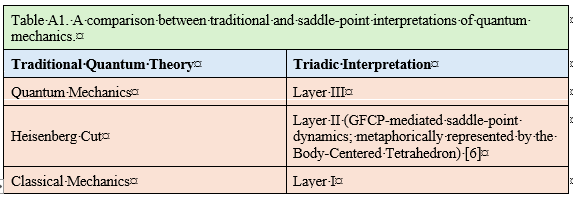
This is where the Body-Centered Tetrahedron [6] becomes an illuminating metaphor.
The BCT occupies an intermediate position between the visible tetrahedron and the invisible hypertetrahedron.
Likewise, the GFCP-mediated saddle-point dynamics occupy an intermediate position between quantum mechanics and classical mechanics.
The correspondence may be summarized as follows.
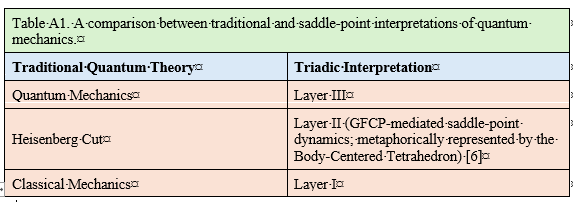
In this picture, the Body-Centered Tetrahedron does not represent wavefunction collapse itself. Rather, it represents the organized mediating regime through which quantum possibilities become classical events.
The Heisenberg cut is therefore transformed from an abstract boundary into a structured region of interaction.
A4. From Boundaries to Mediators
Whether or not this geometric interpretation ultimately proves useful for quantum foundations remains an open question.
Nevertheless, it illustrates a broader philosophical theme that has emerged throughout this essay. Again and again, apparent dualities seem to conceal an irreducible mediating structure.
In Peirce’s philosophy [9]:
Object → Sign → Interpretant
In Neo-Janus authorship:
Human → Human–AI Dialogue → Emergent Scholarship
In simplicial geometry 12]:
Tetrahedron → Body-Centered Tetrahedron → Hypertetrahedron
And now, at least as a conceptual possibility, in quantum theory:
Quantum Dynamics → GFCP-Mediated Saddle Point → Classical Dynamics
If this interpretation survives further mathematical and experimental investigation, the Heisenberg cut would no longer be viewed as a mysterious dividing line. It would instead be understood as another manifestation of a more general principle: nature does not merely separate domains—it connects them through organized mediation.
Author’s Note
The ideas presented here are intended as conceptual metaphors, not as established physical claims. Their purpose is to stimulate dialogue between geometry, quantum foundations, semiotics, and the emerging practice of human-AI collaboration. Whether these parallels eventually mature into a rigorous scientific framework remains an open question. But history suggests that new geometries have often preceded new physics, and for that reason alone, they deserve thoughtful consideration.
References:
[1] Werner Heisenberg. https://en.wikipedia.org/wiki/Werner_Heisenberg
[2] Heisenberg cut. https://en.wikipedia.org/wiki/Heisenberg_cut
[3] Ji, S. (2025). The Geometry of Reality (GOR): A Triadic Framework for Matter, Mind, and Spirit. https://622622.substack.com/p/geometry-of-reality
[4] Ji, S. (2026). A Geometric Worldview integrating modern physics, biology, and Jungian Synchronicity https://622622.substack.com/p/a-geometric-worldview-integrating
[5] Copenhagen interpretation. https://en.wikipedia.org/wiki/Copenhagen_interpretation
[6] S. (2026). The Body-Centered Tetrahedron (BCT): The Missing Link in an Emerging Geometry of Unified Cosmology
https://622622.substack.com/p/the-body-centered-tetrahedron-bct
[7] 5-cell. https://en.wikipedia.org/wiki/5-cell
[8] Neo-Janus: Humanity’s Threshold Between Extinction and Nirvana
https://622622.substack.com/p/neo-janus-humanitys-threshold-between
[9] Charles Sanders Peirce. https://en.wikipedia.org/wiki/Charles_Sanders_Peirce
[10] Ji, S. (2026). Saddle-Point Interpretation and Thermodynamic Quantum Field Theory. https://622622.substack.com/p/saddle-point-interpretation-and-thermodynamic
[11] Ji, S. (1991). A Biological Model of the Universe: The Shillongator. In: Molecular Theories of Cell Life and Death (S. Ji, ed.), Rutgers University Press, New Brunswick, N.J. Pp. 50-53.
[12] Simplicial complex. https://en.wikipedia.org/wiki/Simplicial_complex
Comments
Nothing yet. Say the first thing.
Sign in to join the conversation.