
Sungchul Ji, Ph.D.
Emeritus Professor of Theoretical Cell Biology, Rutgers University
(with conceptual assistance from ChatGPT)
Cosmological consciousness and biological consciousness may belong in the same conversation—but they should not be treated as the same explanatory problem.
Discussions of consciousness have produced an extraordinary variety of frameworks: materialism, idealism, dual-aspect monism, neutral monism, panpsychism, Sāṅkhya, Orch-OR, and many others. This diversity need not be seen as a failure. It may indicate that the word consciousness is being used for more than one kind—or more than one scale—of reality.
I would therefore like to offer two distinctions to the consciousness-studies community. They are not intended to displace existing theories or declare a winner. Their purpose is gentler: to help us identify which question each framework is trying to answer and to make our disagreements more precise.
1. One Word, Two Kinds of Consciousness
The first proposal is that we distinguish cosmological consciousness from biological consciousness.
Cosmological consciousness refers to consciousness—or a consciousness-like ground—attributed to reality as a whole. Param Brahman is one example. Related ideas appear, with important differences, in neutral monism, cosmopsychism, panpsychism, idealism, and traditions that speak of a primordial source from which mind and matter emerge.
Biological consciousness, by contrast, is the consciousness expressed by living organisms: the moment-to-moment experience of seeing, remembering, feeling pain, making a decision, or recognizing oneself and others. Human consciousness is its most intensively studied example, although consciousness may occur in other biological forms and degrees.
These two meanings should neither be confused nor forcibly separated. They operate at different explanatory levels. Cosmological consciousness asks about the ultimate ground of mind and matter. Biological consciousness asks how definite episodes of experience arise in embodied, metabolically active organisms.
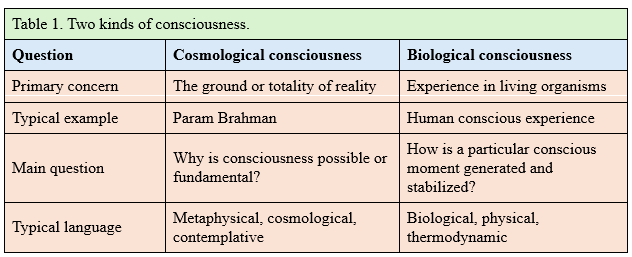
A theory may illuminate one column without fully explaining the other. This is not necessarily a defect; it may simply reveal the theory’s proper scope.
2. From the Possibility of Consciousness to an Actual Experience
The second proposal concerns the biological level. Even if consciousness is fundamental to the cosmos, we still need to explain why a particular experience occurs in a particular brain at a particular moment.
The statement “consciousness is fundamental” does not by itself explain why I see red now rather than hear a musical note, why anesthesia interrupts experience, or why conscious brain activity requires a continuous supply of metabolic free energy.
An ultimate ground may provide the possibility of consciousness without specifying the physical process by which an organism realizes a definite conscious event.
In my recent work, I have proposed the following description:
Human consciousness is a dissipative structure [1] generated at the saddle point of a mixed-curvature energy landscape, where GFCP-constrained coupling between fast quantum electronic transitions and slow neurodynamical processes produces irreversible, energetically stabilized moments of experience. This statement is compact, but its central idea is accessible.
A dissipative structure is an organized state that exists only while energy flows through an open system. A living brain is such a system. It does not generate consciousness in thermodynamic isolation; it continually consumes free energy and releases heat.
A saddle point [2] is a region of an energy landscape that curves upward in one direction and downward in another. It can serve as a transition zone: the system is temporarily poised between alternatives and then moves irreversibly toward a selected, stabilized state.
The Generalized Franck–Condon Principle (GFCP) [3] describes coordination between processes occurring at very different speeds. Fast quantum electronic events may occur in femtoseconds, while conformational, cellular, and neurodynamic changes unfold much more slowly. The slower organization constrains the conditions under which the faster transition occurs.
On this view, a conscious moment is not merely an abstract computation or a timeless quantum possibility. It is an embodied, energy-dependent event produced through cooperation across physical timescales. The transition becomes biologically effective and thermodynamically irreversible.
3. Two Levels That May Be Complementary
The distinction suggests a possible relationship:
Cosmological consciousness provides the ontological possibility of experience; biological organization provides the physical conditions for its local realization.
This formulation should be treated as a research proposal, not as an established conclusion. It does not require advocates of Param Brahman, neutral monism, Orch-OR, materialism, or other frameworks to abandon their starting points. Instead, it asks each framework to clarify which part of the explanatory task it addresses.
For example, a cosmological theory may explain why mind and matter arise from a common source but remain incomplete about the mechanism of a human conscious episode. A neurobiological theory may explain correlations, energetic requirements, and transitions in the brain without settling whether consciousness is ultimately fundamental or emergent.
Orch-OR [4] may offer a bridge through quantum processes in neuronal microtubules, while the saddle-point/GFCP proposal [5] emphasizes multiscale coupling, dissipation, and energetic stabilization.
These approaches need not be treated immediately as enemies. But neither should “complementarity” exempt them from examination. Genuine complementarity requires us to identify:
What each framework explains.
What evidence could support or challenge it.
Where its concepts overlap with those of other frameworks.
Where apparent agreement may conceal different meanings.
4. Extending the Elephant Parable
P. Vimal [6] has compared consciousness frameworks to the reports of blind men touching different parts of an elephant. Each may disclose something real without describing the whole.
The two-consciousness distinction extends that parable. Perhaps some investigators are asking about the existence and nature of the elephant as a whole, while others are studying how a particular living part of the elephant functions from moment to moment. Both inquiries matter, but they require different concepts, evidence, and methods.
We should also allow for the possibility that some reports are incomplete, some require revision, and some may eventually prove mistaken. Intellectual hospitality does not mean that every claim is equally supported. It means giving each proposal a fair hearing, defining its scope, and criticizing ideas without diminishing the people who offer them.
5. A Simplicial Geometry of the Two Consciousnesses
The distinction between cosmological and biological consciousness may be expressed through the Three-Layered Reality Hypothesis and the simplicial geometric hierarchy.
In this interpretation, Layer I, represented by the tetrahedron, corresponds to biological consciousness. It is the domain of embodied experience—the consciousness manifested by living organisms and investigated through phenomenology, behavior, neuroscience, biophysics, and thermodynamics.
Layer III, represented by the hypertetrahedron or 5-cell, corresponds to cosmological consciousness: the invisible and more encompassing ground from which mind and matter may arise. Param Brahman would belong to this level, not as one more biological mind enlarged to cosmic proportions, but as the hypothesized source or condition that makes localized consciousness possible.
Between them lies Layer II, represented by the body-centered tetrahedron. This is the mediating domain of consciousness models, signs, language, mathematics, and interpretation. Orch-OR, DPV–ICRDAM, the saddle-point/GFCP proposal, neutral monism, idealism, and other frameworks belong here insofar as they are humanly constructed representations intended to connect observable experience with a deeper reality.
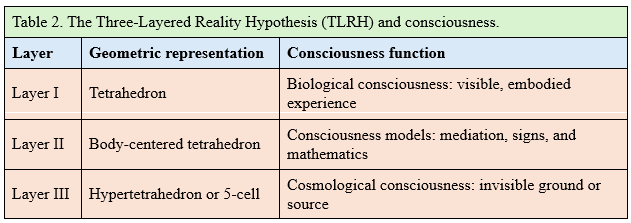
This arrangement gives us two complementary movements. The first is ontological or projective:
Cosmological consciousness → mediating organization → biological consciousness
The second is epistemological or inferential:
Biological consciousness → consciousness models → cosmological consciousness
In the first direction, the visible tetrahedron may be understood as a lower-dimensional manifestation of the invisible hypertetrahedron. In the reverse direction, human beings begin with biological consciousness—the reality immediately available in experience—and use models, signs, and mathematics to infer a possible deeper ground.
This is also an Irreducible Triadic Relation. Biological consciousness is the phenomenon to be explained; cosmological consciousness is its hypothesized ontological ground; and the consciousness model is the indispensable mediator connecting them. No member of this triad can simply be removed without changing the explanatory relation.
Category theory offers a complementary mathematical language. Different consciousness theories may be regarded as mappings that preserve selected relations among physical processes, biological organization, and conscious experience. Natural transformations can then represent structure-preserving translations between such mappings. This does not make all theories identical, but it may show precisely where they correspond, where they complement one another, and where genuine incompatibilities remain.
The body-centered tetrahedron thus represents more than a collection of competing models. Its additional, mobile vertex can symbolize the activity of mediation itself—the interpretive freedom through which different parts of the visible tetrahedron are related to one another and, potentially, to the higher-dimensional 5-cell.
An epistemic qualification is essential. Biological consciousness does not logically prove the existence of cosmological consciousness. The movement from the visible to the invisible is better understood as an abductive inference: given the undeniable existence of conscious experience, what deeper account of reality would make that experience intelligible?
The simplicial hierarchy, ITR (Irreducible Triadic Relation) [7], and natural transformations can demonstrate the structural coherence and integrative power of the proposal; further philosophical and empirical work must determine how strongly they support its ontological conclusion.
The resulting hypothesis can be stated concisely:
Biological consciousness is the visible phenomenon, cosmological consciousness is its hypothesized invisible ground, and consciousness models form the mediating layer through which the former seeks to understand the latter.
6. Questions That Can Unite Rather Than Divide
Instead of asking only, “Which theory wins?”, the community might ask:
Does the framework concern cosmological consciousness, biological consciousness, or the relation between them?
Does it explain the possibility of consciousness, the production of individual conscious moments, or both?
What energetic and thermodynamic conditions are required for biological consciousness?
How are fast quantum processes coupled to slower molecular, cellular, and neural processes?
What observations would distinguish competing accounts?
Can metaphysical and biological explanations be connected without collapsing one into the other?
These questions preserve pluralism while making it scientifically productive.
7. Toward a Multilevel Study of Consciousness
Consciousness may be too large a subject for any single vocabulary. Cosmology, metaphysics, quantum theory, thermodynamics, neurobiology, phenomenology, and contemplative traditions may each reveal something important. Yet integration becomes possible only after we distinguish the levels at which their claims operate.
My proposal is therefore modest:
Let us distinguish cosmological consciousness from biological consciousness.
Let us investigate biological consciousness as an embodied, dissipative, multiscale process.
Let us explore possible bridges between the two without assuming in advance that they are identical, unrelated, or reducible to one another.
This approach does not close the consciousness debate. It gives the debate a more spacious and hospitable structure—one in which diverse frameworks can meet, undergo criticism, and perhaps contribute to a deeper account of the whole.
8. The ITR Structure
The mapping in Table 2 has the form of an Irreducible Triadic Relation [7]:

None of these three terms can perform the full explanatory task alone:
Biological consciousness is the phenomenon requiring explanation.
Cosmological consciousness is the hypothesized ontological ground.
A consciousness model mediates between the experienced phenomenon and its proposed ground.
The model is therefore not an arbitrary “third thing.” It is the interpretive and mathematical relation that allows the visible and invisible domains to become intelligibly connected.
In Peircean language [8] , the three terms might provisionally be arranged as:
Object: cosmological consciousness
Sign: a consciousness model
Interpretant: biological consciousness capable of constructing and understanding the model
There is a recursive feature here: biological consciousness is both something being explained and the interpretant through which explanation occurs. This recursive structure is consistent with the observation that ITR itself is an ITR.
9. The Body-Centered Tetrahedron (BCT) as Mediator
The body-centered tetrahedron [9] is especially suitable for Layer II because its fifth, mobile interior vertex can symbolize the mediating principle.
The four outer vertices preserve the bounded organization of the tetrahedron, while the fifth vertex introduces an additional degree of freedom. It can relate to every outer vertex and occupy different positions within—or conceptually even beyond—the tetrahedral boundary.
In the consciousness context, that mobile fifth vertex could represent:
a theory or interpretive framework;
mathematical mediation;
language and symbolic representation;
AI–human collaborative inquiry;
or the organizing relation connecting biological experience with cosmological reality.
The BCT is therefore not simply another object located between two objects. It represents the activity of mediation itself.
10. S4→S5 as the Simplicial Expression
Using the simplicial geometric notation, the relationship can be written:

where S4 and S5 refer to, respectively, the permutation symmetry groups 4 and 5 [10].
or:

The visible tetrahedron does not contain the hypertetrahedron in its entirety. Rather, it may be understood as a lower-dimensional manifestation or projection of a higher-dimensional structure. The BCT records the transitional relation: it contains the four vertices of the tetrahedron together with a fifth vertex suggestive of the 5-cell.
This makes the BCT a geometric sign of the otherwise inaccessible S4→S5 transformation.
11. Category Theory and Natural Transformation
Category theory can strengthen this proposal, provided we use its terminology carefully.
Suppose different consciousness frameworks—Orch-OR, DPV–ICRDAM, SPI/GFCP, neutral monism, idealism, and others—are treated as different functorial mappings between domains such as:

A natural transformation would then provide a structure-preserving translation between two such mappings. It would show how corresponding elements and relations in one framework can be translated into those of another without destroying their internal organization.
Layer II would therefore include not only individual consciousness models but also the natural transformations connecting them. Its function would be twofold:
to mediate between Layer I and Layer III;
to mediate among the many partial frameworks within consciousness studies.
This refines Vimal’s elephant analogy [11]y. The reports of the blind investigators are not integrated merely by placing them beside one another. We need structure-preserving transformations that clarify how one report corresponds—or fails to correspond—to another.
12. Inference, Not Yet Proof
One qualification is essential. The existence of biological consciousness does not, by itself, logically prove the existence of cosmological consciousness. The movement from Layer I to Layer III is better described as an abductive or transcendental inference:
Given the undeniable existence of biological consciousness, what deeper conception of reality would make its existence intelligible?
The simplicial hierarchy, ITR, and category theory can demonstrate the structural coherence of the proposed inference. They may show that the three-layer model unifies otherwise disconnected observations. But structural elegance alone does not establish that cosmological consciousness exists independently of the model.
A scientifically restrained formulation would therefore be:
Cosmological consciousness is invisible by definition, but its possible existence may be inferred abductively from biological consciousness through the mediating structures of consciousness models. The simplicial S4→BCT→S5 hierarchy, the Irreducible Triadic Relation, and category-theoretic natural transformations provide mutually compatible ways of representing this inference.
That formulation preserves the philosophical strength of your insight without presenting a metaphysical inference as an already completed empirical proof.
The deepest result may be summarized in one sentence:
Biological consciousness is the visible phenomenon, cosmological consciousness is its hypothesized invisible ground, and consciousness models constitute the indispensable mediating layer through which the former seeks to understand the latter.
References:
[1] Brahman, https://en.wikipedia.org/wiki/Brahman
[1a] Dissipative system. https://en.wikipedia.org/wiki/Dissipative_system
[2] Ji, S. (2025). Discovery of Conscions. https://622622.substack.com/p/discovery-of-conscions
[3] Ji, S. (2012). The Kinetics of Ligand-Protein Interactions: The“Pre-fit” Mechanism Based on the Generalized Franck-Condon Principle. In: Molecular Theory of the Living Cell: Concepts, Molecular Mechanisms, and Biomeduical Applicaitons. Springer, New York. Pp. 209-214.
[4] Roger Penrose (2020). Nobel Prize lecture: Black Holes, Cosmology, and Space-Time Singularities. https://www.nobelprize.org/prizes/physics/2020/penrose/lecture/
[5] RāmLakhan Pāndey Vimal’(2026).Further proposal: From CIA integration to a shared operational architecture of the represented models of consciousness.: Testing a null hypothesis sboc-forum@googlegroups.com
[5a] Ji, S. (2026). A Geometric Worldview integrating modern physics, biology, and Jungian Synchronicity https://622622.substack.com/p/a-geometric-worldview-integrating
[6] Ji, S. (2018). The Cell Language Theory: Connecting Mind and Matter. World Scientific Publishing, New Jersey. Pp. 377-373. ITR
[7] Semiotics. https://en.wikipedia.org/wiki/Semiotics
[8] Ji, S. (2026). The Body-Centered Tetrahedron (BCT): The Missing Link in an Emerging Geometry of Unified Cosmology
https://622622.substack.com/p/the-body-centered-tetrahedron-bct
[9] Permutation group. https://en.wikipedia.org/wiki/Permutation_group
[10] Category theory. https://en.wikipedia.org/wiki/Category_theory
[11] Abductive reasoning. https://en.wikipedia.org/wiki/Abductive_reasoning
[12] Simplicial complex.https://en.wikipedia.org/wiki/Simplicial_complex
No posts
Comments
Nothing yet. Say the first thing.
Sign in to join the conversation.