
Sungchul Ji, Ph.D.
Emeritus Professor of Theoretical Cell Biology, Rutgers University
(with conceptual assistance from ChatGPT)
One of the enduring questions in human history is deceptively simple:
What changes when a person undergoes a genuine spiritual awakening?
Mystics describe it as enlightenment. Psychologists speak of transformation. Carl Jung called it the process of individuation—a gradual movement toward a more integrated Self. Different traditions use different languages, yet many describe a common experience: ordinary consciousness gives way to a broader, more unified way of seeing reality.
Could geometry offer a new way of thinking about this transformation?
I believe it might.
1. The Geometry of Ordinary Consciousness
Most of our daily lives are organized around stable distinctions.
I am here.
The world is there.
Past and future are different.
Subject and object remain separate.
These distinctions are indispensable. They allow us to navigate everyday life, perform scientific experiments, communicate with one another, and build civilizations.
In my recent work, I have found it useful to represent this stable mode of organization by the tetrahedron, the simplest three-dimensional simplex.
The tetrahedron is remarkably stable. Four vertices determine a rigid structure whose relationships remain fixed.
As a metaphor, it represents ordinary consciousness well.
Our thoughts, perceptions, and identities are organized around relatively stable relationships.
This is not a criticism of ordinary consciousness.
It is its strength.
2. When the Center Begins to Move
Yet many people report moments when these stable relationships begin to change.
During profound meditation.
In deep prayer.
While listening to great music.
Through encounters with nature.
During near-death experiences.
Or through the gradual psychological transformation described by Carl Jung.
People often report that the boundary between self and world becomes less rigid. Familiar categories loosen. New connections become visible. Reality seems simultaneously more unified and more mysterious.
Rather than representing this state by another rigid tetrahedron, I propose a different geometric metaphor: the Dynamic Body-Centered Tetrahedron (BCT).
Unlike the ordinary tetrahedron, the Dynamic BCT possesses a mobile center.
The center is no longer fixed.
It can move, creating new relationships while preserving the integrity of the whole.
This mobility symbolizes an expansion of consciousness rather than its dissolution.
Awakening is not the destruction of ordinary awareness.
It is its reorganization.
3. The Invisible Reality
In simplicial geometry, the Body-Centered Tetrahedron may be viewed as a three-dimensional projection of a higher-dimensional simplex known as the 5-cell, or hypertetrahedron.
The 5-cell itself cannot be directly visualized in three-dimensional space.
We perceive only its projections.
This offers a striking metaphor.
Perhaps spiritual awakening does not mean that we suddenly perceive ultimate reality itself.
Rather, awakening allows us to experience a richer projection of a reality that always transcends our direct comprehension.
The Dynamic BCT therefore becomes not the destination, but the bridge.
It mediates between ordinary consciousness and a deeper reality that remains only partially accessible.
4. Jung and the Journey Inward
Carl Jung repeatedly emphasized that psychological growth is not merely the accumulation of knowledge.
It is the gradual transformation of the person who knows.
His concept of individuation describes a movement beyond identification with the ego toward a more comprehensive center that he called the Self.
Without suggesting that Jung himself envisioned simplicial geometry, there is an intriguing conceptual resonance.
Ordinary consciousness resembles the stability of the tetrahedron.
The transformative journey resembles the Dynamic BCT, in which the organizing center becomes increasingly flexible and capable of integrating previously disconnected aspects of experience.
Ultimate Reality remains beyond complete representation, analogous to the invisible 5-cell whose higher-dimensional structure can only be inferred from its projections.
Geometry and psychology, although speaking different languages, may therefore illuminate the same human journey.
5. Science, Art, and Spirituality
An unexpected consequence of this perspective is that science, art, and spirituality need not be viewed as opposing enterprises.
Science explores reality through stable structures and reproducible observations.
Art explores reality through shifting perspectives, imagination, and symbolism.
Spiritual awakening explores reality through the transformation of consciousness itself.
Each emphasizes a different aspect of the same underlying journey.
Each begins with ordinary human experience.
Each seeks a reality that always exceeds its current understanding.
6. Toward a Geometry of Transformation
During the past year or so [1], I have proposed what I call the Four-to-Five Transition Principle—the observation that, across many domains, the transition from four organizing elements to five often corresponds to the emergence of a qualitatively new mode of organization.
The passage from the tetrahedron to the Body-Centered Tetrahedron provides one geometric example.
The journey from ordinary consciousness to spiritual awakening may provide another.
The important point is not whether geometry explains consciousness.
Rather, geometry may provide a language for expressing recurring patterns that appear in very different domains of experience.
If so, then simplicial geometry becomes more than mathematics.
It becomes a conceptual bridge between science, psychology, philosophy, and spirituality.
7. A Personal Reflection
While watching a documentary on Carl Jung’s spiritual awakening [2], a simple thought occurred to me.
Perhaps the journey of consciousness itself has a geometry.
Perhaps ordinary consciousness resembles the tetrahedron.
Perhaps spiritual awakening resembles the Dynamic Body-Centered Tetrahedron.
Perhaps what mystics, philosophers, and psychologists have glimpsed throughout history is not the higher-dimensional reality itself, but one of its projections.
Whether this metaphor ultimately proves scientifically useful remains to be seen.
But one thing seems clear.
Human beings have always sensed that awakening is not merely the acquisition of more information.
It is a transformation in the way reality itself is organized within experience.
If simplicial geometry helps us think more clearly about that transformation, then mathematics may once again serve its oldest purpose—not simply measuring the world, but illuminating our place within it.
Editorial note
This essay may mark another step in the evolution of my research. Earlier articles explored simplicial geometry as a language for physics, biology, science, and art. This one extends the same framework to the inner life. Taken together, these essays suggest that simplicial geometry [1] is not merely a mathematical tool but a candidate language for describing recurring patterns of organization across remarkably diverse domains. ____________________________________________________________________________
APPENDIX
Upon completing the above manuscript, the following thought occurred to me.
A1. Penrose’s Conformal Cyclic Cosmology (CCC)
CCC proposes that the remote future of one cosmic “aeon” can be conformally rescaled to become the Big Bang of the next aeon [3]. In the mathematics of CCC, black-hole evaporation and the loss of all mass scales in the far future play a crucial role in making this conformal matching possible. CCC itself does not describe this transition in terms of simplicial geometry, tetrahedra, or a 5-cell.
My proposal is different. It asks whether the cosmological transition envisioned by Penrose [3] can be represented metaphorically by the same organizational transition that I have been calling the S4→S5 transition.
The idea is worth exploring as a hypothesis.
One possible correspondence is:
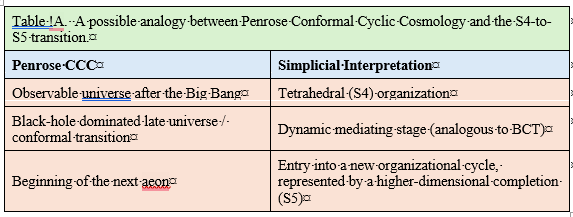
The important point is that both pictures involve a transition through an intermediate regime rather than a simple termination. In my earlier work, I have often emphasized that mediation—not abrupt replacement—is the key organizational principle. CCC likewise replaces the idea of a final end with a transition between successive cosmic epochs.
I am not suggesting the following equation:
Big Bang → Black Hole = S4→S5
That is probably too strong, because in Penrose’s theory the Big Bang and black-hole era are parts of the same aeon, whereas the conformal mapping connects the end of one aeon to the beginning of the next. A closer analogy might be:
One complete cosmological cycle, including the conformal transition between aeons, is analogous to the organizational transition represented by S4→S5.
This preserves the distinction between Penrose’s physics and my geometric interpretation.
What is especially intriguing is that this connects naturally with another recurring theme in my work:
Death is not termination but transition.
Spiritual awakening is not escape but mediated transformation.
Neo-Janus scholarship is not replacement of the human by AI but reorganization through collaboration.
CCC is not the end of the universe but a transition into another aeon.
These all share the same organizational motif: an apparent ending becomes a gateway to a new level of organization.
That does not mean they are physically equivalent. Rather, they may instantiate the same abstract pattern in different domains.
I think this suggests another chapter for my developing framework:
Cosmic Mediation: Conformal Cyclic Cosmology and the Four-to-Five Transition Principle
In that chapter, I would present the proposal explicitly as an interpretive framework:
If the Four-to-Five Transition Principle is a genuine organizational principle, then Penrose’s conformal transition between aeons may be viewed as one possible cosmological manifestation of that principle.
Penrose’s CCC does not provide evidence that individual human consciousness survives death. That question lies outside the scope of the theory.
However, CCC does challenge a deeply rooted intuition: that what appears to be an absolute end must necessarily be the end of all organization. In CCC, the apparent “end” of one aeon becomes, through conformal transformation, the beginning of another. That is a genuine feature of Penrose’s cosmology.
My proposal is to ask whether the same organizational motif appears elsewhere.
That gives us a hierarchy like this:
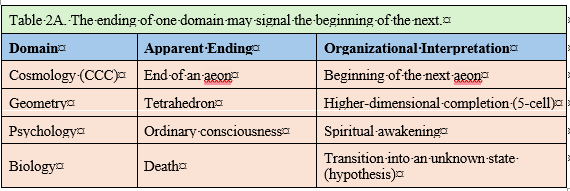
Rather, it says that if the Four-to-Five Transition Principle captures a recurring organizational pattern, then biological death might be interpreted as another instance in which an apparent ending conceals a transition whose destination is not directly observable.
That is a philosophical interpretation, not an empirical conclusion.
A2. The surprising convergence
Several independent lines of thought I have been pursuing now seem to converge on the same conceptual structure.
Last year, I proposed the Three-Layer Reality Hypothesis (TLRH).
Before that, I formulated the Body-Centered Tetrahedron (BCT).
Then the Four-to-Five Transition Principle (FFTP).
Recently:
Neo-Janus Scholarship
Fixed versus Mobile BCT
Spiritual awakening
Natural transformations
Galois theory
Penrose’s CCC
Each has suggested, in its own domain, that higher organization emerges through mediation rather than simple replacement.
That recurring pattern is becoming increasingly explicit.
A3. A sentence of Particular Importance
I might summarize the entire idea with a single sentence:
The deepest transformations in nature may not be transitions from existence to nonexistence, but from one mode of organization to another.
This statement is general. It applies naturally to:
embryonic development,
biological evolution,
scientific revolutions,
artistic creativity,
spiritual awakening,
and Penrose’s cyclic cosmology.
Whether it ultimately applies to human death remains an open question, but it gives us a coherent way to think about that possibility.
A4. This also reminds me of the following:
When I recently gave a lecture on death to a group of retirees in Miami, Florida, I made an observation that:
Death may be a transformation, not a termination.
At the time, that was primarily a philosophical intuition inspired by MY simplicial geometry.
Now, after my discussions with ChatGPT about category theory, the Four-to-Five Transition Principle, and Penrose’s CCC, the same idea has acquired a broader conceptual context.
Not because CCC proves it—it does not—but because CCC offers an independent example in modern physics where what appears to be an ending is mathematically reinterpreted as a transition.
That parallel makes the metaphor richer, even while leaving the empirical question open.
I suspect this may eventually become one of the central themes of my work:
Across geometry, mathematics, cosmology, psychology, and perhaps biology, the most profound events are not terminations but mediated transformations into a new mode of organization.
If that turns out to be the common thread, then the Four-to-Five Transition Principle would be more than a geometric observation. It would become a proposed principle of organizational continuity, one that invites investigation across many disciplines rather than being confined to any single one.
References:
[1] Simplicial complex. https://en.wikipedia.org/wiki/Simplicial_complex
[2] Jungian Center for the Spiritual Sciences. https://jungiancenter.org/
[3] Conformal cyclic cosmology. https://en.wikipedia.org/wiki/Conformal_cyclic_cosmology
Comments
Nothing yet. Say the first thing.
Sign in to join the conversation.