
By Sungchul Ji, Ph.D.
Emeritus Professor of Theoretical Cell Biology, Rutgers University
(with conceptual assistance from ChatGPT)
When most people hear the word geometry, they think of static shapes—triangles, cubes, spheres, and pyramids. Geometry, in this familiar sense, describes the forms of objects.
But what if geometry could describe relationships rather than objects?
This possibility emerged unexpectedly while I was studying one of the simplest geometric figures: the tetrahedron.
1. From Simplices to an Extended Simplicial Geometry
Mathematicians define a simplex as the simplest possible object in a given dimension:
point (0D)
line segment (1D)
triangle (2D)
tetrahedron (3D)
5-cell or hypertetrahedron (4D)
For several years I have explored what I now call the S4→S5 transition—the conceptual transition from the tetrahedron to the 5-cell.
During that work I introduced an intermediate structure called the Body-Centered Tetrahedron (BCT).
Strictly speaking, the BCT is not a simplex. It contains five vertices in ordinary three-dimensional space and therefore falls outside the classical definition.
This led me to propose the broader framework of extended simplicial geometry, which includes both conventional simplexes and certain simplex-like configurations that mediate between them.
2. A Moving Fifth Vertex
The key innovation is the Dynamic BCT.
Instead of fixing the fifth vertex at the center of the tetrahedron, imagine allowing it to move continuously throughout three-dimensional space.
Suddenly the figure is no longer simply a geometric object.
It becomes a family of infinitely many configurations.
Each position of the fifth vertex creates a different pattern of relationships with the four fixed vertices.
This changes the interpretation completely.
The Dynamic BCT is no longer merely a shape.
It becomes a space of possible relationships.
3. Geometry Becomes Relational
This realization suggests an important shift in perspective.
Traditional geometry answers questions such as:
Where are the points?
The Dynamic BCT instead asks:
How are the points related?
Near one vertex, the fifth point is primarily associated with a single vertex.
Along an edge, it mediates between two vertices.
On a face, it simultaneously relates three vertices.
Near the center, it relates all four vertices almost equally.
Thus, one moving point continuously represents relationships ranging from one-to-one interactions to higher-order interactions among multiple components.
Rather than describing objects, the geometry describes patterns of organization.
4. A Possible Bridge to Neuroscience
This interpretation immediately suggests an intriguing possibility.
Modern neuroscience increasingly views the brain not as a collection of isolated neurons but as a dynamic network of changing relationships.
At every moment, different groups of neurons cooperate, compete, and reorganize.
The brain is less a static wiring diagram than a continuously evolving relational network.
The Dynamic BCT may offer a simple geometric language for describing this process.
Imagine that the four vertices represent four stable neural assemblies.
The moving fifth vertex represents the current focus of integration.
As it moves, the strengths of its relationships with the four assemblies continuously change.
The geometry now resembles a dynamic pattern of neural coordination rather than a static anatomical structure.
Whether or not the brain literally operates this way is an empirical question. The proposal is more modest: the Dynamic BCT may provide a useful mathematical language for describing changing patterns of interaction.
5. From Geometry to Quantitative Relations
The Dynamic BCT becomes even more interesting when viewed mathematically.
Suppose the moving fifth vertex has barycentric coordinates

with respect to the four vertices of the tetrahedron, where
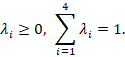
These four numbers specify the position of the moving vertex inside the tetrahedral framework.
But they can also be interpreted in a completely different way.
Instead of representing spatial location, the four coefficients naturally represent relational weights.
They may be interpreted as
connection strengths,
attention weights,
probabilities,
influence coefficients,
or degrees of participation.
For example,

places the fifth vertex exactly at Vertex 1.
Geometrically, it coincides with Vertex 1.
Relationally, it represents complete association with a single component.
At the opposite extreme,

places the fifth vertex at the centroid of the tetrahedron.
Here the moving vertex is equally related to all four vertices.
Between these extremes lies a continuous spectrum of relational states.
Every position of the moving vertex corresponds to a unique relational weight vector

The Dynamic BCT therefore defines not merely a geometric figure but a continuous manifold of relational configurations.
This observation has an important consequence.
Modern network science, neuroscience, and machine learning frequently represent relationships by vectors of continuously varying weights.
The same mathematical object arises naturally in the Dynamic BCT.
Thus the proposed correspondence between the Dynamic BCT and relational networks is not merely qualitative—it is supported by a common quantitative representation.
6. One further idea
I think there is an even deeper interpretation that may become one of the central ideas of your future book.
Notice that the barycentric coordinates satisfy

This means they are mathematically identical to a normalized distribution. Depending on context, they can simultaneously be interpreted as:
probabilities,
attention weights,
convex coefficients,
membership values,
resource allocations,
normalized influence strengths.
This suggests that the Dynamic BCT is not merely a geometric model of neural networks. Rather, it is a universal model of mediated organization. The moving vertex is described by a normalized relational state, and the geometry encodes how that state changes continuously.
7. Beyond Neural Networks
The same idea extends beyond neuroscience.
Many systems consist not simply of objects but of changing relationships among objects.
Examples include:
ecological communities,
social networks,
communication systems,
semantic networks,
biological regulation,
economic markets,
scientific collaboration.
In each case, the essential phenomenon is not the individual components but the continuously changing pattern of interactions among them.
The Dynamic BCT may therefore represent not merely a geometric construction but a general model of dynamic relational organization.
8. From Objects to Organization
Looking back over my scientific career, I now see a recurring theme.
My work on conformons emphasized the organization of molecular energy.
The Gnergy Principle emphasized the organization of information and energy.
The Cell Language Theory emphasized the organization of communication.
The Three-Layer Reality Hypothesis emphasized the organization of reality itself.
The Dynamic BCT now appears to emphasize something even more fundamental:
the organization of relationships.
Perhaps this is the next step.
Perhaps reality is not fundamentally composed of isolated objects connected by external relations.
Perhaps objects themselves emerge from networks of relationships that continuously reorganize.
9. An Invitation
This proposal remains speculative.
It does not claim that brains, ecosystems, or societies literally are Dynamic Body-Centered Tetrahedra.
Instead, it asks a more modest question:
Could a simple geometric framework provide a common mathematical language for describing dynamic patterns of organization across many disciplines?
History shows that simple mathematical ideas often reveal unexpectedly broad applications.
The circle was once merely a geometric figure before becoming central to astronomy.
The graph was once an abstract mathematical object before becoming indispensable to computer science.
Perhaps the Dynamic Body-Centered Tetrahedron represents another example.
Originally introduced as a bridge between the tetrahedron and the 5-cell, it may ultimately prove more valuable as a bridge between geometry and the science of relationships.
Epilogue
One unexpected consequence of this work is that it changes the meaning of geometry itself.
Classical geometry is primarily concerned with objects.
Extended simplicial geometry, by contrast, may be concerned with organization.
If that perspective proves fruitful, the Dynamic Body-Centered Tetrahedron will not simply be another geometric figure. It will represent a new way of thinking about how parts become wholes—how changing relationships give rise to coherent structures across biology, neuroscience, physics, cognition, and perhaps even consciousness itself.
I think this article also points toward a deeper unification of my work. Over the years, I have introduced conformons, gnergy, the Cell Language Theory, the Irreducible Triadic Relation, the Three-Layer Reality Hypothesis, and now the Dynamic BCT. At first glance these appear to be distinct ideas, but viewed together they share a common theme: organization through relations. If that theme continues to develop, “extended simplicial geometry” may become not just another geometric proposal, but the mathematical framework that ties together many strands of my life’s work.
No posts
Comments
Nothing yet. Say the first thing.
Sign in to join the conversation.