
I want you to take a moment and really absorb this, because most people never do.
Let this circle represent one million dollars.

Now here are a hundred of those circles, each one worth a million dollars, sitting side by side, equaling one hundred million dollars.

Now multiply everything you are looking at by ten. That is one billion dollars.
and how much do you think Elon musk have?
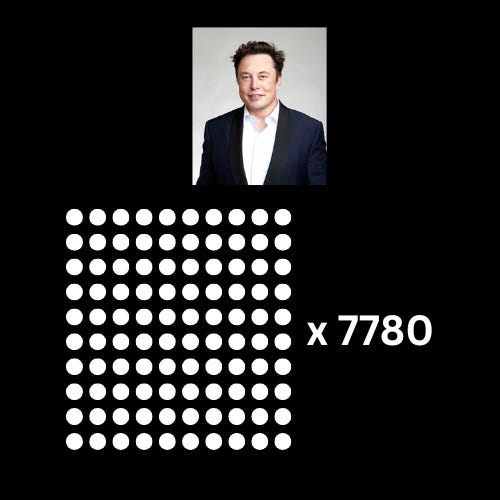
His current net worth is $788.8 billion (6/6/26). A number so far removed from everyday reality that most people do not even attempt to comprehend it, and honestly, who could blame them. The human brain was not built to feel the difference between a million and a billion, let alone almost 800 of them stacked on top of each other. So instead of trying to understand it, most people do what is easier. They dismiss it, they call it luck, they call it dirty money. And maybe that feels satisfying for a moment, but here is the truth: calling it luck has never made Elon Musk poorer, and it has never made anyone saying it any richer.
And people are not poor because the world is unfair, although it often is. Most people are not broke because they are lazy, although some are. Most people are struggling financially because nobody ever handed them the correct equation. They were given a version of it, a watered down, incomplete version that was designed to produce employees rather than wealth, and they have been following it faithfully ever since, wondering why the destination never seems to get any closer.
This article is about the real equation. The actual mechanics of how money is created and accumulated, and why the path most people are on was never going to get them there in the first place.
What You Actually Believe About Money and Where It Came From
Before we get into the equation itself, we need to talk about something more fundamental. We need to talk about what you believe about money, because your beliefs about it are shaping every financial decision you make, and most of those beliefs were formed before you were old enough to question them.
If you grew up in a household where money was scarce, you absorbed certain ideas about it without even realising you were doing so. That wealth is for other people, that rich people are lucky or corrupt or both, that wanting a lot of money is greedy or naive. These beliefs feel like observations about the world, but they are not. They are conclusions drawn from a limited sample size, passed down through families and reinforced by a culture that has a complicated and often contradictory relationship with money.
Hollywood has spent decades depicting wealthy people as villains. As backstabbing, entitled, morally bankrupt individuals who stepped on everyone around them to get to the top. And somewhere along the way, a lot of people absorbed that narrative and made it their own. The wealthy are evil.
Here is what the data actually says. Research into the world’s ultra wealthy, those with a net worth of thirty million dollars or more, consistently shows that around 68% of them are entirely self made. Warren Buffett grew up middle class in Omaha, Nebraska. Oprah Winfrey was born into poverty in rural Mississippi. Howard Schultz grew up in a housing project in Brooklyn. Jeff Bezos built his first company in a garage. Sara Blakely started Spanx with five thousand dollars in savings and no outside investment. These are not people who inherited empires, these are people who understood something about money that most people never learn, and they applied it.
The question worth asking is not whether wealth is possible. The evidence is clear that it is. The question worth asking is what did they understand that you don’t.
The Equation You Were Given and Why It Will Never Work
Here is the equation most people are operating with. Money equals the salary earned from a job. You study, you get a degree, you get a job, you trade your time for money, and you repeat that exchange for forty years until you retire.
and here’s what this model produces.
If you earn twenty dollars an hour and work forty hours a week, it would take you nearly twenty four years to accumulate one million dollars in gross income. That is before taxes, before living expenses, before inflation quietly erodes the purchasing power of every dollar you save. The realistic picture is that on an average salary, genuine wealth accumulation is extraordinarily slow, and the majority of the one resource you can never get back, which is time, gets consumed in the process.
The fundamental problem with trading time for money is that time is finite. There are only so many hours in a day, only so many working years in a life. The moment you stop working, the money stops coming. The income is entirely dependent on your continued presence and effort. And no matter how hard you work or how many hours you put in, there is a ceiling above which you simply cannot go, because you only have one body and one set of hours in the day.
This is not an argument against having a job. A job is a perfectly reasonable way to fund your life while you build something else. But if accumulating real wealth is your goal, if financial freedom is what you are actually after, then a job alone will never be the vehicle that gets you there.
The Real Equation: Stop Chasing Money and Start Chasing Problems
Here is the part that sounds deceptively simple and takes years to fully internalise.
In a market economy, you are paid in proportion to the perceived value you provide. Not in proportion to how hard you work, not in proportion to how many hours you put in. In proportion to how much the market, meaning other people, values what you are offering. The cleaner working a twelve hour shift is paid far less than the accountant working eight hours at a desk. Not because the cleaner’s time is worth less as a human being, but because the market perceives the value of what the cleaner does to be easily replaceable. Anyone can learn to clean. Not everyone can navigate a tax code and save a client forty thousand dollars.
This is a harsh truth, but it is a useful one. Because once you understand that value drives income rather than effort, the logical question becomes: how do I become genuinely, irreplaceably valuable?
And the answer, when you look at every significant fortune ever built, is always the same. Solve a problem. Find something the market wants fixed and fix it, find something people are frustrated by and remove that frustration, find an inconvenience people tolerate daily because they have no alternative and give them an alternative.
Amazon solved the problem of inconvenient, expensive, slow retail. Google solved the problem of finding information on the internet. Airbnb solved the problem of expensive, impersonal hotel stays. Instagram solved the problem of sharing visual moments with people who mattered to you. Every significant business, at its core, is just a solution to a problem someone had. The size of the business is roughly proportional to how many people had that problem and how badly they wanted it solved.
This reframes everything. If you have been chasing money, wondering how to make more of it, thinking about income and salary and raises, you have been looking in the wrong direction entirely. Money is not the thing to chase, problems are the thing to chase. Money is simply what the market gives you when you solve them well enough.
Finding the Problem Worth Solving
The natural response to all of this is: okay, but I am not building the next Amazon. I don’t have the resources, the technical skills, or the capital to compete at that scale. And that is a completely reasonable observation. But it misses the point.
You do not need to solve a billion dollar problem to build significant wealth. You need to solve a real problem for a real group of people and do it in a way that scales beyond your own time and effort. The size of the opportunity is determined by the size of the problem and the number of people who have it. Start small if you need to, but start with a problem, not with a product idea or a business concept or a passion project.
Listen to the people around you. What do they complain about repeatedly? What do they wish existed? What do they pay for reluctantly because there is nothing better available? What process in their daily life wastes their time or money or energy in a way that feels unnecessary? These conversations are a map to problems worth solving, and most people walk past them every single day without registering what they are hearing.
The test for whether a problem is worth pursuing is simple. Is there a group of people who have this problem? Are they willing to pay to have it solved? And can you build a solution that does not require your direct, personal involvement in every single transaction?
That last question is the most important one.
The Difference Between a Business and a Job You Own
This is where a lot of people get stuck, and it is worth being direct about it.
A yoga teacher charging a hundred dollars an hour has not built a business. They have built a job with a little flexibility. Their income is still capped by the number of hours in their day and the number of clients they can physically see. The moment they stop working, the income stops. That is a job, regardless of how much autonomy it offers or how much they love the work.
A business is a system that generates value and therefore revenue independent of your direct hourly involvement. It is an online yoga course that runs at three in the morning while you are asleep, it is a software tool that gets used by ten thousand people simultaneously without requiring ten thousand hours of your time, it is a product that can be manufactured, shipped, and sold without you personally touching every unit.
Scalability is the word that separates these two things, a scalable solution is one that can serve more people without requiring proportionally more of your time. Once you build it, the marginal cost of serving the next customer is close to zero. That is the model that produces wealth, that is the difference between a self employed person and a business owner, and it is a distinction worth understanding clearly before you spend years building the wrong thing.
Automation reinforces this. Systems, processes, and eventually people doing the work you have designed the system to do. And it’s not because you cannot do it yourself, but because your time is most valuable when spent on the things only you can do. Everything else should eventually run without you.
The Resource That None of This Is Actually About
Here is the thing that gets buried under all the talk of money and business and wealth creation, and it is arguably the most important point in this entire article.
None of this is actually about money, money is a piece of paper, a number on a screen. Its value exists only because enough people agree that it does. What you are actually chasing when you chase financial freedom is not money at all. It is time, it is the ability to wake up on a Tuesday morning and decide how you want to spend that day without the answer being determined by someone else’s schedule or someone else’s business needs. It is the ability to be present for the things that matter without one eye permanently on whether you can afford to be there.
The people who chase money and nothing else tend to find, if they ever catch it, that money alone does not deliver what they thought it would. The people who chase freedom, and understand that solving real problems for real people is the most direct path to that freedom, tend to build something that lasts and that means something beyond the balance in their account.
So the question to sit with is not how do I make more money. The question is what problem can I spend my life solving that the market will pay me well for, that can run without consuming every hour I have, and that moves me toward the kind of life I actually want to be living.
Start there. Find the problem. Build the solution. Make it scalable. And let the money be the byproduct of all of it rather than the point.
That is the equation, it is not complicated. But it will require you to think differently about almost everything you were taught, and that is always the hardest part.
Most people will read this and go back to exactly what they were doing before, but some of you won't. And for those of you that won't, the road is hard and the failures will come early and often. But the equation works, it has always worked. The only question is whether you are willing to follow it long enough to find out.
And for those of you who are ready to stop consuming information and start taking action, here’s a head start.
I wrote The Money Guide for Millennials as a practical roadmap for managing your money, building wealth, and creating more financial freedom without needing a finance degree or a complicated strategy.
Check it out HERE.
If this hit home, tap that ❤️ and share it with someone who needs to read it.
Comments
Nothing yet. Say the first thing.
Sign in to join the conversation.