
These aren't hacks or shortcuts.
They are the boring, unglamorous, deeply effective daily decisions that separate people who are always stressed about money from people who are quietly building real wealth. Nobody teaches you this in the 16 plus years most of us spend in formal education. You graduate knowing algebra and the periodic table and almost nothing about the financial system you will spend your entire adult life navigating.
So most people figure it out the hard way. Through stress, bad decisions, empty accounts, and the quiet shame of feeling like everyone else has it figured out except you.
Here are the exact 9 habits that changed everything for me:
We’ve all grown up hearing the same conditioning repeated so many times it started to feel like wisdom. “Money doesn’t buy happiness.” “Don’t be so materialistic.” “There are more important things in life than money.”
And while none of that is entirely wrong, it creates a subtle but dangerous guilt around wanting financial security that holds millions of people back from ever taking their finances seriously.
Wanting financial security isn’t greedy. It’s responsible. Money gives you options. It gives you the ability to say no to things that drain you and yes to things that genuinely matter. It gives you the power to take care of the people you love without stress eating you alive every single month. Feeling guilty about wanting that is not humility. It’s self-sabotage dressed up as virtue.
All of life is the study of attention. Where your attention goes, your life follows. If you treat money as something slightly shameful to think about, you will unconsciously avoid the very decisions that would change your life.
Budgeting matters. Tracking your spending matters. But there is a hard floor to how much you can cut before you’ve stripped your life down to the bare minimum and you’re still not getting ahead.
At some point you’ve cancelled every subscription, stopped eating out, and eliminated every small pleasure. And the needle still hasn’t moved enough because the problem was never really the spending. It was the income.
When you squeeze your life to save $200 a month by denying yourself every joy and obsessing over every small purchase, you don’t just save money. You trap yourself in a scarcity mindset that makes everything feel harder, smaller, and more stressful than it needs to be. And a scarcity mindset is one of the most expensive mental states you can live in because it narrows your thinking exactly when you need it to be most expansive.
Earning, on the other hand, has no ceiling. There is no limit to what you can make. A freelance skill developed on weekends, a side hustle built around something you already know, a promotion you’ve been putting off asking for, a service you could offer to people who need it. The opportunities exist for most people who look for them seriously and consistently.
Take the exact same mental energy you currently use to protect your pennies and redirect it entirely toward one question. How can I earn an extra $500 or $1,000 this month? That single question will change your financial life faster and more dramatically than any budget ever could.
Compound interest is the single most powerful wealth building force that exists. Most people understand this intellectually but never truly feel the urgency of it until it’s too late to fully take advantage of it. And that gap between knowing and feeling is costing them hundreds of thousands of dollars over their lifetime.
Here is the urgency that most people miss. Every month you delay investing is not just one month of missed growth. It is one month less of your money compounding on top of itself, building on the returns that built on the returns before them, accelerating over time in a way that feels almost impossible until you see the numbers.
The longer your money sits uninvested, the more of that exponential growth you permanently lose. You cannot go back and reclaim it. Time is the one ingredient in compounding that cannot be bought, borrowed, or replaced.
The amount you start with matters far less than most people think. Starting with $50 a month at 22 will outperform starting with $500 a month at 35 because of the decades of compounding that sit between those two starting points. Whatever small amount you have available right now, start today. Future you will be grateful in ways you cannot fully appreciate yet.
If all of your investments are tied to a single country, your entire financial future depends on one economy continuing to perform well. And while every major market has periods of strong growth, no economy is immune to recessions, political instability, industry specific downturns, or the kind of unexpected events that can reshape the financial landscape overnight.
The intelligent move is to spread your risk across multiple economies and markets. Consider adding international exposure through global index funds or ETFs that invest across developed and emerging markets around the world, alongside your domestic investments.
When one region is struggling, another may be growing. That balance helps protect the long term trajectory of your portfolio from being derailed by problems in any single country or market. Diversification is not about chasing the highest returns. It is about reducing the risk that one economic event has the power to undo years of disciplined investing.
The goal is simple. Never let your financial future depend entirely on the success of one country, one market, or one economy.
This is the shift that changes everything. And it sounds deceptively simple until you try to actually apply it in real time when money is tight and the pressure is real.
When you look at something you want and your immediate thought is “I can’t afford that,” you shut your brain down completely. That statement is not a financial reality. It’s a decision to stop thinking. It closes every door before you’ve even tried to open one and trains your brain to see scarcity everywhere it looks.
Wealthy people think differently not because they have more money but because they ask different questions. Instead of “I can’t afford that” they ask “How can I afford this?” And that one small shift does something remarkable. It forces your brain to look for solutions instead of accepting limitations.
It moves you from being a victim of your circumstances to being a creator of them. Practice catching yourself every time “I can’t afford that” forms in your mind and replace it with the question. You will be surprised how often your brain finds an answer when you actually ask it to.
You cannot budget your way to wealth. But you absolutely need to know where your money is quietly disappearing every month because the leaks are almost always larger and more numerous than you think.
Most people have a vague, uncomfortable sense of their spending but never actually sit down and confront the real numbers. Because looking feels uncomfortable. Because the reality might be worse than the estimate. And as long as you don’t look directly at it, you can maintain the comfortable fiction that it’s probably not that bad. That avoidance is costing you real, significant money every single month.
Every three months, sit down with your last three bank statements and go through every single line without flinching. Categorise everything honestly. Find the recurring charges you forgot about. Find the subscriptions you signed up for during a free trial and never cancelled. Find the patterns in where your impulse spending actually goes. Most people who do this exercise are genuinely shocked by what they find. Awareness alone changes behaviour. You simply cannot fix what you consistently refuse to look at.
Here is where most budgeting advice goes fundamentally wrong. It treats all spending as equally problematic and all saving as equally virtuous regardless of context.
It tells you to cut everything that isn’t essential and squeeze your lifestyle into the smallest possible shape. And it works for about three weeks before you feel so restricted and miserable that you abandon the whole thing and spend two months making up for lost time.
Conscious spending is a completely different philosophy. It says your bank statement should read like an honest map of your actual values. What you genuinely, honestly love and what actually improves the quality of your daily life. Spend extravagantly on those things without guilt.
Travel if travel genuinely enriches your life. Invest in your fitness without hesitation if your health is a real priority. Pay for courses, books, and experiences that make you better. And simultaneously, cut with zero sentimentality on everything else.
The designer labels purchased for appearances. The random online shopping done out of boredom at midnight. The goal is not to spend less on everything. The goal is to spend intentionally on what matters and ruthlessly eliminate everything that doesn’t.
Here is a genuinely sobering reality. Most people spend 16 or more years in formal education and emerge knowing almost nothing about how money actually works. Nobody taught you about compound interest in any meaningful way. Nobody explained tax-advantaged accounts, index funds, net worth, cash flow, or the basics of building lasting wealth.
You were handed algebra, history, and a diploma, and then released into a complex financial system you had never been prepared to navigate. The inevitable result is that most people figure it out the hard way, through expensive mistakes and years of confusion that didn’t need to happen.
That gap is now entirely your responsibility to close and the good news is that closing it has never been easier or more accessible. Block out one hour a week and treat money like a subject you are genuinely, seriously studying.
Read about personal finance. Listen to financial podcasts during your commute. Watch videos from people who have built real wealth and teach it clearly and honestly. Have direct conversations with people who are further along financially than you and ask them real questions.
The more deeply you understand how money actually works, the better every financial decision you make becomes. And here is the most important part. Knowledge compounds exactly like money does. The more you learn, the more you earn. The better your understanding, the more clearly you can see opportunities that were always there but invisible to you before.
This is the most important investment on this entire list and it is the one that gets treated as optional, as something to get to eventually, as a luxury rather than a foundation. It isn’t optional. It is the prerequisite for everything else working.
You can follow every other habit on this list with perfect consistency. But if your health is deteriorating, your energy is chronically depleted, your mind is foggy from poor sleep and chronic stress, and you are too exhausted to perform at the level your goals actually require, the entire structure collapses. Because you are the engine behind every other investment you make.
Every financial goal you have depends on you functioning well enough to pursue it. Your body and mind are not separate from your wealth building journey. They are the foundation it is built on.
Invest in your fitness because a body that moves well has more energy, more focus, and more resilience than one running on empty. Invest in your sleep because it is not laziness, it is the maintenance your brain requires to make good decisions. Invest in your mental clarity because a calm, clear mind is one of the most underrated competitive advantages in existence.
Invest relentlessly in your skills because the more genuinely valuable you become, the more generously the market rewards you. Better health produces more energy. More energy produces better work. Better work produces more money. It always comes back to this. Take care of the foundation first and everything else has something solid to stand on.
Nobody is born knowing how to manage money.
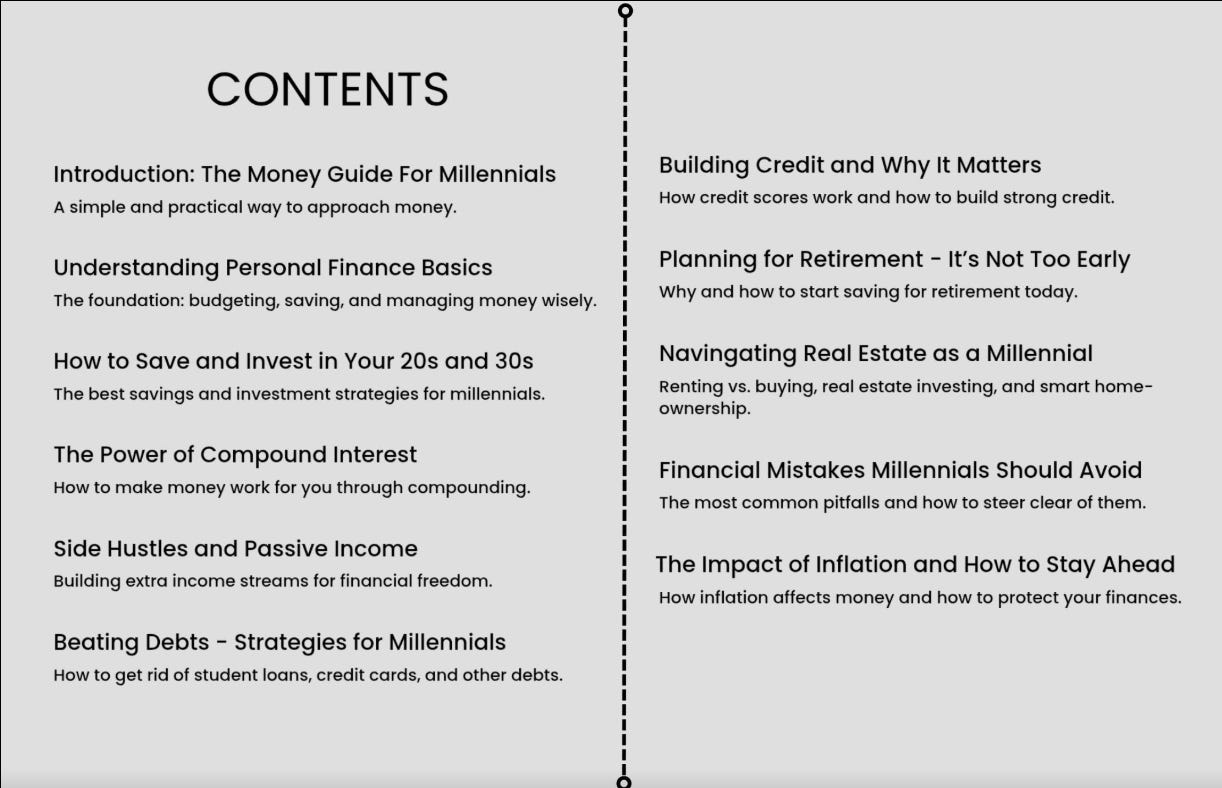
The 9 habits you just read are a small part of the lessons that transformed my relationship with money. If you want a simple roadmap for managing your finances, building wealth, and avoiding the mistakes that keep most people stuck for years, you’ll find it inside my eBook, The Money Guide for Millennials.
Because making money is important.
But knowing what to do with it is what changes your life.
A Peek inside the eBook:
Get your copy HERE ↓
The Money Guide For Millennials
If this hit home, tap that ❤️ and share it with someone who needs to read it.
Comments
Nothing yet. Say the first thing.
Sign in to join the conversation.