
You probably have some money saved right now, maybe it is sitting in a current account earning close to nothing, maybe you have been meaning to do something with it for months but every time you look into it you hit a wall of jargon, conflicting advice, and the very real fear that you might make the wrong decision and lose everything you worked so hard to save. So you close the tab and tell yourself you will figure it out later.
This is that later.
This guide covers everything. The philosophy behind investing, how it actually works, what to buy, where to buy it, what to do when the market crashes. By the end of it you will have no excuse not to start, and more importantly, you will actually understand what you are doing and why.
Before anything else, you need to understand why investing matters in the first place, because a lot of people skip this part and then wonder why they cannot stay motivated when the market dips.
The money sitting in a bank account is losing value every single day, the number is not going down, the number stays the same. But because of inflation, the purchasing power of that number quietly shrinks over time. A thousand dollars today buys you less than a thousand dollars bought three years ago, and considerably less than it bought twenty years ago. The number on the screen is the same, everything it can buy is not.
The first reason to invest is to not get rich overnight, to not beat the market and also not to find the next Nvidia before anyone else does. The reason is to simply to stop your money from slowly being eaten alive by inflation while it sits doing nothing.
The second reason is that beyond just keeping pace with inflation, a well invested dollar grows into more dollars over time. This is the power of compound interest, which Albert Einstein reportedly called the eighth wonder of the world.
When your money earns a return, that return itself starts earning a return, and the cycle continues. The longer you leave it alone, the more dramatically it multiplies. Time is the single most important ingredient in this equation, which is why starting now with a small amount consistently beats waiting until you can afford to invest more.
An asset, in its simplest definition, is anything that puts money in your pocket. A rental property puts money in your pocket through rent and through appreciation in value over time. A share in a company puts money in your pocket when the company grows in value or pays out dividends. The goal of investing is to accumulate assets that keep generating returns whether you are working or not.
There is no shortage of things you could theoretically invest in. Stocks and shares, government bonds, corporate bonds, property, foreign exchange, cryptocurrency, fine art, vintage watches, NFTs. The list is long and gets more confusing the further into it you go.
For most people starting out, the answer is simpler than the options suggest. Stocks and shares, because they are accessible, they do not require a large amount of capital to get started, they do not demand specialist knowledge, and historically they have produced consistent returns over the long term that most other asset classes struggle to match.
So what does it actually mean to buy a stock? When you buy a share in a company, you are buying a small percentage of ownership in that company. You make money in two ways. First, if the company grows in value, your shares grow in value proportionally. Second, some companies pay what are called dividends, which are essentially a portion of the company’s profits distributed directly to shareholders. You make money while the company makes money, without having to do anything beyond holding the share.
Now here is where most beginners go wrong, and it is an easy mistake to make because it feels completely logical. They try to pick the right stocks, they think about the companies they use every day, the ones they believe in, the ones they read about in the news, and they decide to put their money into those specific companies because surely they can tell a winner when they see one.
This is almost always a mistake.
Warren Buffett, the most successful investor in history, does not recommend individual stock picking for ordinary people. JL Collins, whose book The Simple Path to Wealth changed the way a generation thinks about investing, does not recommend it either. Research consistently shows that even professional fund managers, people whose entire careers are devoted to picking stocks, fail to beat the broader market over a long enough time horizon. The S&P 500 index outperforms the majority of actively managed funds in most years when you take a long enough view.
The reason individual stock picking fails most people is not just about picking the wrong companies. It is about not knowing when to sell, you might have had a feeling in 2015 that Nvidia was going to be huge. But if you had actually bought it, would you have held through every dip? Would you have held when it looked like AI was cooling off? Would you have known not to sell when it dropped 30% before eventually going on to make extraordinary returns? Knowing a company is good is not the same as knowing when to buy, when to hold, and when to sell. That requires a different skill set entirely, one that takes years to develop and that even professionals frequently get wrong.
There is also the graveyard of companies that once seemed too big to fail. Kodak invented the digital camera in 1975 and still filed for bankruptcy in 2012. Blockbuster was so dominant that Netflix offered to sell itself to them for fifty million dollars and was laughed out of the room. Lehman Brothers survived the Civil War, two World Wars, and the Great Depression before collapsing in a single weekend in 2008, wiping out the retirement savings of thousands of employees who had their entire financial future tied to the company’s stock.
Every generation has its version of this story. Right now you probably cannot imagine a world without Apple or Amazon or Netflix. Neither could anyone imagine a world without Lehman Brothers in 2007.
The point is not that you should avoid these companies. The point is that you should not bet everything on any single one of them.
If you should not pick individual stocks, then what should you do? You should buy the whole market.
An index fund is a fund that tracks a stock market index. The most famous example is the S&P 500, which is an index of the five hundred largest companies in the United States. When you invest in an S&P 500 index fund, your money is automatically distributed across all five hundred companies in proportion to their size. At the time of writing, that means roughly 7% in Nvidia, around 6% in Apple, around 4% in Microsoft, and so on down to smaller companies like Match Group, which owns Tinder and Hinge, sitting at the very bottom of the index at a fraction of a percent.
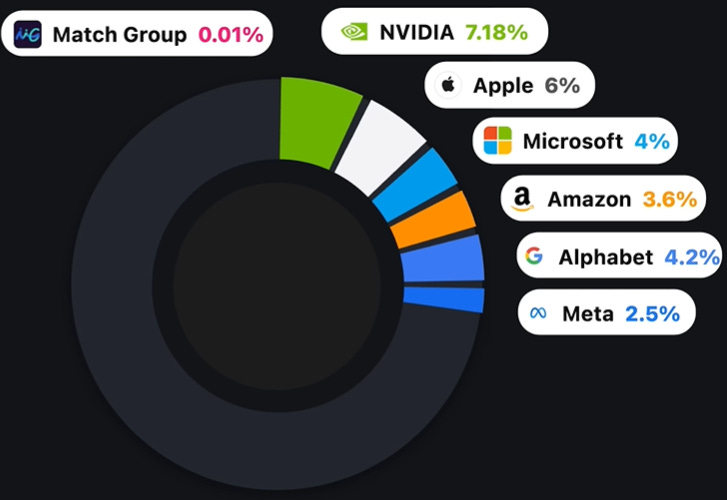
The elegance of this approach is threefold.
First, you are diversified instantly, your money is not riding on any single company succeeding. If one fails, it represents a tiny fraction of your total investment, the index absorbs the loss and continues.
Second, the index is self healing, it is not a fixed list of five hundred companies that never changes. It is a continuously curated list of the five hundred most valuable companies at any given moment. When Blockbuster collapses, something like Netflix takes its place, when a company stops being among the five hundred largest, it gets replaced by one that is. You are not betting on any specific company surviving forever. You are betting that the top five hundred companies at any given time will collectively grow because thousands of people are going to work every day creating value within them.
Third, the track record is remarkable. Over the past hundred years, the S&P 500 has returned an average of somewhere between 7 and 9% per year. Not every year. Some years it drops significantly. But over a long enough time horizon, the direction has always been upward.
For those worried about the concentration of American companies, there is also the option of a global index fund such as the Vanguard FTSE All-World, which spreads your money across the top 3,700 companies across 49 different countries. If you believe the US economy faces particular risks, a global fund ensures you are not entirely dependent on one country’s economic health. The fund automatically adjusts its weightings as value shifts around the world. You are not betting on USA, you are betting on human productivity and economic activity across the entire planet, which is a considerably safer bet.
This is the fear that stops most people from ever starting. What if I invest and then the market collapses and I lose everything?
It is a legitimate concern, and it deserves a direct answer.
Let’s use the COVID crash of March 2020 as an example, because it is the most dramatic market event in recent memory. The S&P 500 dropped 34% in a single month. If you had invested a thousand dollars at exactly the wrong moment, just before the crash, you would have watched that thousand dollars become six hundred and sixty dollars. A loss of three hundred and forty dollars in weeks.
At that point, every instinct would be telling you to sell before it gets worse. And if you had sold, you would have lost three hundred and forty dollars for good.
But if you had held, something different would have happened. The market recovered to its pre-crash levels by August 2020. Five months later, you were back to a thousand dollars. By the end of 2021 that thousand was worth fourteen hundred. By 2025 it was worth over two thousand one hundred. In five years, through a global pandemic and one of the sharpest market drops in modern history, you would have more than doubled your money, simply by holding and doing nothing.
For the S&P 500 to go to zero and stay there, every single one of the five hundred largest companies in America would have to simultaneously collapse to nothing. At that point you would have considerably larger problems than your investment portfolio. The scenario in which you lose everything by holding a broad index fund is effectively the scenario in which civilisation itself has collapsed, in which case no financial instrument would retain its value anyway.
The practical lesson is this. Invest money you do not need for at least five years, ideally much longer, when the market drops, do not sell. Hold, keep contributing if you can, and let time do its work.
You cannot buy an index fund directly. You need to go through a brokerage platform, which is essentially an online intermediary that executes the purchase on your behalf.
There are many options depending on where you live. Vanguard is one of the largest and most trusted globally, available in many countries and known for its low fees.
The most important thing is to find a platform available in your country, check that it offers a low cost index fund option, and start with whatever amount you can afford. Most platforms allow you to begin with as little as ten or twenty dollars. The amount matters far less than the habit of contributing consistently over time.
The single biggest mistake people make with investing is waiting until everything feels certain before they start, certainty never arrives. The market will always have something scary happening, some political crisis, some economic warning sign, some reason to wait just a little longer. The people who build wealth are not the ones who waited for the perfect moment, they are the ones who started with whatever they had, held through the uncertainty, and let time do the heavy lifting.
Open a brokerage account this week. Start with whatever you can afford, even if it is fifty dollars. Choose a broad market index fund, set up an automatic monthly contribution so it happens without you having to think about it.
Then leave it alone.
And everyone, this is the end of the article. I know this one was a little longer than usual (especially considering the name of this publication 🙄), but investing is one of those topics where half-knowledge can be expensive.
And if you're ready to take control of your finances beyond just investing, The Money Guide for Millennials is a great place to start.
It covers everything from budgeting and debt to credit scores, wealth building, and financial freedom in a simple, beginner-friendly way.
Check it out HERE
Tap that ❤️ and If this helped you understand something you have been putting off for too long, share it with someone who needs to read it.
Comments
Nothing yet. Say the first thing.
Sign in to join the conversation.