
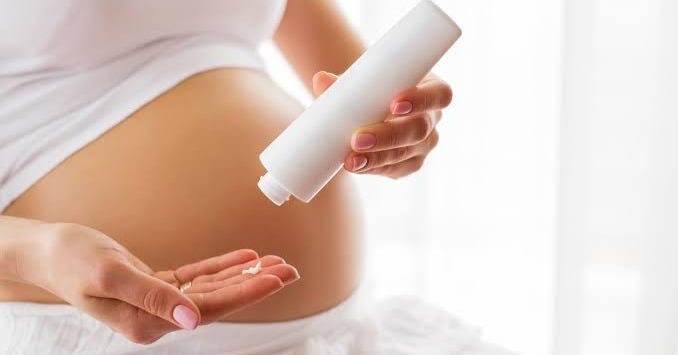
When I was pregnant with my son, I went looking for one simple answer: what do I actually need to stop using? What I found was the list that gets reprinted or copied across most pregnancy blogs, and it was a lot longer than I expected.
I am a biochemist, and I remember reading it and thinking that most of it had no business being there.
And, Complexions, here is the part that never goes viral. The list of ingredients you actually need to avoid in pregnancy isn't page-long. It's closer to two.
Those two are retinoids and hydroquinone, and the agreement on them is about as firm as skincare guidance ever gets. Read across the NHS, the British Association of Dermatologists, UKTIS, the American bodies and the peer-reviewed reviews, and they line up on the same short answer: avoid those, and most of the rest is fine.
So why does it feel so much more frightening than that? Not because good information is missing. Plenty of clinicians and creators put out calm, careful, accurate work, and if you are reading this, you have probably found some of them.
The problem is structural. Fear travels further than reassurance, so the algorithm rewards the scary version of a claim over the measured one, whoever posted it. Add the fact that pregnant women are, rightly, kept out of clinical trials, so for a lot of ingredients, there simply is no pregnancy-specific data, and you have the conditions for "no data" to get repackaged as "danger" and handed to you at speed. If that has left you anxious, it is not a failure of judgment. It is a predictable result.
Real disagreement does exist, but it is narrow: low-strength salicylic acid, chemical sunscreens, a couple of others, and even there, the question is how cautious to be without human data, not whether harm has been shown.
So let me walk you through it properly. What is worth avoiding, what is a fair question, and what is just fear with good SEO. Then a simple routine.
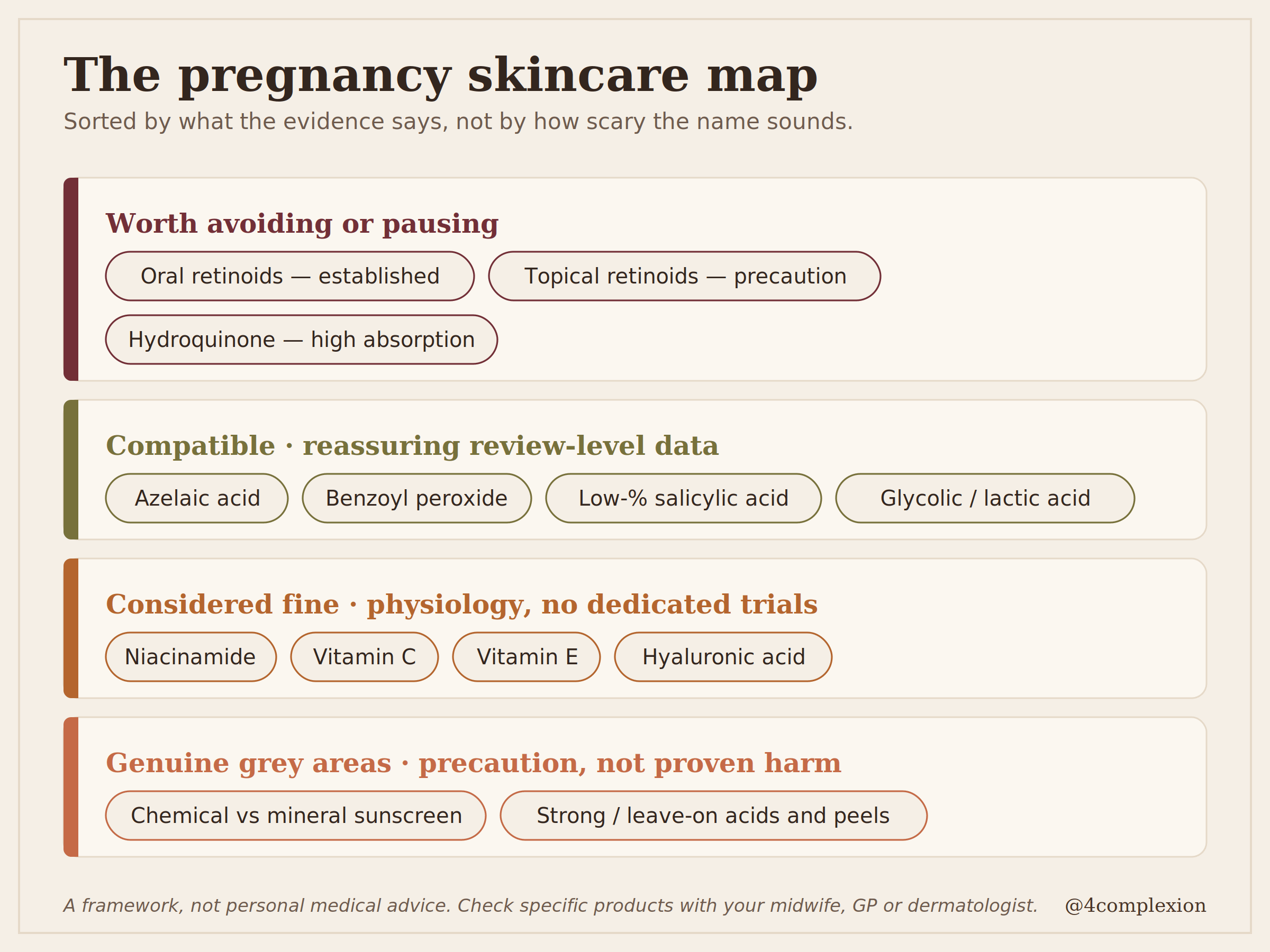
The whole map at a glance, sorted by what the evidence says rather than how scary the name sounds.
Almost all skincare scaremongering runs on one trick. It points at a hazard and stops there.
A hazard is something that could cause harm under the right conditions. Risk is whether it actually will, given how much reaches you and how.
For example, bleach is hazardous. You still clean your loo with it, because you are not drinking the bottle. Same chemistry, different risk, and the difference is dose.
In toxicology, working out actual risk comes down to three questions.
How much actually gets in? Your skin is a barrier, and a good one. Most actives work at the surface, and only a sliver crosses into your blood. A molecule on your face is not a molecule reaching your baby.
At what dose? Two percent absorption is a different conversation from forty. The number matters more than how the word sounds.
And what does the evidence say? More to the point, which kind: human data showing a problem, human data showing reassurance, or no study either way. That last one, in particular, trips everyone up. "We haven't run the trial" is not "we found harm." Most of pregnancy skincare lives in that grey space, and flattening it either way is how people get scared off perfectly good products.
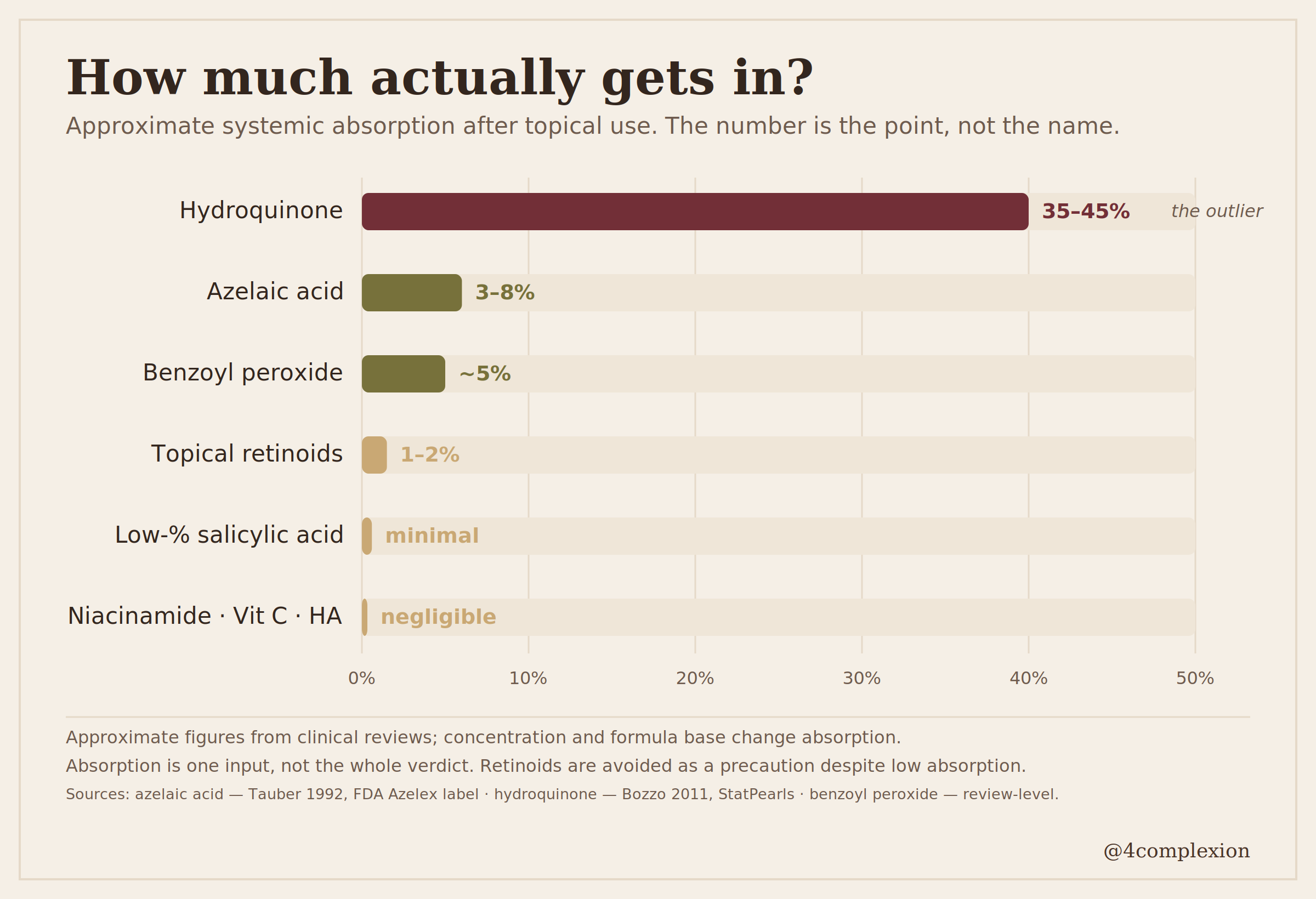
How much of each active actually reaches your bloodstream after topical use. Hydroquinone is the outlier, which is exactly why it earns caution.
Know someone who'd find this calming? Send it their way.
The one unambiguous entry on the whole list. Isotretinoin, the acne tablet, is a known teratogen: it can cause serious birth defects. Not a precaution, an established fact! Which is why it comes with pregnancy-prevention programmes and monthly monitoring. If you are on it, that is a conversation with your doctor, not a skincare question.
Different animal, where the nuance matters. On skin, retinol and tretinoin absorb at roughly 1-2%, and the human data is reassuring. A meta-analysis of 654 exposed pregnancies against 1,375 controls found no rise in major malformations, miscarriage, stillbirth, low birthweight or prematurity. The newest evidence, a Nordic registry cohort (2026) from Denmark, Iceland, Norway and Sweden, agrees.
So why the blanket ‘avoid’?
Because the oral version is a proven teratogen, and stepping back from the whole family is the sensible call in the one window where guessing feels reckless. So if you used retinol before you knew, don't panic. Stop now, and that's it. The advice to avoid it is caution, not alarm, and the data behind it is reassuring.
The skin-lightening agent, and the interesting one, because there is no demonstrated rise in malformations here either. I would still be cautious, for one reason: absorption. Hydroquinone goes systemic at roughly 35 to 45 percent (Bozzo et al., 2011; StatPearls), far higher than anything else here. When that much crosses into you, "no evidence of harm" is not reassurance. It is missing information about a large exposure. The guidance is to minimise it. Not because anything bad has shown up, but because that much of it gets in.
Aspirin at proper doses is different from the salicylic acid in your 2% exfoliant. High oral doses carry real pregnancy considerations. Your cleanser or toner does not.
Two ingredients get reflexively banned despite being fine. Each is here by association: same chemical family, or just a similar name, as something you should actually avoid.
The poster child. Same name as those oral salicylates, same intimidating chemical family, so it gets banned on vibes. But no pregnancy study shows a problem with topical use, absorption from a rinse-off or low-percentage ( 0.5-2% ) leave-on is minimal, and even low-dose oral aspirin showed no raised risk. American College of Obstetricians and Gynecologists lists it among the things you may use for acne in pregnancy. It just has an unfortunate surname.
Sounds industrial, behaves like a lamb. About 5 percent absorbs, converts to benzoic acid, a food additive, and your kidneys clear it. Reviews place it, alongside topical antibiotics like clindamycin, as a first-line option for acne in pregnancy. The scary name does all the work. The molecule does not.
Maybe my favourite reassurance here, partly because it occurs naturally in wheat, rye and barley. You have, statistically, already eaten it. The absorption data is properly reassuring: the primary human study put topical uptake at 3.6% from a 20% cream, the FDA label rounds it to about 4% (Azelex), and it climbs toward 8% only in some gel formulas. It is Category B with no animal teratogenicity, and considered compatible across all trimesters (review). Barely absorbed, no red flags, and quietly brilliant for pigmentation, which makes it the one to know for this stage.
These three get called pregnancy-safe everywhere, and I use them happily, but not because trials exist. They don’t. What exists is physiology. Niacinamide is vitamin B3, already in your food and your prenatal. Vitamin C, and its fellow antioxidant vitamin E, are dietary molecules that barely register systemically off your face. Hyaluronic acid is a humectant your body already makes, working at the surface. So the honest line is not “proven safe.” It is “dietary or self-made molecules with no route to harm, and no reason anyone has found to worry.” Strong, but it's physiology, not a trial. Worth being honest about the difference.
Glycolic and lactic acid only show effects at high doses in animal studies. In humans, topical absorption is minimal (Bozzo et al., 2011), and reviews consider them fine up to about 10 percent, at a pH above 3.5 (review). Above that, or as an in-clinic peel, is a different thing and belongs in the grey-area pile.
The quiet one, and worth knowing if breakouts are your issue. Sulphur has been used on skin for a very long time, and a narrative review of acne in pregnancy considers it safe in pregnancy and breastfeeding, with the honest caveat that, like the trio above, this rests on a long track record rather than dedicated trials. Gentle, low-absorption, and a soft landing when stronger acne actives are out.
Two more that come up constantly: fragrance and essential oils.
Fragrance first. It is the most common cause of allergic contact dermatitis from cosmetics (DermNet), and leave-on products sensitise more than rinse-offs. Pregnancy can also leave skin more reactive. So the real reason to go fragrance-free now is unglamorous: irritation is likelier and easily avoided. so not a safety issue.
The scarier version you will read is about phthalates, and this is where it pays to be precise, because "phthalates" is not one substance. The ones carrying a real reproductive-toxicity flag, DEHP and DBP, are not the ones in your perfume.
They are the plasticiser and old nail-varnish types, and the EU restricted them in cosmetics years ago.
The phthalate actually used in fragrance is a different molecule, diethyl phthalate (DEP), a solvent that helps scent linger, and regulators currently rate it low-concern.
There is an honest wrinkle, though. Fragranced products are the main source of DEP in the body. So unlike the phthalates you mostly get from food, cutting fragrance genuinely does lower your DEP levels, though in pregnancy studies the drop is small and inconsistent. And DEP isn't fully settled either. The research linking it to pregnancy outcomes is mixed: some studies see a possible link, others don't, so there's no clear answer yet.
So fragrance-free is one of the few phthalate levers that genuinely does something, and a sensible low-effort precaution if it settles your mind. Worth doing if it helps you worry less. Not something to panic about.
Essential oils are the interesting one, because "natural" makes people relax when they should pay attention. An essential oil is a concentrated, bioactive mix that varies batch to batch. The real concern is not vague pregnancy toxicity off a folklore list. It is phototoxicity. Cold-pressed citrus oils, bergamot above all, carry furocoumarins like bergapten that react with UV light and can cause a streaky burn-and-pigment reaction (furocoumarin reviews).
Sit with that a second: an ingredient that pigments your skin in sunlight, at the stage your skin is already itching to pigment. This applies to everyone, but it matters more when you're already prone to pigmentation. Steam-distilled or bergapten-free citrus oils avoid the problem, and well-formulated products keep the levels low. So the blanket 'no essential oils in pregnancy' rule is mostly overcaution. The one that's actually worth heeding is citrus oils plus sun exposure.
Every pregnancy forum eventually descends into mineral-versus-chemical war, so let us use it to show hazard versus risk one more time.
The weaponised fact: the FDA ran randomised trials, a 2019 pilot and a larger 2020 study of 48 people, and chemical filters like avobenzone, oxybenzone and octocrylene turned up in blood above 0.5 ng/mL, some after a day of heavy use. Clean-beauty accounts stop at 'absorbs into your blood,' which is exactly the phrase to set an anxious mind spiralling.
Those studies looked at the older American set, oxybenzone, octinoxate, octocrylene and the rest. Those are the molecules the whole scare is built on, and octinoxate in particular has since been flagged by the EU as endocrine-active.
But most UK and EU sunscreens now run on a newer generation of filters like Tinosorb S, Tinosorb M and Mexoryl. These are big, heavy molecules built to sit on the surface. One study found Tinosorb M penetrates about 0.01% of the applied dose through human skin, and receptor tests do not show the hormone activity the bans are about.
None of that is pregnancy-specific trial data, so I would not say proven safe. But "barely gets in, and does not behave like a hormone" is a fair reading, and it means the sunscreen you are most likely holding is not even the one that was studied. It's also why this fear leans so heavily on US data: the filters those studies tested are the ones America was limited to, because the FDA only proposed adding the newer high-molecular-weight filters to its rules in late 2025. Europe and much of Asia moved on years ago.
Look at what the threshold is, though. 0.5 ng/mL is the point above which the FDA asks for more toxicology work. A trigger for research, not a finding of harm. The system doing its homework, which should reassure you, not scare you. Absorption is not danger. Prefer a mineral filter, zinc or titanium dioxide, that sits on top? Perfectly reasonable, I will not talk you out of it. But wearing sunscreen, every day, is not up for debate while you are pregnant. Here is why.
Pregnancy hormones can trigger melasma, the “mask”, those patches of deeper pigment across cheeks, forehead and lip. What drives it and worsens it is not a missing serum. It is UV. So daily sunscreen is not vanity here, it is the only lever that really moves. And it matters for every skin tone. In deeper skin tones, melasma tends to be more stubborn and harder to shift, so daily protection matters more, not less.
You do not need fourteen steps, least of all now. A version that holds up, built to keep your barrier calm and your pigment quiet:
Morning: gentle cleanser, or just water. Vitamin C, if you like one. Moisturiser. Then broad-spectrum sunscreen, applied properly and treated as the main event, because for melasma it is.
Evening: gentle cleanser, your pigmentation and/or your acne active, moisturiser to seal. Niacinamide fits either side of the day and gets on with almost everything.
For pigment specifically, the useful actives are all in the ‘reach-for’ group above. A few more sit comfortably alongside them: alpha arbutin, thiamidol, and topical tranexamic acid are all surface-level brighteners that barely cross the skin barrier, TXA especially, since it's too hydrophilic to get far past the stratum corneum. Like the vitamins, none has a dedicated pregnancy trial, but there's no route to harm and no reason found to worry.
Azelaic acid is the standout I always recommend, whether it’s for breakouts, melasma or rosacea: it calms pigment production, it is well tolerated, and it is fine across all trimesters. If you use one active, use that.
Vitamin C adds antioxidant support and a little brightness, niacinamide helps with evenness, and a low-strength AHA a couple of nights a week can lift surface dullness if your skin fancies it. And sunscreen every morning does more for your pigment than anything else on the list.
The one you will notice missing is hydroquinone, the classic fade-it-fast option. Pause it for now, for the absorption reason. If your melasma is stubborn, that's a conversation to have with a dermatologist about timing, rather than something to tackle alone.
That is all. Almost annoyingly simple, and it works.
Most of what you were told to fear barely gets in, or is already in your food, or was only ever a precaution. The actual short list is retinoids and hydroquinone. Hydroquinone because it actually absorbs. Retinoids as a caution borrowed from the pill, even though the topical data is reassuring.
None of this is medical advice, and a newsletter cannot know your skin or your pregnancy. Take the real bottles and their INCI lists to your midwife, GP or dermatologist and ask. A good one will be glad you did.
But you can put the fear down. The question was never “is this scary?” It was “how much gets in, at what dose, and what does the evidence say?” Ask that, and most of what you put away can come back out.
One more thing before you go. Tell me what you're stuck on. Is there an ingredient, a condition, or a bit of skincare advice you've seen going around that you'd like me to take apart properly?
Leave it in the comments, and it might become the next piece.
Bye now, M x
No posts
Comments
Nothing yet. Say the first thing.
Sign in to join the conversation.