
The NIH has been hamstrung in completing its mission by the loss of thousands of staff. This is Concern 5 of The Bethesda Declaration: One Year Later, a comprehensive overview of the harmful policies witnessed by NIH staff since January 2025.
In case you missed them, we’ve already covered concerns 1 (an antiscience agenda), 2 (discriminatory policies), 3 (ignoring ethical standards), and 4 (an unstable research environment). We will be sharing the remaining four concerns in the coming weeks.
Thanks for reading! Subscribe for free to receive new posts and support my work.
If you share these concerns, please add your voice (named or anonymous) so we can draw attention to these issues. Read the full report and learn more about the Bethesda Declaration Movement on the 27 UNIHTED website.
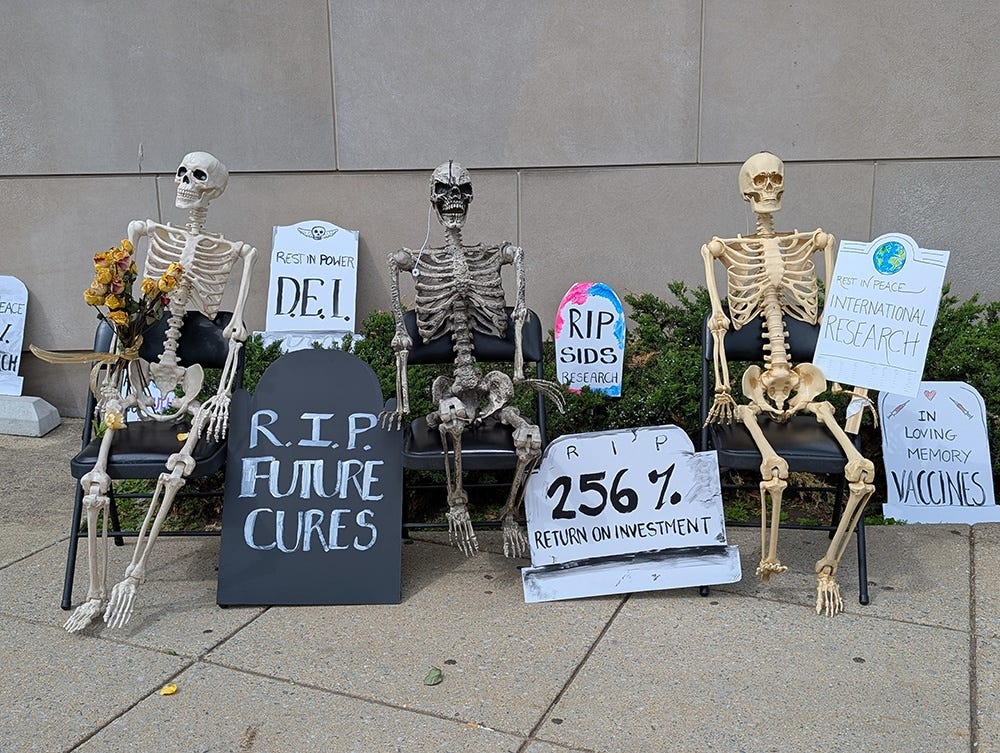
Concern 5: Lost critical expertise is hindering the NIH mission
Why It Matters
As of April 2026, NIH lost over 4,400 employees since January 2025 through probationary firings, reductions in force (RIF), incentivized retirements, staff resigning in protest or under pressure, alongside usual departures, representing a reduction of roughly 20% to 25% of its total workforce. Contract terminations and non-renewals have further reduced capacity. In many cases, cuts were made arbitrarily and without consideration of how key job functions could still be accomplished by remaining staff. Cuts targeted critical areas such as workforce management, legislative affairs, communication, and ethics, among many others. NIH’s expert workforce management staff identified, trained, and managed the scientific leaders of our nation. Communications staff helped share NIH research findings with the public. Ethics staff ensured adherence to ethical guidelines. Policy staff enabled effective communication with Congress. The reductions in mission-critical personnel has significantly impeded NIH’s ability to achieve its statedpriorities. The mission of NIH, to seek fundamental knowledge and apply that knowledge to enhance health, lengthen life, and reduce illness and disability, cannot be achieved without the foundation of the individuals who sustain it.
Specifically, the planned and actualized staff reductions led to losses in:
Irreplaceable knowledge and institutional memory. RIFs removed entire offices and divisions from NIH, leaving little or no staff in certain mission areas. With almost no one remaining in these areas, certain areas of expertise and knowledge of past practices are no longer available to the agency
Novel perspectives, emerging scientific expertise, and future leaders. The termination of probationary employees categorized as new hires or recently promoted personnel deprived NIH of scientists and related professionals capable of advancing both the agency and the wider scientific community. These dismissals effectively suppressed the introduction of novel ideas and innovative scientific methodologies. Since recently promoted staff constituted some of NIH’s most exceptional talent, these actions severely impacted the cultivation of future agency leadership.
Undermining relationships with scientists and community partners. These professional relationships were formed through years of outreach and collaboration. The sudden nature of the terminations left no time for proper communication and orderly transition, jeopardizing any future partnerships.
Ability to carry out NIH’s most basic functions. Personnel reductions among critical grants management staff have compromised the capacity of NIH institutes struggling to evaluate research proposals, manage funding allocations to external research institutions, and issue research grant awards. As discussed in Concern 3, termination of Clinical Center staff continues to endanger patients and disrupt research.
Transparency and trust. RIFs removed roles related to information sharing with the public and Congress, including communications and legislative affairs offices as well as staff who processed Freedom of Information Act requests, a primary tool for the public to understand government actions.
These losses will be exacerbated by the OMB Schedule Policy/Career rule, which was designed to strip career civil servants of their employment protections by making positions “at will” and enabling the executive branch to fire staff for political reasons and without performance-related cause. The new category classifies positions that “help shape or carry out Presidential policies, or involve a high level of confidentiality or policy influence” and was intended “to enhance accountability in these policy-influencing positions.” However, the White House’s list of NIH job classes to be designated Schedule Policy/Career includes frontline staff and managers (e.g., Health Scientist Administrators, Branch Chiefs) involved in regular scientific administrative work. Civil service protections were designed to stop the “spoils system,” wherein the elected party rewarded its supporters with government jobs. Removing civil service protections will increase political pressure on government career professionals, exacerbating the ongoing brain drain, increasing grant funding barriers, and furthering the discriminatory practices described in Concern 2.
Examples
Firing staff responsible for public and congressional communications undermines stated goals to rebuild public trust in NIH. Through dismissals and reorganization, individual institutes and centers have been left without dedicated communication teams. A consolidated central communications office cannot have all the information needed to provide accurate and up-to-date information about advances in every health area in the NIH mission. This limits NIH’s ability to inform the public about taxpayer-funded research outcomes and counter false information about NIH and the science it funds. The same winnowing and reorganization has negatively impacted policy and legislative functions; staff with critical institute-specific expertise are no longer available to answer urgent legal and congressional inquiries.
Widespread vacancies in institute and center directors and senior staff. With the change in administration, NIH lost 17 of 27 Institute and Center Directors, and 14 directorships remain vacant. In some institutes and centers, gaps in permanent leadership extend to the division level. Reassignment of senior staff as detailees to other institutes adds further concerns about the functional stability of NIH. As a result, the ability to develop institutional goals, plan long-term priorities and provide guidance to a highly concerned research community has been crippled.
RIFs were executed without understanding of staffing needs. RIFs were based on broad position codes, without evaluation of component roles.Entire human resources (HR) branches were let go based on alphabetical order (e.g., Branches A-E) without regard to responsibilities. As a result, the RIFs eliminated all HR for some institutes and centers, as well as the entire NIH-wide retirement office, leaving some parts of NIH without HR staff to support ongoing incentivized retirement programs and other staffing changes. Moreover, the lack of transparent communication and the targeting of specific sectors, like HR and administrative officers (AO), impeded staff from carrying out basic job functions that led to widespread confusion about roles, responsibilities, and who remained to do the work. Demonstrating clear continuing need for some RIFed positions, Contracting and Acquisitions staff, who provided for the purchase of office and research supplies, research and development contracts, information technology contracts, and other needs, were asked to continue to work while on administrative leave after receiving RIF notices. Despite their continued service and demonstrated need, most were separated from federal service and let go on Monday, July 14, 2025.
Regulation-driven, statutory, time-limited and essential activities are stalled. Absent staff with the necessary training and skills to complete them, NIH functions required by law, such as review of contract deliverables and invoices, Paperwork Reduction Act clearances, pre- and post-award administration of grants, and timely responses to congressional inquiries, are being conducted without appropriate expertise. For example, probationary terminations and incentivized retirements substantially reduced grants management staff at many institutes, impeding NIH’s ability to award grants. The shortage of grants management staff has become so severe that one institute estimates that under current staffing levels, they could issue only about 5% of its typical new awards, potentially leaving $500 million unspent. At another institute, property management staff were RIFed, and the upper managers who have assumed responsibility for oversight of government property are unfamiliar with how the electronic systems work. As a result, staff whose laptops were broken could not obtain new ones. The fulfillment of Freedom of Information Act requests has been distributed across staff, taking time away from science, grants management, and other critical activities.
Insufficient oversight of high-risk studies and clinical trials. Lack of staff with clinical knowledge and expertise can lead to safety and productivity risks. Over the last 18 months, NIH has lost dozens of clinically-trained scientists responsible for the oversight of high-risk projects, such as drug and device-based interventions in children and patients with advanced or rare diseases. This reduction in clinical staff presents ethical challenges including endangering research participants, as discussed in Concern 3.
The talent pool for NIH staff has been curtailed. The American Association for the Advancement of Science (AAAS) fellowship program, Presidential Management Fellows (PMF), and other fellowship and internship opportunities have been discontinued. This disrupts long-standing pathways to NIH employment and blocks NIH from the benefits of working with creative young scientists (and non-scientists) who represent the future of the U.S. health research enterprise. In addition, reporting suggests that the dismissals of NIH employees, which targeted workforce management, scientific administration, financial management, and communications, likely disproportionately impacted people from racial and ethnic minority groups. The OMB has removed race and ethnicity from their published workforce data, undermining the ability to monitor disparate effects. This reduction in diversity diminishes the ability of NIH to serve all Americans.
Recommendations
Bring NIH staffing back to appropriate levels to enable mission-critical work, including communications, workforce management, human resources, legislative affairs, and other domains targeted by RIFs. Hiring excellent and needed staff will require restoring the reputation of the NIH working environment, which is widely recognized as hostile, as discussed in Concern 9. Rehire RIFed employees and probationary employees, where possible. Conduct a careful review of institute- and center-specific staffing needs, and restore staff with specific expertise in acquisitions, communications, legislative affairs, planning and evaluation, and other staff areas that were targeted by consolidations. Restore staff support for NIH’s internal laboratories, including administrative operations, purchasing of laboratory supplies, hiring of needed personnel, and management of lab facilities, so that labs run efficiently and scientists can pursue science rather than paperwork.
Protect the NIH mission by ensuring career civil servants retain employment protections and cannot be fired for political reasons, as would be enabled by the recent implementation of the Schedule Policy/Career designation. Congress must ensure that NIH staff have access to the full benefit of civil employee protections, so they continue to be hired and retained based on merit and not political views.
Fill vacant institute and center directorships with qualified scientists selected through the search process typical at NIH prior to 2025. Congress should establish binding requirements to ensure rigorous search processes for these directorships, such as mandating search committees composed of both internal civil servant staff and independent external scientists and requiring a minimum time period for posting job announcements.
Address Clinical Center staff shortages to ensure patient wellbeing and continuity of research, as recommended in Concern 3.
Reinstate fellowship and training programs that provide a pipeline of excellent NIH staff, such as the AAAS fellowship program and PMF program.
What you can do
Stay informed!
Read the full report.
Follow 27 UNIHTED here or on Bluesky, Instagram, LinkedIn, or Facebook for up-to-date content on what’s happening inside NIH.
Look out for the next post in our Bethesda Declaration: One Year Later series on how Changing of policies without staff input is creating foreseeable damage.
In case you missed it, find our first, second, third, and fourth post of the series.
Inform others! Share this post with your colleagues.
Call your members of Congress and urge them to enact protections for NIH, including stopping the discriminatory censorship at NIH and saying no (permanently!) to Russell Vought’s proposed rule on financial federal assistance.
Help us stop Russell Vought from doing further damage (or at least pull him out of hiding in the shadows and bring him the infamy he deserves!) by urging Congress to impeach, convict and remove him from office.
Need more ideas? Check out the 27 UNIHTED Advocacy Menu.
Thanks for reading! Subscribe for free to receive new posts and support my work.
Comments
Nothing yet. Say the first thing.
Sign in to join the conversation.