
From the lead author (anonymous current employee)
I’m a long-time NIH staff member who manages a portfolio of grants on the prevention of chronic diseases that affect many Americans, including my family, friends, and neighbors. I’ve had a passion for science since I was a kid, and I was fortunate to find my NIH job towards the beginning of my career. Over the years, I’ve had the opportunity to work with senior scientists (many of whom I’d looked up to as a student) as well as graduate students and Post-doctoral fellows just starting out. What I have witnessed since this Administration took over 17 months ago has been heart-wrenching, infuriating, and shocking, which led me to want to share my thoughts below...
Report on Disparities in Fiscal Year 2025: Success Rates and Award Numbers Across NIH
Previous reports have examined the NIH-wide success rate for grant applications in fiscal year (FY) 2025 compared to FY 2024, with NIH recognizing a substantial drop in a recent blog post. Using publicly-reported data from the NIH Data Book, I worked with Alyx (Alyssa) Tonsing-Carter, former Chief of the Analysis and Evaluation Branch of the National Institute on Aging Office of Planning, Analysis and Evaluation, to find the overall success rate for investigator-initiated (or untargeted) R01-equivalent and other research project grants funded by NIH fell from 17% to 12%, a 29% decline.
We know that multiple co-occurring assaults on NIH underlie this reduction; however, a substantial driving force was the mandate from the Office of Management and Budget (OMB), led by Russell Vought. This mandate was implemented in June 2025 and said that NIH Institutes and Centers (ICs) fund 50% of competing research project grants with multi-year funding (MYF). Several reports have explained how MYF reduces the number of awards that can be made, particularly impacting clinical trials, which often need a longer term than can MYF allows for. We also viscerally know the effects of loss of staff (~20% across NIH), particularly Grants Specialists who process and release grant awards; IC leadership vacuums; and the Administration’s specific targeting of grants based on the topic of interest, including prohibiting funding for projects focusing on workforce diversity, climate change, gender ideology, vaccine hesitancy, and misinformation amongst others. This includes numerous grants seeking to understand why individuals from specific racial and ethnic minority groups are more likely to develop chronic diseases than non-minority groups as well as grants that seek to learn how public health policies affect the development of diseases that afflict so many Americans, solely because the grant used the word “policy” (stay tuned for upcoming Substack on this issue!). During that period (and it continues until today), my colleagues and I have spent countless anxiety-provoking hours working – and worrying – with our researchers trying to figure out how to renegotiate and justify the merit of their grants so that they could complete their studies, when those grants were judged to be highly meritorious and consistent with NIH’s mission to improve human health.
Although the average success rate across NIH decreased from 17% to 12% in FY25, it’s also important to consider the wide variability in the success rates for R01s and other research project grants by individual Institute and Center.
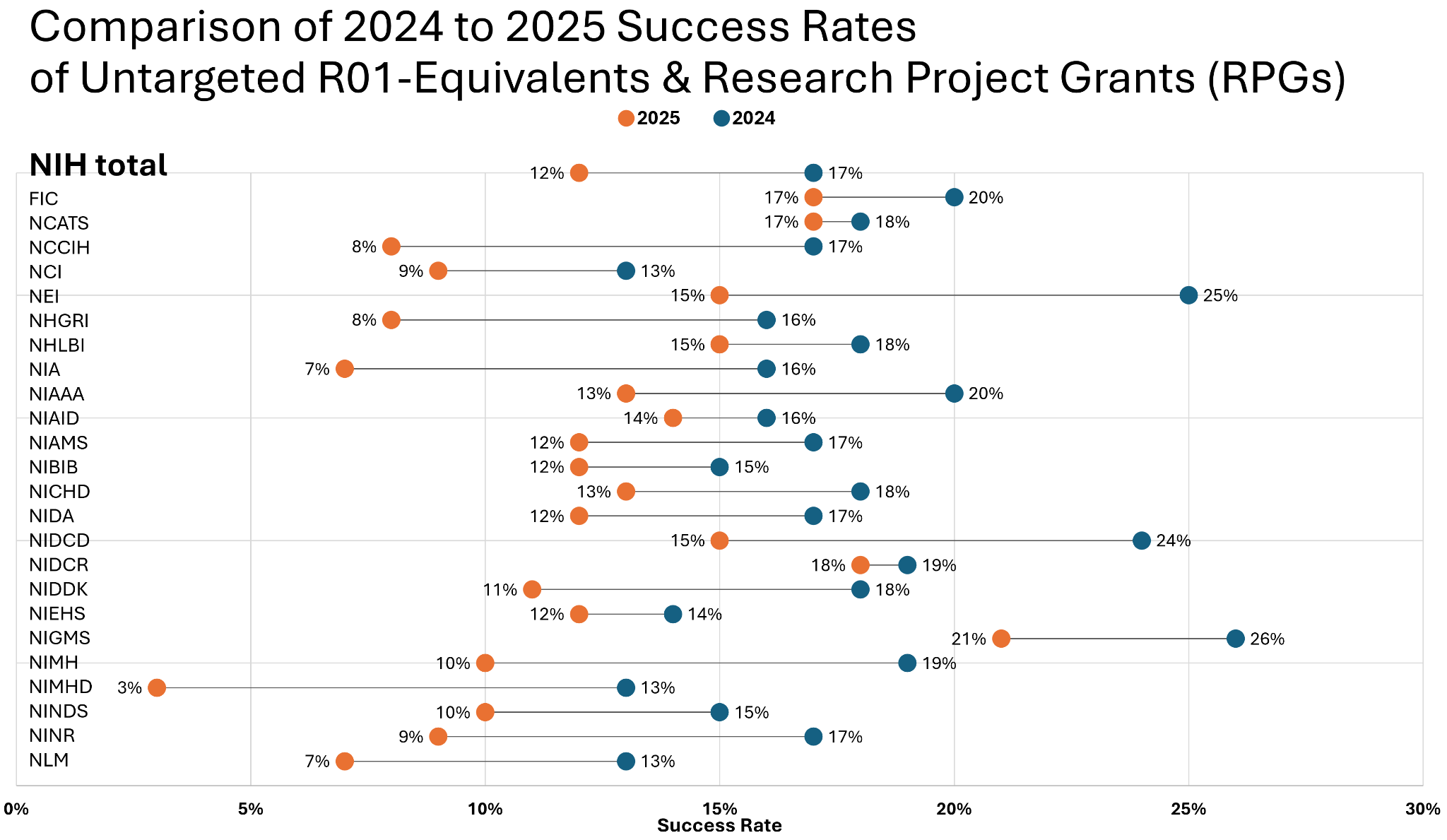
Image and analysis by Alyx Tonsing-Carter
Starting with large ICs (i.e., those with the largest annual budgets), success rates across the five largest ICs declined by differing levels: NCI (-31%), NIAID (-12.5%), NIA (-56%), NIGMS (-19%), and NHLBI (-16.6%). The reasons for these differences were likely multi-factorial, although NHLBI’s rate may have been the result of lower use of MYF compared to other ICs. Amongst a number of other ICs, we found that many experienced substantially higher declines in success rates than average, including NIMHD (-77%), NCCIH (-53%), NHGRI (-50%), NINR (-47%), NIMH (-47%), NLM (-46%), and NEI (-40%). A key reason for the declines at NIMH and NHGRI, in particular, were substantially higher losses of staff–largely associated with probationary employees (employees hired within 12 months) being fired regardless of performance, along with early retirement, deferred resignation, or departure for other reasons (forced return to the office, etc.). NIMH resorted to requesting temporary assistance from Grants Specialists from other ICs as well as clinical staff1 and PhD students from within NIMH to process their awards in the latter part of FY25. Other ICs were slashed because they were the target of the Administration based on their research mission or priorities, including NIMHD (-77%) and NINR (-47%), which disproportionately fund minority health and health disparities research.
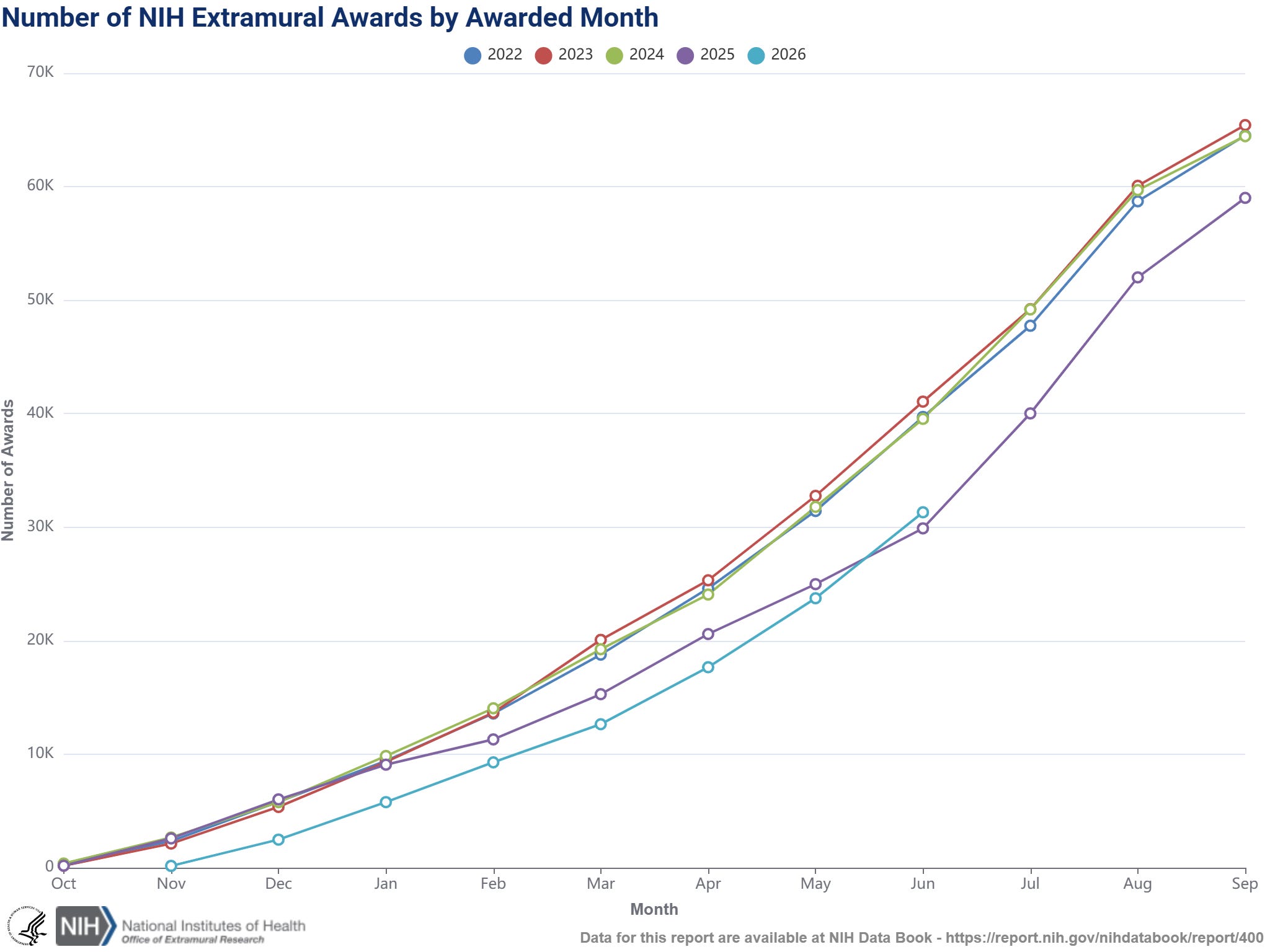
To date in FY262, awards by month for all extramural grants are following the same trajectory as in FY25 with only ~2 months remaining in the FY. This observation suggests that NIH is on track to award substantially fewer awards again in FY26 compared to prior FY22-FY24. Data specifically for R01-equivalent awards was not yet available when we performed this analysis.
But NIH has reported that success rates for early stage investigators (those within 10 years of their terminal degree who have not secured a competitive R01-equivalent grant award) dropped from ~29% in FY23 to 18% in FY25. NIH does not readily share success rates by race/ethnicity, even internally. To perform demographic analyses, staff need to submit a data request to the Office of Extramural Research. Though it is critical to protect sensitive data, NIH should regularly share success rate data aggregated by demographic group to ensure greater transparency
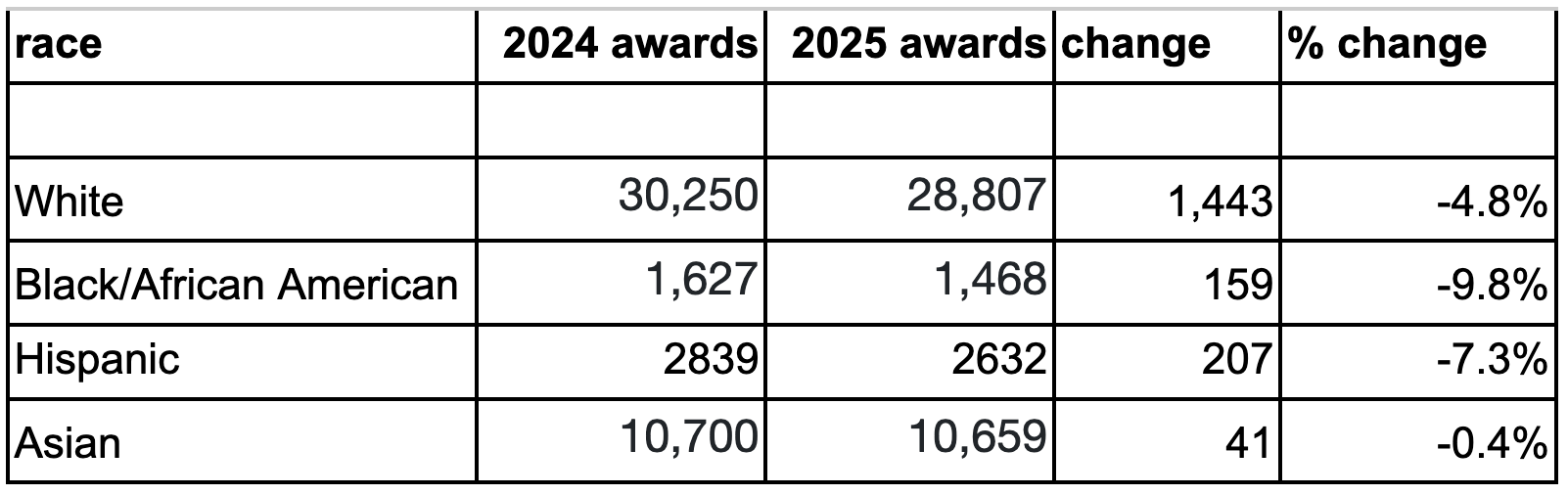
We found that when focusing on investigators by race and ethnicity, disparities in number of research project grant awards appeared, with African-American/Black investigators and Hispanic investigators experiencing larger reductions in numbers of awards in FY25 compared to FY24, -10% and -7% respectively, compared to White (-5%) and Asian (-0.4%) investigators. Research consistently shows that diverse teams drive better science, thus, we expect these increased inequities could hamper the development and implementation of novel strategies to prevent and treat diseases that affect Americans.
Prior analyses have also revealed that African-American/Black scientists tend to focus more frequently on health disparities and patient-focused interventions or topics which have been targeted by the Administration. Moreover, research topics that Black scientists are more likely to pursue tend to be funded by NIMHD, NINR, NIAID, NIDCR, and NICHD, which collectively averaged an outsized drop in success rates for R01s and research project grants in FY25 at -34%.
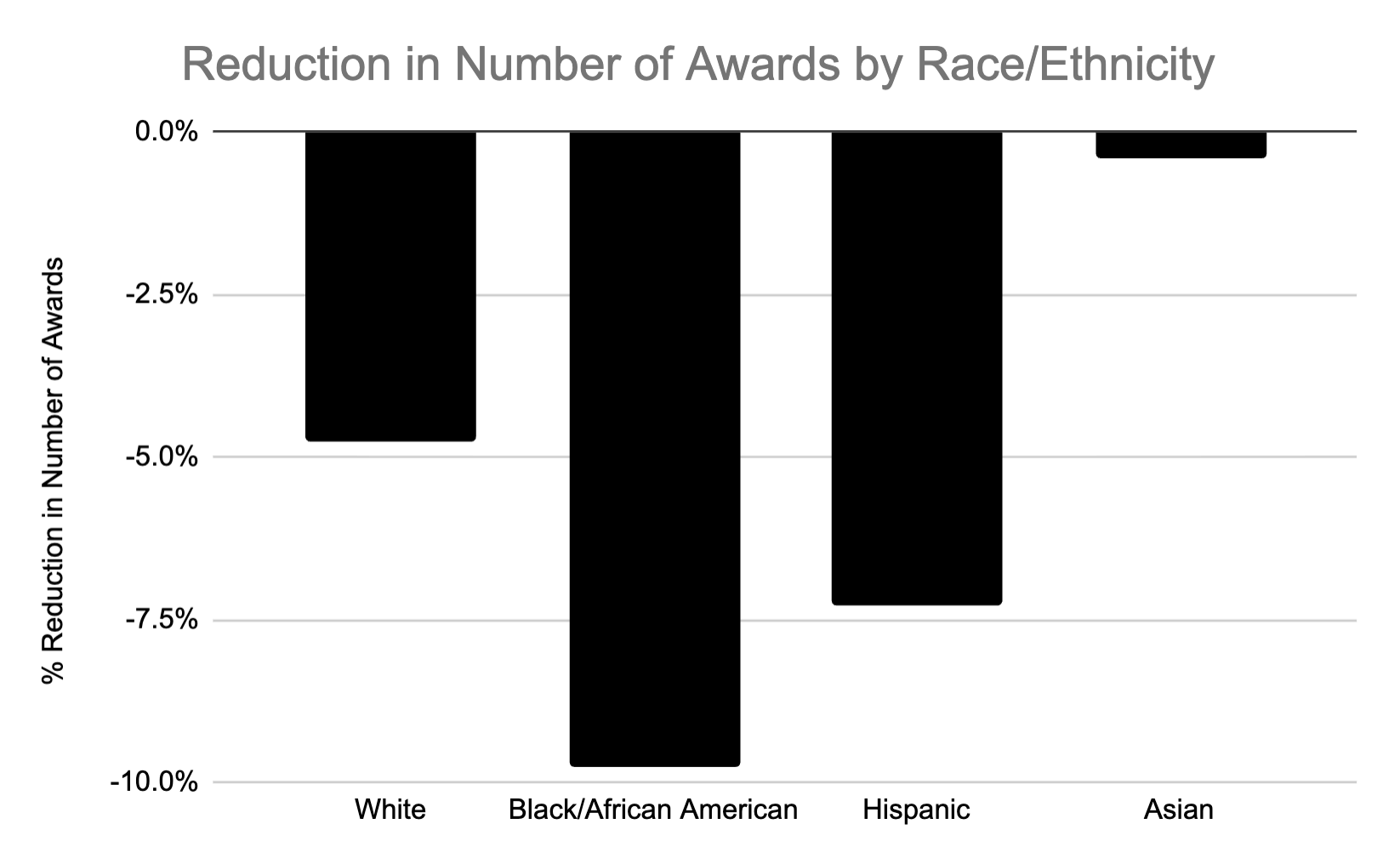
Image and analysis by 27 UNIHTED. Edited: Original copy of image included mislabeled axis (% Reduction of Success Rate instead of % Reduction in Number of Awards)
The harm that this Administration has inflicted on our next generation as well as investigators from minority groups, many of whom are part of the next generation, is unconscionable and cruel. It will also leave the US at a distinct disadvantage in competing with other countries around the globe for scientific advancement and jeopardize the U.S.’ ability to address the pressing epidemics of chronic diseases and conditions that are shortening lifespans in the United States, a supposed priority of the NIH Director. Although these challenges have been a setback for NIH-funded research, NIH staff remain determined to work with our research communities through the end of this fiscal year and into the next. We will weather this storm and continue to advance research, because our our work is imperative - we will continue to promote discovery to improve the health of all Americans.
What you can do
Stay informed!
Inform others! Share this post with your colleagues.
Call your members of Congress and urge them to enact protections for NIH, including saying no to Russell Vought’s proposed rule on financial federal assistance.
Help us stop Russell Vought from doing further damage (or at least pull him out from where he’s hiding in the shadows and give him the infamy he deserves!) by urging Congress to impeach, convict and remove him from office.
Need more ideas? Check out our Advocacy Menu.
1Source: personal communications
2Data accessed on 7/19/2026
*We ask that original content be attributed to the noted author with an accompanying link to the source
Appendix
Raw data that from Reduction in Number of Awards by Race/Ethnicity acquired from NIH Data Book
Comments
Nothing yet. Say the first thing.
Sign in to join the conversation.