

This was the week the world came to our doorstep. A World Cup turned North America into one enormous stadium, and TSMC bet another 100 billion dollars that the future of the chip gets built in the Arizona desert. From my cross-border point of view, the center of gravity has never felt closer to home. But greatness and grief arrived together. As ICE agents killed two more men in botched operations, I was reminded that everything we build, in trade, in technology, in sport, rests on one fragile foundation. Trust. This week, we look at who is earning it and who is breaking it.
First time reading? Join thousands of intellectually curious readers. Sign up here.
Phoenix just became the epicenter of advanced American chipmaking. On Thursday, TSMC announced an additional $100 billion investment, lifting its total Phoenix, AZ commitment to $265 billion, the largest single foreign direct investment in United States history. That is roughly 10 fabs, two advanced packaging plants, and an R&D center. Soon, close to 30 percent of TSMC’s most advanced capacity will sit in the Arizona desert.
Here is the truth behind the headline: a fab is not just a building. TSMC Phoenix employs about 3,500 people today, and you cannot run 10 of them on local hiring alone. This scale demands housing, roads, water, schools, and the supplier businesses that ring every plant. Building those cross border businesses is exactly the work we do at Intermestic Partners.
The workforce answer is next door. We keep looking to Vietnam and India when Mexico graduates thousands of qualified engineers every year from Guadalajara, Querétaro, Monterrey, and Puebla. Build that pipeline. Our work with AccesoLatino and the Carlos Slim Foundation’s Capacítate para el Empleo is the human capital engine that can feed it.
The mechanism already exists. TN visas under the USMCA, the old NAFTA professional category, let Mexican engineers work here legally. Picture a corridor where talent moves between Phoenix and Guadalajara, strengthening both sides. That is what unlocking the full potential of North American leadership looks like in practice.
As a fronterizo, I see the deeper win. When engineers build careers on both sides of the line, Mexico grows its own technology base, and talent that once had to leave home for opportunity increasingly finds it at home. That is how you answer economic migration: with work, not walls.
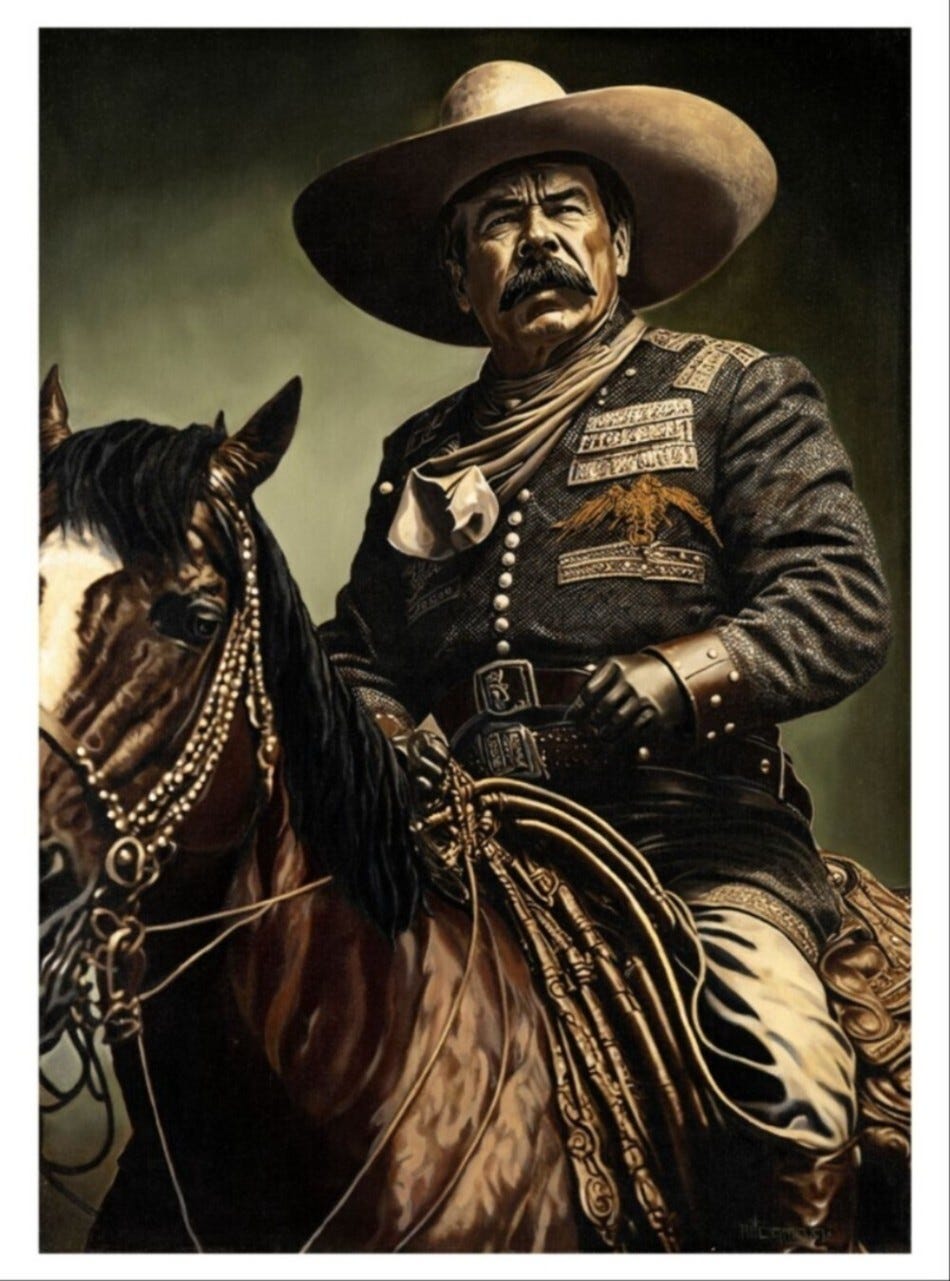
Pancho Villa - El Centauro del Norte
Born José Doroteo Arango Arámbula in Durango, Mexico, Villa commanded the largest military force of the Mexican Revolution, governed the border as if boundaries were suggestions, and remains the only Mexican commander to launch a military invasion of the United States.
Professional poster prints available now.
Shop now $25
I spent years building trust between law enforcement and the communities we served, at the border and as mayor of Nogales, because I learned one truth early: people who trust the badge report crime, and people who fear it stay silent. That trust is now unraveling.
In two weeks, federal ICE agents have killed two more men. In Texas, Lorenzo Salgado Araujo. In Maine, Johan Sebastián Durán Guerrero, 25, who advocates say was authorized to work here and carried a Social Security number. Senator Angus King confirmed Guerrero was not the person ICE was looking for. He died in his car, near his home.
Then look at the officer. According to family members and public records, the agent who fired carried a documented history of violence and serious mental health struggles, and relatives say he should never have been given a badge. He was a recent hire. That is no accident. Amid its hiring surge, ICE lowered standards, offered signing bonuses, and cut training to roughly 47 days. You cannot do the precise, investigative work that actually removes dangerous criminals with officers screened and trained this way.
Here is what should trouble everyone, citizen or not. When federal agents kill Americans and legal workers, this stops being an immigration debate and becomes a rule of law crisis.
Know your rights. Keep your hands visible. You have the right to remain silent. You do not have to open your door without a judicial warrant signed by a judge. Stay calm, stay safe, come home.
Fix the screening. Restore the training. Rebuild the trust.
Every company I advise that works across the border moves sensitive data between the United States and Latin America every single day. Customer records, payroll, trade secrets, wire instructions. That data is now under constant attack, and most leaders do not realize how exposed they are.
The numbers are sobering. Latin America is now the most heavily targeted region on earth for cyberattacks. Organizations there absorb around 3,100 threats every week, roughly double the United States average. Mexico ranks among the top targets in the hemisphere. And only 14 percent of companies in the region feel confident their own teams can handle it.
The weapon of choice is phishing, criminals posing as your bank, an invoice, a payment notice, even a government agency, waiting for one employee to click. Artificial intelligence is making these traps sharper, with cloned voices and near perfect fakes.
So I did something about it. I recently sat down with a team of ethical hackers, the white hat specialists who break into systems on purpose to find the holes before criminals do, including the social engineering tricks that fool people rather than machines. We are folding that capability into Intermestic Partners.
Here is my thinking as a strategist. For any company operating on both sides of the border, protecting data and privacy is no longer an IT problem. It is a condition of doing business and a matter of trust with every customer you serve.
The threat is real. The defense has to be too. Let us build it together.
Email me to learn more.
This week, United States and Mexican negotiators sit down in Mexico City for the third round of talks on the future of the USMCA. The headlines will focus on steel, autos, and agriculture. The real question for the next decade sits underneath all of it: can investors trust Mexican courts?
I have spent my career telling global companies that North America is where they should build. It is a harder case to make today. Mexico’s judicial overhaul replaced appointed judges with elected ones, many with little experience on the bench, chosen in low turnout elections and, critics warn, exposed to political and even criminal pressure. As a former official, I understand the appeal of accountability. As a policy advisor, I see the danger. No company moves billions of dollars into a country where a contract dispute could land before a judge who answers to the wrong people.
Here is the fix that belongs on the table. Cross border deals can be written to resolve disputes through international arbitration, seated in a neutral place such as Houston or New York, with awards enforced under treaty rather than in a local courtroom. The USMCA review is the moment to strengthen these protections, restoring the investor safeguards the current deal watered down.
Trade is not just tariffs. It is confidence. Mexico did extraordinary work positioning itself as Washington’s preferred partner. Now it must protect the one thing capital cannot live without: a rule of law it can rely on.
That is how we unlock the full potential of North American leadership.
I grew up in Nogales with a ball at my feet and a border at my back, dreaming that the whole world might one day watch this game in my corner of it. This month, it did. The 2026 World Cup turned North America into one enormous stadium, and this weekend it crowned a champion in New Jersey.
This weekend Spain lifted the trophy, its first since 2010. It was Lionel Messi against Lamine Yamal, a teenager who once posed as a baby beside the legend, a passing of the torch nearly twenty years in the making.
The scale was staggering. FIFA and the World Trade Organization estimate the tournament generated around 80 billion dollars in global economic output, with the final alone drawing more than a million visitors to the New York region.
Here is the part that stings and inspires at once. All three host nations, Mexico, the United States, and Canada, were gone by the round of 16. Yet the tournament still lived in our streets, our restaurants, our border crossings, our kids.
That is the real trophy. Not the one lifted this weekend, but the millions of children on both sides of the line who just watched greatness up close and thought, maybe me.
We will not host again soon. The road runs through Spain, Portugal, and Morocco in 2030, then Saudi Arabia in 2034. A World Cup does not return to American soil until 2038 at the earliest.
So the work starts now. Build the fields. Fund the programs. The next Messi might be lacing up in Nogales.
Thanks for reading Power Courier by Marco Lopez! Subscribe for free to receive new posts and support my work.
Comments
Nothing yet. Say the first thing.
Sign in to join the conversation.