

The fastest-growing layer in Discover : creatorcontent grew 7.8x in 3 months. neoncluster grew 18x. Together, the three-stage video cascade (creatorcontent → freshvideos → neoncluster) creates a YouTube amplification machine that reaches 13% of devices. This is your story more than anyone’s: the cascade is an EN phenomenon. Here’s what’s happening.
The three pipelines
creatorcontent: the social intake
The entry point for social content into Discover. YouTube dominates at 72% of the pipeline: video creators, channels, clips. x.com comes second at 23%: posts and threads that become Discover cards.
Reach: 6.7%. Growth: 7.8x in 3 months (48K → 371K hits, Dec → Feb). Median age: 1.9h (near real-time).
The FR picture is an inversion: x.com dominates at 72%, YouTube is under 5%. Same pipeline, opposite sources. And FR’s growth is even more explosive at 33x, from near-zero to a major pipeline in one quarter.
freshvideos: the amplifier
The intermediate stage. Video content from creatorcontent gets amplified here, with a delay of +7 hours.
In EN: 94% video, 94% YouTube. A near-pure video pipeline. Reach: 7.1%. Growth: 7.2x in 3 months.
The domains beyond YouTube are telling: ESPN, CNN, Formula 1, Olympics, TikTok; sports and news video from premium sources get filtered through here.
In FR, freshvideos is only 53% video: TF1 and L’Equipe bring 47% articles. The cascade doesn’t work the same way in French.
neoncluster: the broadcast endpoint
100% YouTube. 100% English. In France: 20 hits in February (the pipeline effectively doesn’t exist).
In EN: 13% reach, a broadcast-level pipeline, higher than content (8.8%). It’s the third stage of the cascade, arriving +15h after freshvideos, +23h after creatorcontent. Hits per URL: 8.8: each video that makes it here gets seen across many devices.
The content: news-heavy YouTube channels. International news, celebrity/entertainment, politics. This isn’t gaming or vlogs, it’s YouTube as a news distribution network.
Growth: 18.2x in 3 months (24K → 431K hits).
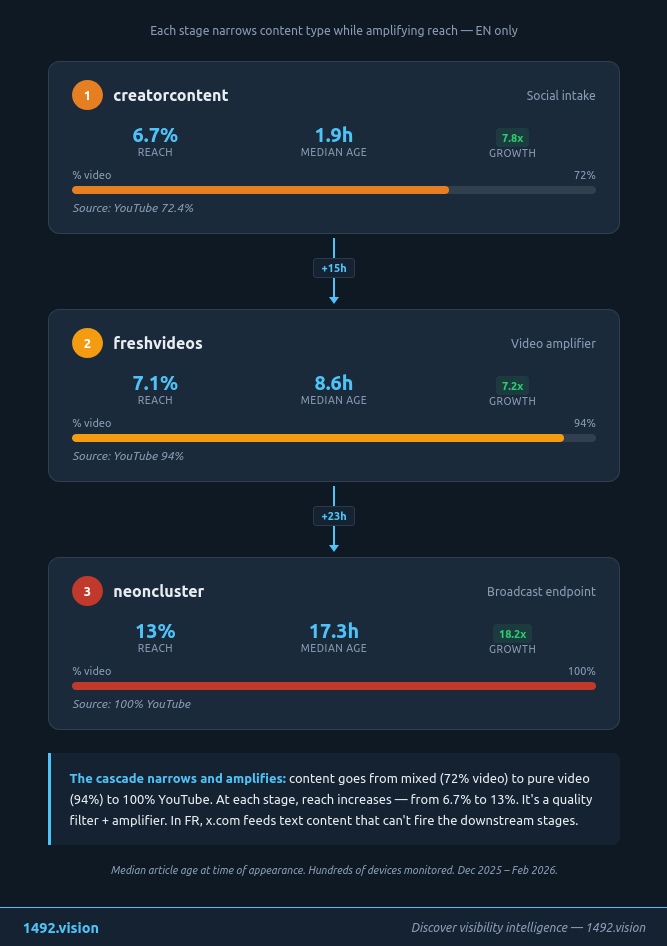
The three-stage video cascade: creatorcontent (intake, 1.9h) → freshvideos (amplifier, 8.6h) → neoncluster (broadcast, 17.3h, 13% reach). At each stage, content purifies and reach increases.
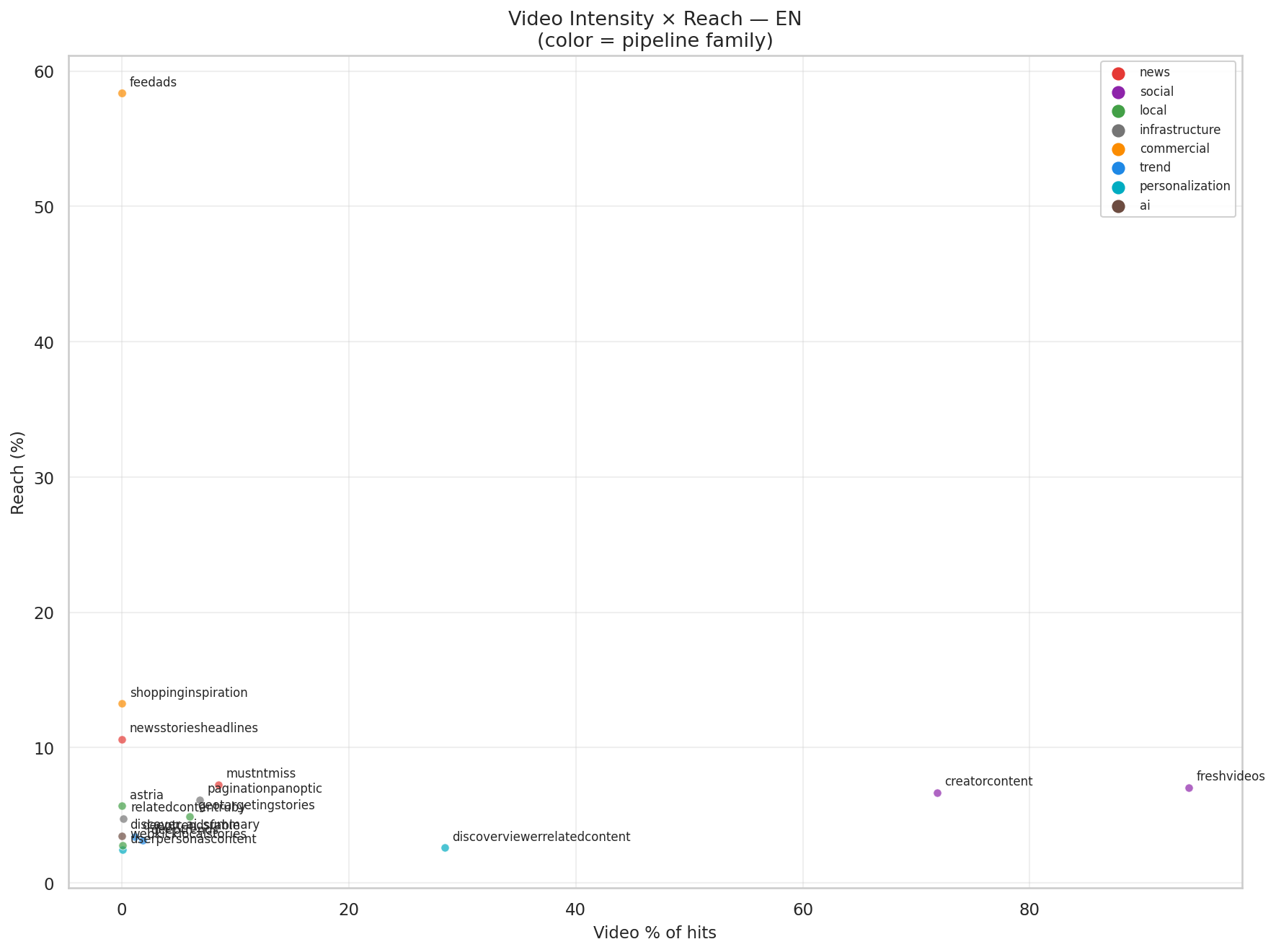
Video percentage (X) vs reach (Y) for every EN pipeline. neoncluster at 100% video / 13% reach. freshvideos at 94%. creatorcontent mixed. The cascade filters and amplifies.
The cascade mechanics
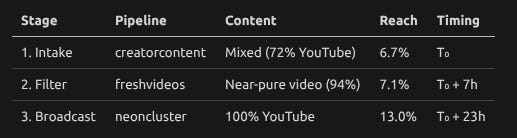
At each stage, the content purifies (from mixed to 100% video) and reach increases (from 6.7% to 13%). This is a quality filter + amplifier, structurally similar to deeptrendsfable → deeptrends, but for video content.
Most social content that enters creatorcontent doesn’t make it through. Only 16% of creatorcontent URLs appear in freshvideos. And neoncluster is even more selective: 74,000 URLs from 130,000 in creatorcontent. The cascade is a funnel: wide intake, narrow broadcast.
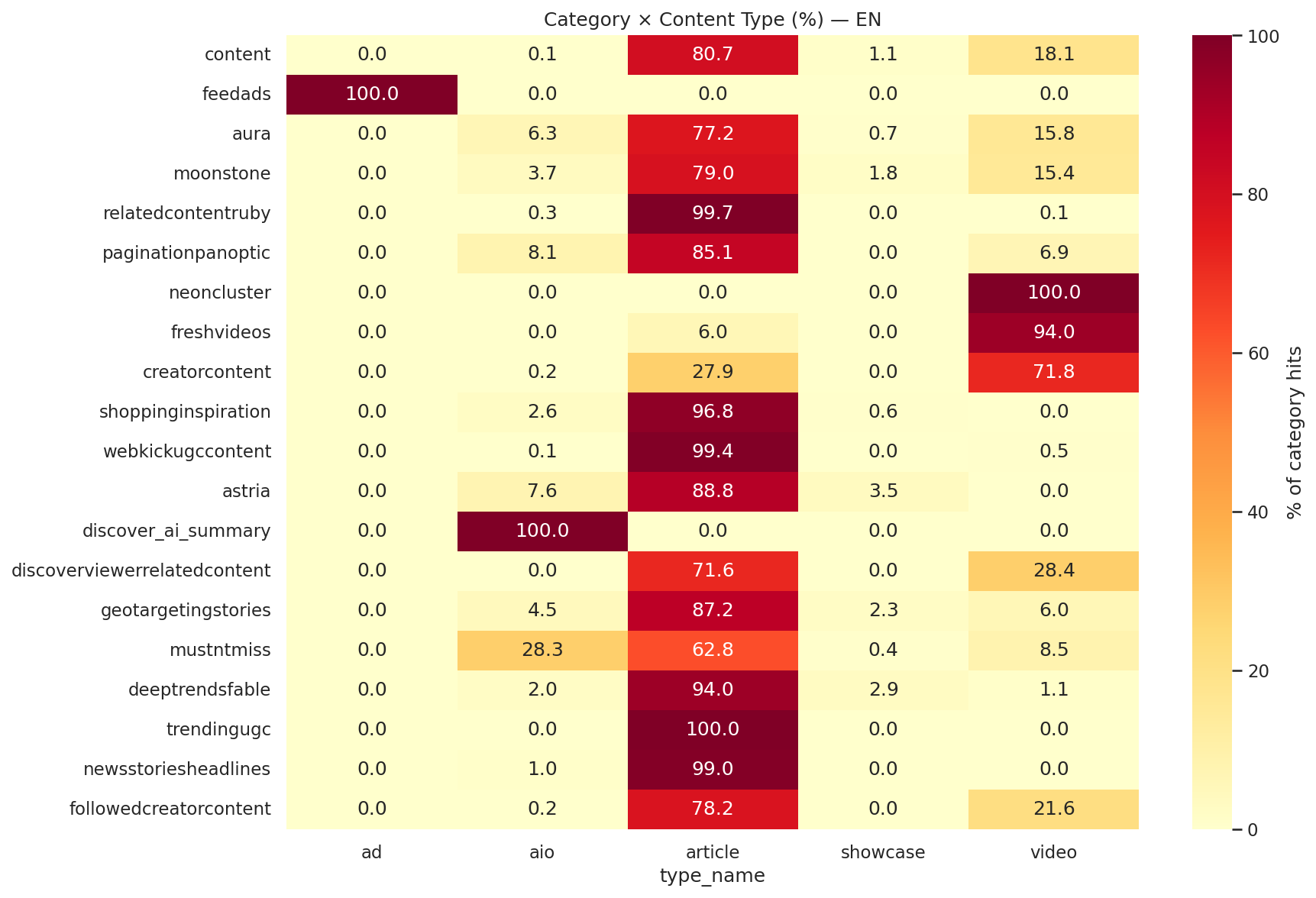
Article/video/ad breakdown by pipeline. freshvideos EN is 94% video. neoncluster is 100%. The cascade progressively filters out non-video content.
x.com vs YouTube: the inversion
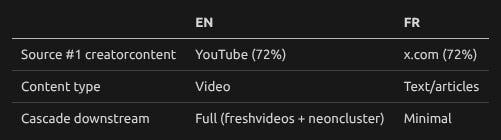
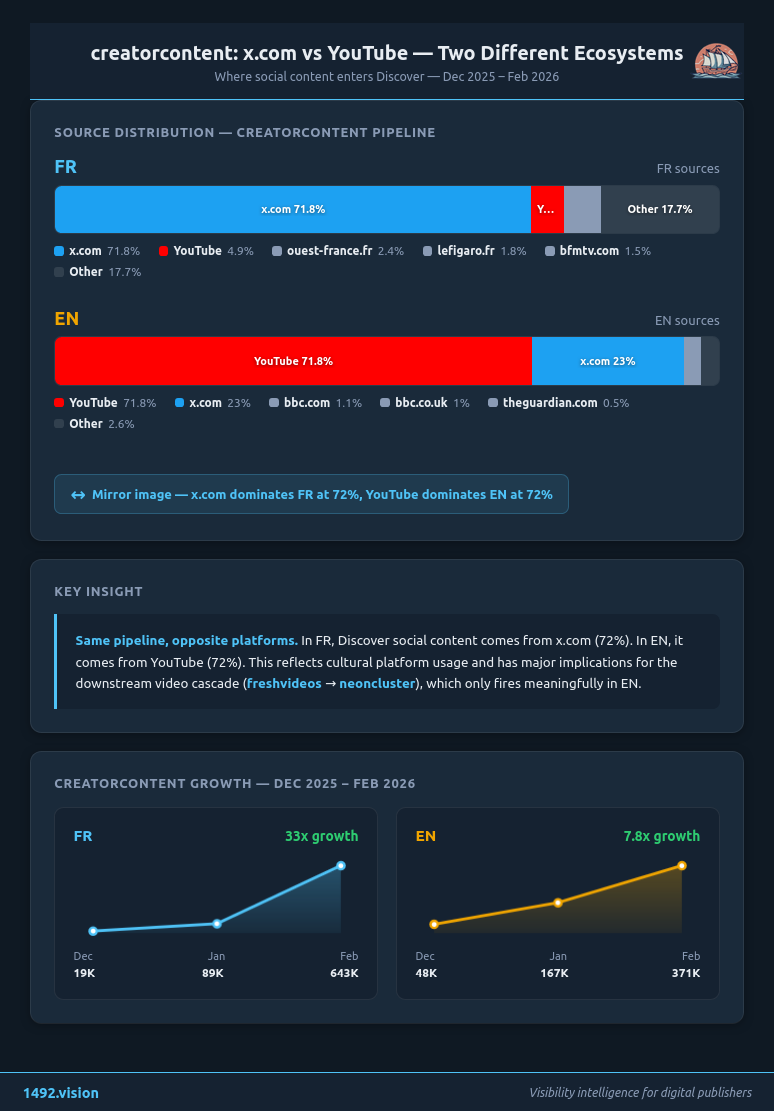
creatorcontent EN = 72% YouTube. creatorcontent FR = 72% x.com. Same pipeline, opposite sources.
In EN, YouTube is the pipeline to Discover: channels feed a three-stage amplification cascade that ends at 13% reach. In FR, x.com is the content discovery source: tweets and threads become Discover cards, but the downstream video stages barely fire because the content isn’t video.
The inversion reflects platform culture: YouTube is the dominant creator/news platform in anglophone markets. x.com holds outsized influence in francophone media and politics. Discover mirrors this, the same pipeline tuned to different ecosystems.
For EN publishers, x.com still matters: it accounts for 23% of creatorcontent, and your posts can become Discover cards. But the amplification path (freshvideos → neoncluster) is video-only.
The growth: an explosion
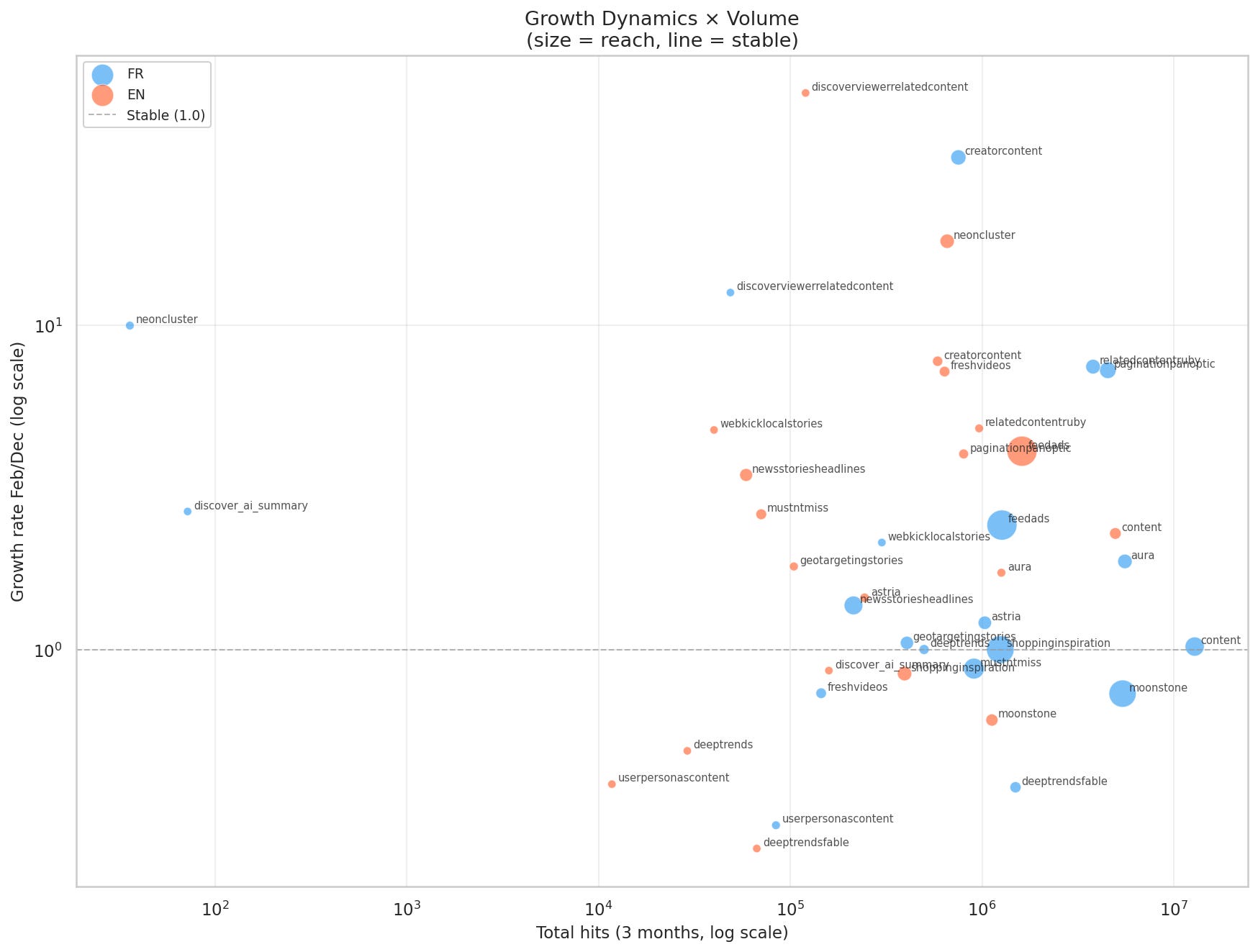
Growth (Y, log) vs volume (X, log). Above the line = growth. neoncluster EN at 18x and creatorcontent at 7.8x are clear outliers.
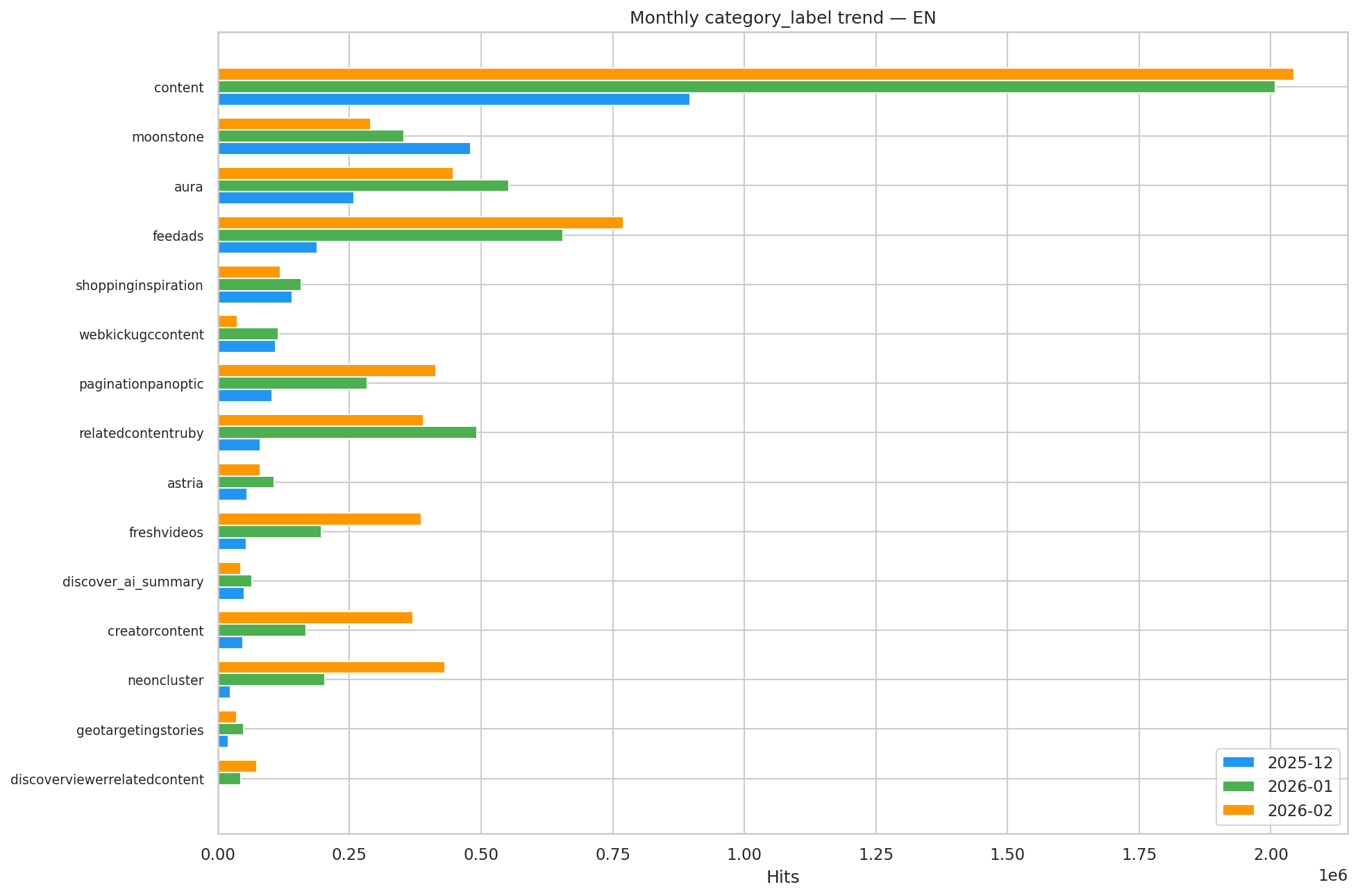
Grouped bars Dec/Jan/Feb. The explosion of neoncluster from near-zero to a broadcast pipeline in 3 months is visible.
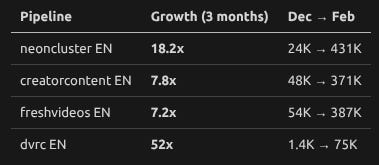
This is not gradual growth. These pipelines were launched or dramatically expanded in late 2025. Google is aggressively building out the social/video layer of Discover, and the EN market is where the infrastructure is most complete.
The trajectory matters more than the snapshot: at 18x growth in 3 months, neoncluster went from negligible to the third-largest EN pipeline. If these growth curves continue even partially, the social/video family will rival the core editorial pipelines by mid-2026.
What this changes
YouTube is a Discover distribution channel. If you produce video, you have access to a three-stage amplification cascade that ends at 13% reach, higher than the general content pipeline. Optimizing for YouTube is optimizing for Discover.
x.com still feeds Discover: 23% of creatorcontent EN comes from x.com. Your posts can become Discover cards, even without video. But there’s no amplification path for text content.
The cascade rewards consistency. neoncluster’s 8.8 hits/URL means each video that makes it to broadcast gets seen many times. The pipeline favors channels that produce regularly, not one-off viral moments.
Watch the growth. These numbers are from February 2026. The trajectory is vertical. If you’re not factoring social pipelines into your Discover strategy, you’re ignoring the fastest-growing part of the ecosystem.
Full data: 1492.vision | Interactive: explorer
Next newsletter: what Discover does NOT show: the anti-patterns and structural ceilings every publisher should know.
Thanks for reading 1492.Vision - English Version! Subscribe for free to receive new posts and support my work.
Data: 42 million Discover cards, Dec 2025 – Feb 2026. Analysis: 1492.vision.
Comments
Nothing yet. Say the first thing.
Sign in to join the conversation.