
We’ve shown what each pipeline selects. But what pipelines avoid is equally revealing. Every pipeline has anti-patterns: content types it systematically excludes. These exclusions reveal the design logic and, for publishers, they flag the strategies that hit a structural ceiling.
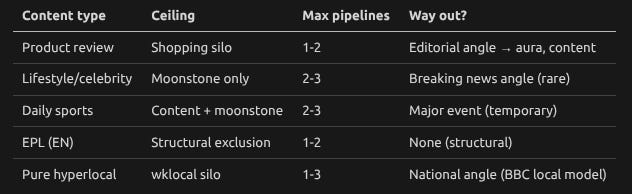
Terms related to the Premier League (Arsenal, Liverpool, Chelsea, Premier League, football) are systematically under-represented across 7+ EN pipelines. This isn’t one pipeline: it’s system-wide.
Sports that are not affected: NFL, NBA, Olympics, rugby, cricket, Formula 1. The exclusion is specific to the EPL.
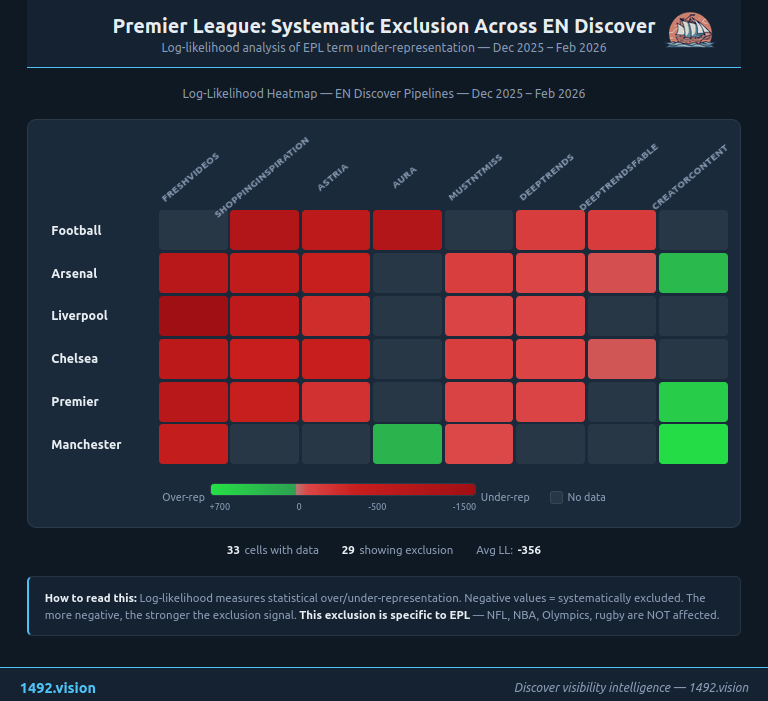
Under-representation of EPL terms across 7+ EN pipelines. Specific to the Premier League: NFL, NBA, F1 are unaffected.
The most likely hypothesis: Premier League broadcasting rights and licensing constraints create restrictions that propagate through the selection system. But this is an observation, not a confirmed explanation.
For EN sports publishers: sport works in content and moonstone. But EPL is a blind spot in the diversification, trends, and local pipelines. This exclusion does not exist in the FR market, where football terms carry no such suppression.
shoppinginspiration has the highest editorial reach in EN at 13.1%. But it’s structurally isolated, though less so than in FR.
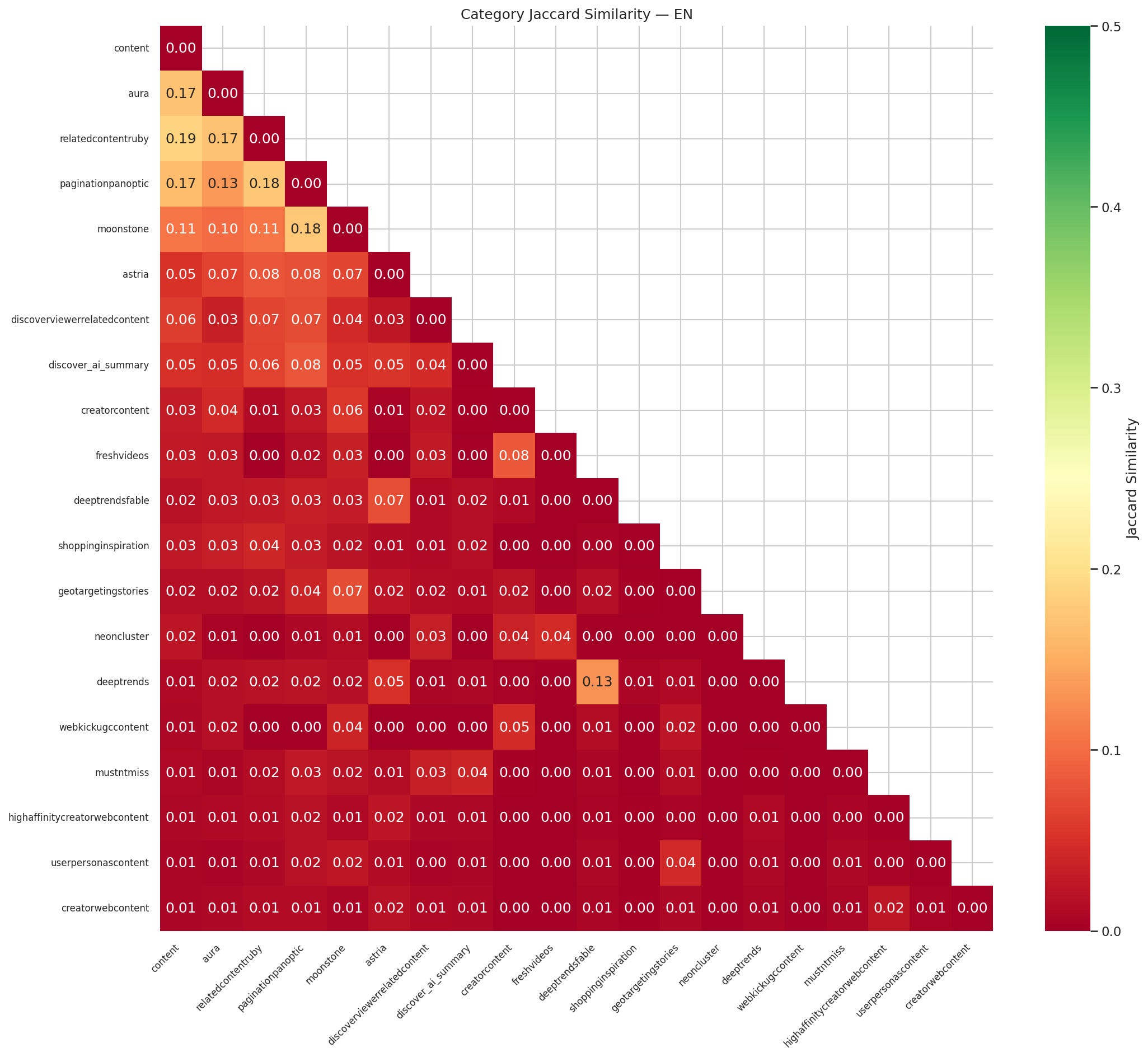
The shopping row shows low Jaccard scores with other pipelines: shared URLs are scarce. Similar isolation for webkicklocalstories and newsstoriesheadlines. Meanwhile, content-aura, content-relatedcontentruby form a warm cluster of overlapping pipelines.
49% of EN shopping URLs also appear in content, and 30% reach aura or relatedcontentruby. This is more permeable than in FR, where shopping is a near-total silo. But the pattern holds: pure product content doesn’t cross to moonstone (only 10%), mustntmiss, or deeptrendsfable.
Why: shopping serves a fundamentally different intent (purchasing) than editorial pipelines (information/entertainment). Google keeps them separate.
For publishers: the EN shopping silo is softer, your product content crosses boundaries more naturally. But a hard ceiling remains. To break it further: add editorial substance (a trend angle, a market analysis). Aura over-represents tech/science at 2x: the bridge exists.
Celebrity news, horoscopes, wellness, entertainment: moonstone loves them. Pure engagement content. People.com reaches 14 pipelines but its volume is heavily concentrated in moonstone and content.
But the diversification pipelines ignore lifestyle. mustntmiss never selects it. deeptrendsfable rarely. aura doesn’t.
Multi-labeling ceiling: 2-3 pipelines maximum for pure lifestyle content. This is a structural ceiling, not an optimization problem. Lifestyle drives engagement but not editorial importance, trending topics, or local relevance: the signals that open other pipelines.
For publishers: lifestyle works well in moonstone, but don’t expect it to cascade further. It’s a single-pipeline strategy. Maximize moonstone reach rather than fighting for the others. Trending cultural events can temporarily unlock deeptrendsfable, but it’s occasional.
discover_ai_summary: 159K hits, 67K URLs, 3.5% reach in EN. This is a real pipeline, not an experiment.
The sources form an elite club: Reuters (7.8%), NYT (4.7%), CNBC (4.6%), Yahoo Finance (4.0%), Guardian (3.4%), Bloomberg (3.2%), ESPN, BBC, CNN, FT. Finance, international news, and space are over-represented.
mustntmiss EN carries 29% AIO content. paginationpanoptic EN: 7.8% AIO. The AI summary layer is spreading across the pipeline ecosystem, not staying contained.
In France: almost zero. The AIO rollout is market-by-market, not simultaneous. French market is an outlier whne it comes to the AIO (discover like serp)
For EN publishers: AIO is already here and growing. Quality press with structured, factual content is selected. This is a measurable competitive advantage: if you’re in the club (Reuters, NYT, FT), you get an additional pipeline. If you’re not, it’s a gap to close.
For publishers watching from other markets: AIO readiness isn’t a Discover factor today. But the EN trajectory suggests it will be.
Sports is ubiquitous in moonstone and content: it’s engagement gold. But it’s under-represented in: aura, astria, webkicklocalstories, deeptrendsfable, deeptrends.
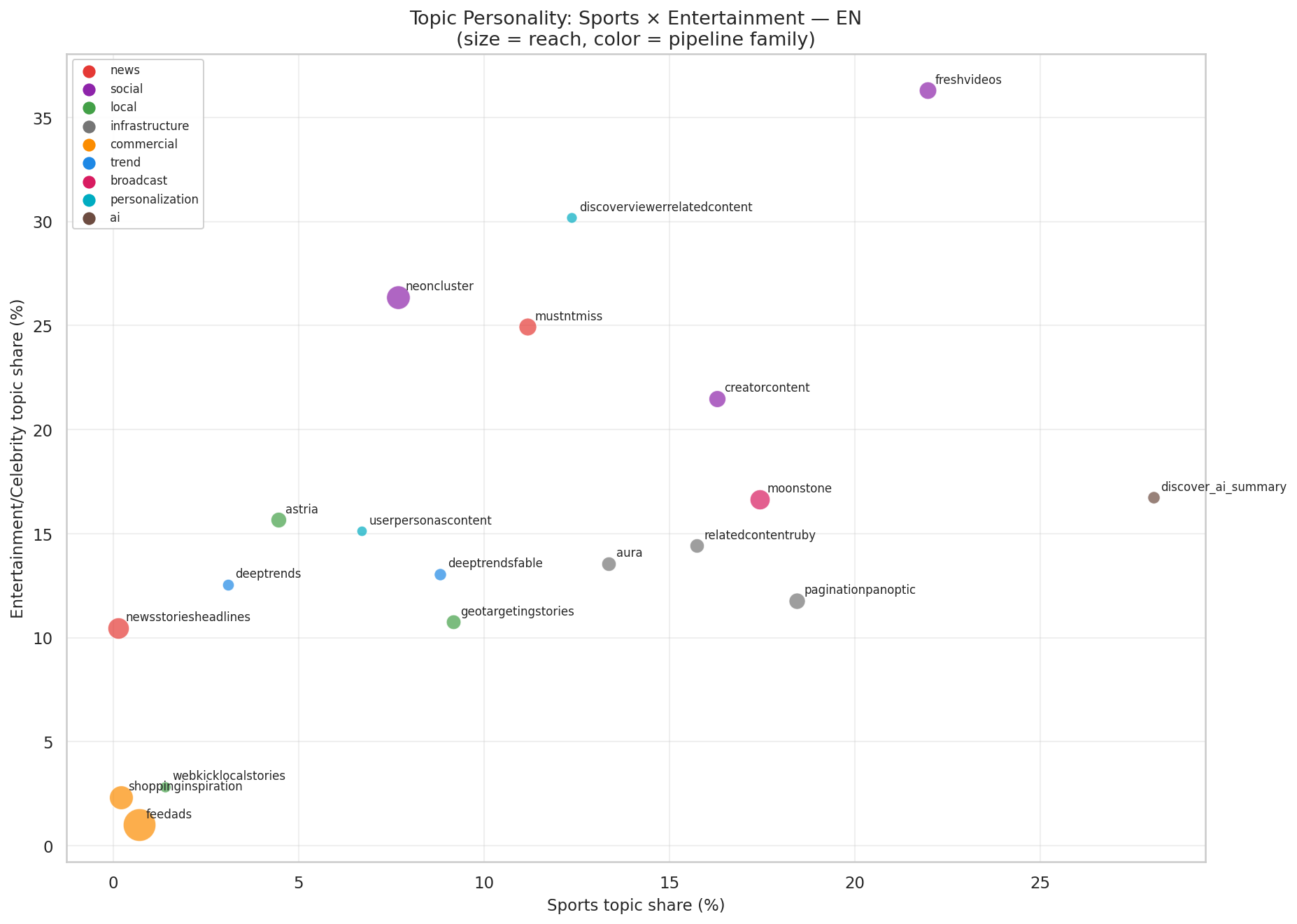
Pipelines positioned by sports share (X) vs entertainment share (Y). Daily sports is confined to the engagement pipelines. Diversification pipelines avoid it.
ESPN, despite massive volume, has a concentrated footprint: 14 pipelines, but the bulk is in content, moonstone, and freshvideos. Little presence in trends or diversification. Sky Sports follows the same pattern.
Major sporting events (Olympics, Super Bowl, World Cup finals) break this rule: they activate deeptrendsfable, mustntmiss, newsstoriesheadlines. But daily sports coverage doesn’t.
In EN, the EPL exclusion adds a layer: even event-level football is suppressed. Sports has a structural ceiling similar to lifestyle (high engagement, narrow pipeline distribution).
Full data: 1492.vision | Interactive: explorer
Next newsletter: the grand finale: recommendations by publisher profile. Your Discover action plan, pipeline by pipeline.
Data: 42 million Discover cards, Dec 2025 – Feb 2026. Analysis: 1492.vision.
No posts
Comments
Nothing yet. Say the first thing.
Sign in to join the conversation.