
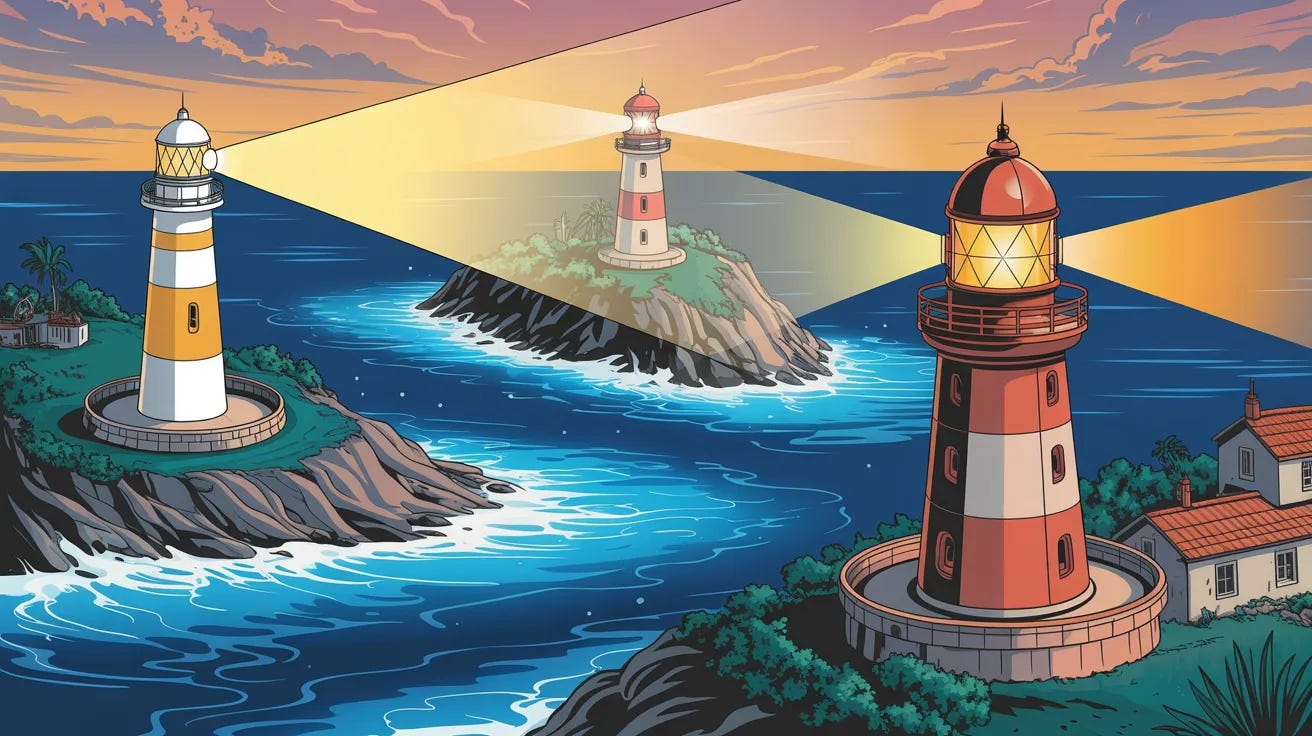
Beyond the core editorial pipelines, Discover has pipelines designed for specific content types. Three stand out: shoppinginspiration (product content that lives for days), the deeptrends two-stage trend detector (a sequential filter that separates signal from noise), and webkicklocalstories (hyperlocal content invisible to the rest of the system). Each has its own rules.
13.1% reach — the highest editorial pipeline in EN after moonstone. And a median lifespan of 2.5 days — 5x longer than a news article in content (0.48 day). A product review published Monday is still visible Wednesday in Discover.
This is faster than in FR markets, where shopping content lives 3.7 days with 19.7% reach. The EN shopping window is shorter but still the longest-lived editorial pipeline by far.
The content selected: reviews, comparisons, benchmarks, product analysis. The EN pipeline is heavily tech-oriented — TechRadar (6.2% of pipeline), What Hi-Fi, Digital Camera World, Tom’s Hardware, Tom’s Guide, T3. Pure tech review publishers dominate.
In the FR market, shopping is a structural silo — very low co-occurrence with other pipelines. A Samsung review stays in shopping and doesn’t cross to moonstone or deeptrendsfable.
The EN picture is different. 49% of shopping URLs also appear in content (vs 67% FR), 30% reach aura, 30% reach relatedcontentruby, and 10% make it to moonstone. EN shopping content crosses pipeline boundaries more freely. Exclusivity is 51% — meaning roughly half of shopping URLs appear only in shopping, compared to a tighter silo in FR.
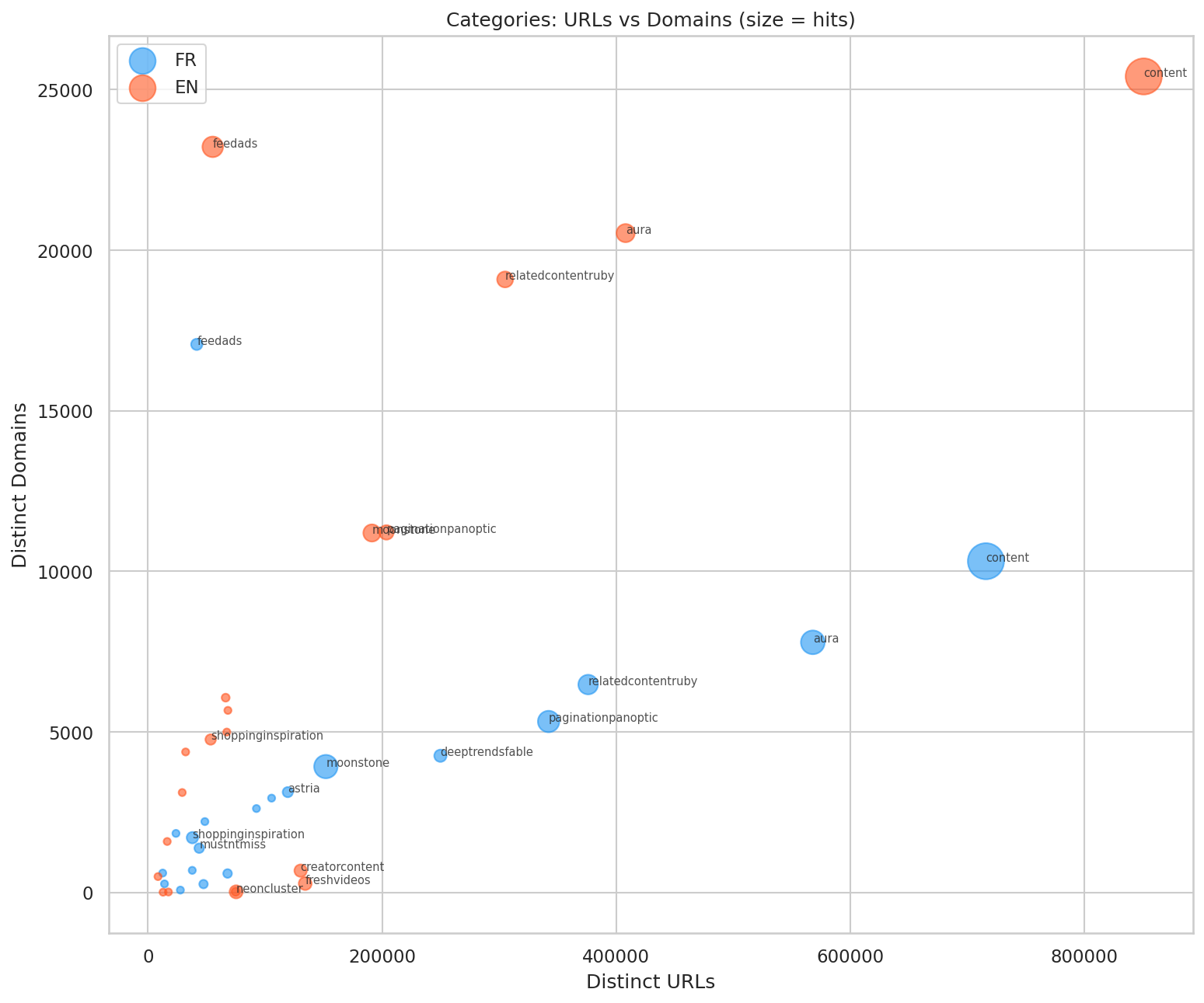
Shopping: many URLs, few domains = concentrated silo. Content: many URLs, many domains = broad distribution.
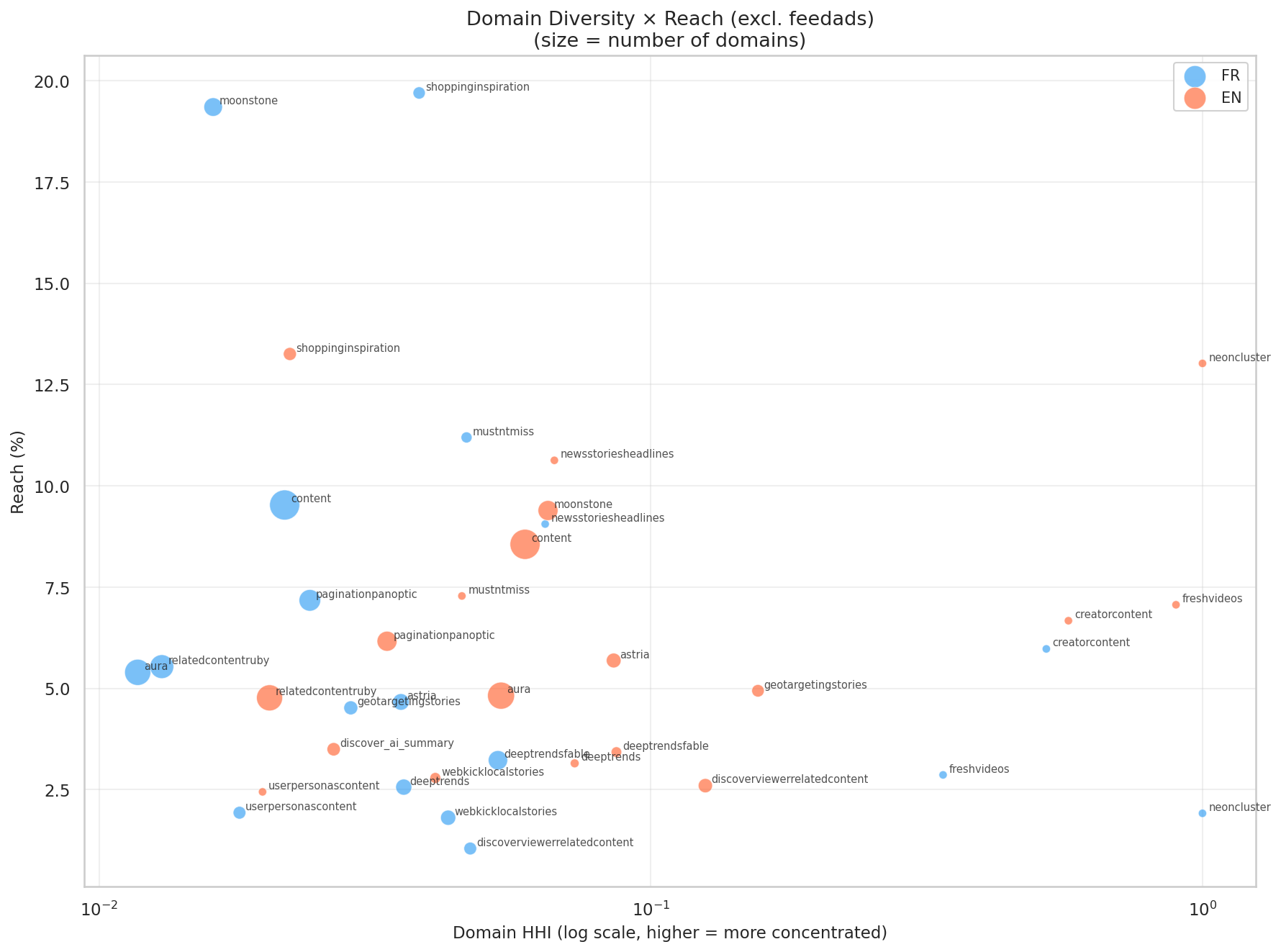
Shopping has a high HHI (concentrated in few domains) vs moonstone (broad distribution). The silo is quantifiable.
For tech/review publishers, the EN opportunity is clearer than in FR: your shopping content already crosses into other pipelines more naturally. Adding an editorial angle (trend analysis, market context) opens aura further (science/tech is 2x over-represented there). Treating a product launch as a news event can open content + deeptrendsfable.
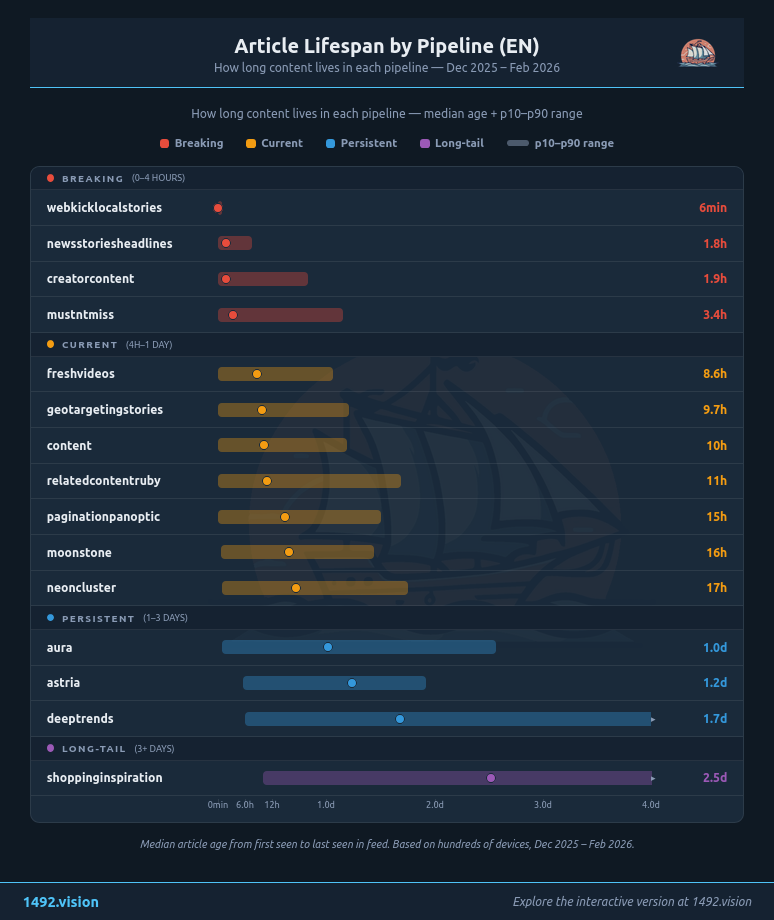
shoppinginspiration: 2.5 days. content: 0.48 day. Product content lives 5x longer than news.
Two pipelines, one sequential mechanism:
deeptrendsfable — the broad scanner. 3.4% reach, median age 14.2h. It scans for trend signals across all topics. Slower than in FR (10.1h) — the EN trend scanner takes longer to pick up signals, possibly due to the broader, more fragmented EN content landscape.
deeptrends — the persistence stage. 3.1% reach, median age 1.7 days. 37% of URLs are shared with deeptrendsfable. Passage rate: 47% — nearly half of deeptrendsfable URLs make it through to deeptrends.
This is a strikingly different ratio than FR, where only 27% pass through but 64% of deeptrends URLs come from deeptrendsfable. In EN, the two-stage link is weaker (37% vs 64% shared) but the filter is more permissive (47% vs 27% passage rate). The EN trend detector lets more content through but draws from a wider pool of sources beyond deeptrendsfable.
The mechanism is a temporal quality filter: deeptrendsfable detects quickly (day 0), deeptrends persists if the topic holds (day 1-2). Ephemeral trends die at the first stage. Lasting trends pass to the second.
The topic profile is broad — international news, celebrity/entertainment, sports (American football, basketball), space, consumer electronics. No single topic dominates above 2.2x over-representation. The detector scans everything: what’s rising, not what’s popular.
The “FaBLE” name likely refers to user-side long-term interest embeddings. The hypothesis: the pipeline matches emerging trends against each user’s stable interests — which explains the topic diversity.
2.8% reach — low, but not the lowest. And 81% exclusive URLs — content that appears nowhere else in Discover. Even more exclusive than in FR (67%). The EN hyperlocal channel is more isolated from the broader system.
The domains: a mix of US regional and UK local press. Oxford Mail, Dorset Echo, Liverpool Echo, Bournemouth Echo, EDP24 (East Anglia), OregonLive, BBC local. No national title in the top ranks. The title keywords: council, town, school, state — plus US state names (Idaho, Oregon, Colorado, Oklahoma, Montana, Mississippi) and UK county names (Dorset).
The pipeline is ultra-fast in EN: median age 0.1h — near-instant, compared to 4.9h in FR. This suggests the EN version of webkicklocalstories acts as a real-time local breaking pipeline, not just a hyperlocal content filter.
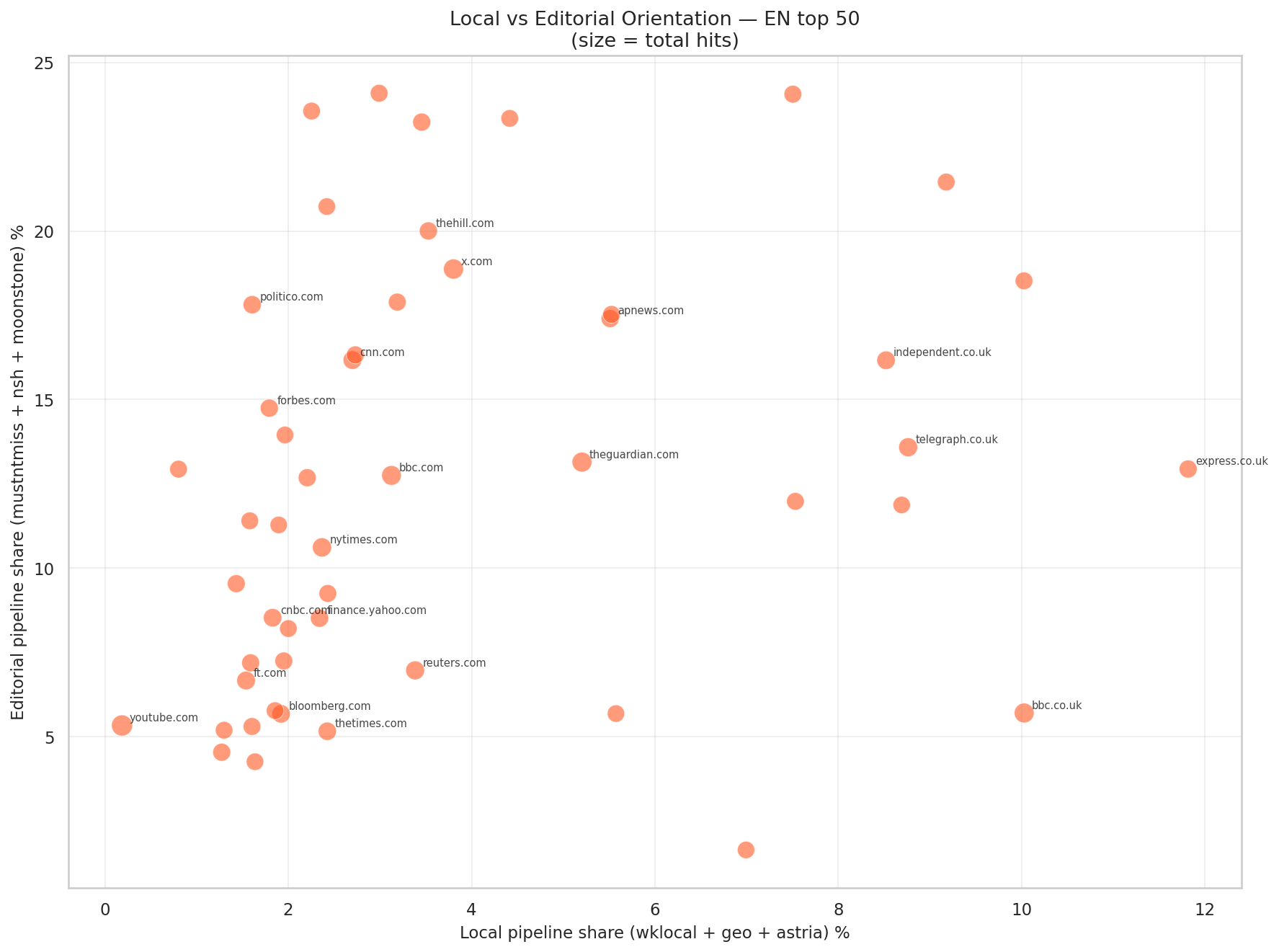
Regional domains cluster upper-right (local + editorial). National titles upper-left (editorial, not local). Tech/video lower-left. Three distinct approaches to local.

A key EN difference: geotargetingstories has only 44% content overlap (vs 72% in FR). The EN geo pipeline is more independent from the general content stream, acting more like a standalone local distribution channel. And its top source is x.com (30% of hits) — social media filtered by location, not just traditional press.
For regional publishers, webkicklocalstories is an existential pipeline. Without it, four-fifths of their Discover-eligible content wouldn’t appear in the feed at all. Its reach is modest — but the content is geographically targeted, and its near-instant pickup makes it a breaking news channel for local stories.
Product publishers: your content lives 5x longer than news — and in EN, it crosses pipeline boundaries more than in FR. Lean into the editorial angle to amplify further.
Trend-sensitive publishers: deeptrendsfable is your early warning system — but it’s slower in EN (14h vs 10h FR). Publish when topics rise. The 47% passage rate to deeptrends means nearly half of trending content earns a second life.
Regional publishers: webkicklocalstories is your dedicated channel with near-instant pickup. 81% of its content exists nowhere else in Discover. Combine local reporting with a national angle to open the other pipelines (BBC local model).
Full data: 1492.vision | Interactive: explorer
Next newsletter: YouTube, X, and the social pipeline explosion — the layer growing fastest in Discover.
Data: 42 million Discover cards, Dec 2025 – Feb 2026. Analysis: 1492.vision.
No posts
Comments
Nothing yet. Say the first thing.
Sign in to join the conversation.