
When you publish an article, it doesn’t appear once in Discover and vanish. If it performs, it travels through multiple pipelines over the following hours and days : each opening a new visibility window, at a different timing, for a partially different audience. Here’s that journey.
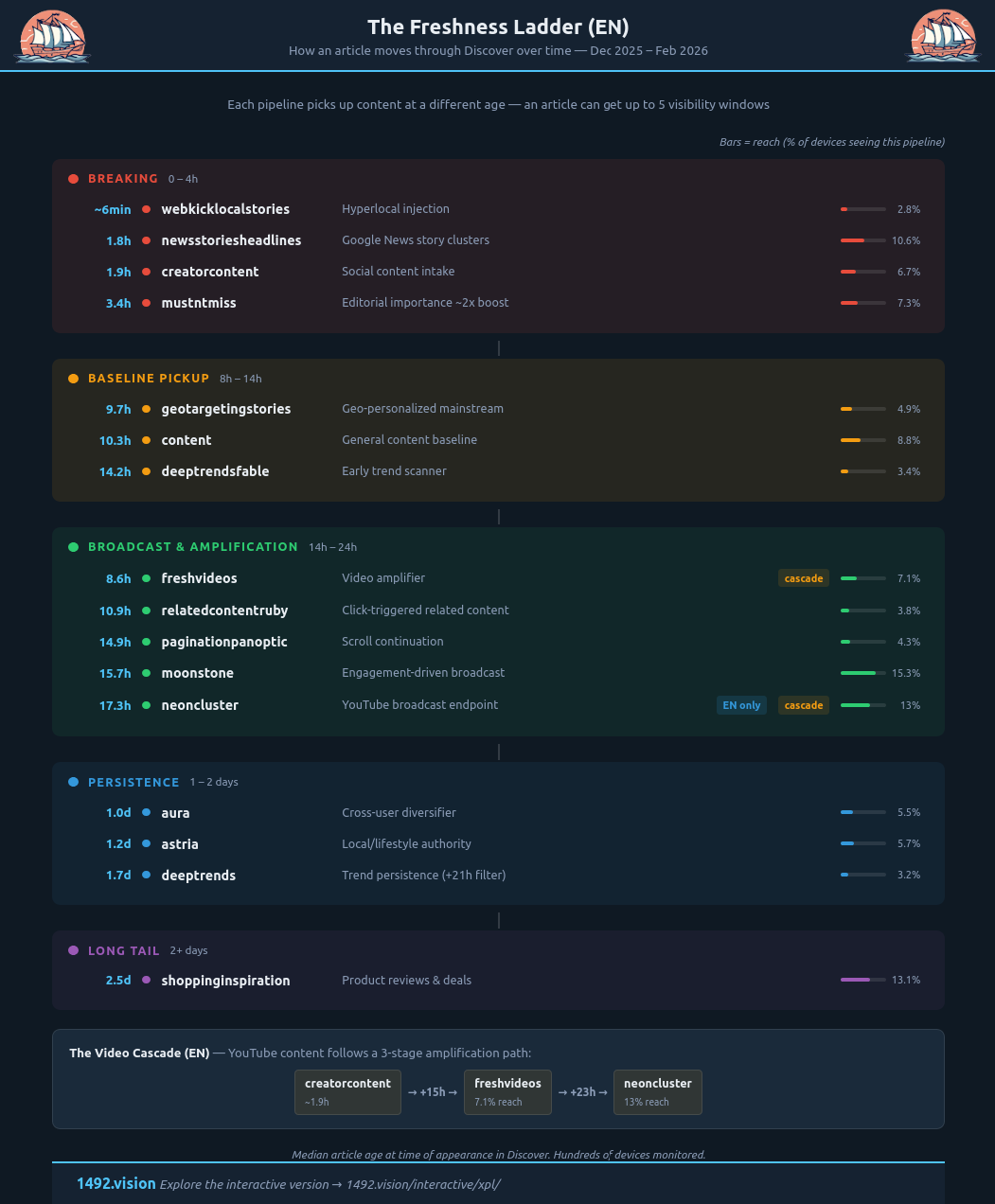
The lifecycle of an article in Discover, based on median ages per pipeline:
0-2h — The breaking window
newsstoriesheadlines (1.8h EN): Google News clusters : if your article is part of a breaking story, it enters here first
creatorcontent (1.9h EN): social intake : if the content circulates on x.com or YouTube. This is EN’s fastest entry point alongside news : far quicker than in FR markets where social intake is slower (7.4h).
2-12h — The baseline pickup
mustntmiss (3.4h EN): editorial importance flag : if the subject is major, ~2x priority boost. Slower than in FR (2.6h) : the EN pipeline treats editorial urgency with a slightly wider evaluation window.
freshvideos (~8.6h): video amplification : arrives much earlier in the EN lifecycle and with 7.1% reach (vs 2.9% FR). Video is a first-class citizen in the EN ecosystem, not an afterthought.
discover_ai_summary (~9.8h): AI-generated overview cards : EN-only pipeline, 3.5% reach. A new pipeline surfacing AI summaries of trending topics. Does not exist in the FR market.
content (~11.6h): the general pipeline : this is where most articles first appear
12-24h — The broadcast and amplification
deeptrendsfable (~14.2h): the trend scanner : later than FR (10.1h), but still within the first day
moonstone (~15.7h): engagement broadcast : if the article triggers engagement signals. 9.4% reach : significantly lower than FR’s 19.3%. The EN engagement broadcast is narrower.
neoncluster (~17.3h): YouTube video clusters : 13% reach, EN’s third-largest pipeline. Near-zero in FR. This is the biggest EN-specific pathway: YouTube content gets its own broadcast pipeline.
relatedcontentruby (~10.9h EN): triggered by user click : a click on a related article → seed→expansion at next refresh
paginationpanoptic (~14.9h): scroll continuation : users who scroll deep
1-3 days — Persistence
aura (1.0 day EN vs 1.5 day FR): long-tail diversifier : the article reaches new segments via cross-user profiles. Faster in EN : diversification kicks in earlier.
astria (1.2 days): local/lifestyle authority
deeptrends (1.7 days): trend persistence : if the subject held, +26h after deeptrendsfable
3-7 days — The long-tail
shoppinginspiration (2.5 days EN vs 3.7 days FR): product reviews live the longest : 13.1% reach. Faster turnover in EN, but still the longest-lived editorial pipeline.
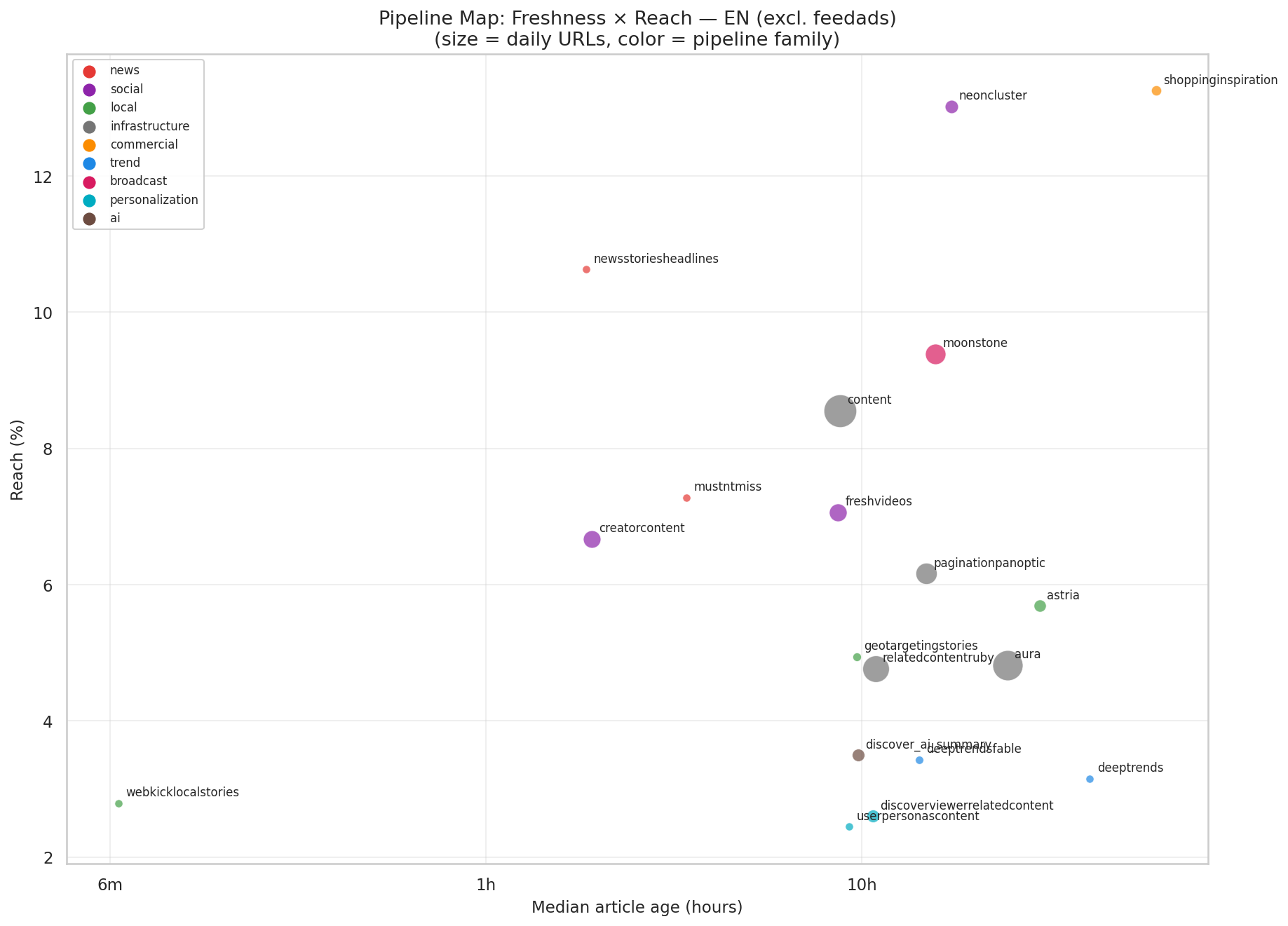
The X-axis (median age, log) IS the freshness ladder. From left (nsh, creatorcontent = breaking) to right (shopping, feedads = persistent). The Y-axis adds reach : neoncluster and shopping are the EN broadcasts.
The lifecycle of an article in Discover: from breaking (0-2h) to long-tail (3-7 days). Each pipeline has its own time window.
It’s not just about timing. Breaking pipelines also place content higher in the feed.
newsstoriesheadlines and relatedcontentruby in positions 2-4 (top of feed). moonstone and shopping in positions 6-8 (deep). Speed AND prominence go together.
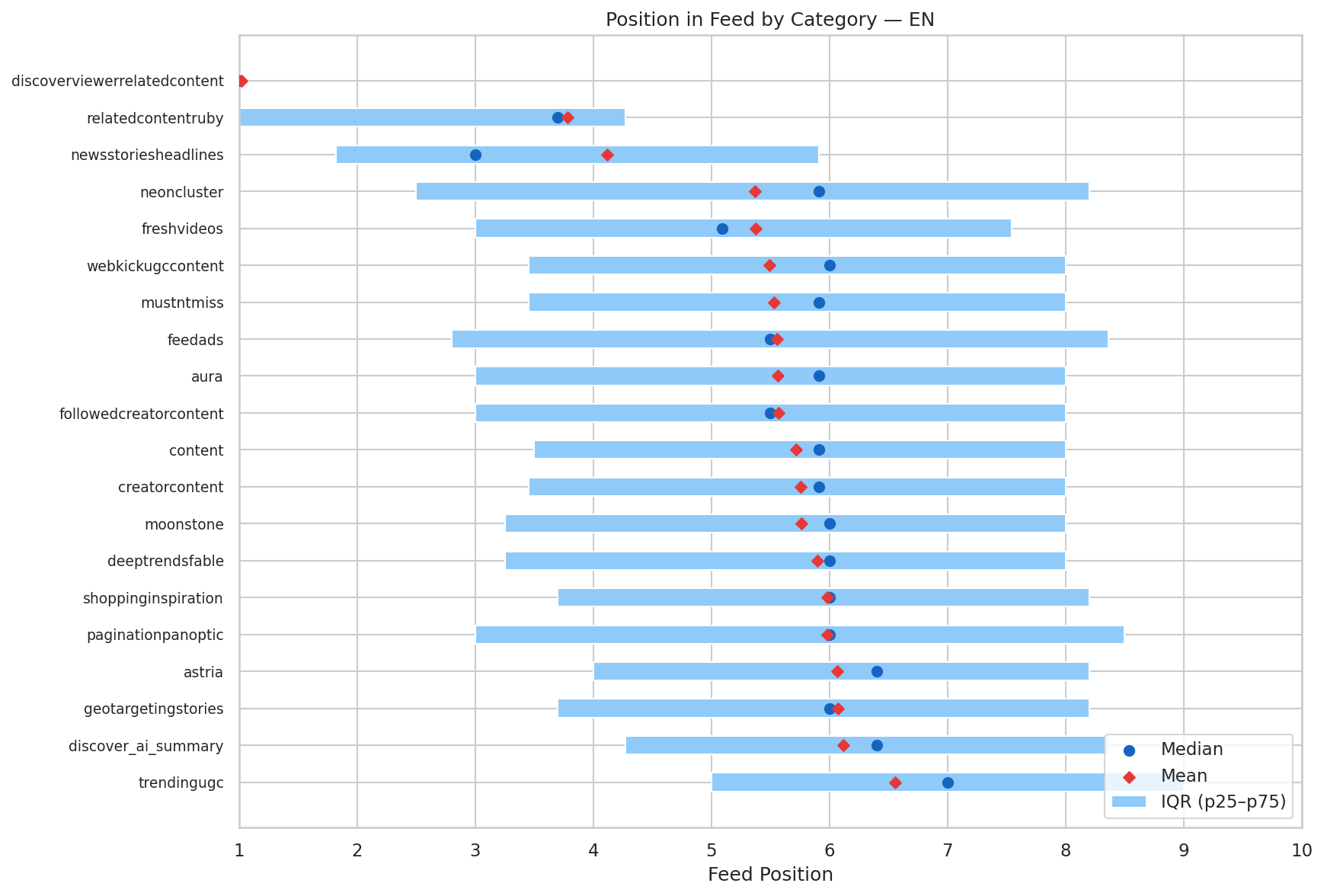
The first two hours deliver a double advantage: fast selection AND premium placement.
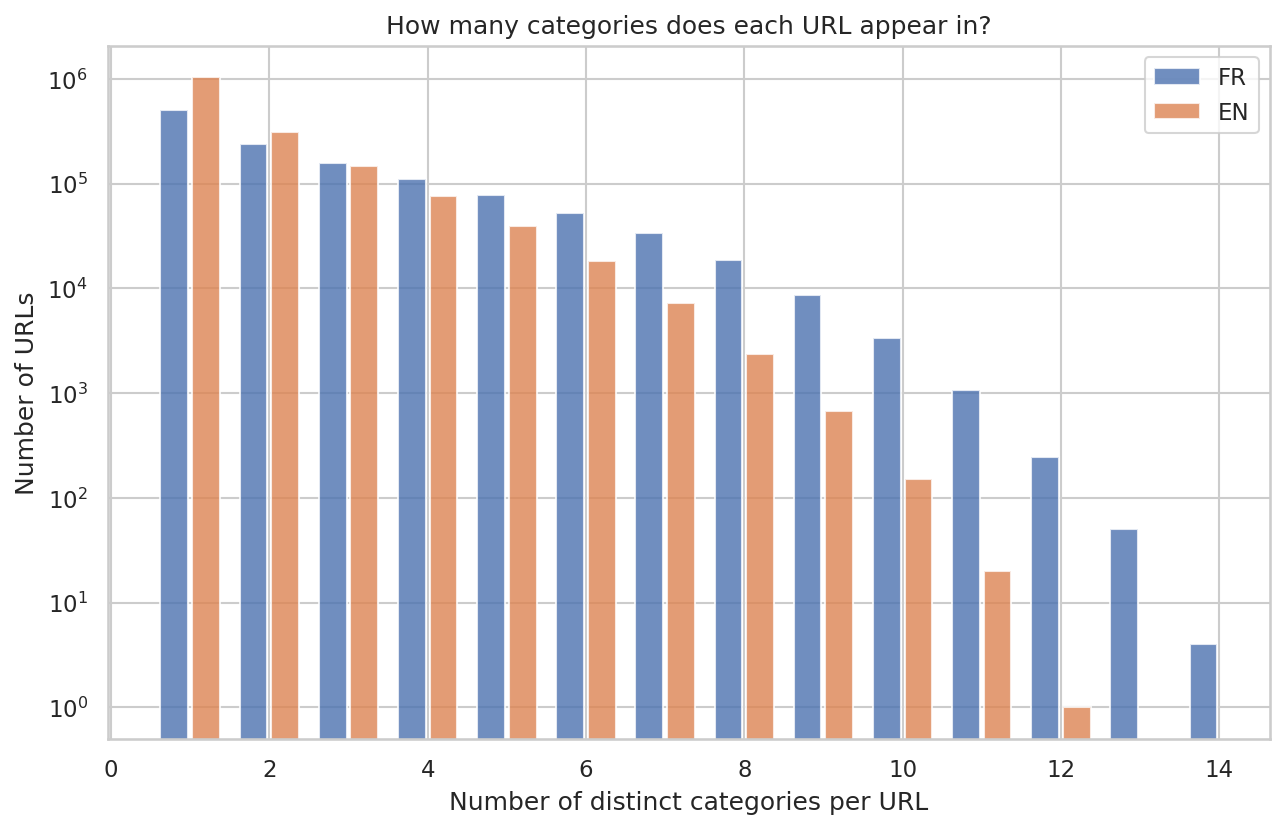
The ladder is the best case. Reality: a large share of EN URLs appear in only one pipeline : typically content.
How many pipelines per URL? The drop is exponential : from single-pipeline majority down to a few outliers at 14.
To climb, an article needs signals: engagement (→ moonstone), trend (→ deeptrendsfable), editorial importance (→ mustntmiss), local relevance (→ geo/wklocal). Without a signal, the article stays in content : the baseline. With a signal, it traverses the system.
Why articles move from one pipeline to another:
Engagement-triggered: content → moonstone (engagement signals detected)
Time-triggered: deeptrendsfable → deeptrends (+26h if the subject holds)
Video cascade: creatorcontent → freshvideos (+7h) → neoncluster (+15h) — the EN video cascade is a major pathway, carrying 13% reach at its peak
User-action: any article → relatedcontentruby (user click → seed→expansion at next refresh)
Google News: breaking story → newsstoriesheadlines (Google News cluster)
Editorial boost: major subject → mustntmiss (priority multiplier ~2x)
AI summary: trending topic → discover_ai_summary (EN only : AI-generated overview card)
The freshness ladder exists in both markets, but the EN ecosystem has distinct characteristics:
Video is a real pathway, not a niche. The creatorcontent → freshvideos → neoncluster cascade carries massive volume in EN. Neoncluster alone has 13% reach : it’s the third-largest pipeline. In FR, it’s effectively zero. If you produce video content, the EN Discover ecosystem has a dedicated three-stage amplification path for it.
AI Overviews are live. discover_ai_summary is an EN-only pipeline with 3.5% reach and ~10h median age. It surfaces AI-generated summary cards for trending topics. This pipeline doesn’t exist in FR.
The engagement broadcast is narrower. Moonstone reaches 9.4% in EN vs 19.3% in FR. The EN market’s engagement amplification is roughly half of what FR publishers see. This may reflect a more competitive, more fragmented EN content landscape.
Diversification is faster. Aura kicks in at ~24h in EN vs ~35h in FR. EN articles reach new audience segments through cross-user profiles about 10 hours earlier.
Shopping turns over faster. Product reviews peak at 2.5 days EN vs 3.7 days FR, but with lower reach (13.1% vs 19.7%). The EN shopping pipeline is faster but shallower.
13 EN-exclusive pipelines exist : sports stacks (home_stack_sports), entertainment drops (entertainmenttrailerdrop), weather (wx, air_quality), followed creator content. These are small-volume but show that the EN ecosystem is broader and more specialized.
Publish when the topic is rising, not when it’s peaked : deeptrendsfable detects trends early
The first 2 hours matter most for news: mustntmiss and newsstoriesheadlines decide fast
The first 12 hours of engagement determine moonstone pickup, but the EN moonstone bar is higher (9.4% reach vs 19.3% FR)
Video content has its own clock: creatorcontent picks up in under 2 hours, neoncluster broadcasts at ~17h : plan your YouTube/video publishing for the EN cascade
Product content is the exception: shoppinginspiration doesn’t care about timing : it lives 2-3 days regardless of publication date
AI summary cards (EN only) surface at ~10h : if your topic is trending, there’s a new pipeline carrying it
Next newsletter: shopping, trends, local : the specialized pipelines that each operate by their own rules.
Full data: 1492.vision | Interactive: explorer
Data: 42 million Discover cards, Dec 2025 – Feb 2026. Analysis: 1492.vision.
No posts
Comments
Nothing yet. Say the first thing.
Sign in to join the conversation.