
9.4%. In English Discover, each URL selected by moonstone is shown to roughly 1 in 10 devices. In French, it’s 19.3% — nearly 1 in 5. Same pipeline, radically different power. Why?
9.4% reach per URL in English Discover. That’s above content’s 8.7% baseline, but modest. Compare with French moonstone: 19.3% — double the reach from a smaller URL pool. Moonstone is Google’s engagement broadcast machine, but its power varies dramatically by market.
In EN, the broadcast role is shared: neoncluster reaches 13% (pure YouTube), feedads 58.4% (ads), newsstoriesheadlines 10.6%. Moonstone is one voice in a crowd. In FR, moonstone is the dominant broadcast pipeline for editorial content — no real competitor.
The content profile is unmistakable: trending events, entertainment, sports, weather — content optimized for click-through. The over-represented sub-topics tell the story:
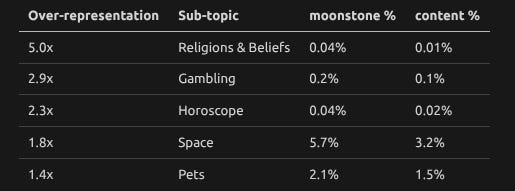
Over-represented title words — olympics, trump, greenland, medal, trailer, snow — confirm the pattern: current trending events + entertainment hooks. Under-represented words — christmas, hybrid, suv, stock, review, luxury, tech — reveal what moonstone avoids: product reviews, tech specs, shopping content. Rational/informational rather than emotional/engaging.
Median article age: 0.65 days. Not breaking news — fresh but not urgent. The sweet spot where engagement signals are available.
Volume: 7.8% of the EN feed. A mid-tier pipeline — behind content (34.2%) and feedads (11.1%). Co-occurrence with content: 73%. Most moonstone articles also pass through content, but EN moonstone is more independent than its French counterpart (85% overlap in FR).
Each domain positioned by its share of content (X) and moonstone (Y). Business Insider and USA Today lean moonstone-heavy (engagement). The Financial Times and The Times lean content-heavy (authority). x.com is the social outlier.
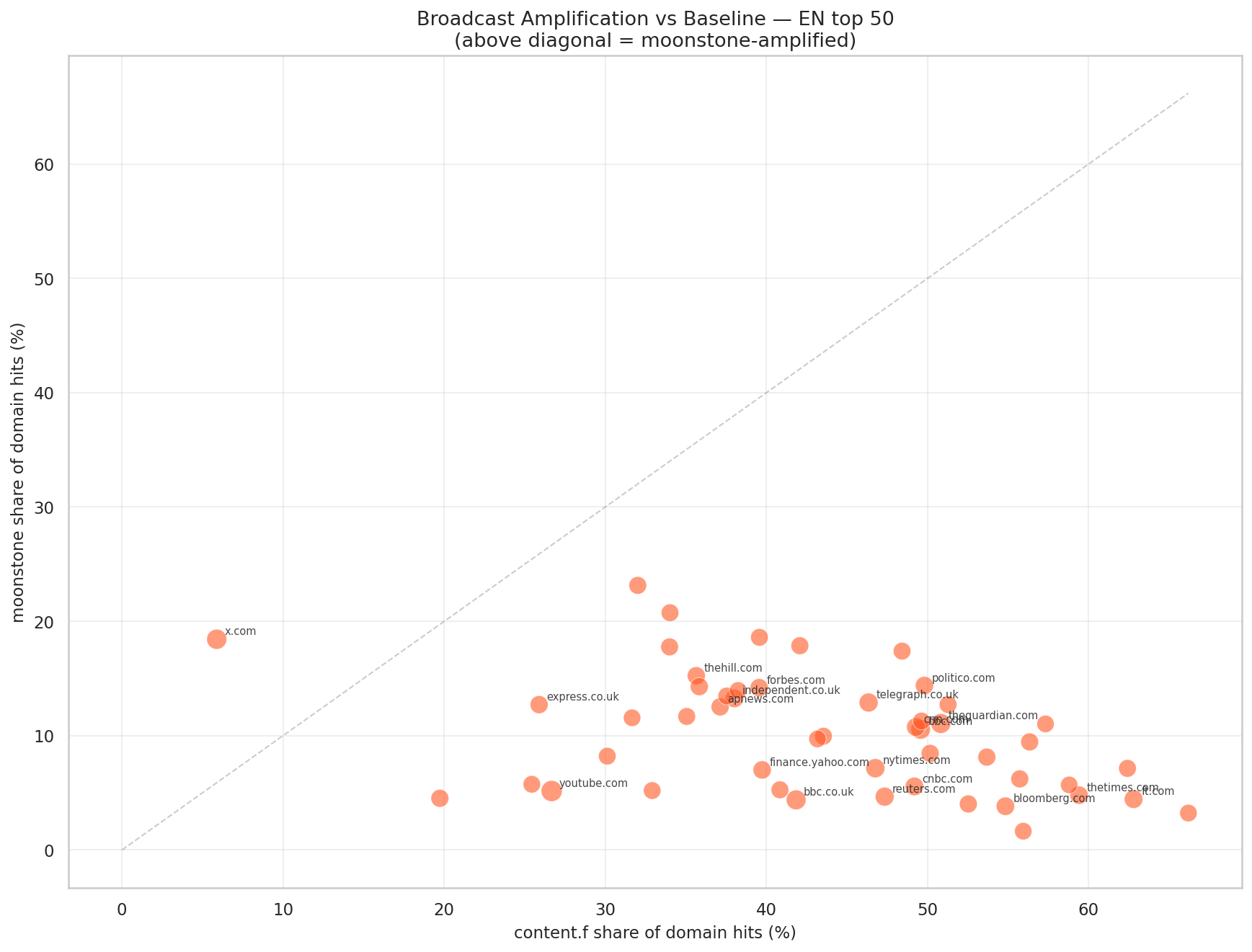
The EN moonstone leaderboard is a mix of US news heavyweights and social platforms:
Business Insider — 20.7% moonstone share, the highest among major publishers. Trending business stories with engagement-friendly angles.
USA Today — 18.6%. Broad-appeal national news, the American equivalent of the Ouest-France model: wide coverage, accessible angles.
x.com — 18.4%. Social content as engagement fuel — a feature unique to EN moonstone. In French moonstone, x.com is negligible; in English, it’s a top-3 source.
Politico — 14.4%. Political news with a trending edge. The Hill follows close behind at 15.2%.
CBS News, NBC News — 17.8% and 14.3%. US broadcast networks punch above their weight in moonstone, matching the engagement-first editorial style of TV news.
The profile of the leading EN moonstone domain isn’t a tabloid — it’s a publisher that combines trending angles + broad appeal + high-frequency output. The Business Insider / USA Today model.
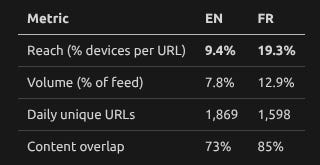
The gap is genuine — not an observation artifact. Our density-normalized analysis confirms: content (the baseline) reaches ~9% in both languages, proving the method works. Moonstone’s 2x FR advantage is real.
Why? Three factors:
Competition: in EN, broadcast is distributed across moonstone (9.4%), neoncluster (13%), feedads (58.4%), and newsstoriesheadlines (10.6%). In FR, moonstone has the broadcast lane almost to itself.
Content sources: EN moonstone digests social content — YouTube (23%) and x.com (20.4%) are top sources. FR moonstone stays anchored in traditional press. Social content fragments the pool.
Pool strategy: FR moonstone selects fewer URLs and shows them to more devices. Google runs a tighter broadcast in FR — quality over quantity.
Moonstone sits high on entertainment, moderate on sports. Aura is the anti-moonstone: low on entertainment, oriented toward intellectual curiosity.
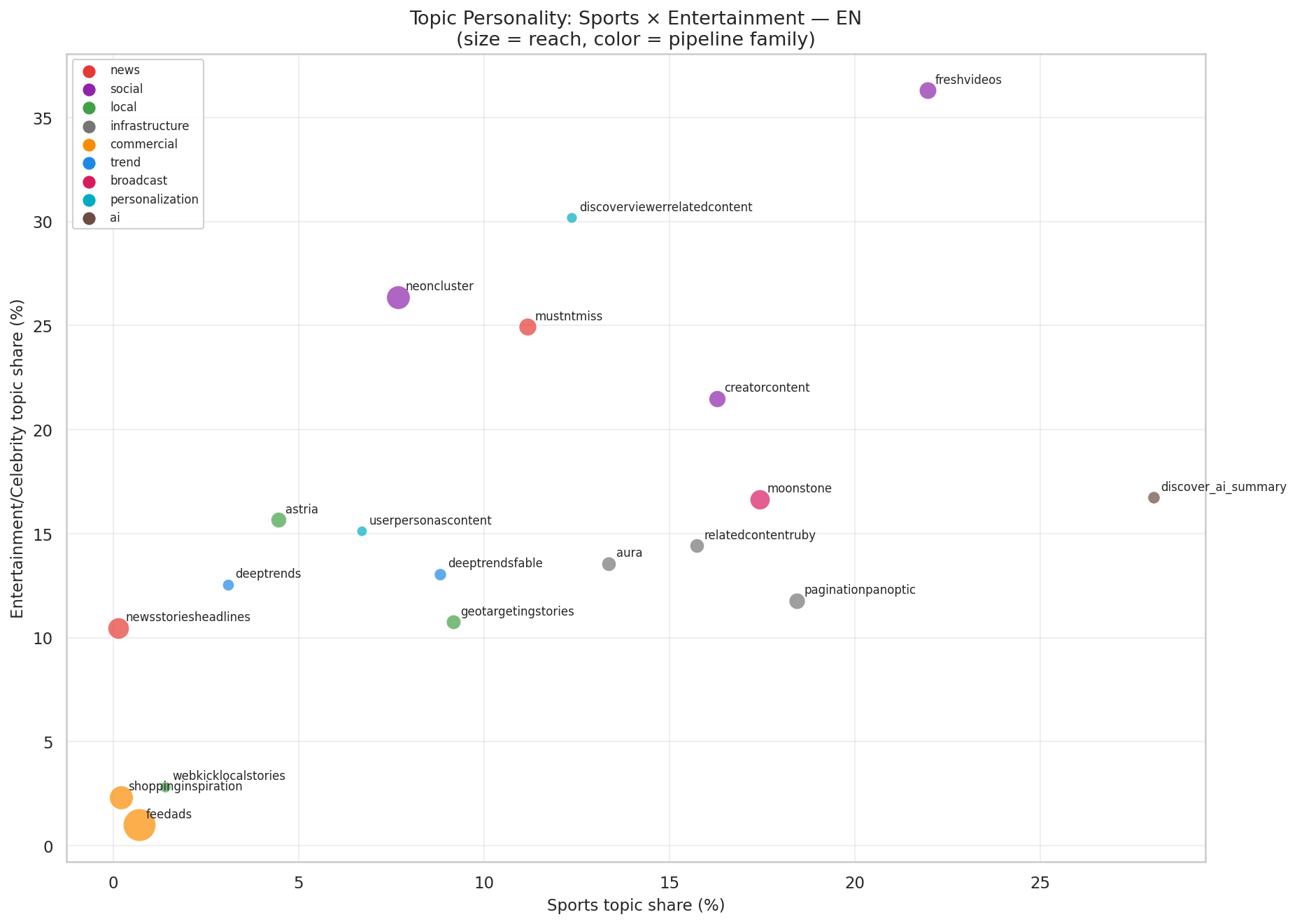
Moonstone is the anti-aura. Where aura diversifies into science/tech long-tail, moonstone concentrates on proven engagement patterns. Deep analysis, niche subjects, technical content — moonstone doesn’t select them.
In EN, this contrast is sharpened by neoncluster: pure YouTube video, 13% reach, the highest editorial broadcast pipeline. Neoncluster handles video engagement; moonstone handles text engagement. Two broadcast pipelines, two content types, one goal: maximize clicks.
Engagement-friendly content (trending angle, emotional hook, broad appeal) → moonstone is your amplifier. The lever is direct.
Technical/niche content → moonstone won’t carry it. Target aura or deeptrends instead.
The USA Today model: combine broad news coverage + accessible angles → moonstone selects naturally.
Timing matters: moonstone content is 0–3 days old. Publish when the topic is peaking.
Social matters in EN: unlike FR, EN moonstone picks up x.com and YouTube content. If your content circulates on social platforms, moonstone notices.
And remember: moonstone alone isn’t enough. 9.4% reach is meaningful — but it’s one pipeline among 20. The next article in the series will show how content travels across multiple pipelines to multiply visibility.
Full data: 1492.vision | Interactive: explorer | Full reference article
Next newsletter: the journey of a viral article through Discover — the freshness ladder.
Data: 42 million Discover cards, Dec 2025 – Feb 2026. Analysis: 1492.vision.
No posts
Comments
Nothing yet. Say the first thing.
Sign in to join the conversation.