
Whenever I go anywhere in Scotland, most people I meet seem to ask the question: why would you go there? What could possibly be in Dundee (or Aberdeen, or Stirling, or literally any town in Scotland) that is of interest? The first answer is that Scotland is beautiful and even the council flats in any town make me want to shed a tear of thanks and kiss the sweet ground. The second answer is that in the year 1812, anarchist and philosopher William Godwin sent his fourteen year old daughter Mary Wollstonecraft Godwin (not yet Mary Shelley) to live with the family of his friend William Baxter for two years, who lived on the bank of the Tay River in Dundee when the town was still primarily a whaling port, and I wanted to see the site where one of the world’s most beloved authors lived as a teenager. (Poor Things and Alasdair Gray fans note: Godwin Baxter is indeed the namesake of Bella’s “maker” for this reason.)
Shelley, of course, wrote Frankenstein at the age of eighteen, just four years after her time in Dundee. I decided I would go find the place where she lived and then walk through the town all the way up to the top of Dundee Law (“law” apparently means a big hill, or maybe a tiny mountain or burial mound) to accomplish some sort of perverse ritual in which I might channel some aspect of Mary’s life and possibly talent.
According to biographer Fiona Sampson in her book In Search of Mary Shelley, in 1811, when Mary was thirteen, she came down with a case of psoriasis that had her sent away to a girls’ school near the sea; though Sampson speculates that this might have had something to do with quibbles Mary was having between her stepmother and the other children in the household. Mary was a middle child, her mother dying just ten days after her birth. Sampson writes Mary must have, at some level, been developing a certain sense of herself as different from those around her, not least because her mother was a rebellious and well-respected proto-feminist intellectual for her time, and was tragically and devastatingly unknowable to Mary as she grew up. “Most children pass through phases of self-consciousness and outgrow them,” Sampson writes, “But there’s something ineradicable about the experience of resembling no one as you grow up.” 1
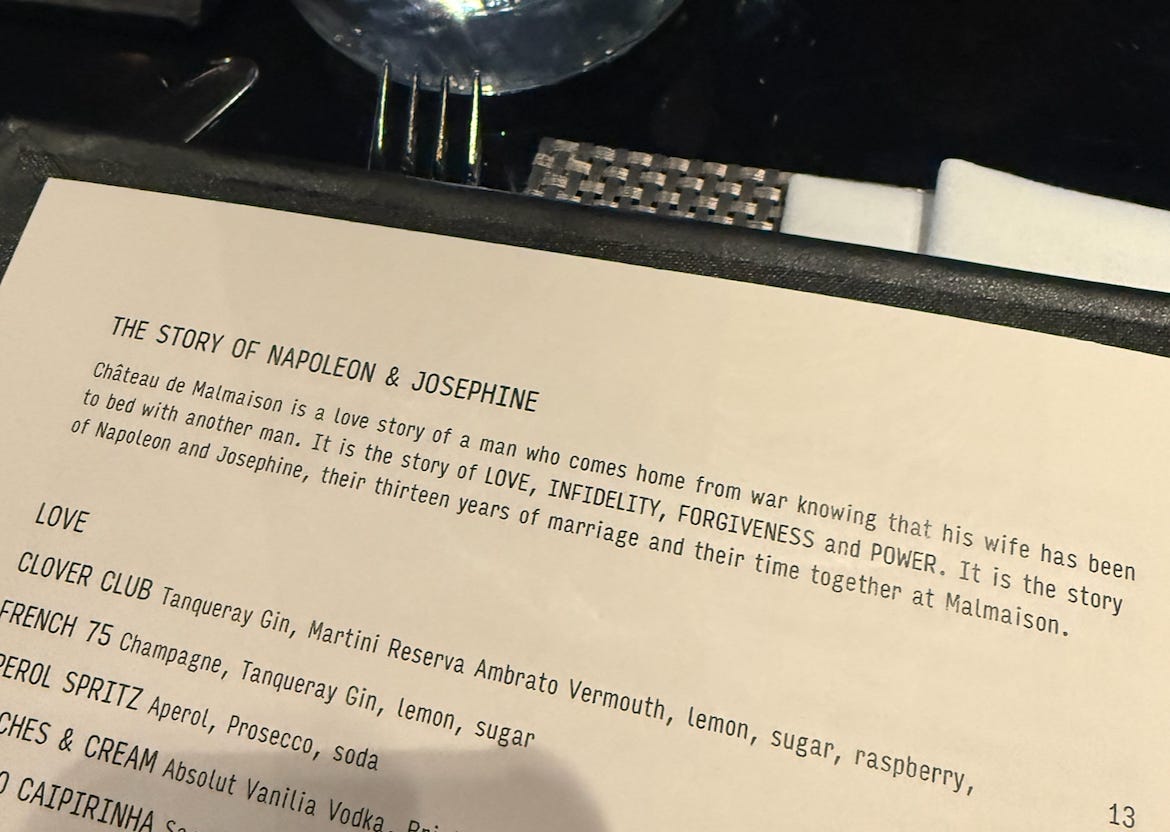
When the psoriasis re-appeared on her arm, she was invited to live with the Baxters in Dundee, supposedly because the sea and country air was better for clearing up her skin condition. My boyfriend and I drove into Dundee over the Tay River and parked near the Hotel Malmaison, a gorgeous Victorian-era tenement. Our room was so luxurious it contained not a cuck chair but an entire cuck couch, and the building was dolled up inside with violet brocade wallpaper. The cuck couch made perfect sense once I spotted the floor-to-ceiling portraits of Napoleon and his wife Josephine in the lobby—Malmaison as a referent to their apparently insane parties and the couple’s on-again, off-again relationship.
Our hotel was in the city centre, just a few miles from Broughty Ferry, the neighbourhood where the Baxter house was located. Baxter was a businessman in the textiles trade who knew Mary’s father in part because they were both part of the same Protestant sect called the Glassites, and there seemed to be a mix of speculation both online and in history books about why exactly Mary was sent up here—was it really because of her psoriasis, or was it more because of tension between her stepmother Mary Jane and her stepsister Claire Claremont (then known as Jane)? Or was it something more—tension between Mary and her own father? Though there are scarce letters from her time as a child, one could speculate how she might have felt about living in her father’s house from an 1823 letter she wrote to her friend Jane. Her husband had just died, and she was worried about having to return to her father’s house (again):
…I am threatened with a renewal of my girlish troubles. If I go back to my father’s house—I know the person I have to deal with; all at first will be velvet—then thorns will come up—in fact it could not last long.2
I was telling all this to my boyfriend as we walked from the nondescript bus stop at Broughty Ferry Lane toward the house. Sampson says this part of the bank was known as “‘the richest square mile in Europe,’” during its time, though mostly what we saw were early 1900s housing complexes, quiet gardens, quaint road signs. It was modest. We passed shabby (but to me, the American, always impressively beautiful) tenement flats. There was a big insulated wall from the edge of the river. Apparently, at the time, the docks at this part of the city did not yet exist and were expanded later, so the house would have been almost directly on the shore, where you could walk out of the house and perhaps cross a road and see a sheered edge right over the river.
Biographer Martin Garrett writes that it was in Tay that Mary saw mountains for the first time, explored the woods outside the city on Dundee Law as well as castle ruins and the whaling ships about to set off on voyages to the north. In the 1831 introduction to Frankenstein, Mary has written that “It was beneath the trees of the grounds belonging to our house, or on the bleak sides of the woodless mountains near, that my true compositions, the airy flights of my imagination, were born and fostered.”3
The house the Baxters lived in was called “The Cottage,” though in reality it was a mansion overlooking the river, and apparently the grounds had “large old trees on the front lawn facing the water, and thick stands of trees to the south and east to protect it from sea winds.”4 All of this makes it sound absolutely gothic and dark and alluring. When I arrived, I looked around for anything of the sort. On either side of South Baffin Street where the house was to be located, there were the shabby residential tenements, a closed tattoo parlour, a pet grooming shop that looked like it’d been around for a couple of decades. And then looking up towards where the mansion would be was a brilliantly empty lot.
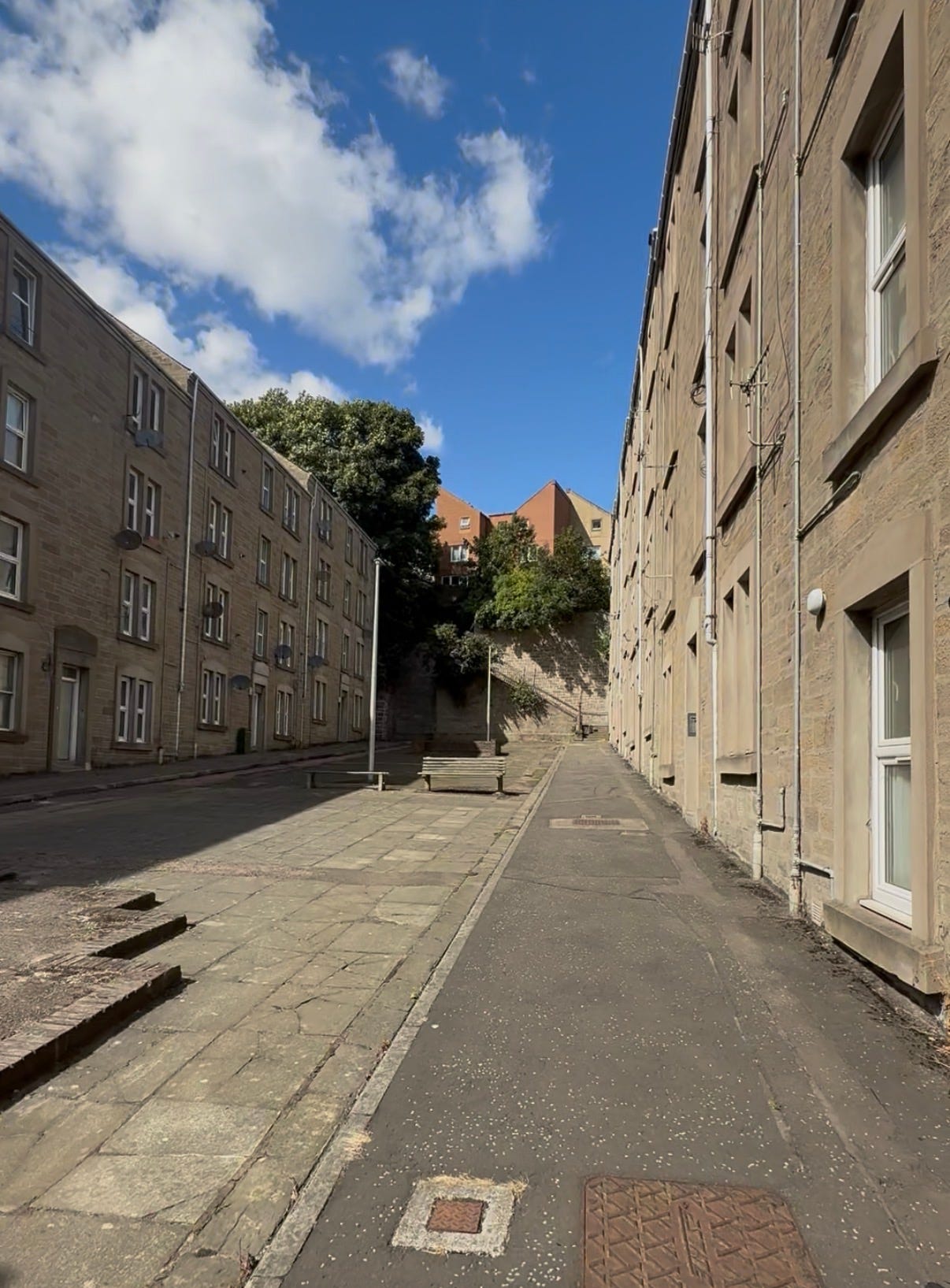
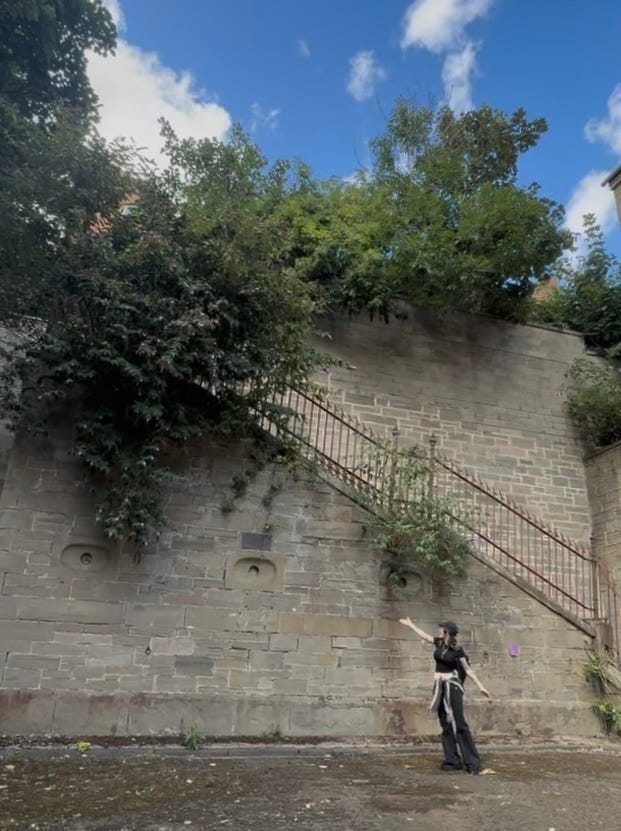
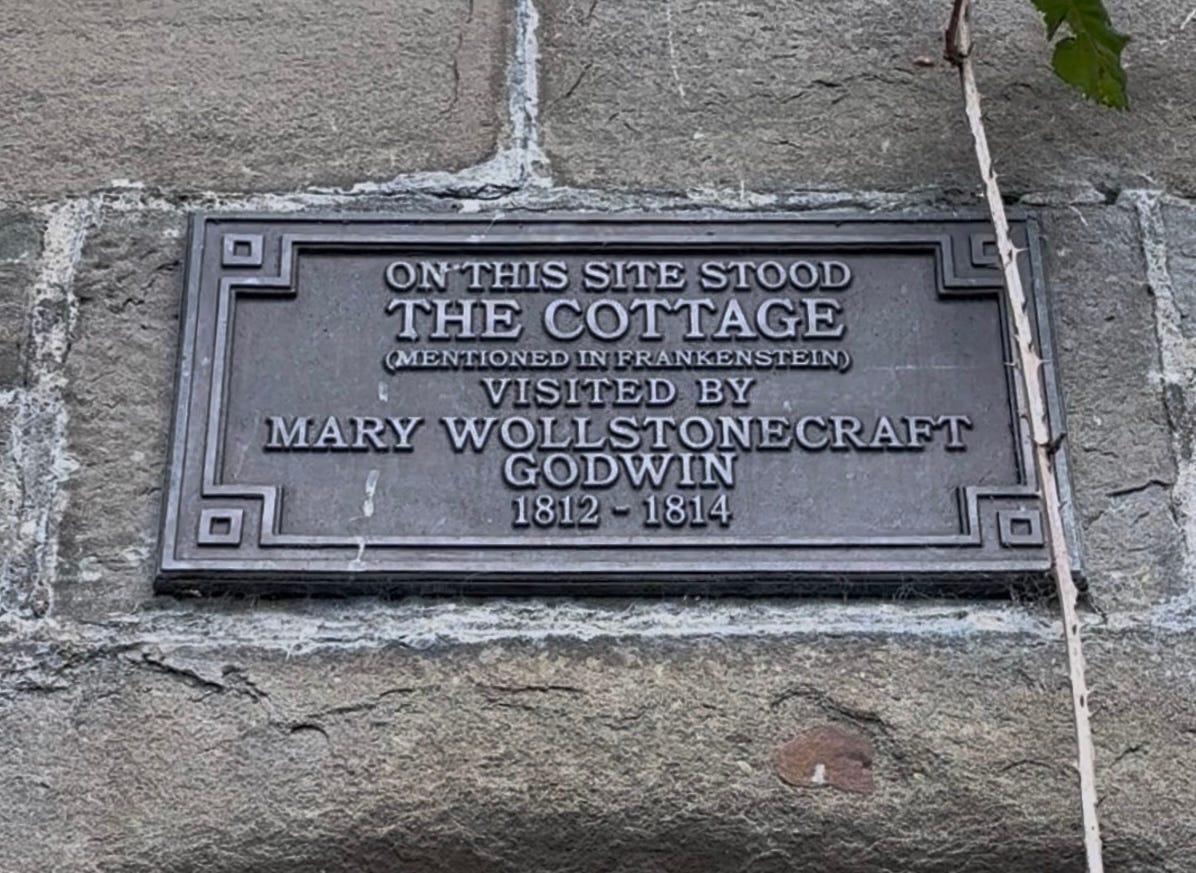
We walked into the lot. There weren’t too many trees in sight—at least not any of the whimsy she described. Maybe the house was up and near the back, where you could see a stone wall inset with a set of Victorian stairs? There were residential buildings on either side, newer builds compared to the 1800s but still quite old. Otherwise, as we approached the steps, we saw a tiny plaque about the size of a book pasted into the wall.
Only a little bit anticlimactic. But it felt good to stand there at the very spot.
Tourism gob calls these the set of steep “Frankenstein steps” laid behind the cottage, though, as far as I know, they have never actually been described in Frankenstein. This connection mostly comes from her 1831 introduction, and that her creative development was fostered by Mary’s habit of walking one and a half miles away from the Baxters’ all the way to the top of Dundee Law, the tallest hill in the city. At the time, it was green with wild and thick woods. I walked up the stairs to start the journey and looked over the Tay. I squinted my eyes, trying to imagine what she would have seen from this view: old harpooning boats driving in the bay full of seal tusks, whale oil, the carcasses of whales themselves, or maybe even that of a polar bear. I can’t imagine it, though, because the sun is out and the weather is unusually hot and everything from this point on is uphill.
It’s on the way, though, that I do find the large, beautiful old-growth trees reminiscent of Mary’s writings, dotted throughout the residential areas. Our walk from the Baxter plaque to the top of the law was going to take about half an hour, but I spent so much time stopping to film the sunlight through the trees on the way it took us about an hour and a half. There are no good photos of this part of the trip, because it’s impossible to translate the way the light moves through the leaves in an iPhone photo. I try to imagine what Mary might have worn as she urban hiked her way through the town, what buildings might or might not have been here yet— the industrial part of the city was just beginning to bustle, though it wouldn’t reach it’s peak until 1830, long after she’d left, and the closer we got to the law, the newer the houses looked (and the more sparse the trees seemed to become). What might Mary have done had it poured rain or been colder; what kind of shoes might she have worn? It’s only through research about Dundee’s former industry that it becomes easy to see where inspiration for Robert Walton’s expedition and the Arctic floats of ice in Frankenstein, where the creature finally meets his maker, comes from. In that 1831 introduction, she’d written that the shores of the river here might have been “blank and dreary,” but “they were not so to me then. They were the eyrie of freedom, and the pleasant region where unheeded I could commune with the creatures of my fancy.”5
In Dundee, Mary meets Baxter’s youngest daughter, Isabella, whose mother of the same name has only died the year before. Sampson reports that it’s here Mary finds someone she can share experience with. I try to imagine the feral friendships of my teenage years—how strong and obsessive those bonds felt for me—and project it onto Mary and Isabella. Would they have walked to the woods together, and what would they have talked about? You grow up feeling alien only to come to Scotland and find that there was someone just like you here all along; someone fiercely intellectual, living with their own kind of mothergrief.

We finally make it to the foot of Dundee Law, which has been aptly named the Shelley Gardens. It’s overgrown, and we find a set of steps in which the entry sign has been spray-painted over like we’re not supposed to go that way, but rather through some other entrance. We go up the steps anyway and find a wooded clearing. I run towards the centre, then realise there’s a rugged fence protecting the community gardens that I can’t get through. So we go around, and hike up, and up. When we get near the top, there’s another plaque. It tells us that apparently in the mid-1800s, they came through and razed the entire thing. And then in the 1960s, they figured that was bad, so they worked to replant all of the trees that used to inhabit the area to restore the law as much as they could.
What happens to Mary in Dundee is perhaps most interesting when you consider what was happening in London at that time, as well. In 1812, while Mary is in Dundee, her best friend Isabella’s oldest sister, Margaret, dies. She was married to a man named David Booth. Mary returned to the Baxter home the next summer, in 1813. She was fifteen, and her friend Isabella was seventeen. By then, David Booth, the widower of Isabella’s older sister, had left Dundee for London to see Mary’s father. Sampson speculates that it’s possible Booth was asking for Mary’s hand in marriage, and that Godwin refused. In March of 1814, Isabella’s brother, Robert, visits Dundee from Edinburgh and meets Mary, falling in love with her, too. Godwin somehow learns of this, and William Baxter receives a letter mid-March to send Mary back home immediately. Godwin’s anxieties around these pursuant suitors, I think, provide an interesting link to one of Mary’s lesser known yet controversial works involving father-daughter relationships, Mathilda, which was written in 1819 (she sent it to Godwin in 1820 to publish it, but he refused). As such, it was not published until 1959—though that’s a story for a later time.
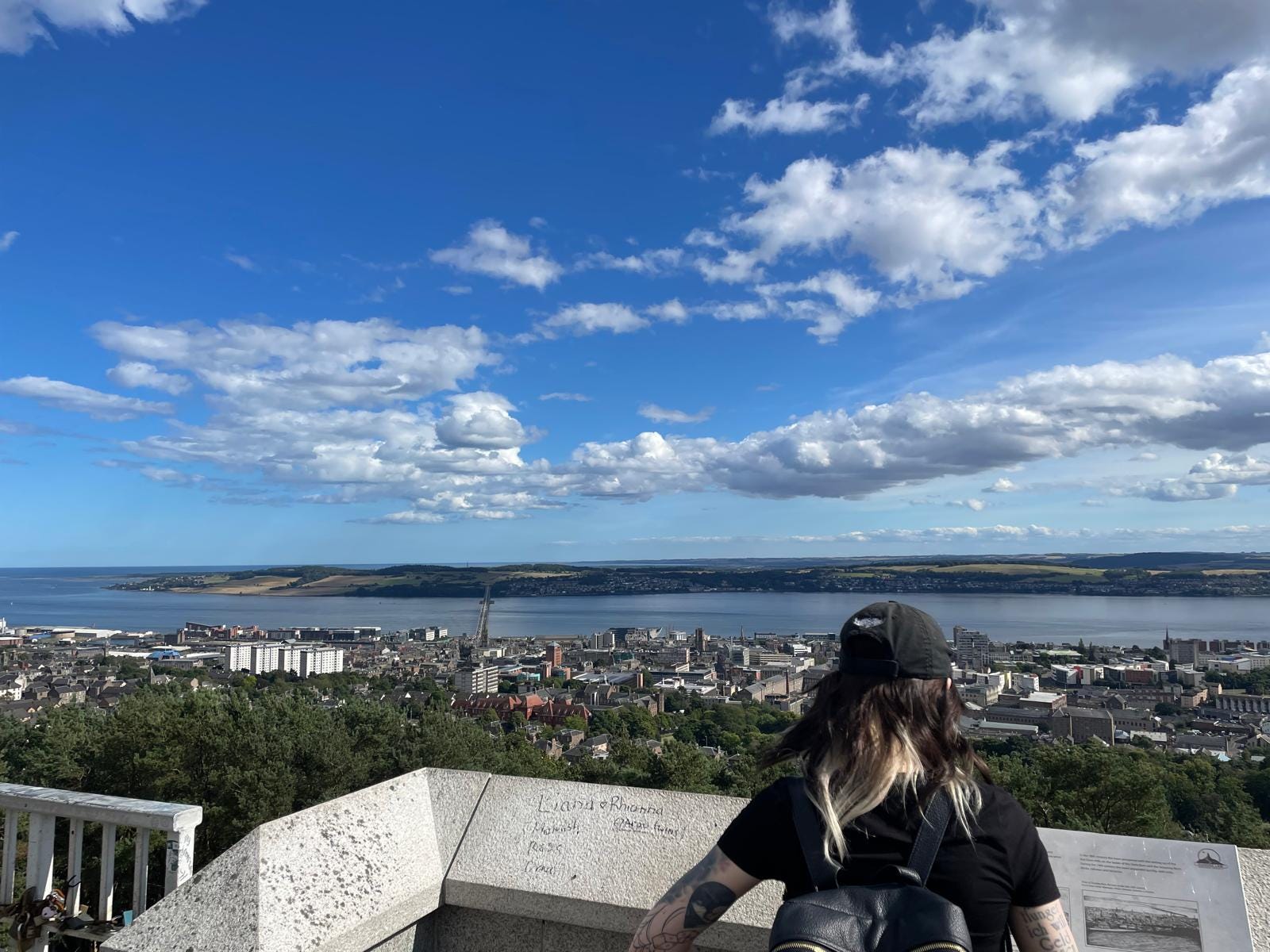
A set of steep winding steps beneath leaf canopy opens up into a vast circular clearing, where, at the very top of the law now sits a war memorial. Across the banisters around the memorial are countless locks engraved with people in love—or moreso, people who’ve passed on to another realm. The oldest I could find, I think, was from 2006. The locks have the dates of the loved ones’ lives on them. A common refrain, “fly free.” Neither pictures nor words do the site justice. The site is busy; busier than the walk up was. The weather was perfect. I try to imagine Mary looking out at the water, seeing the boats dock, perhaps savouring the freedom of the wind and the sun and the view, preparing herself mentally to head back to London to live yet again with her father. Rodge and I point out our hotel from the view and hold hands and I feel grateful I’m with someone who appreciates the experience as much as I do. Mary was sent home just four days after her father’s letter, taking the week-long trip by ship back home to London, where, of course, just a short time later and fully against his wishes, she would begin a life of a different kind of freedom, and elope to France with famed fuckboy Percy Bysshe Shelley, whom she would love until his death at sea.
p53, In Search of Mary Shelley, Fiona Sampson, 2018.
p73, In Search of Mary Shelley, Fiona Sampson, 2018.
p15, The British Library’s Writer’s Lives: Mary Shelley, Martin Garrett, 2002.
p69, In Search of Mary Shelley, Fiona Sampson, 2018.
p15, The British Library’s Writer’s Lives: Mary Shelley, Martin Garrett, 2002.
Comments
Nothing yet. Say the first thing.
Sign in to join the conversation.