
Editor’s Note: The first part of this conversation, along with Tom Snarsky’s introductory essay to Hannah van Binsbergen’s work, can be read here.
TS: If you’re cool with stepping back in time a little bit, some of our readers might not know that your first book, Kwaad gesternte (Unlucky Stars), won the VSB Poëzieprijs. I think different places have very different senses of what a poetry “career” looks like—like how in the UK poets will often publish a pamphlet before a full-length collection, and in the US an MFA thesis often leads to, or itself is, a first book. Could you say a little bit about what this progression is like in the Netherlands, and how well you feel like it describes your own experience as a poet?
HvB: I would say that my trajectory is not a standard trajectory. Now we do have creative writing programs, mostly at art schools, but it’s a relatively new thing and when I started publishing poems, that wasn’t really something that I considered. But there were writing workshops, obviously. I joined a workshop where I learned a lot and that brought me into contact with other people who also wrote; that was a workshop that, funnily enough, I now teach. I co-teach it with the person who founded it, Jeroen van Rooij, who’s also a great writer. And it’s at Stichting Perdu, which I think a lot of poets who’ve visited the Netherlands will probably know about because it’s basically the center for experiment-forward poetry in the Netherlands, and it’s been kind of my home base.
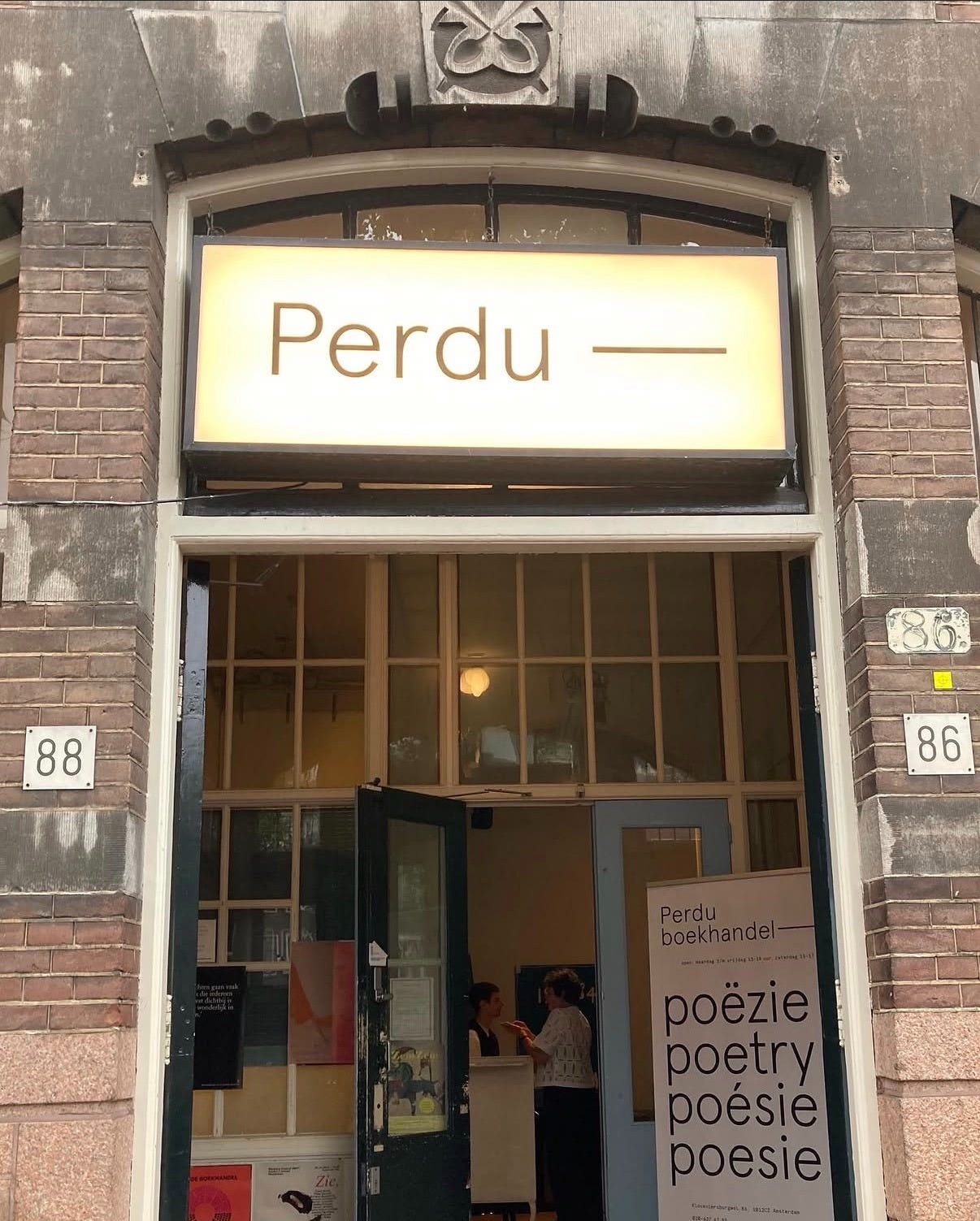
HvB: I was very happy because I thought, okay, this is a place where I can be. I was very confident, I think, in myself and my writing. So I really wanted to publish a first collection, and after that first publication when I was 18—again, the Netherlands being so small—it caught the attention of a publisher. That did not work out. So there was a bit of a lag there, and I think in that lag, I wrote some of my best work—like the biggest part of Kwaad gesternte was written in that period when I was 19, 20, 21. I published this first collection and I remember just thinking: yeah, okay, I think this is cool, and I’m happy that some other people that I respect also think so, but that’s probably going to be the end of it. I’ll publish a second book if they let me, and I will also do something else, because poetry is not a career.
I remember actually being in the room when somebody at the publisher said, oh, I submitted your book for this prize. And I thought, yeah, okay, that’s never gonna happen because it’s not a prize for first collections. It’s like the national award for a collection in a certain year. And then I won it, and that was really strange because I was like 22, and what did I know? I think it gave me a kind of a skewed idea about what my career could be, because those first two years I got a lot of speaking engagements, and I won some money so I could just take it easy and be a writer, which is what I really wanted. Like many people my age or a little bit older, I thought, oh, maybe I can go into academia, and write on the side. It didn’t take me very long studying philosophy that I thought, okay, no, if you want to get into academia, you have to be prepared to sacrifice everything else, and I’m not prepared to do that.
TS: Right; that reminds me of David Foster Wallace going to philosophy grad school and dropping out because all the reading devoured the time he wanted to spend writing fiction.
HvB: I like philosophy fine, but I like poetry better.
TS: I am curious, because 2026 marks ten years since Kwaad gesternte appeared—time and first books make for an incredibly weird memory-cocktail, but: how do you relate to the book now, a decade later?
HvB: It’s strange because this year—because of Trump and various other reasons—there’s all this, “oh, it’s 2016 again!” happening. When I read Kwaad gesternte now, I think it’s very much of its time. I still like it. It speaks to a political position, a political affect that is not where I am anymore. There is a kind of desperation, melancholy, a kind of hopelessness about that book that kept me from touching it for a very long time. I was afraid that that part was too dominant—that it wanted to be political poetry, but it was just the poetry of political uselessness, of lacking, of just losing; of a generation that’s lost—and just like, okay, yeah, we see that everything’s fucked, but we don’t know what to do about it, and we can’t mobilize, we can’t etc., kind of an elegy to political mobilization in a way. And when I read it again, 2–3 years ago, I was actually pleasantly surprised. I don’t think it’s that bleak. I think there are enough moments of levity and even utopianism in it. I’m still behind it, basically; I have a lot of compassion for the person who wrote that, because I do see the incredible loneliness that this book speaks to.
Maybe that’s why it resonated with so many people, that they felt that way themselves: like, I can’t be part of a movement, there is no movement to be part of, and I’m very happy that has changed. It was already changing when I wrote the book, because a lot of Kwaad gesternte is about the apolitical worldview of many of my peers. And even in the year 2015, I was pleasantly surprised by my peers, because they occupied the university. They started the longest occupation of the University of Amsterdam in history. I was also a part of that—a small part—but I think the combination of an articulation of hopelessness with this actual political momentum, that yeah, I was lucky that struck a chord. And I think we’re in a very different place now. There has been political mobilization—it hasn’t been as massive as I would love it to be, but it is there. There’s a lot of very positive solidarity around the genocide in Palestine, which makes me very hopeful. It’s a movement that struggles to maintain itself, I think. The political poetry that I would write right now would speak much more to the future of movements, and the place of our own political actions within a broader framework.
Basically, what I’m doing now is writing the worldview of neoliberalism, and asking whether we can take back the world that they have given us, making it a project of international solidarity instead of a world economy. Very different from Kwaad gesternte, but I still like it.
TS: Do you think Kwaad gesternte might exist in an English version someday?
HvB: You actually were the only person who made any serious moves on that side. I think poetry translation is a hard sell for many editors. I would love to translate it myself, to be honest. I could do it. So, you know, if anybody reads this…
TS: ASL has this great sign for “advertisement” that for me perfectly visualizes the idea of getting the word out there. So let’s sound off the literary klaxon and shout from the hills: publishers, if you’re out there and you want to publish Tom Snarsky’s favorite poetry book of 2016, please get in touch so Hannah can translate her incredible book for your press!!
Your comments above about the political sensibility in Kwaad gesternte make me want to hear more about your connection to socialism in general and to Jacobin in particular—for our readers who might not know, in addition to your literary writings, you were also the founding editor of Jacobin NL, running it from 2021 to 2024, and you’re still on the supervisory board. And especially thinking about this new novel, but also just your writing life in general: What has your commitment to socialism meant for your writing? (I’m also thinking about this stretch from your poem “Quite Naked, Apart from an Old Vest”: “The last lines of the communist manifesto / move me now as much as when I was thirteen. / I like to keep that smell in my clothes.”)
HvB: I am not 100% sure how I came to socialism, to be honest. I think it had to do with poetry, with reading Herman Gorter, but it didn’t have everything to do with that. I grew up in a house where books like Kapital and The Communist Manifesto were around. And my father was, at some point, a Marxist of sorts. So that tradition was never far away. I had a boyfriend when I was a teenager who was very much into folk music—I was a big Bob Dylan fan growing up, and I heard a lot of American union songs and really loved them. And a lot of them are very, very socialist, you know? It maybe wasn’t the standard trajectory, of being close to a movement or having a family that’s very political or having friends that are in a youth party, or whatever. I was, just like everything else, figuring it out on my own.
I started reading some philosophy, and then—I was always interested in poetry that was more or less explicitly political, like the socialist work of Herman Gorter. In a lot of respects, I think he was a model for me. It sounds a bit strange to me now, but I admired him a lot: what he did and the way that he wrote about socialism had a big impact on me. I tried to connect with other people who might have similar ideas, but I found it hard to define a political common ground that I was looking for. I think in the Netherlands, especially back then, there was this great denial around the idea that there was such a thing as class—that class actually exists. The Dutch like to think, class is for English people. We don’t have that. There are no posh people in the Netherlands. That’s true, there are no posh people in the Netherlands, but there are rich people in the Netherlands, and there are culturally dominant people in the Netherlands. Sometimes they are the same people, sometimes they aren’t, but their class obviously exists.
I got met with a lot of raised eyebrows, like, What’s she on about? Then there was the student movement I mentioned before, that was a move in the right direction. It was very anarchist; a lot of the left politics that I got exposed to as a student in Amsterdam was very anarchist. Amsterdam especially has this tradition of squatting—actually, I think a lot of political awakening for many people is through squatting, or through hanging out in squats with anarchists.
So I wrote these poems that were very political, but I always felt that there was a kind of futility about that because I was writing all these political poems without engaging in any kind of movement, and when I tried to I felt a bit out of my depth—like, I felt fine using myself as cannon fodder, marching in a demo or something. That was fine. But, I started thinking: how can I use my own faculties, as a writer and a teacher, to serve the ideas that I think are important?
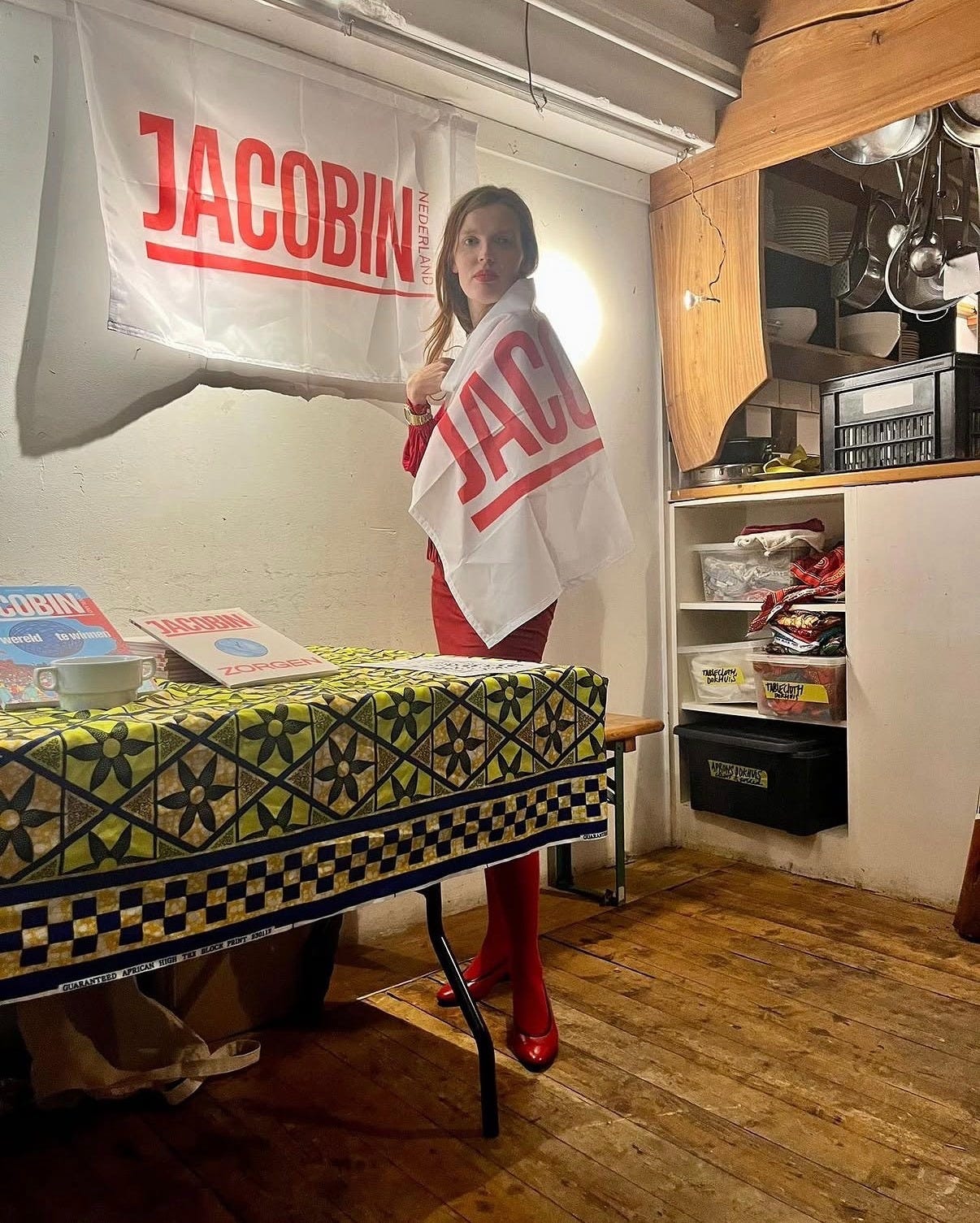
I joined a kind of grassroots union, a solidarity network. It was based on the Angry Workers in Seattle. I was a little bit too socialist for the anarchists, and too anarchist for the socialists; this was a way to come in contact with people who were in a similar boat and do some direct action, which was an incredible experience. And at the same time, some people that I knew were talking about launching a Dutch edition of Jacobin. They had attempted before to launch a political magazine—a socialist magazine—but that didn’t really go anywhere, and they thought the Jacobin franchise would help to delineate what they were doing. A lot of people think of left-wing politics as a morality contest, which annoys me to no end, but, you know.
TS: Yeah, “MLM or bust,” that kind of idea.
HvB: Right. So there was this long launching period, where we tried to figure out how to launch a magazine to a professional standard without any money. That was a challenge. I liked doing it; I learned a lot from it. I learned things as a writer—I think most of the things that I learned were not as a writer, but more as a person relating to other people. I think my experience as a teacher was very relevant in this context. My experience with organizing had been very non-hierarchical. It wasn’t easy to figure out how much of that we wanted and could have on our editorial board. How do we make decisions? Can everybody just do what they want, or do we need some kind of explicit guideline? That was a lot, and it did not leave any room for doing anything else. I mean, I wrote, but I wrote journalism; it was very interesting and taught me a lot about the world, to be honest. I interviewed people who were on strike, I interviewed people who were living on the other side of the world. I interviewed Bernie Sanders.
TS: Bernie for Burlington!
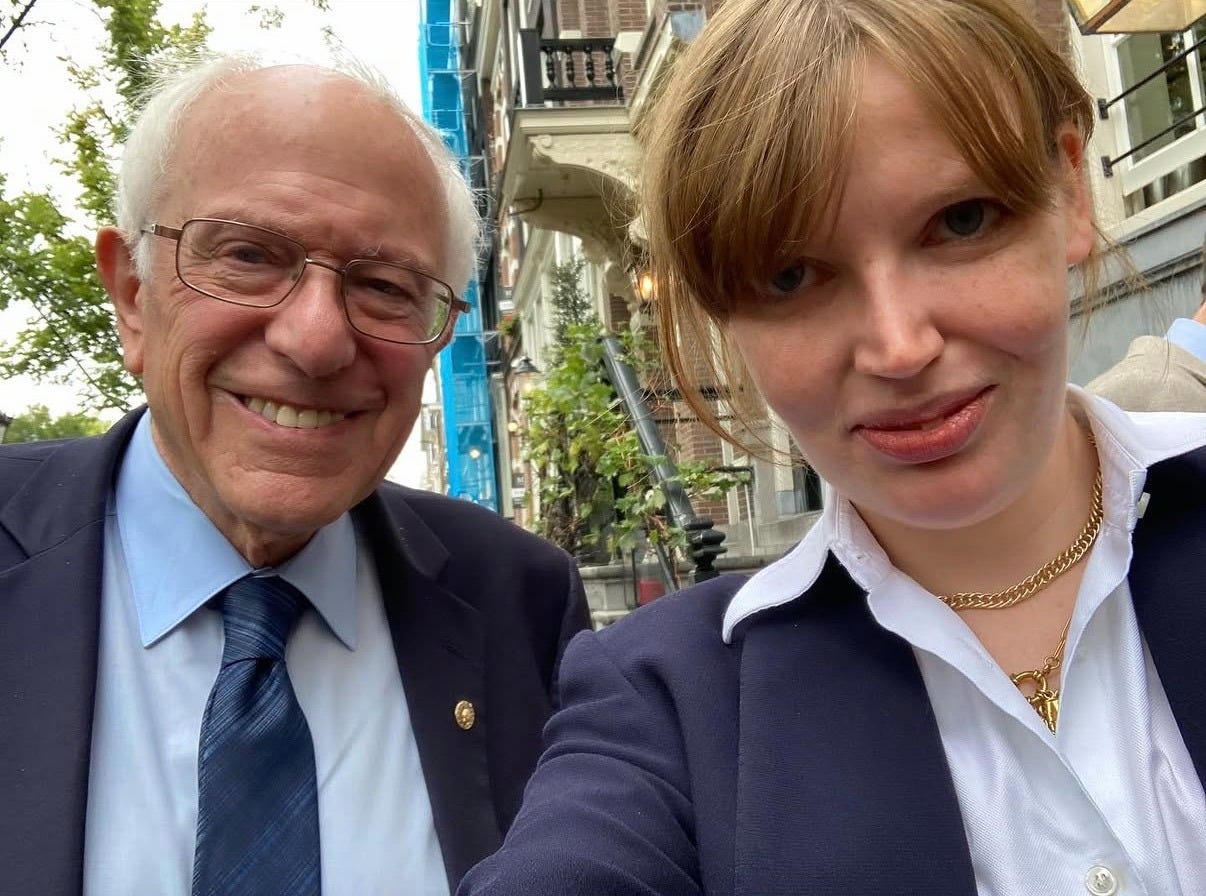
HvB: Yeah, it was amazing, but in the end, I discovered that I am neither a manager nor a journalist. So after four years, I passed the torch to someone else. I’m very glad I did that, and I’m also very glad that I did this at all. It was a way to be part of the class struggle in a way that is more productive than writing poems. It’s not the most productive, but it’s reaching more people than writing poems, and there wasn’t such a thing in the Netherlands before. I’m proud that there is now, and I think it meant a lot to a bunch of people that there is such a thing, so: Yeah, great—but also, never again.
TS: A good baptism by fire. Yeah, that’s beautiful. That’s such a comprehensive answer, I really appreciate that. I would love to pivot a little to talk about something you mentioned earlier, the novel.I’d love to hear for you, as a poet, what it was like to change genres into the novel—to go from writing poetry to writing prose.
HvB: It was not easy. I had a lot of fun with it at the beginning, but then I discovered that there were some things that I just didn’t really know how to do. I’d written some prose before, but I’d spent years and years honing the craft of poetry and learning how to write poems the way that I wanted to write them. I just hadn’t done the same thing for prose yet, so I had to learn how to do that—learn how I wanted to write prose while I was writing that book. I like that book, that first novel, but I like the book that I’ve written now (the second [forthcoming] novel) better.
I was very influenced by Kathy Acker when I wrote Harpie. There’s a lot of sex and violence, and there’s this kind of intensity in the prose that is just difficult to carry on if you also want to tell a story. I think if I had to write the book again, I would not have told a story as much as I did back then. I don’t know if my editor would have liked that, but I was of two minds, deciding what I wanted that book to be. I don’t think I had all the tools to really make up my mind about that.
You’re gonna think we’re very spoiled, but the way it works in the Netherlands is: there is an institution, the Nederlands Letterenfonds, that you go to when you want some money to write something. And, they gave me a bursary to write a second novel in 2020, after the first one had come out. So the timing of that first one was just…the worst. It came out in 2020, and 2 weeks later all the bookshops were closed and nobody wanted to read about crazy suicidal people. That was not great, but with some distance, I can appreciate that there were some reviewers who really hated the book, and some reviewers who called it a miracle. That being said about one and the same book, I think that’s kind of cool.
After I got the green light to go write a second novel, I had a bit of a crisis about what I even wanted from prose. Like, do I even believe in “the novel”? I started reading more into the history of avant-garde prose in the Netherlands. There’s this one group of writers, some of whom were poets and a lot of whom were also writing prose. In poetry, you can do anything; experiment is good. Whereas in prose, because it’s also a more marketable product, let’s say, there is a lot of conservatism compared to what I was used to. I realized that I had to come to a decision on whether I wanted to write purely experimental prose, which I would probably have to call poetry since otherwise I couldn’t get it published. If you say it’s a novel, then you have to keep the reader involved, entertain them a little. I read a lot, and I thought about how I could write fiction without it being the Hampstead novel. And I found out that maybe, you know, the novel might be the problem. Fiction is definitely not the problem. Reading a lot of science fiction has been very influential and very liberating to my fiction.
On the other hand, there is a current of non-standard prose in my fiction—in Dutch, this group is often called Ander proza, like “different prose.” I’m worried with the book that’s gonna come out now, that all my cool friends who know that I read all these books and I write about that tradition a lot, that they’re gonna think that what I’ve written now is not experimental enough. To me, there is definitely an experiment that goes on there. It comes back to this idea of not wanting to write a novel that is basically the story of the psyche of a middle class or upper middle class person. How can you write about the big currents of history in a short narrative? Because, again, I’m a poet. I can’t write, like, 700 pages. It’s not gonna happen. Like when people tell me to write a 2,000 word essay, I struggle to meet the minimum. So yeah, it’s a short novel. And I like short novels—I often think that some of the books I like the most, I wish they were 200 pages shorter. Like have you read Chevengur? It’s a novel by Platonov.
TS: I have not! Isn’t there a slim one by him too?
HvB: The slim one is probably Dzhan, which is basically the same story, but better. (Because it’s shorter!)
TS: Nice. Yeah, I’m a big Marguerite Duras fan, and I think Duras is a great example: the books are so thin, and the narrative, when you’re reading it at a surface level, is not actually wildly disjunctive. But by the end—the effect that you get by the closing pages of, say, Moderato Cantabile is so disorienting, and it twists your idea of what the texture of another person’s inner experience would even be like—all without necessarily going off any kind of experimental deep end. Your new book comes out early next year, right?
HvB: Yeah, in January, I hope.
TS: Okay, great. Let’s close by going backward in time once more: you also published a second collection of poetry, Kokanje, in 2022. How does that book differ from Kwaad gesternte?
HvB: It is my favorite collection; I like it much more than my first book, because it tries to find a way out of the political hopelessness of Kwaad gesternte. I see all of my literary work as basically one trajectory, and I think you could say that it is all about the crisis of collectivity. So, both Harpie and Kwaad gesternte are books that are very much about isolation, about the individual seeing the brokenness of the world and seeking a more or less individual solution to that. The next two books are different, so Kokanje and the book I’m writing now—which is We Come From the Workshop in English; that’s a line from a poem by the Chinese poet Xiao Hai. It’s a beautiful poem. I actually have only read it in English, so I assume that this would be a correct Dutch translation of that line. So maybe that’s just my process, that I think about something in poetry form and then I take the conclusions that came out of that poetry and tell a story with them. I think that’s part of the way that poetry and prose hang together in my practice.
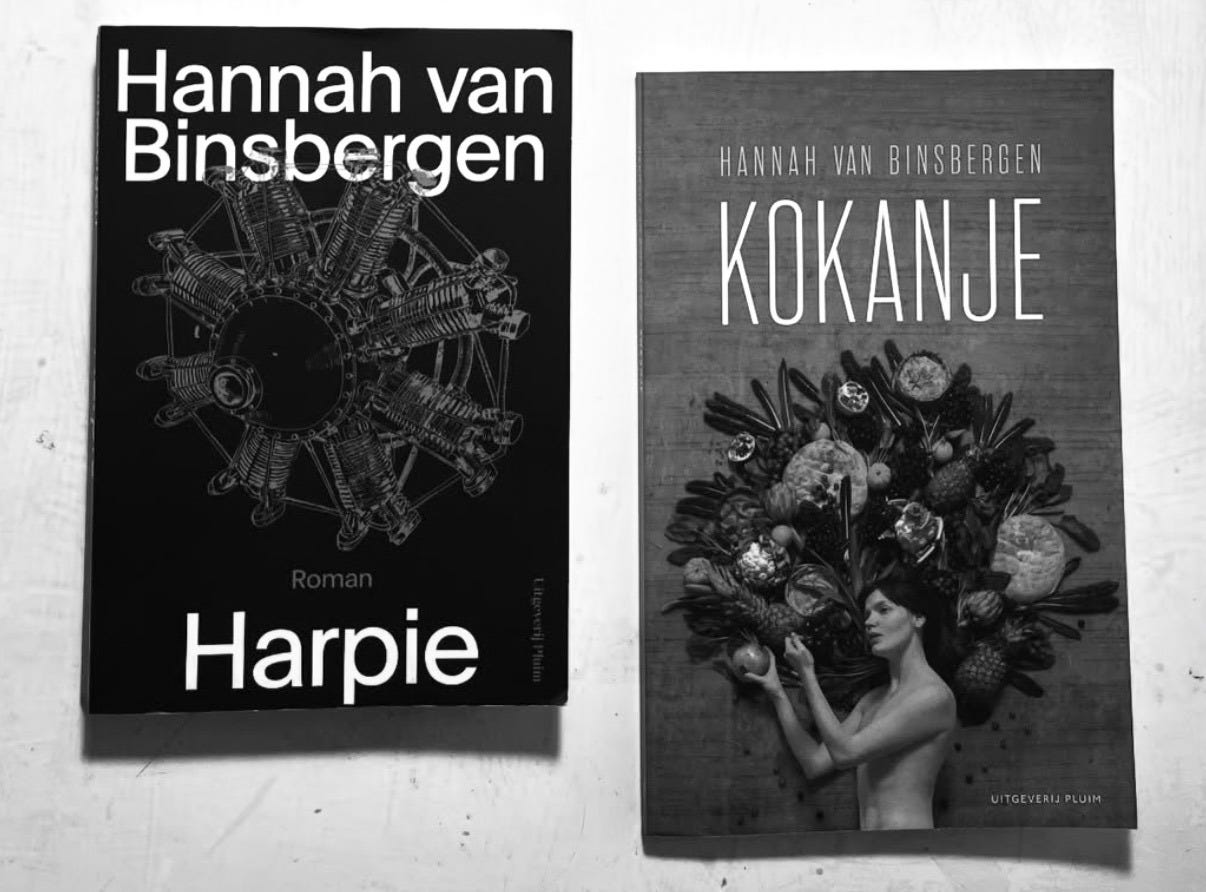
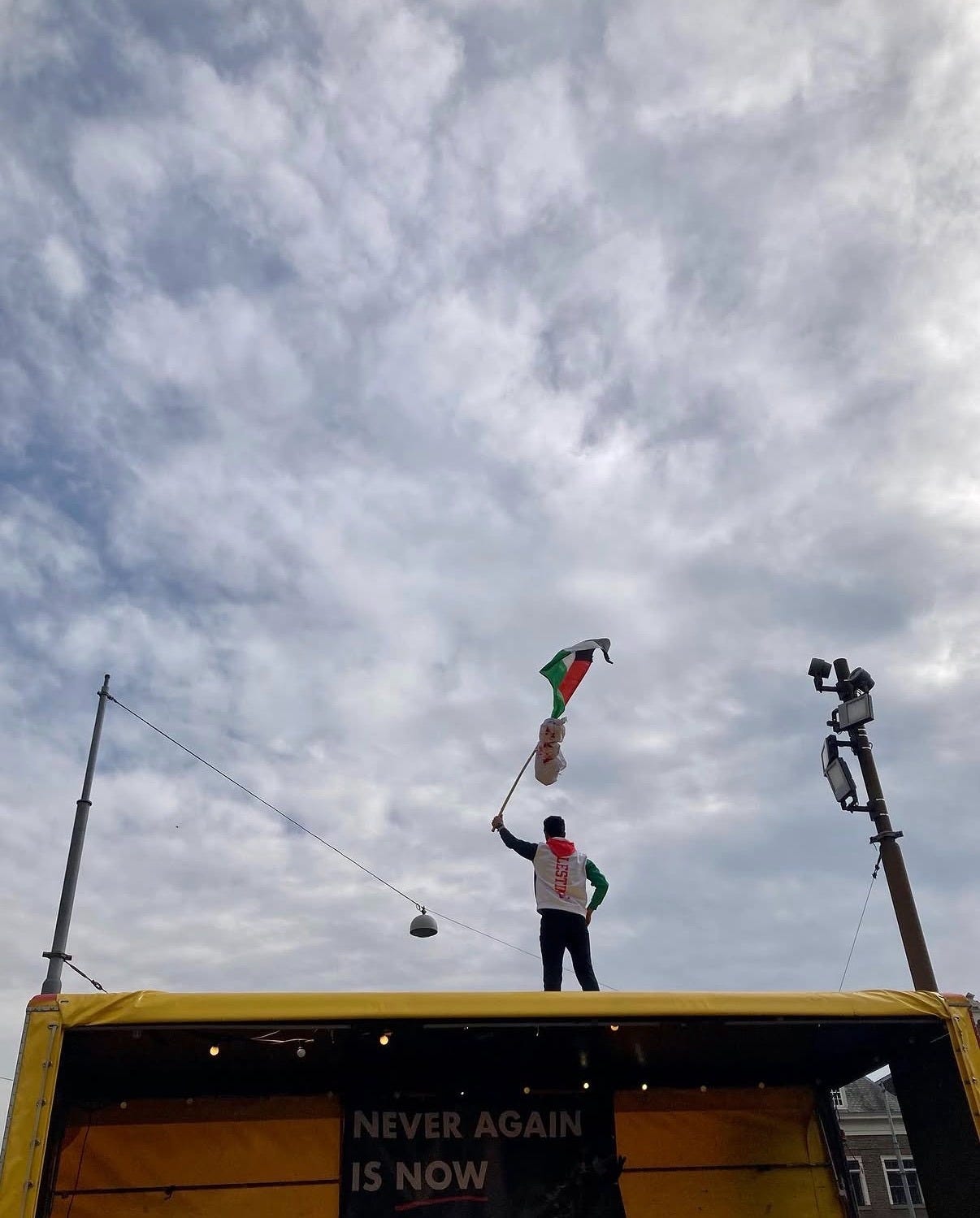
The thing that I like about Kokanje is that it is a book wherein collectivity is very much not just political. It goes back to a kind of human experience of togetherness and joy, a joy that can be pivotal in the right historical movement; it can lead to rebellion, but that’s not the point of it. The point is doing what humans have to do, and like to do, and obviously I wrote this during COVID when we couldn’t do any of those things, which was also the time that we did them anyway. Like in Black Lives Matter, that was that enormous…I remember being at the largest demos of my life during COVID and that was beautiful. It was something that we hadn’t done for so long and we were kind of starved for.
I remember cycling to the big demo that we had in the Dam, the first one in the center of Amsterdam. We didn’t have these very strict lockdowns that some other places had—we had strict enough lockdowns, like nobody could go to work, you can’t go to shops, whatever. But looking around me and being in these very busy cycle lanes that we have in the Netherlands, I was thinking: all these people that I see around me here, they’re all going to the same place. We’re all going to that demo. That was so beautiful.
A lot of that feeling—of the power of the masses, the power of human collectivity, and the joy that comes from it, the transformative power that it has—went into that book, which is about a bunch of people who set out to find the mythical land of Kokanje, i.e. the land of plenty. We call it luilekkerland—like, “lazy, delicious land”—where the houses are made of cake, fried chickens fly through the air, the rivers are made of wine. It’s a kind of pushback against the Protestant idea that everything good, you have to deserve. I think that’s holding a lot of political movements back as well: how people think that in order to be a good environmentalist, in order to be a good socialist, you have to suffer—you have to inflict all kinds of terrible things on yourself, because otherwise you’re being a hypocrite, or you’re not true to the calls or whatever. I think that’s dangerous, and bad—and we should all have fun and fight for a future.
Comments
Nothing yet. Say the first thing.
Sign in to join the conversation.