
For the past few weeks, I’ve been obsessing over my kitchen at Kemble Cottage. I wasn’t spiraling because it wasn’t good…I actually felt like I had the shell pretty dialed in. The layout worked and the bones and proportions felt right. On paper, I probably should have moved on.
But whenever I would go back to glance at it, I had the same thought: it has the shell, but not the soul.
I hate flat spaces. It’s probably my biggest fear as a designer. I don’t mean visually flat, because there are plenty of beautiful rooms that don’t leave much of an impression. I really mean a room without a point of view; one that goes in too many (or not enough) directions. I want all of my rooms to make people stop and think, “I want to borrow something from this room.” I’m never not chasing that moment.
I’ve also put a lot of pressure on this project, which probably isn’t helping. It’s my own house, I’ve been sharing the process publicly, and I know people are following along. I’ve talked about this before, but it’s much easier to make decisions for a client than it is for your own family. You can conjure a vision of what they need more clearly because you aren’t as close. I’m experiencing the whole “shoemaker without shoes” idea.
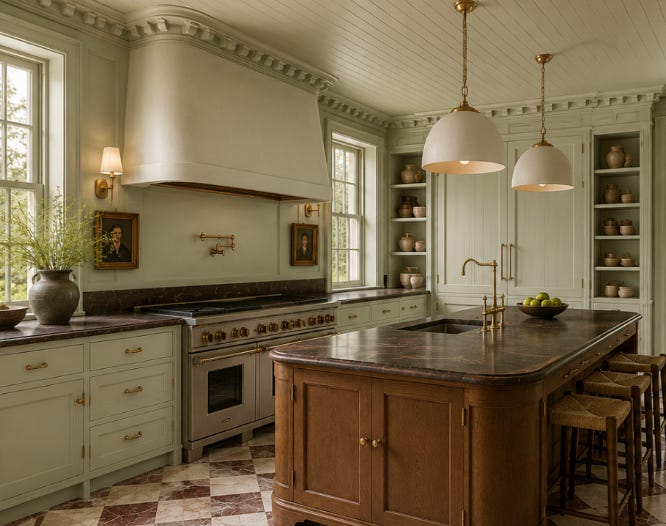
The missing piece was harder to pinpoint because I wasn’t lacking one big design move, but dozens of tiny ones. I needed to zoom in on the pillowed edge of a plaster hood, an ornate yet refined molding profile, and the way the stone will (or won’t) die into the wall. I had neglected to consider a few things that don’t matter much on their own, like the thickness of the countertop and the reveal around cabinet doors. But once you layer enough of those elements together, a room starts to take on a personality. I’d gotten so focused on getting the big picture right that I’d forgotten to take my own advice and remember that the beauty is in the details.
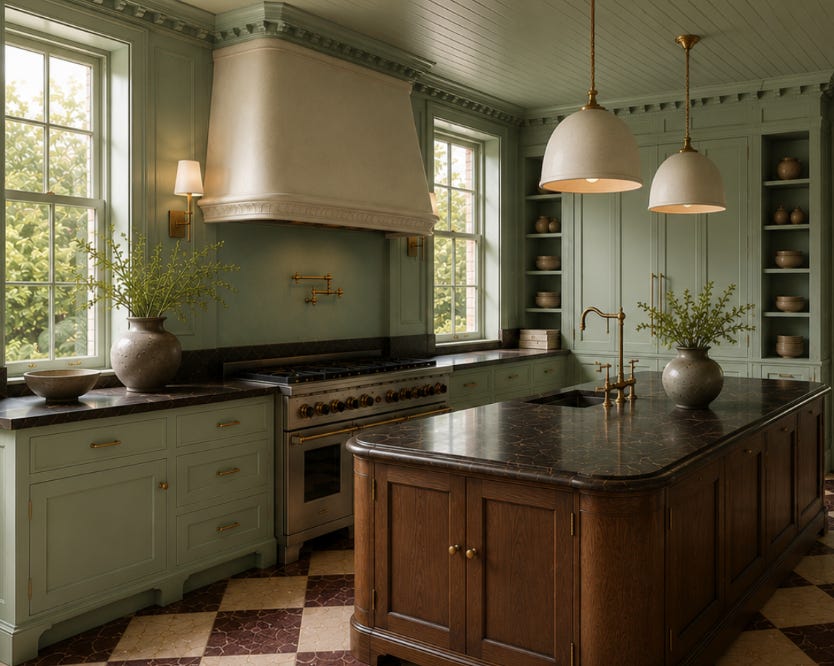
Then there’s the color. Kemble Cottage sits in front of the most incredible park and gardens. It’s one of those rare city properties where every window frames a different view, and because the landscape changes constantly, the house feels different every time you walk through it. I found myself wanting the kitchen to respect that more. My instinct was to let the view be the hero, so I started with this fresh, crisp, almost acidic green that felt like an extension of the garden.
The more I sat with it, though, the more I wondered if I was asking too little of the room. Should the kitchen simply support the view outside, or should it have a voice of its own?
The answer came from something I hadn’t really considered before. Every room facing a beautiful landscape has two completely different lives. During the day, the landscape pours in through the windows. At night, those same windows become mirrors. When the garden disappears, the room has to carry a feeling by itself.
That changed the way I thought about the design. I stopped asking what the right green was and started asking what the room would have to offer after sunset. Sidenote (pun intended), it is entirely possible that I still end up with some shade of green in the kitchen.
One thing we talk about all the time in the studio is studying before we design. Before anyone starts drawing cabinetry or choosing stone, we’re looking. Like, really looking. Why does one room feel calm while another feels restless? Why does one plaster hood feel sculptural and another feel heavy? Why does one room feel layered but not busy? Sometimes the room we’re studying doesn’t resemble the project we’re working on at all. That doesn’t matter. We’re not studying the room itself, but the choices that make it work.
It’s no different than writing. You wouldn’t sit down to write without gathering your thoughts, making an outline, or doing a few first drafts. You would probably think about authors or essays you love. Studying is how we make the design version of an outline. It’s how we remind ourselves of the importance of proportion, restraint, and tension.
Lately I’ve found myself returning to rooms by Pierre Yovanovitch, Giancarlo Valle, Joseph Dirand, deVOL, and Jamb London over and over again. Not because I want a Pierre or Giancarlo kitchen replica, but because each of them solves problems in a way that teaches me something. Pierre reminds me to add whimsy and humor. Giancarlo reminds me to take risks and lean into unexpected colors. Dirand is a master of proportion and sophistication. deVOL understands the importance of imperfection better than almost any designer. Jamb lighting fixtures have an inimitable sense of permanence.
I want to know the thinking behind the room or object, not copy the look.
I think that’s one of the biggest misconceptions about inspiration, especially in these algorithm-driven times. People imagine designers collecting images so they can recreate them. In reality, the longer I’ve been doing this, the less interested I am in borrowing someone’s aesthetic and the more interested I become in understanding which of their decisions made the space work.
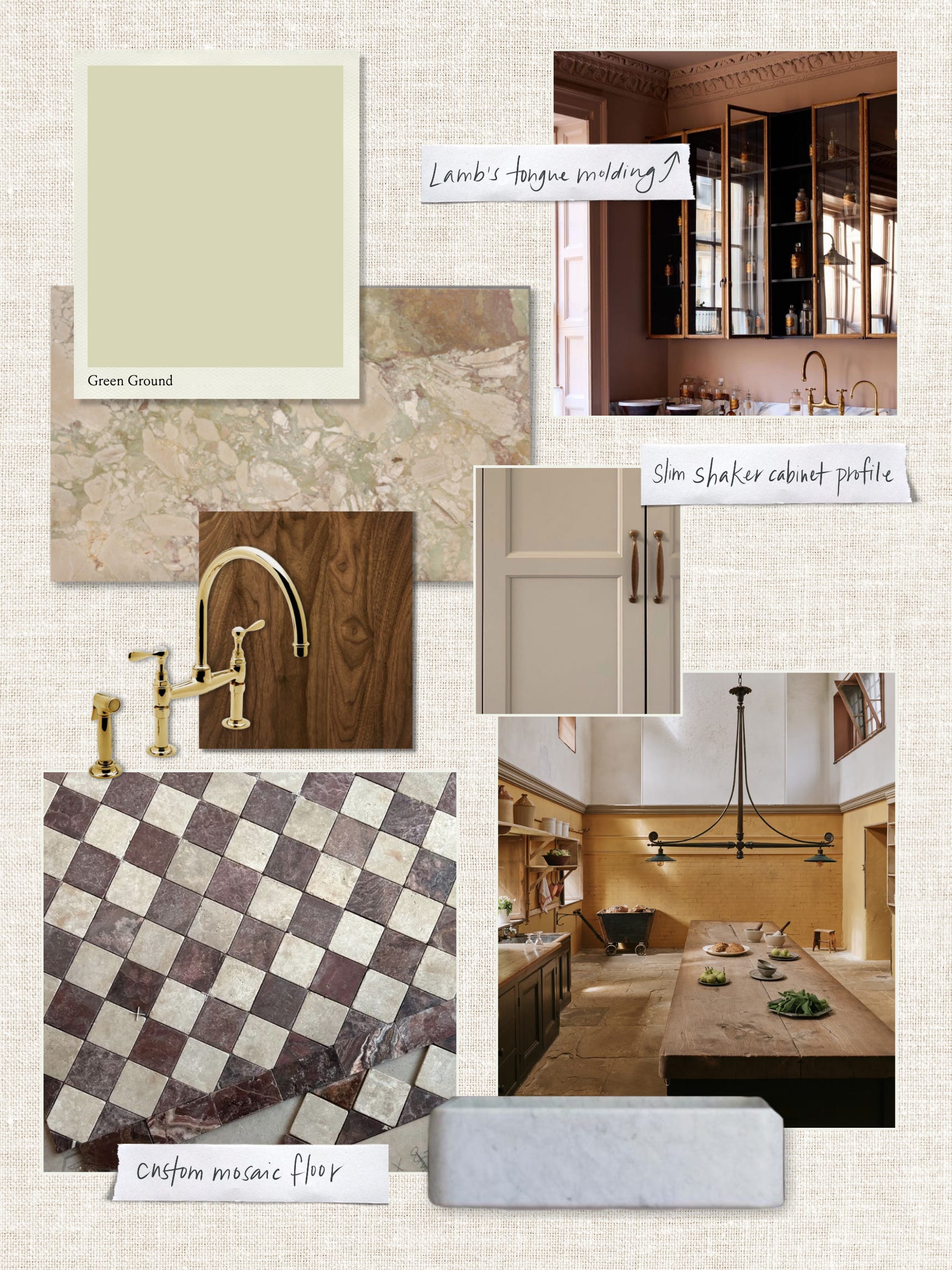
So here’s where I am today: I’m still changing the color and moving moldings around. I still don’t know how high the stone should climb up the backsplash. I’m editing!
But I’m glad I haven’t finished the kitchen yet. It’s finally starting to show me what it wants to be, and I feel like I’m asking the right questions by treating the process like I would a client’s. Could this mean less winging it in my future? I can only hope.

No posts
Comments
Nothing yet. Say the first thing.
Sign in to join the conversation.