

As the music industry scrambles to make sense of AI music — trying to hide it, label it, delete it, or blacklist it outright — the gaps in language and understanding only get clearer. Part of the problem is that “AI music” gets used as a catch-all, and a catch-all creates an instant connotation, even when the reality underneath it is anything but uniform.
Every argument about AI and music makes the same mistake: it treats four distinct economies as one industry, as if they shared a goal, a technology, or a community. They don’t.
Here we’ll discuss these four different economies, who they’re serving, and how they fit into the greater music industry.
These four overlap at the edges. But understanding AI’s role in music starts with figuring out which of the four you’re actually talking about — and right now, most of the industry, and most of the discussion surrounding it, isn’t doing that.
The “AI music” catch-all label isn’t doing anyone any favors.

Active Listening is the version of AI music the major labels are most eager to embrace: AI-powered remixing, stem-swapping, voice-cloned fan edits, and other interactive experiences built around music people already know. Spotify, Udio’s upcoming Starstruck app, KLAY Vision, the app suite emerging from A Vinyl Bar in Shibuya, Hook, Starchild, and others are all chasing variations on the same bet — that superfans will pay to remix music they love rather than create something new.
It’s also the version that fits most comfortably inside the existing music business. Artists opt in, rights get licensed, and catalogs stay central. Universal Music Group, Warner Music Group, Sony Music Entertainment, Believe, and Merlin have all signed deals with various platforms to fold their artists into this ecosystem (if they opt in, of course). The enthusiasm in the industry is undeniable and well-documented, because this is an AI music future the industry can underwrite. It doesn’t require surrendering any of its existing structure, it just adds a new monetizable layer on top.
Like we’ve said before about this genre, for all the partnerships and keynote attention, though, Active Listening remains largely unproven. It gets the press releases because it’s the version the industry can most easily imagine controlling — not because anyone’s confirmed that fans actually want it. The real question is still open: will anyone care?
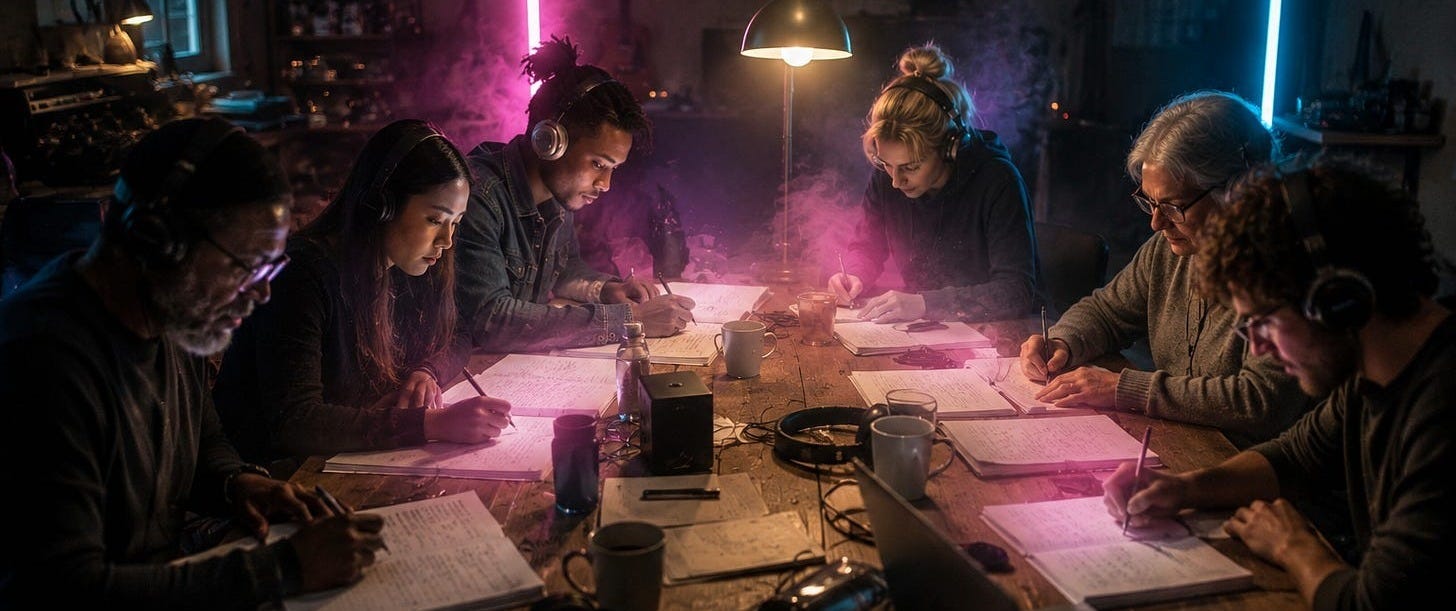
The largest AI music population may also be the one the industry fears the most and understands the least. Call them Creator Communities — Suno-native creators building songs, videos, album art, fictional artists, and entire backstories for audiences often measured in hundreds or thousands. Zinstrel encounters creators in these communities on a daily basis. Most have no interest in a record deal, mainstream radio, or acceptance from the conventional music business. They aren’t waiting to break through. They’re building somewhere else entirely, and much of it never touches a traditional DSP. Their motivations aren’t what you might expect.
That doesn’t mean nobody’s making money. A recent Kapwing analysis using Songstats and AiMCharts data estimated the 10 largest AI music acts had collectively generated around $6.1 million from more than 2.3 billion Spotify streams and YouTube views. But breakout viral names like Xania Monet, Solomon Ray, and Breaking Rust aren’t the norm in this space; most of this economy happily lives in Discord servers, Reddit threads, Twitch streams, and Facebook groups, where success looks more like participation and social recognition than chart position.
This community also absorbs the brunt of the industry’s new rules.
With 90.4% of artists in SIQA’s verified Q1 submission pool using Suno, their work is tangled up in that platform’s legal baggage — how much of these songs can even be copyrighted? — on top of a flood of low-effort AI songs hitting DSPs that makes life harder for creators doing genuinely intentional work. It’s why groups like SIQA, the AI Music Creators Association, and AIMRO have emerged: to formally draw a line between artists building real personas and styles, and the stream farmers flooding the market with agentic slop.

Hybrid Production is the most under-built of the four — and the one where we believe music as a whole is heading. Here, AI is unmistakably a tool in the artist’s hand rather than a replacement for their decisions. It demands real musical skill or taste, yet the tools arriving now are closing the intimidation gap for people who never learned a DAW, without asking them to abandon the production methods musicians already trust. BandLab’s SongStarter, LANDR, and Moises got there first with lighter-touch AI assistance; newer entrants like Riffle and Tamber go further into composition, separation, customization, and arrangement while still leaving the artist in charge of the bigger creative decisions.
This should be the easiest category for the industry to embrace at the cultural level. It preserves human authorship, echoes past waves of production-software adoption, and offers real practical upside without asking listeners to accept a fully synthetic performer. Instead, it remains surprisingly underdeveloped. Mapped against venture taxonomies from the broader AI market — heavy on copilots and workflow tools that extend human capability — the music side of that investment is thin by comparison (although growing). Even live performance and hardware, where human musicians and AI could interact most visibly, barely register, although with hybrid initiatives like Fires of Ardentara and the AI.LOVE.JAZZ contest, that’s changing too.
There’s a second, quieter consequence of that underinvestment: because these tools are built to sit inside a normal production workflow, a song made with them may never carry an “AI” label at all. It’s the same session, just faster — which is exactly why Hybrid Production doesn’t generate the controversy of Suno-driven Creator Communities or the industry affection Active Listening gets. That may be precisely why it’s starved of attention, even though it’s arguably the category best positioned to reconcile “AI-assisted” with “artist-led.”
Hidden AI use is already running underneath the rest of the business: AI-generated demos, synthetic background vocals, automated production elements, undisclosed voice manipulation, and generative material folded into releases still marketed as fully human-made.
In the demo world, Suno is already replacing work that used to require musicians and studio time, like demos. A songwriter can now generate a convincing version of a finished song before anyone else plays a note. That doesn’t automatically make the final release AI-generated, but it does mean AI is now part of the commercial pipeline, and the industry still has almost no shared language for how much involvement should require disclosure.
Suno CEO Mikey Shulman famously said his platform has become “the Ozempic” of the music industry: everyone’s using it, and nobody’s talking about it.
Notably, the legal and cultural scrutiny keeps landing on Creator Communities, not on what labels themselves are producing — Warner’s lawsuit-ending arrangement with Suno has terms that are unknown to the wider industry. Meanwhile, Warner-owned Spinnin’ Records released The Second Voice’s viral “LET ME BE,” which has topped SIQA’s AI music chart.
The double standard shows up case by case. Fenix Flexin’s “Rubberz” went viral this summer, and despite persistent doubts from producers and fans, our evidence that the song was AI-generated, and Treblo’s own assertions about the song’s origins, Fenix maintains the voice on the track is his. Tyga’s 1980s synth-pop side project track “GAVE U RACKS” has drawn a similar debate. And when Australian DJ Josh Fawaz finally disclosed generative AI vocals and drums on his chart-topping “Like a Prayer” cover — following an investigation and public scrutiny — the song stayed in the country’s Top 5 anyway.
Hidden AI use in the industry doesn’t look like a scandal waiting to happen. Instead, it’s an economy the industry is already living inside without having decided how — or whether — to name it. And unlike Creator Communities, it carries none of the reputational baggage, with all of the convenience.
None of these four economies is going away, and they all solve different problems for different people, with different tools and different stakes.
Collapsing all of that into a single label — “AI music” — isn’t just imprecise, it’s actively unhelpful. There is another phenomenon sitting outside these four creative economies: automated slop farming, where the human effectively disappears from the creative loop. Maybe that is what “AI music” should actually describe.
In all of the aforementioned economies, a human has to be somewhere in the mix. And in all of these, the creators care deeply about what they’re putting out into the world.
Poor labeling lets bad actors hide next to good-faith artists, it lets an untested bet get treated as inevitable, and it lets a genuinely useful category go underfunded because nobody’s arguing about it. Or if they are arguing about it, they’re confusing it with one of the other three.
If the industry, the press, the platforms, and the culture at large want to make good decisions about any of this, they’ll need to be more specific. Say what you mean when you say “AI music.”
ENZO RITCH – Beautiful Disaster (R&B / Soul)
Goldie Songs – REGAL (R&B / Soul)
Leea – Entretenimento (Pop)
Stored Nerve – Name on my Arm (Rock / Alternative)
Dakota Decrypt – “Duality of the Cosmic Collapse” Single (Electronic / Dance)
Fake Perfection – “Hit Me” Single (Rock / Alternative)
Gracie – “Unconditionally” Single (Pop)
Ione – “The TikTok Support Loop” Single (Electronic / Dance)
Jestress – “The Fifth Path” Single (Hip-Hop / Rap)
Kojo Osei – “Deadly” Single (Afro-R&B)
Winther + Dezbal – “CONTROL” Single (Rock / Alternative)
1sev7n feat. Jailhouse Lock and From June To December – “The Swarm” Music Video (Electronic / Dance)
The opening track to ENZO RITCH’s new album, Beautiful Disaster, brings an atmospheric blend of R&B, soul, and hip-hop together.
“Every new technology changes the creative process. The people who understand music usually become the ones who use that technology best.”
— Masters Radio Founder Rob Snyder, via LinkedIn

MORE ZINSTREL: Written by Marcus Lawrence, courtesy of composition platform Versey.ai
Zinstrel.com | @zinstrel_ai on Instagram | AI Underground on Discord | r/Zinstrel
Copyright 2025-2026 Zinstrel, LLC - All rights reserved
Special thanks to our paid subscribers: C.Y. Lee, Daryl Dekking, Lynn Clapp, Steve Clapp, Mete Dibi, Daniel Lares, Dexter Garcia, Matthew Marturano, Sammy Stoltz, Tim Burley, Drew Thurlow, Sheila Spence, Lenny Skolnik, Màuhan Zonoozy, Matti Kuha, and Jacci Cenci-McGrody.
No posts
Comments
Nothing yet. Say the first thing.
Sign in to join the conversation.