

Luminate, the entertainment-data firm behind Billboard’s charts, released new AI attitude data July 24, and it reveals a surprising split within Gen Z. Teenagers are more open to AI music, while 18-to-24-year-olds are sharply against it.
Asked how they’d feel learning a song was made with AI, only one age group says they’d actually be more into it: teenagers, 13 to 17, net positive at +19%. Everybody else is net negative — but it’s not a steady slide from “young and open” to “old and closed.”
Listeners 25 to 44 are only mildly turned off, dipping to just -3%. Then 18-to-24-year-olds plunge to -29%. That’s a cliff, and it lands them almost exactly where their grandparents are: 55-to-64-year-olds reported -30%. Two generations, one nearly identical number. Only listeners 65 and older are more skeptical than both, bottoming out at -47%.
So this isn’t young people warming up to AI music while their parents resist. It’s teenagers standing alone as the one genuinely receptive group, with a slice of young adults landing about as cold on AI music as people three decades older.
Labeling may only exacerbate the broader perception problem. MBW shared a recent Stanford/Reed College study that found listeners imagined fewer and less engaging narratives when music was labeled AI, regardless of whether it was actually human- or AI-composed. The reaction tracked the label more than the music itself, helping fuel AI creators’ growing anti-labeling stance.
Gen Z’s broader distaste for AI has been well documented this year: Gallup and the Walton Family Foundation found rising anger and falling excitement, and Pew finds under-30 adults are simultaneously the most AI-exposed and most pessimistic. But a microgeneration actually warming to AI music is noteworthy for the future of the medium amid a sea of pessimism elsewhere.
Google rolled out a new version of its music-generation model, Lyria 3.5, inside its Flow Music app on July 29. The update focuses on four things: richer melodies, better lyrics that actually follow your prompt, more realistic and emotional-sounding vocals (including cleaner pronunciation), and more control over tempo and song length. There’s a whole playlist available for people to listen to what the new model sounds like.
UMG, Warner, Sony, and eight independents — including HYBE, BMG, Believe, Concord, and Dirty Hit — proposed new rules this week for which AI-involved songs can count on official charts, per Variety. The framework covers authorized AI tools trained on licensed data, copyright and personality-rights compliance, disclosure, and no chart manipulation. The rule doing the heavy lifting remains undefined: a song has to be “substantially human made.”
No chart enforces it yet, Billboard included; it’s just a proposal for now. The bigger problem is that chart compilers generally receive the finished master, not a verifiable record of how it was created. A song with human-written lyrics rendered through AI vocals may be difficult to distinguish from one involving far less human authorship. Under these rules, songs could be treated as fully AI-generated and disqualified despite meaningful human input.
Suno now lets you upload an image on web and edit it just by typing what you want changed — you can generate either a new still image or a short video out of it. It works across song covers, playlists, and your profile picture and banner. It continues Suno’s push to build out the whole visual side of an artist’s presence on the platform.
AI music platform Treblo released an open-source classifier on Aug. 3 that detects whether a song was generated on its own platform, claiming a false positive rate below 1 in 10,000.
Additionally, co-founder Ryan Tremblay officially confirmed what Zinstrel and AI detection firm HumanStandard reported back in June: Fenix Flexin’s hit summer song, “RUBBERZ,” was created with Treblo.
“We built Treblo for everyone, from normal people experimenting at home to charting artists looking for new sounds,” he said. “Someone appears to have used our model to find a sound that millions of people connected with and that’s exciting.”
The classifier currently only detects Treblo’s own models. The company says it’s working to extend coverage to other major platforms.
With this confirmation, Tremblay says “RUBBERZ” becomes the first known AI-generated song to reach the Billboard Hot 100. It also contradicts the repeated denials the Shoreline Mafia member has made regarding the song’s AI use.
Treblo shared three links alongside the announcement. A blog post at treblo.com/blog/treblo-ai-music-classifier lays out the company’s rationale and results. A web classifier at treblo.com/detect lets anyone upload or link a song and get a probability score for whether it was made on Treblo — no account or technical background required. And an open-source repo at github.com/Sonauto/treblo-classifier makes the underlying model available to developers, researchers, or competing platforms who want to run it themselves or build on it.
The news lands as scrutiny of “RUBBERZ” is already resurfacing. Seven of the 15 dates on Fenix Flexin’s tour — Seattle, Sacramento, San Diego, Santa Ana, Los Angeles, Tucson, and Brooklyn — are now marked “Cancelled,” with no explanation given. The cancellations follow a viral video from creator medasin, “The Reckoning of Fenix Flexin & Purps,” that’s put the AI allegations in front of a much bigger audience.
Fenix Flexin’s public stance has also shifted since June: rather than denying AI involvement outright, he’s now saying only that he “never lied.”
Mureka launched a new feature in its Editor suite called Download Score that turns your AI-generated song into actual sheet music with chords, right inside its editor. Mureka’s pitching it for a few uses: playing your song on a real instrument, pulling the chords into a DAW to keep producing, studying the song’s structure, or using it for collaboration and copyright registration. That last one is the interesting part — notated sheet music may make a song easier to document and submit, but it doesn’t resolve whether the underlying AI-generated composition qualifies for copyright protection.
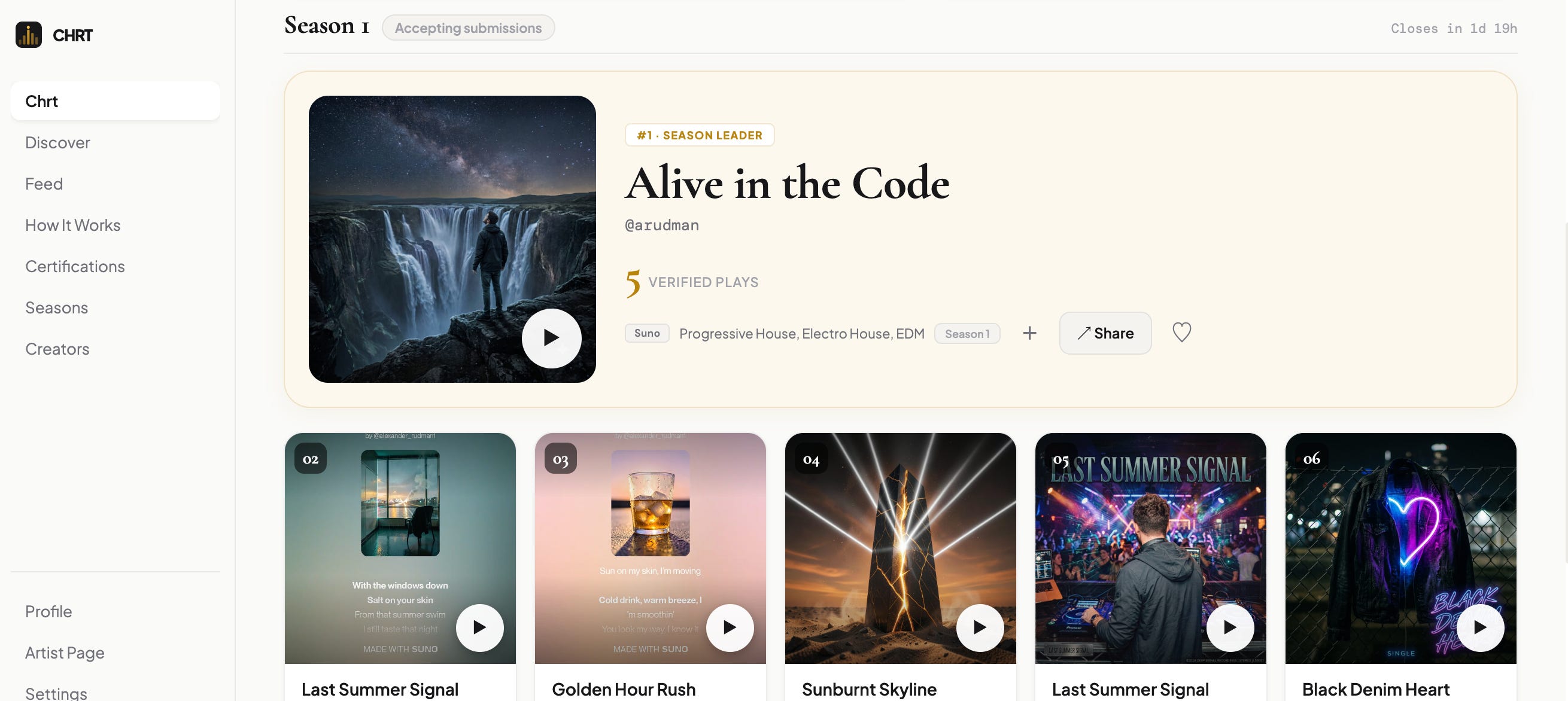
While major labels are trying to get AI songs banned from official charts, the AI music world continues to try to develop its own charts. A new platform called CHRT Music just launched, and it only ranks AI-generated songs. It runs on three-week “seasons” that overlap on purpose, so a new submission window opens the moment the last one closes, and ranking is based on verified human plays rather than judges. Creators earn permanent badges as they hit certain play-count milestones, and whoever tops a season gets a spot in CHRT’s Hall of Fame. Free accounts get five submissions a month; paying unlocks unlimited. CHRT is stepping into territory already covered by SIQA and UpChart, but leaning into the certification and season format as its angle.
Mobvision, a Discord-run AI music contest, crowned its third-edition winner last week: Chilean producer Kaiman, for his earworm track “WiggityWippity-DopBopShoWop-SugarCoat-SweetTalk-SodaPopDrop” by his virtual project, Duchess of the Damned.
“Unless a legacy corporation controls your creativity and profits from your revenue, your work has no recognized value and is barred from free and fair access to fans.”
— Mark Grissom, owner and music publisher at Grissom Music Group, announcing a new AI advocacy group, the Association of AI-Assisted Creators & Fans

MORE ZINSTREL: Written by Marcus Lawrence, courtesy of composition platform Versey.ai
Zinstrel.com | @zinstrel_ai on IG | AI Underground on Discord
Copyright 2026 Zinstrel, LLC - All rights reserved
Special thanks to our paid subscribers: C.Y. Lee, Daryl Dekking, Lynn Clapp, Steve Clapp, Mete Dibi, Daniel Lares, Dexter Garcia, Matthew Marturano, Sammy Stoltz, Tim Burley, Drew Thurlow, Sheila Spence, Lenny Skolnik, Màuhan Zonoozy, Matti Kuha, and Jacci Cenci-McGrody.
No posts
Comments
Nothing yet. Say the first thing.
Sign in to join the conversation.