
Unitree prices IPO at $9B, first mainland-listed humanoid maker
→ 2,760x oversubscribed, 150.8 yuan/share raising $900M for R&D and manufacturing → Why humanoid sales (867.8M yuan) overtaking quadrupeds signals market maturity: real revenue, real profits, not speculation
Dyna Robotics’ Dyna-2 proves human-to-robot scaling law
→ 1M+ hours egocentric human video pre-training, zero-shot performs 39 robot tasks across embodiments
→ What monotonic scaling from 1K to 1M hours demonstrates: lockbox tasks unsolvable at 100K hours, 90% success at 1M
HII commits $900M to Path Robotics and GrayMatter over 7 years
→ Autonomous welding, sanding, grinding across Navy shipbuilding (carriers, subs, destroyers, unmanned vessels)
→ Why performance-based agreements with tech readiness gates signal procurement maturity vs R&D contracts
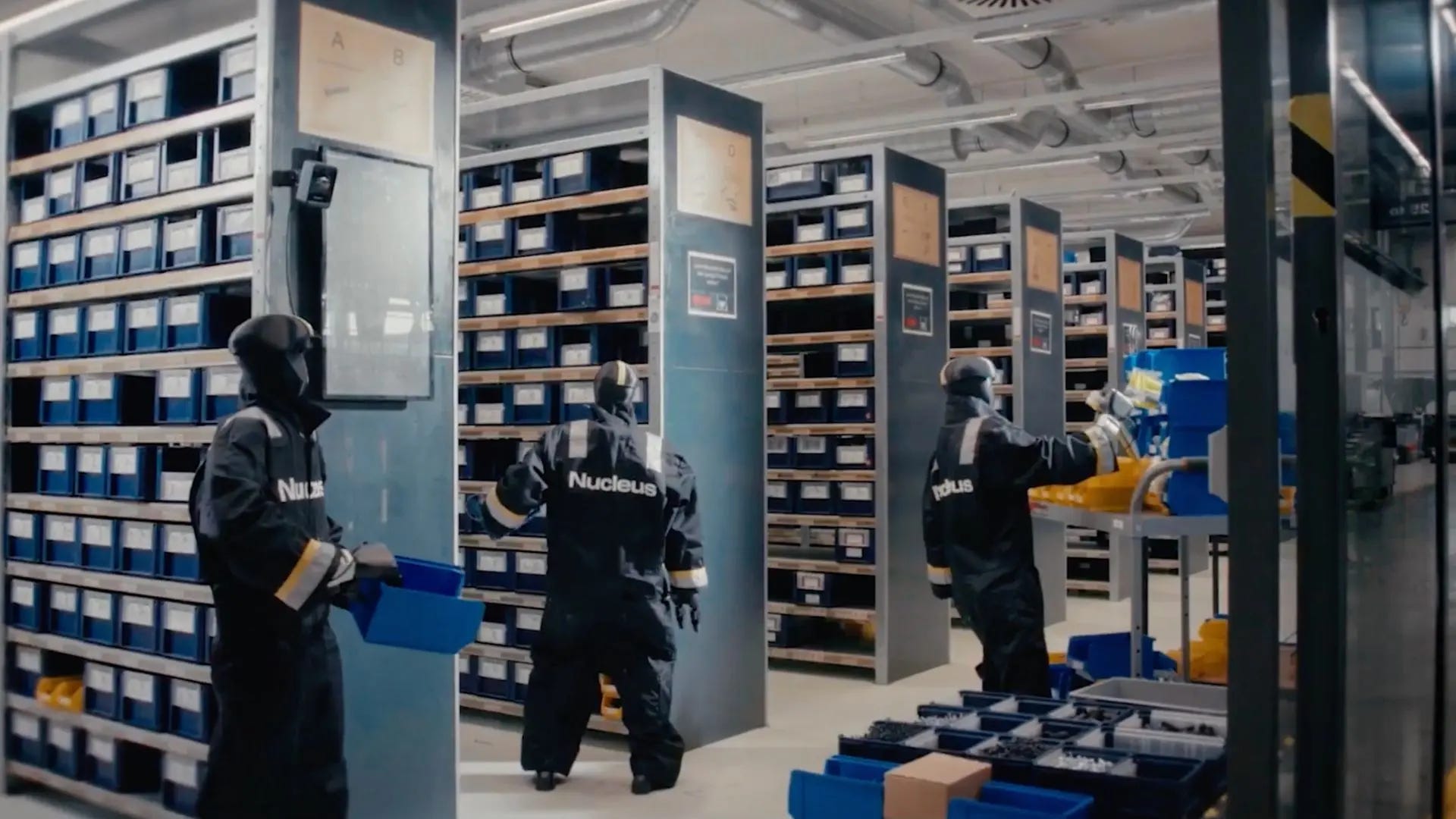
Nucleus Robotics deploys in operating factory in <90 days
→ Hardware-independent control software enabling multi-vendor humanoid coordination layer
→ Why intelligence layer (perception, planning, real-time adaptation, fleet coordination) matters more than locking to single vendor
Niantic/NVIDIA/Flexion compress months of adaptation to days
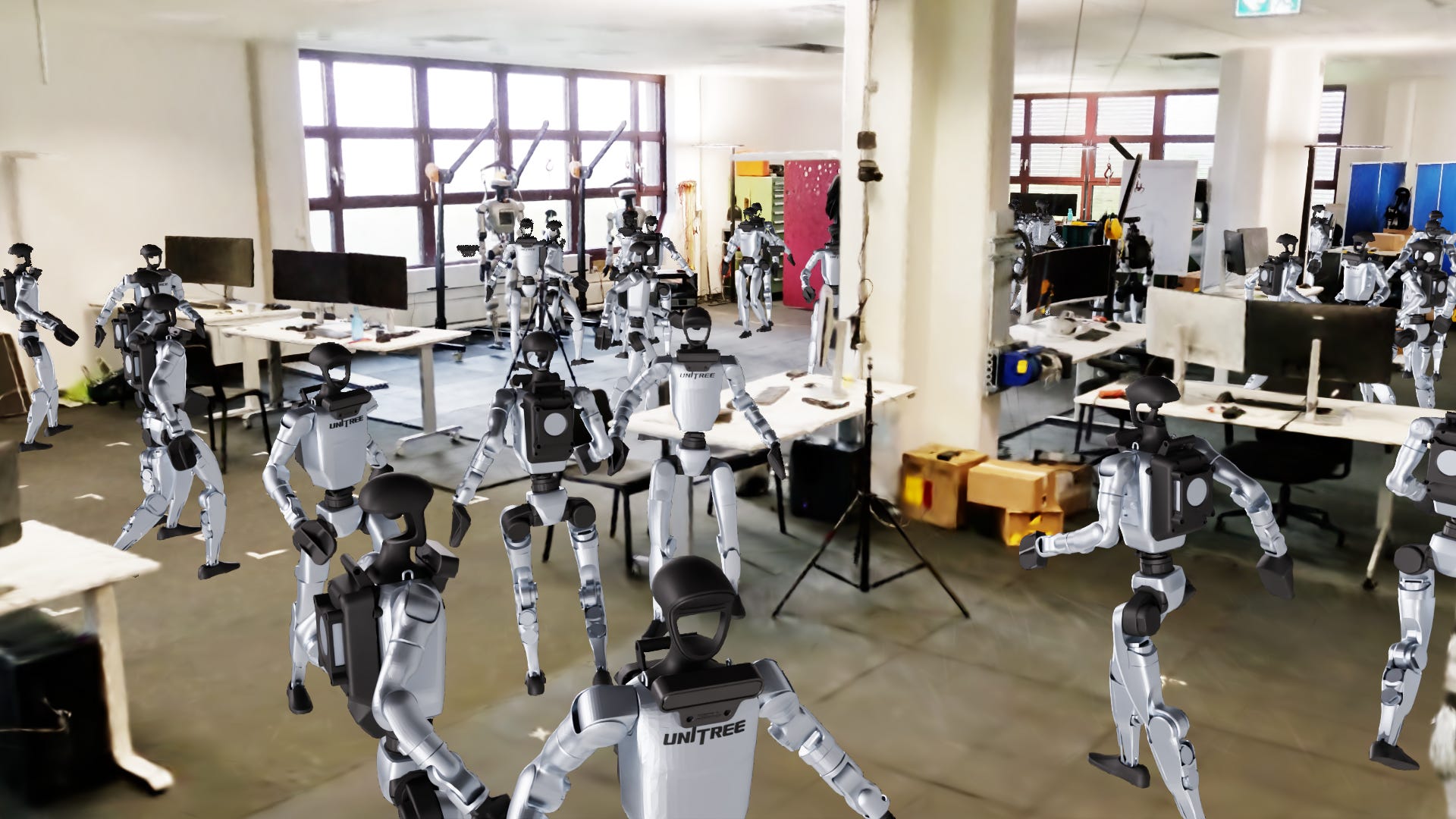
→ Photorealistic office scan enables RGB-only policy training with zero real-world fine-tuning
→ What real2sim photorealistic 3D Gaussian splats matching collision meshes reveal: visual and physics layers must agree or miscalibration transfers to hardware
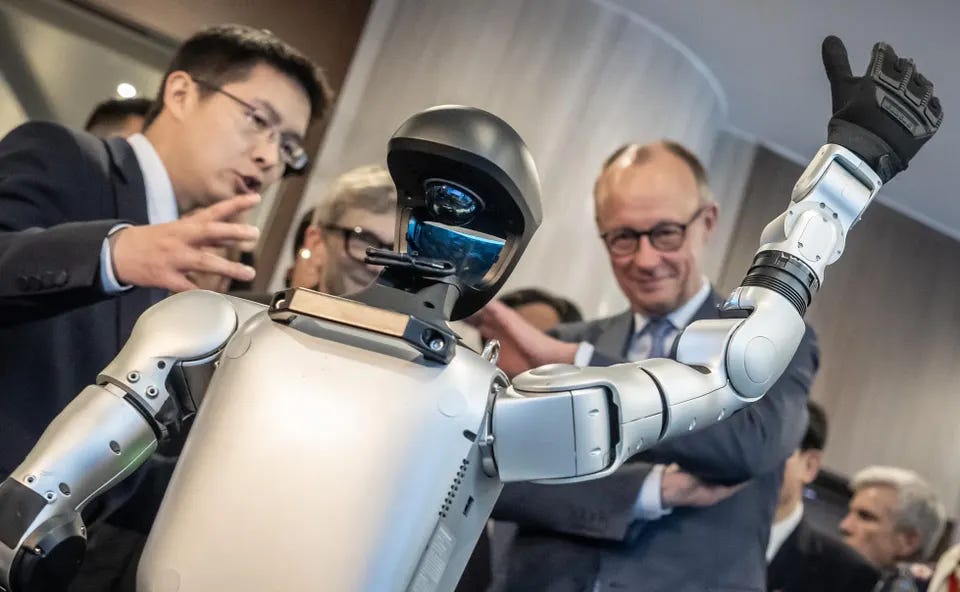
China’s Unitree has priced its Shanghai initial public offering at 150.8 yuan ($22.34) per share, valuing the company at around 61 billion yuan ($9.04 billion), in a deal that would make it the country’s first mainland-listed maker of humanoid robots. In a filing to the Shanghai Stock Exchange, Unitree, also known as Yushu Technology, said it was seeking to raise 6.1 billion yuan (roughly $900 million). The Hangzhou-based company is selling 40.45 million new shares, or 10% of its enlarged share capital, on Shanghai’s STAR Market, with Chinese AI company DeepSeek among the strategic investors. IPO subscriptions open August 10, with proceeds going toward robot software and hardware, new products, and building a manufacturing base.
The numbers in the prospectus are extraordinary for a hardware company. Overall revenue more than quadrupled to 1.7 billion yuan in 2025, with humanoid robots generating 867.8 million yuan in sales and overtaking four-legged robots as Unitree’s largest business. The company is profitable, and from 2023 to 2025 it sold 33,294 quadruped robots and 5,632 humanoids. Founded in 2016 by Wang Xingxing with cheap robot dogs, Unitree has completed an extraordinary 10-year arc to become the world’s first publicly listed humanoid robot manufacturer. Investor appetite has been staggering: the offering was reportedly oversubscribed by 2,760 times, with demand during the offline subscription process equivalent to 71.46 billion shares.
The same week as the IPO, Unitree quietly dropped a new low-cost modular humanoid starting at $4,290, with 31 degrees of freedom and flexible deployment. For context, Tesla’s Optimus is estimated at $20,000-$30,000. That pricing underscores how aggressively Chinese manufacturers are driving down the cost of humanoid hardware, even as the market runs hot on real revenue, real profits, and real products rather than pure speculation.
But the geopolitical backdrop is impossible to ignore. The IPO comes as the United States and China ratchet up trade and technology tensions, with Washington tightening Chinese access to U.S. technology and markets, including new restrictions on foreign-made humanoid and four-legged robots—and Beijing responding with export curbs and sanctions. U.S. sales accounted for 13.3% of Unitree’s revenue last year, and while its existing robots have U.S. approvals, future models could be barred from sale there entirely.
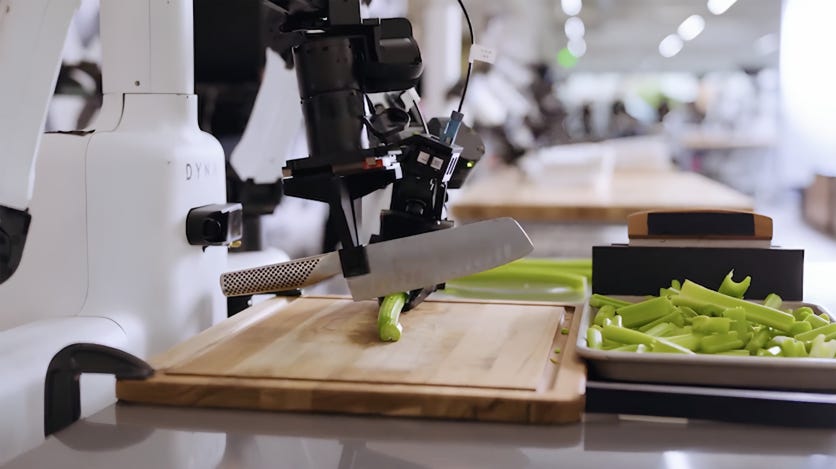
Dyna Robotics has introduced Dyna-2, a new flagship world-action model (WAM) pre-trained on more than one million hours of egocentric human video—roughly 170 years of continuous waking experience. The model establishes several novel scaling laws, most notably proving for the first time that a human-to-robot transfer scaling law exists: more human data in pre-training improves prediction on robot data the model has never seen, with zero robot data used during pre-training. The core bet is that the right source of pre-training data is sensorized video of humans performing everyday tasks, which already exists at effectively unbounded scale and carries exactly what a manipulation policy needs to learn, how scenes evolve, how objects respond to contact, and how hands interact with them.
Dyna-2 is a single generative model that can denoise future video and future actions jointly or separately, built on a video-diffusion backbone. Trained on a corpus of over one million hours (43.8 million clips, 97,160 unique task instructions, 9,917 distinct objects), the model shows that held-out prediction improves monotonically and follows a clean power law all the way to the million-hour scale. Crucially, that same trend transfers across the embodiment gap: evaluated zero-shot on 39 robot tasks across two embodiments, performance predictably improves as purely human data grows, with an inflection point emerging between 10k and 100k hours of pre-training.
The scaling law carries through to real robots in post-training. With just a few hours of robot data—and no robot data during pre-training—Dyna-2 performs tasks across bi-manual parallel-jaw arms, semi-humanoid, and dexterous hand platforms, with mean normalized performance rising from 20% to 53% as pre-training scales from 1k to 1M hours. Some tasks require a threshold amount of pre-training before becoming solvable at all: Lockbox Key Turning was never solved up to 100,000 hours, but at one million hours it succeeded 90% of the time. In one striking example, just 13 minutes of teleoperation data was enough to fine-tune the model to open bottle caps using two five-fingered robot hands.
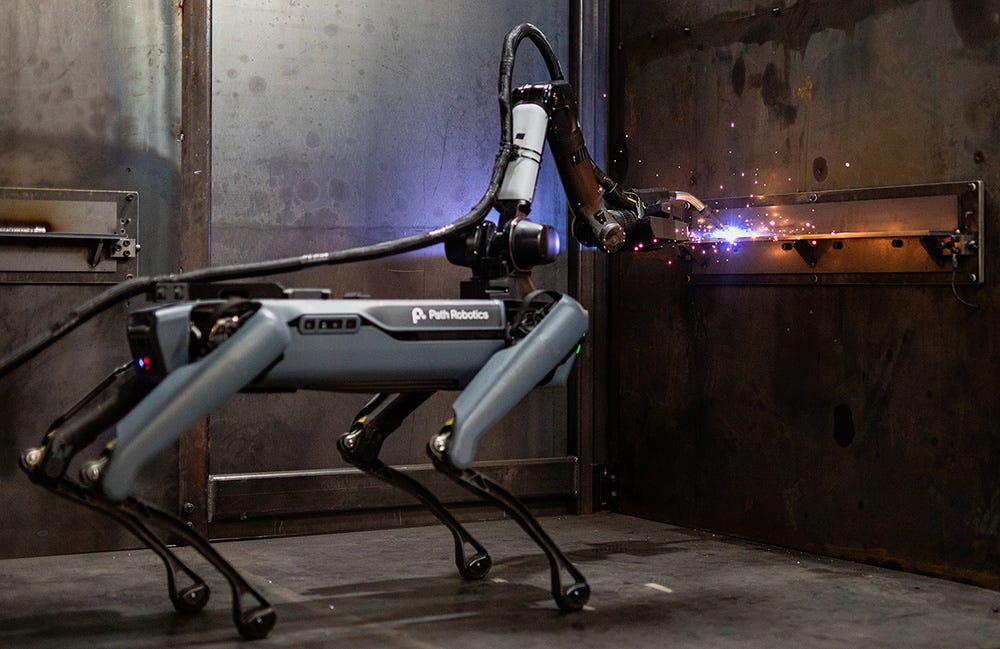
Huntington Ingalls Industries (HII) has announced long-term performance-based production agreements with GrayMatter Robotics and Path Robotics, intending to award up to $900 million in total shipbuilding work across seven years. Path Robotics provides robotic welding technology, while GrayMatter offers robotic sanding systems.
Both companies are part of HII’s High-Yield Production Robotics (HYPR) program, launched in April, which aims to accelerate advanced, adaptive automation in the fabrication of both crewed and uncrewed naval platforms. The funding is contingent on the two companies meeting clearly defined technology and manufacturing readiness, as well as performance milestones. With the agreement, HII plans to accelerate development and deployment of physical AI across U.S. Navy shipbuilding programs, including aircraft carriers, submarines, destroyers, amphibious ships, future frigates, and unmanned surface vessels.
The agreements include two stages. In the development stage, both companies will partner with HII to develop, validate, and qualify high-precision production techniques applicable across autonomous welding, grinding, blasting, painting, assembly, and inspection, then integrate them into an autonomous production line. For instance, Rove pairs Path Robotics’ Obsidian physical AI model with a quadruped robot to bring autonomous welding beyond fixed cells, deploying directly onto large assemblies and immovable structures.
In the delivery stage, HII will begin sourcing shipbuilding work from both companies through the new line, contingent on favorable cost, schedule, and quality performance, starting with small steel structures and growing to include units and modules. In 2026, HII plans to outsource more than 2.5 million hours of shipbuilding work, a 30% increase from 2025, while expanding its structural assembly network to enable more work to be completed outside the shipyards before final assembly.
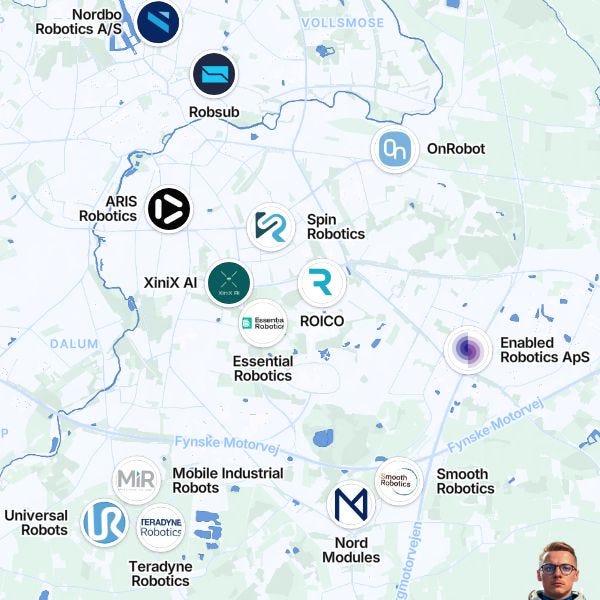
Danish city of robotics! 🇩🇰
When I arrived in Odense in 2024, the first thing I saw was robots. Lots of them.
Cleaning robots greeted me at the station, an autonomous one trailing advertising banners rolled past, and a few minutes later I spotted UR robots playing tic-tac-toe in a shop window.
Odense is one of Europe’s strongest robotics ecosystems, especially for collaborative and industrial robots.
Nucleus Robotics has emerged from stealth, with founder Melvin Schwarz announcing via X that the German company deployed humanoid robots inside an operating factory in under 90 days. The announcement serves as the first public test of Nucleus Robotics’ core pitch: software that helps humanoid robots adapt to existing industrial sites without rebuilding production lines.
Nucleus Robotics describes its core technology as an intelligence layer spanning perception, task planning, real-time adaptation, and fleet coordination for industrial humanoid operations. Registered in Gütersloh in February 2026, the company’s framework covers imitation-based training, real-time monitoring, and teleoperation capabilities for handling complex exception cases. By focusing on hardware-independent control software, Nucleus Robotics aims to enable manufacturers to add new robotic systems without locking factory workflows into a single hardware vendor.
Schwarz previously co-founded VisionAI before assembling a European robotics team with experience spanning major automation enterprises, research institutions, and aerospace organizations. The startup is now positioning its operator software layer to capture deployment management as manufacturers increasingly test humanoids from various global hardware suppliers, a bet that the future of industrial robotics will be multi-vendor, and that whoever controls the coordination layer will hold a valuable position in the stack.
A collaboration between Niantic Spatial, NVIDIA, and Flexion Robotics has demonstrated something striking: a humanoid can learn to navigate a real office by training entirely inside a photorealistic scan of that office, then walk it with no real-world fine-tuning, using RGB camera vision instead of a depth sensor. The weight of the story is in the economics of deployment. Reinforcement learning is the scalable way to teach a humanoid to navigate, but a robot doesn’t get many second chances in the real world,a misjudged gap or a collision with a glass door is expensive and can damage hardware. So training happens in simulation, which raises the question: how do you know a policy will hold up at a specific site before the robot arrives?
Simulated worlds are usually randomized, untextured geometry, because depth is easy to simulate. But that leaves the robot blind to materials, semantics, and what things actually are. RGB is what humanoids already carry and encodes both geometry and meaning, but you can only train an RGB policy if the simulated imagery genuinely looks real. The unlock: if the training world is a faithful reconstruction of the actual deployment site, RGB becomes trainable—and the policy specializes in the building it will work in. Deploying to a new environment has traditionally taken months of on-site adaptation; this pipeline compresses that to days.
Each company owns a distinct piece. Niantic Spatial handles “real2sim”, turning a real place into a high-fidelity, simulatable copy from a few minutes of video off an off-the-shelf 360° camera, no LiDAR or specialist workflow. Crucially, the visual layer (a photorealistic 3D Gaussian splat) and the physics layer (the collision mesh) come from one reconstruction, so they agree by construction. Most pipelines build geometry separately and try to register the two—and if a rendered wall and a collision wall disagree by a few centimeters, the robot carries that miscalibration onto real hardware. NVIDIA handles training: the splat and mesh export as a single USDZ matching NVIDIA’s NuRec spec, loading directly into Isaac Sim and Isaac Lab, gravity-aligned and collider-ready with no manual conversion. Flexion handles “sim2real,” training an RGB-only navigation policy inside the reconstruction using domain randomization plus large-scale offline-trained image encoders that produce robust features on real imagery.

Comments
Nothing yet. Say the first thing.
Sign in to join the conversation.