

If you’re anything like me, you’ll find the American healthcare system to be a confusing and sometimes intimidating web of policies, payments, and restrictions. You can go to this specialist, but not that one. These medications are covered by your insurance, but not those ones. Your bill is $1,000, but you only need to pay $100 out of pocket. If American healthcare coverage was a game, it would be Tetris; you have all these different pieces that fit together in a certain way, and if you can’t find a way to make them fit, game over!
One big part of this game is the role of employers. As of 2022, over half of Americans get their health insurance through their work. To most of us, this practice seems normal at this point, but have you ever stopped to wonder whether it’s actually a standard practice around the world? Do other countries get their healthcare coverage through their employers? And if not, why did we start doing that?
The U.S. is one of the only nations in the world with a multi-payer healthcare system (we’ll talk about some of the other types of systems in a minute) but without a universal coverage option. In this system, healthcare coverage is not guaranteed for every citizen, and those who do have it, can get it from a variety of private and government funded options. Here are the primary options for obtaining health insurance in the U.S.:
Employer provided (55%): A majority of Americans receive healthcare coverage through their employer. In most cases, the employer pays a majority (sometimes all) of the cost of an individual’s health insurance premiums. This means, as I’m sure many of you know, when you leave or change jobs, your coverage goes bye bye (or you sign up for temporary, and more expensive extended coverage).
Medicare or Medicaid (37%): These are government funded health insurance programs that are offered to certain groups of people. Medicare is for anyone over 65 and Medicaid is for low-income individuals. Many people who use these programs also opt for supplementary insurance coverage if they can, as these two federal programs can sometimes fall short of people’s coverage needs.
Pay directly for private insurance (10%): The most expensive option is to pay out of pocket for private insurance. Why would people do that? Well, this is often the only option for many groups of Americans, including people who are unemployed or self-employed, retirees who aren’t 65 yet, and those who have a job, but whose employer doesn’t offer healthcare coverage.
Just don’t have health insurance (10%): The sad truth is that millions of American simply choose not to or can’t get health insurance due to the high costs and complexity of our system. This results in even higher medical bills for many, and sometimes prolonged financial hardships.
*Percentages shown signify proportion of Americans who used that option in 2022. The numbers exceed 100% due to insurance overlap. For example, someone on Medicare can purchase supplementary private insurance.
The short answer to this question is…no, not really. A system in which employment status determines one’s healthcare coverage is not a normal practice for most other countries. In fact, a majority of wealthy nations essentially guarantee some form of health insurance for all of their residents; some countries even mandate it under threat of financial penalty. The graphic below shows the most common types for healthcare systems across the globe:
Most wealthy countries fall into the top two categories: Universal coverage with single-payer system (think Canada) and Universal coverage with multi-payer system (Germany uses this approach). We’re one of the odd ones out down in the bottom left category (multi-payer system with no universal coverage).
For the most part, other nations that offer health insurance fund it through general tax revenues or premiums collected from individuals. For those countries in which people pay premiums for healthcare, the price is set at a percentage of one’s income and has a maximum contribution cap, so that people don’t end up contributing excessive amounts of money to insurance premiums. In these systems, everyone is guaranteed certain medical services, which for most wealthy nations includes preventative care, hospital care, dental, vision, most prescription drugs, mental health services, rehab, and sometimes long-term and hospice care.
Basically, the difference between the U.S. and most other wealthy countries when it comes to health care coverage boils down to this:
In the U.S., you can get your health insurance from a variety of sources that vary greatly in cost, but financial coverage for basic health services is not guaranteed for everyone.
In other wealthy nations, everyone makes some sort of financial contribution to healthcare that is capped to avoid excessive costs for individuals, and everyone is guaranteed financial coverage for basic health services.
A new way to gain employee loyalty
So, if the American system is unique with its involvement of employers in health insurance, how did we get to this point? Let me assure you, it wasn’t by some grand intentional plan, but rather by a series of arbitrary and chance decisions made over the span of a century.
As more Americans started to work in the industrial sector in the early 20th century, the high potential for workplace injury posed risks to people’s ability to earn money—can’t make money if you’re in the hospital with a broken leg. In response, unions and private insurance companies started offering wage protection policies in exchange for small monthly contributions. Basically, they offered a small financial safety net for workers who got seriously ill or injured on the job; individuals still had to pay for their own medical bills though.
The response for many employers, especially those that wanted to steal employee loyalty from their unions, was to offer injury and sickness wage protection themselves. This eventually led to some companies experimenting with medical insurance options to further strengthen employee loyalty and entice new employees. Insurance companies were generally supportive of these programs because they helped solve the “risk pool” problem. Basically, if health insurance is voluntary (which it was and essentially still is), it’s more likely that people who are at high-risk for health issues will opt in while those who are generally healthy may not. This creates a financial risk for health insurance companies as they will end up paying a lot for medical care. With the advent of employer health care coverage, large groups of employees (both healthy and unhealthy) will join the employer’s plan and de-risk the pool for insurance companies.
During WWII, Congress enacted the Stabilization Act of 1942, which aimed to reduce wartime inflation. Among other things, this act limited how much employers could pay their employees. Without the ability to keep and attract new employees using high salaries, more and more companies began offering health insurance options to sweeten the employment deal. To make the deal even sweeter, these benefits were not subject to taxes. These wartime policies and subsequent employer actions led to an exponential increase in health insurance enrollment across the nation, and forever changed our healthcare system.
Failed U.S. attempts to create a national health insurance
In the early 1900s, medical costs for Americans were rising—changing regulations in the medical field resulted in more doctors going to med school, and therefore needing to charge more for their services. The federal government was not oblivious to these health-related financial hardships. There were many early supporters of government supported health insurance options, especially since many European governments were starting plans of their own in the first few decades of the 20th century. A national health insurance program was part of President Teddy Roosevelts platform for the 1912 election, and around 1916, legislation was introduced in congress that would initiate planning efforts for national sickness, unemployment, and old age insurance. Thanks to opposition from congress and the increasing concerns about the Great War (WWI), which was underway during that time, the legislation failed. That’s strike one.
In the 1940s, President Truman and several members of congress supported multiple legislative efforts to institute a national health insurance program, but all of these attempts were squashed by congress again—strike 2!
A decade later, President Eisenhower, who was not a proponent of comprehensive national healthcare coverage, wanted to at least protect everyone, especially poor and high-risk people, from exorbitant medical bills. His solution was to create a reinsurance program that provided a certain amount of government support to those who have high medical bills. Guess what…also killed by congress. A third swing and a miss by the federal government—you’re out! However, this proposal from President Eisenhower did help inspire later programs such as Medicare and Medicaid, so not a total loss.
With the continued opposition from members of congress and special interest groups, and the growing popularity of employer provided health insurance plans, America had made its health insurance bed, and now we all have to sleep in it.
Here are some facts about American healthcare as of 2022 from commonwealthfund.org. The below facts are based on a comparison between the U.S. and 38 other wealthy nations.
As a percentage of GDP and on a per capita basis, the U.S. spends the most on healthcare but has the lowest average life expectancy.
The U.S. has the highest rate of avoidable deaths (deaths that could have been prevented with medical treatment).
Americans go to the doctor far less than most other rich nations.
The percentage of American adults with multiple chronic conditions is the highest among studied rich countries.
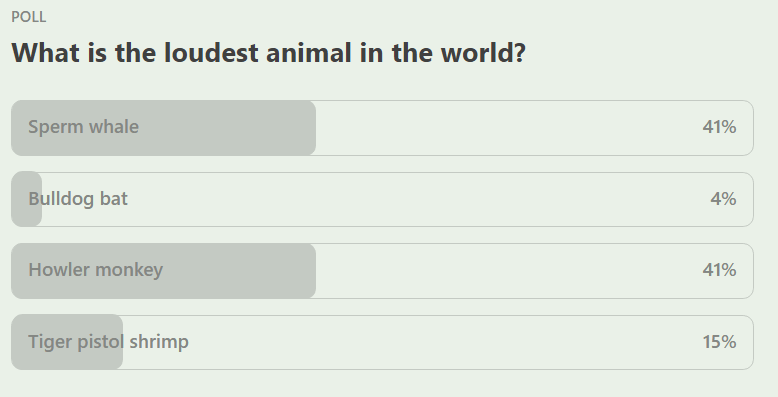
We had a tie last week! But the winner, the loudest animal in the world is…the Sperm Whale! It makes a clicking sound that registers at 230 decibels! Next is the Tiger Pistol Shrimp, which can generate sounds with its claws that hit 200 decibels. Bulldog Bats and Howler Monkeys reach 140 decibels and 128 decibels respectively.
No posts
Comments
Nothing yet. Say the first thing.
Sign in to join the conversation.