
0:00
-53:19
Walking barefoot and blindfolded across a minefield of LEGOs.
Lathering your body head-to-toe in olive oil and sliding down a life-sized cheese grater.
Attempting to rob Kevin McCallister’s home on Christmas Eve.
This is just the shortlist of activities any self-respecting introvert like me might choose over…networking.

Dear Lord did I used to hate networking (and depending on the context, I still do). Given the choice between small talk or shoving hot needles underneath my fingernails? I can always get a manicure afterwards. But the more I “put myself out there,” the more I realized it wasn’t networking that I hated but instead:
Loud noises in crowded spaces.
Monotonous small talk that always begin with, “So what do you do?” (shoot me)
Looking like an idiot interjecting myself in other people’s conversations where I clearly didn’t belong.
Feeling like a used car salesman collecting business cards so I can follow up with my potential “leads.”
The desperate need for a hot shower after spending all night selling the worst version of myself (and then needing days to recover before I had the energy to sell my soul all over again).
A missed opportunity at my 6th grade end-of-year formal perfectly sums up practically every in-person network experience I’ve ever attended.
Picture the stereotypical middle school dance—the girls standing against one wall, the guys standing against the other. A glance here, a gesture there. But nobody is ready to make the first move. What feels like days passes before one courageous (but still very awkward) soul meanders to the middle of the dance floor…then another…and then another. And then before you know it, everyone is dancing, talking, and laughing without a care in the world.
Except me.
Now picture twelve-year old me sitting in the corner all by myself. Yeah…right. Like I’m going out there and looking like a fool. You see, I wasn’t “ready” to dance yet because I didn’t know enough moves. Or the song wasn’t perfect yet. Or the timing wasn’t right. Or that girl I was crushing on might think I look stupid. But then MY SONG starts playing: Pour Some Sugar On Me by Def Leppard! (Yes, I’m a Xennial child of the 80’s.)
But I still didn’t get up. Because I still wasn’t ready.
Here is where the story gets interesting…my dad spots me and sits down to have a chat (Side note: My father was the principal of my school, but this is another topic for another essay…and another session with my therapist). My dad asked me why I wasn’t dancing, especially because the girl I liked was out there, and he knew it was my favorite song. I told him, “I’m waiting for the right time.” And that’s when he hit me with a truth bomb:
“You will never be ready. The timing will never be right. Just get out there.”
And so I did. And dancing like an idiot to Def Leppard is one of my fondest memories of middle school and the first think I think of anytime I hear that song.
Rinse, lather, and repeat this story for the next two decades of my life. I avoided every possible in-person networking opportunity I could, and the ones I did attend I took it upon myself to make sure the back corner of the far end of the room was kept warm. Because no matter who I might want to connect with, I was never “ready,” and the timing was never “right.”
What I ultimately despised about networking events was the notion that I had to “fake it,” inauthentically masquerading myself as The Wolf of Wall Street peddling 100 pounds of bullshit, until I could actually “make it.”
But the harsh reality for an awkwardly introverted creative weirdo like me with zero connections who wanted to make it in a highly competitive industry was clear:
Being awesome at what you do is only half the battle.
The other half is making sure the right people know that you’re awesome.
In my podcast interview with Troy Takaki, the most well-connected person in Hollywood you’ve never heard of, he said:
“You don’t network to get jobs. You network to meet people. And people get you jobs.” - Troy Takaki, ACE
While I wholeheartedly endorse Troy’s sentiment and have shared this quote (and our podcast together) for years, I would add that networking can also be about far more than meeting people for the sake of them helping you get jobs (or clients). Having built a strong support network across three completely different industries over my twenty-five year career, what I’ve discovered is that “networking” doesn’t have to be about schmoozing, working the room, taking from whomever you can convince to give, or selling your soul for your next paycheck. If you’re willing to give first and prioritize building genuine relationships instead of collecting more connections, networking is an enjoyable, rewarding, and even energizing experience...even for awkward introverts like us.
We introverts already possess all the raw materials to become amazing at networking!
It’s not that we crave solitude so much as seeking engaging conversations with interesting people who inspire us (in rooms where we can hear each other speak!).
It’s not that we’re shy so much as waiting patiently for the right kinds of people to share our ideas with who won’t immediately judge us.
It’s not that we’re awkward so much as carefully choosing the right moment to bring value to a conversation where people are willing to actually listen (instead of just waiting for their turn to speak).
It’s not that we hate the game of networking, it’s that we prefer a slow game of chess to a superficial version of speed checkers (or Go Fish!).
It’s not that we hate networking for the sake of getting more work or clients so much as wanting to build genuine relationships so we can build a better life.
Therefore, to expand upon Troy’s thoughts, I’d like to offer the following perspective:
“You don’t just network to get jobs. You network to find your people. And your people help shape who you become.” - Me
Networking is about so much more than gathering more “connections” in search of your next gig, client, or big contract. And networking is about even more than building a successful career or business. According to one of the most extensive scientific studies on human longevity and happiness conducted at Harvard University1, the #1 factor that determines your level of happiness is the quality of your relationships.
With a little patience, perseverance, and a clear networking strategy, your introversion is no longer a liability but can instead become your greatest asset. And here’s the best part: You can build your dream network from the comfort of your laptop.
Everything you’ve ever wanted is on the other side of outreach. And in today’s essay I’ll show you how to write outreach with a 70% response rate that people are not only excited to receive but will also make them eager to respond and help you!
Prologue: Why should you listen to me?
I. WHO to target (and where to find them)
II. How NOT to approach you ideal connections
III. HOW to approach your ideal connections
IV. WHAT to ask (so you don’t blow it)
V. BONUS: The VSA Formula Checklist
If you know someone who struggles with networking but is desperate to make real connections, would you be willing to share this guide with them today?
Before we dive deep into the how (and yeah, this essay goes DEEEEEEEEEEEP), we should first address the elephant in the room...
Just to be clear: You’re about to take networking advice from the founder and acting president of ‘Introverts Anonymous.’ When people see me at in-person events, it’s like a Bigfoot sighting.

I’m definitely not a “people person” (but I do very much consider myself a “person person”). Yet despite my extremely introverted temperament—and despite being raised in a Wisconsin dairy farming community of 412 people and starting with ZERO connections—I’ve built my entire creative career on the quality of my outreach and the genuine relationships those connections have become.
The week before college graduation I sent out one cold email with one résumé attached. It led to one job interview. This led to three years of full-time work as a trailer assistant editor (and then editor).
I edited my first feature film at 25, a job that was referred to me through my network. It was acquired a year later by Fox Searchlight for $4.75 million dollars.
Of the next six feature films I edited, 3 came from warming up my network. Two came from cold outreach. One literally fell in my lap because of a referral from my mentor...whom I connected with via cold outreach.
My first job editing television was the #1 show on cable TV at the time (Burn Notice), and I got the interview via a referral from a mentor...whom I connected with via cold outreach. That one email yielded 4 seasons and 25 episodes of work.
My next four TV jobs—8 seasons of work—all came from a combination of referrals and warming up my existing network.
I landed my lifelong dream job—editing and associate producing Cobra Kai—via cold outreach to a former colleague I hadn’t worked with in years. That one email landed five seasons of work.
6 cold outreach emails.
10 referrals from advocates.
20 years of gainful employment.
And this is in just one industry. At the age of 38 I (brilliantly) decided that I wanted to become an American Ninja Warrior. I had zero connections and zero experience. If I was going to not only learn this sport but also break into this community and get on the show, I needed mentors. And I needed connections.

Three years later I was called by the casting department to compete on the show (twice) simply because my ninja trainer put in a good word (it also helped that my audition reel was kinda badass). And my ninja trainer was willing to take a chance on me because of the other trainer I had been working with for the last three years.
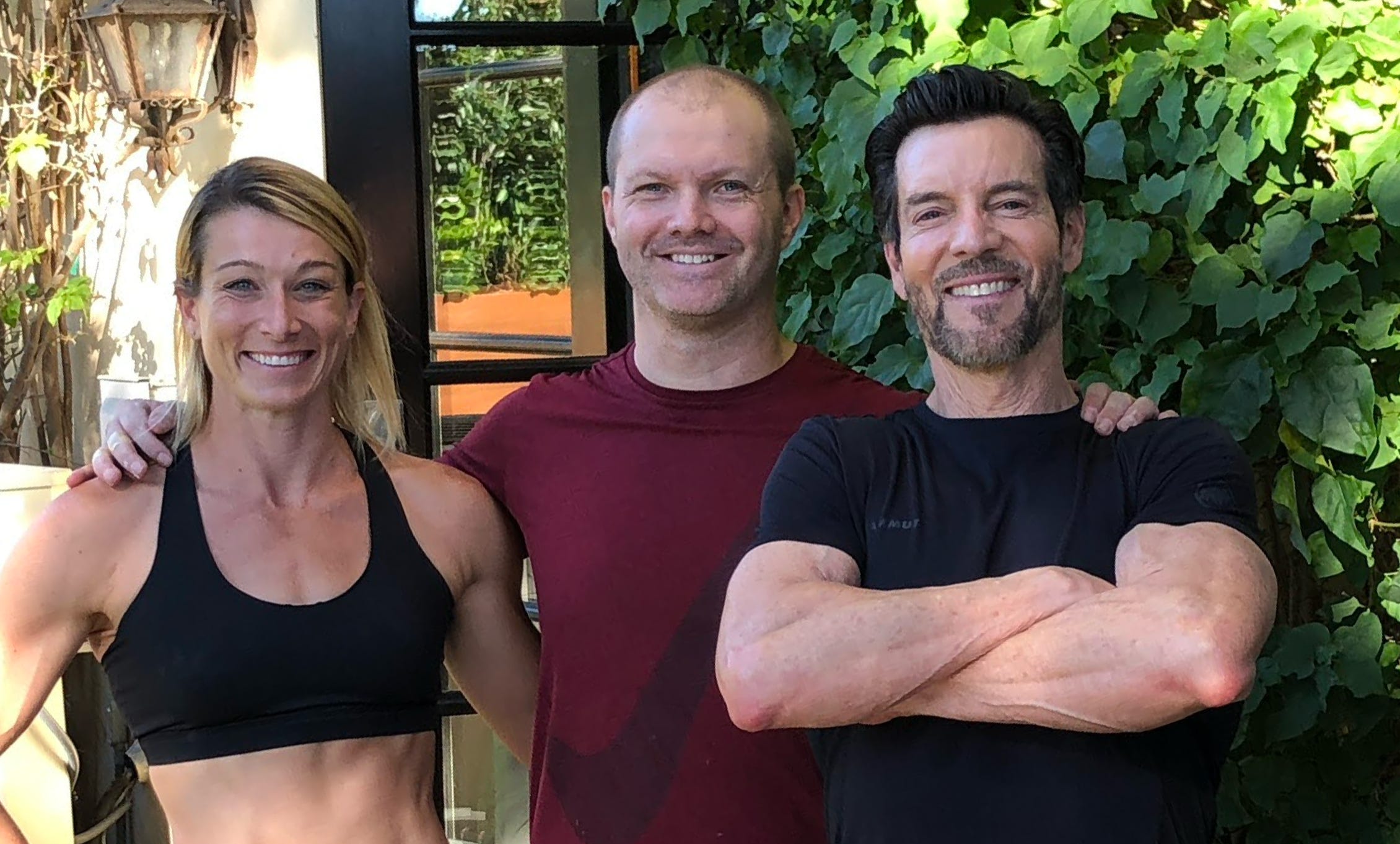
2 cold outreach emails.
2 legendary trainers, mentors, and now friends.
In my 10+ years of hosting The Zack Arnold Podcast, I have yet to break through to the A-list level garnering millions of downloads per episode like Tim Ferriss or Steven Bartlett (Diary of a CEO). Yet I have a lot of similar guests on my “little show” such as NYT Bestselling authors James Clear, Oliver Burkeman, Cal Newport, Greg McKeown, Ramit Sethi, Gretchen Rubin, Annie Duke, and the #1 TED talk of 2025 Amie McNee (to name a very small few). I’ve also talked to countless Oscar and Emmy winners, the former head of Amazon Movies, Olympic medalists, and many many more.
How did I build my roster of hundreds of podcast experts over the years?
You guessed it...
Cold. Outreach.
Well...cold outreach, and some badass introductions from an advocate, that is.
You see, now that I’m pivoting my career away from Hollywood and into the non-fiction space as both an (aspiring) author and public speaker, I have a new mentor just an email away who helps me fill knowledge gaps, who forces me to Re:Think my assumptions, who tells me my book ideas need more thought, and who has facilitated countless introductions to people I might otherwise struggle to connect with.
My author mentor? Adam Grant.

How the hell did NYT Bestselling Author Adam Grant become my mentor? You guessed it again! → Cold. Outreach.
I have built my entire career across three completely separate industries not by schmoozing or working the room, not by selling myself, and not by taking the shotgun approach “spraying and praying” my résumé across cyberspace in hopes someone might take a chance on me.
I have instead built my entire creative career by strategically reaching out to the right people I needed in my network at every stage of my journey who were excited to hear from me and eager to help. And why were they so eager to help little old me? Because I always give more than I take (or at least I hope that’s the case!).
I have built my entire career using a single outreach formula: VSA.
Value. Story. Ask.
But before we get into the nuances of how to approach the right people (and why), we first need to make sure you’re reaching out to the right people in the first place…
The following is the most widely cited quote about the importance of building the right network and surrounding yourself with the right people:
“You are the average of the five people you surround yourself with the most.” - Jim Rohn
In today’s digital age where our real lives are now primarily online and we fill the remaining gaps in the analog world, I still believe believe this general sentiment to be true, but now we become the average of the most frequent content we consume with our eyeballs and voices we allow into our earbuds. Given how easily we can get sucked into the dark abyss of snake oil influencers and enragement bait, one would think the best option is to disconnect altogether, especially highly sensitive introverts like us who JUST. CAN’T.
When approached with the right rules, boundaries, and guardrails, however, the digital world opens a vast ocean of possibilities for us introverts who absolutely detest the in-person networking experience. But saying “I’ll just network online instead” will only lead to infinitely more overwhelm, more rejection, and more despair...unless you have a strategy.
No different than how you might approach saving for retirement by creating a diverse portfolio of investments, when building your network you need a diverse portfolio of relationships far beyond the people you can ping when you’re just looking for the next gig or client. Regardless of your industry or goals, your portfolio should have a healthy assortment of relationships across all five of the following levels:
The Five Levels of Your Network
Peers
Experts
Mentors
Advocates
Gatekeepers
Your peers may include your friends, your colleagues, former classmates, those in groups who share the same passions or unique interests, or other connections you’ve collected over the years. But there’s most likely a vast, untapped network of peers you haven’t even considered.
Your “peers” can be defined as anyone that shares the same goals as you or those who share the same obstacles. In short, you are on similar journeys walking similar paths (in a given context or circumstance).
The key with peers is understand the context of your relationship, not just your job title or standing in the world. For example, you most likely would never consider Steven Spielberg to be a peer of yours. However, what if you and Steven Spielberg were neighbors and shared a property line? (Yes, we’re living in fantasy land, but stick with me here.) Now imagine if a giant tree fell down and crushed the shared fence that separates your properties? In this context, you and Steven Spielberg share a common goal and a common obstacle: You need to get rid of the fallen tree and fix the fence. In this context, you and Steven Spielberg are peers.
When do you need peers?
When you need help troubleshooting
When you need accountability
When you’re learning new things and want to compare notes
When you need support from someone who gets it (and gets you)
When you need a friend
Where can you find your peers?
In-person networking events, panels, and conferences
In-person activities like classes, sports, recreation, etc
Online groups and forums
Social media (but proceed with caution)
Online classes and communities (like → The Arnold Academy!)
Having a strong peer network is vital to not only achieving your goals in work but also building a more fulfilling life. But a strong peer network alone will only get you so far...
The term “expert” is often associated with gurus or masters of their craft, those who know it all and have achieved it all. Across social media and YouTube there is an endless supply of experts proclaiming they know everything. But I promise you...they’re full of shit. If you ask anyone who has actually achieving something meaningful by developing a high level of competence and expertise, they will be the first to tell you they have so much more to learn. (For more on this phenomenon, see → The Dunning-Kruger Effect.) Rather than building your network of the world’s foremost experts in your given field, what if instead you approached those who are just a step or two ahead of you on the exact same path?
Your “experts” can be defined as anyone doing now what you hope to be doing next, those who have overcome the obstacles you are currently struggling with, or those who possess the knowledge and wisdom you seek.
Nobody would characterize an entry-level intern right out of college as an expert, but if your goal is getting the same internship and your obstacle is having no idea how to get your foot in the door, this intern is literally the world’s expert on your current problems.
When do you need “experts”?
When you are unsure of your path
When you are unsure what skills to learn
When you are unsure which knowledge to acquire (and which to avoid)
When you need an objective perspective on your current work
When you need an outside opinion on an upcoming opportunity
Where can you find your “experts”?
Podcasts and books
Online communities (like → The Arnold Academy!)
Social media (again, proceed with immense caution here)
LinkedIn
Industry conferences and panels
Having a variety of “experts” in your network is absolutely vital to achieving your goals, but at some point you’ll need more than someone you can take out to coffee and “pick their brain.”*
*Side note: NEVER reach out to someone cold and ask them out to coffee so you can pick their brain. Trust me on this one.
When you’ve reached the point where asking a few questions of “experts” and filling knowledge gaps isn’t enough to get you to the promised land, you’re going to need mentors.
Your mentors can be defined as experienced and trusted individuals who are invested in your journey and provide you ongoing guidance along the way.
Like your “experts,” mentors have already achieved what you want to achieve next. But they can also empathize with your journey as they’ve been there before. Whether you are Luke seeking his Obi-Wan or Daniel in desperate need of his Mr. Miyagi, the mentors you surround yourself with will determine where your career goes and who you become along the way.
When do you need mentors?
When you’re seeking regular guidance and check-ins
When you need someone to point out your blind spots
When you need someone who can challenge you when you’re stuck
When you need more accountability than peers can provide
When you’re facing difficult decisions and need an outside perspective from someone who has been there
Where can you find your mentors?
All the same places you find your “experts”
Here’s the catch...you can’t just find a mentor. You must earn a mentor. And the only way to do so is by reaching out to someone as your “expert” first, asking good (and thoughtful) questions, taking action, and demonstrating to the right person that you are worth investing in over time.
But even a strong network of mentors isn’t enough to open doors you never could otherwise. At some point you’re going to need an advocate or two.
If you aspire to do more in your work and life then just making the donuts, at some point you’ll need a trusted advocate who vouches for you when nobody else is willing to take a chance on you.
Your advocates can be defined as the trusted advisors who see your potential and are willing to open doors you could never enter otherwise.
You cannot send a stranger cold outreach asking them for an introduction or a referral until you have earned that gesture. I cannot tell you how many people have asked me to refer them for a job when I barely know them and have never worked with them before. Your advocates are putting themselves on the line when they advocate for you. And they will only be willing to do so when they have the confidence you have the skills, experience, the right character, and can provide value to the people they will connect you with.
When do you need advocates?
When you can’t get in the door otherwise
When your work doesn’t speak for itself yet
When you want to connect with a hard-to-reach gatekeeper
When you need someone to vouch for your potential
When you need an edge competing with people more experienced than you
Where can you find your advocates?
Like mentors, advocates cannot be found, they must be earned.
Having a strong network of advocates will most likely be the difference between building the career or business you desire versus stringing together gigs that just pay the bills. But at some point you’ll just have to go for it and connect directly with the gatekeepers.
The time will inevitably come when you must connect with someone who will ultimately decide your fate—will you be brought into the fold? Or left out in the cold? The person making that decision is your gatekeeper.
Depending on your industry or business, your gatekeepers can be defined as either the people hiring you or the clients/customers buying your product or service.These are the decision-makers who control the access to the opportunities and revenue you seek.
You might assume that like mentors or advocates, gatekeepers must also be earned. On the contrary, if you are confident you are the best fit for the opportunities you seek and that you are the best solution to their problems, I’m all for reaching out cold directly to the gatekeepers! If you can make their lives easier, why wouldn’t you?
When do you need gatekeepers?
When you need opportunities
When you need clients and customers
When you need income!!!!!
Where can you find your gatekeepers?
LinkedIn
Jobs boards
Industry panels and conferences
Trade publication announcements
Podcast interviews
Social media
Talent agencies and management companies
Professional associations and guilds
Curated communities and networks (like → The Arnold Academy!)
Your existing network!
For most people, networking is a transactional means leading to the end of getting work. It’s all about selling themselves. Those feelings of shame and disgust are why you need a hot shower after networking events. But if you stop trying to optimize your number of connections and instead approach building your network with the mindset of expanding a diverse portfolio of relationships, the people you connect with can open doors you never imagined possible. That is, if you don’t blow it in our approach...
Having received thousands of (mostly shitty) outreach emails in my career, I have a pretty good sense of what works and what doesn’t. In fact, I collect bad outreach like baseball cards. Before sharing some of the favorites in my collection and breaking down why most approaches fail, it’s imperative that you first step into the mind of the very “busy” person you intend to connect with. This is a process I like to call:
Crawling Into the Brain of Your Recipient.
Take a moment to imagine the ideal person you hope to connect in their daily work environment. Imagine the amount of requests put upon them for their time and their expertise. Imagine them being so busy your message finds them eating lunch at their desk.
Now imagine their email inbox.

While it may seem nearly impossible to compete for a busy person’s valuable attention given how little they have available for the next stranger who lands in their inbox, it is possible to stand out amongst the noise if you give first and provide value to this person. But because “providing value” is such an elusive and overly-used cliché nowadays, and because drafting genuine outreach can be a tedious and time-consuming ordeal, most people opt for the easy route instead.
Here are the five most common mistakes I see people making with their outreach.
Mistake #1: Making it all about YOU
It’s a common mistake to assume your best and only approach is to sell yourself and include every relevant piece of information that will set you apart from your competitors (and of course don’t forget to attach your resume and a link to your website!). But you’ve lost the game immediately if you are making your first message all about you.
From your perspective you might be thinking “This is my one shot!” so you must share all of your credits, your experience, your education, and of course it’s absolutely imperative that you impress them with your uncanny ability to interpret the deeper meaning of their creative choices such that it reads like a graduate film school thesis.
Keep in mind:
A busy person has no problem ignoring your email.
It is not their responsibility to respond to your message.
It is your responsibility to earn their response.
Mistake #2: Your message isn’t personal and reads like a template (or even worse is a group message)
I know how tempting it is to be as efficient as possible with the limited amount of time you have to network. We all love our Macro keyboard commands that get us from 8 keystrokes to 2 keystrokes…but outreach messages are NOT the place to focus on efficiency.
Sending 500 generic messages with a 1% response rate gets you 5 responses…and they’ll be tepid at best. Sending 10 highly personalized, thoughtful, and hand-crafted messages to the right people with a 70% response rate gets you 7 responses…all of which have the potential to lead to a genuine relationship.
Stop hunting with a shotgun and start hunting with a sniper rifle.
Here’s an example of a common template message I’ll receive from acquaintances, colleagues and even strangers:
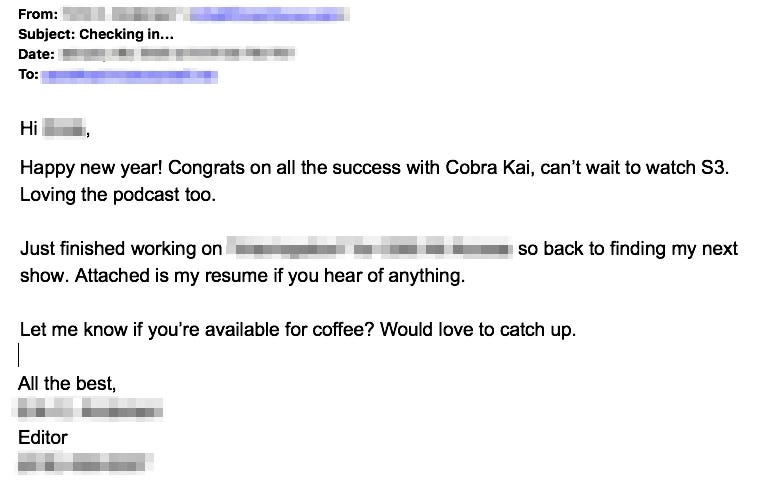
First of all…how do I know this is a template email? Because they used the wrong name! Yes they took the time to personalize the first sentence, but anyone with Google or IMDb can find out in 2 minutes or less what I’ve been working on.
For context, this is an acquaintance I know personally whom I’ve met at several past networking events, and he’s a great guy. I truly want him to succeed. But we’ve never worked together, so I don’t feel comfortable blankly forwarding his résumé for a job without knowing more about his job performance firsthand. And furthermore, I only hear from this person when he’s unemployed. UGH.
Had he instead watched an episode or two of my work or listened to a recent episode of my podcast and commented on something that inspired him, I absolutely 100% would respond. But in this case it’s tough to make the time for coffee or lunch when this technically was written for someone else and not me.
Here’s an example of the (obnoxious) type of group emails I get ALL. THE. TIME.
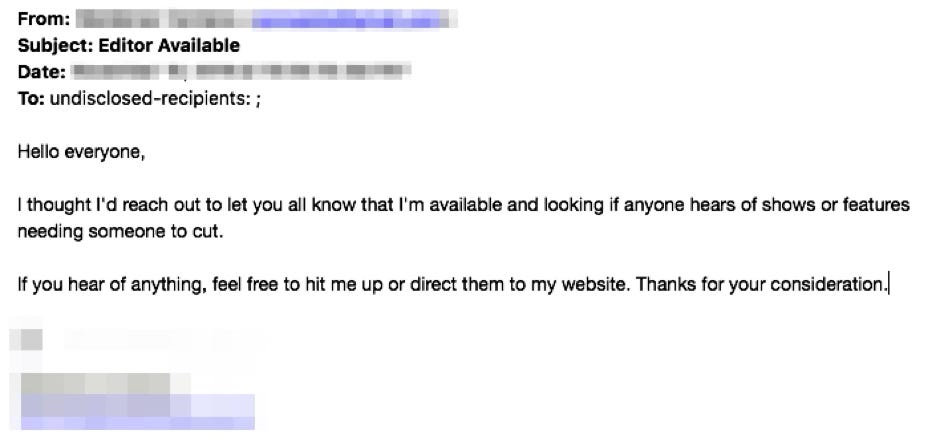
If I don’t know this person, or even if I’ve met them casually but not worked with them before, once again why would I refer them? Vouching for someone puts my reputation on the line. And if I do know this person or I’ve worked with them in the past…why haven’t they made the effort to reach out to me personally?!?!?!
Mistake #3: You get too personal (and send your life story)
Yes yes, I realize I just told you NOT to send a template and instead take the time to craft a personal message. But please don’t send your life story. At best you have two minutes (or less) to get this person’s attention AND have them respond before they are onto other messages and urgent matters in their life. Your life story will have to wait for another conversation.
Here’s the perfect example of a very personal, heartfelt message that is clearly not a template composed just for me (that sat in my inbox because I didn’t have time to either read or respond to it).
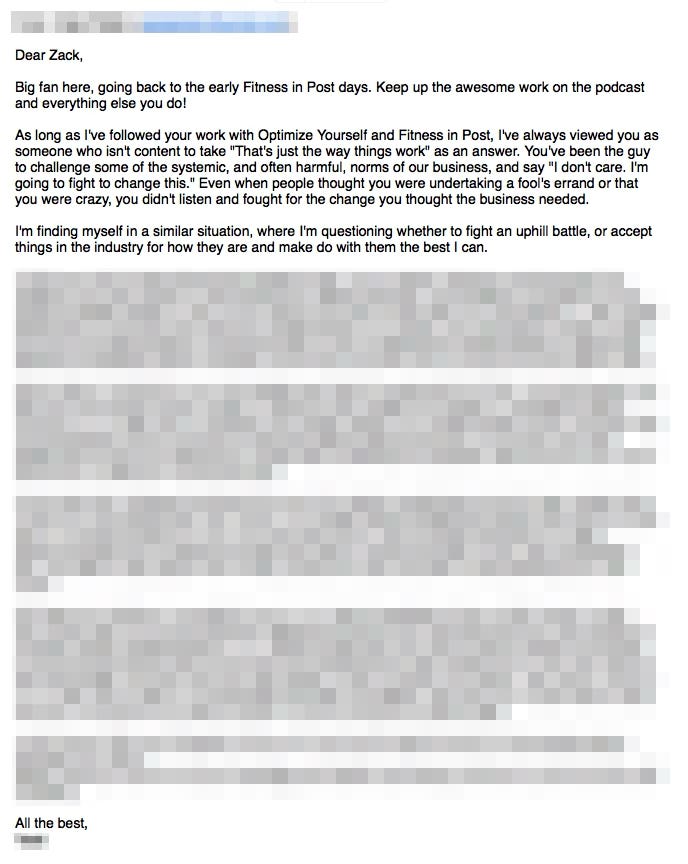
This person’s heart is in the right place, and they’ve clearly done their homework on me, but alas because the email is incredibly long, detailed, and personal—and because crafting an equally thoughtful response will most likely take me HOURS—this will continue to sit on my pile of messages that deserve a response but just don’t fit on my calendar.
Mistake #4: You haven’t made it abundantly clear how this person can help you (or why they should at all)
I can’t tell you how many times I’ve been told by someone desperately struggling, “Nobody wants to help me.”
It’s not that people don’t want to help you.
It’s that you haven’t made it clear how they can help you.
Read that one more time. 👆
Now think for a second about where you are right now in your career. Imagine someone reaching out to you with a similar backstory, similar challenges, and facing the same obstacles that you perhaps overcame just a few years ago to get where you are today. If this person seems genuine and hard working with good intentions, wouldn’t you want to help them succeed? I’ll bet you’d go out of your way to help them! Why? Because they remind you of yourself at that point in your life.
Now imagine receiving a message like this instead:
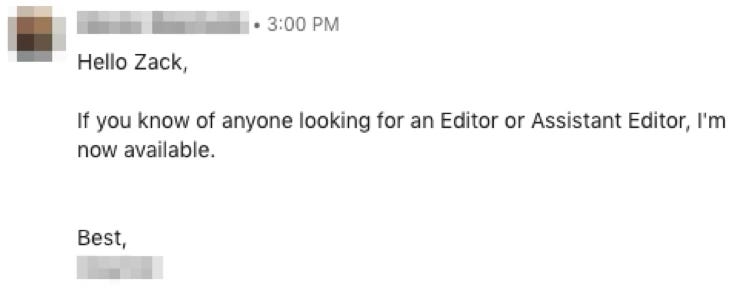
No doubt this person has good intentions, but there’s only one way I can help them: Giving them a job (or referring them). Except I don’t know anything about this person. At all. Why in the world would I consider them for an upcoming job opportunity or refer them if I know NOTHING about them or their past experience? I want to help people, but sorry. This is an instant ‘Delete.’
Mistake #5: Your questions requires a lengthy response (or you’re asking too many questions)
At this point you’ve stopped selling yourself, you’ve ditched the templates, and your message is short and concise. And you’ve also made it clear who you are, what you want, and where you need help. Now it’s time for the ‘ask.’
Here’s a message that’s easy to respond to, doesn’t ask too many questions, and one can certainly respond to quickly, no?

If your first ‘ask’ forces someone to open their calendar, you’ve already lost. Yes this message is easy to respond to…but unfortunately the answer will probably be no—especially if it requires scheduling time in someone’s day they don’t even have for themselves. Furthermore, no matter how brilliant your questions are (or how smart you think they make you look), if they aren’t easy to answer in 2 minutes or less, you’ll once again be filed to the “Someday” pile at best.
Here’s another example of how NOT to ask questions in your cold outreach:
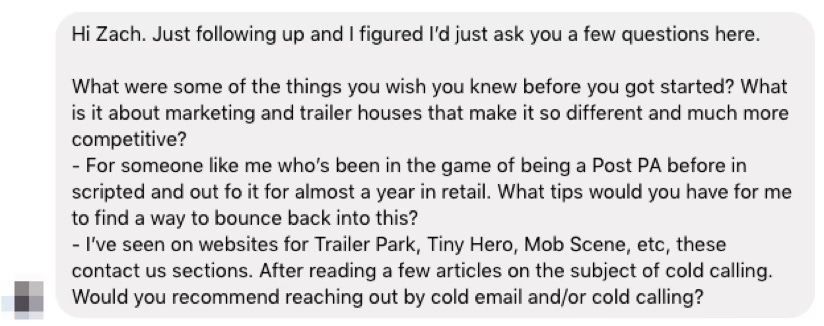
Every single one of these is a great question…and each is a wonderful topic of conversation over lunch or a meet-and-greet phone call. And doing a good job of answering every single one of these questions would take FOR-EV-ER.
No matter if you want to connect via outreach or in person; no matter which level of your network you’re looking to build upon; and no matter whom you’re reaching out to next, you can’t make your approach until you know the answer to the following question:
Who is the hero of the story?
Not to wax too philosophically in a pocket guide about networking, but humans have used storytelling as a means to make sense of our reality since the beginning of time. From cave paintings lit by fire to books read by candlelight to the cold, soul-sucking glow of TikTok, we use stories to understand our place in the world. Everyone is on their own hero’s journey. And the key to building real relationships and connecting with people on a human level is knowing who the hero of the story is in relation to the person you want to connect with and why. If you’re not sure who the hero of the story is, ask yourself:
Whose goals are we talking about?
Whose obstacles are we talking about?
When you are reaching out to an “expert,” YOU are the hero of the story. No really...it’s okay to make it about you! As long as you have provided enough value at the beginning of your approach (more on this elusive idea of “value” below), most people are happy to help you—just as long as you’ve made it clear HOW they can help you by telling a clear story and having a clear and simple ask (more on those below as well).
When reaching out to your experts, the story is about your goals and your obstacles. You are the hero, they are the guide.
As I discussed previously, you are not going to reach out to someone cold and ask them to be your mentor (no really, promise me you’ll never do that). Therefore, if done properly your “experts” will become your mentors. The key to developing this mentor-mentee relationship over time is to continue asking questions that allow this person to help you, listening to their advice, taking action on their advice, and then reporting your results. This is what I call ‘The Cycle of Mentorship.’
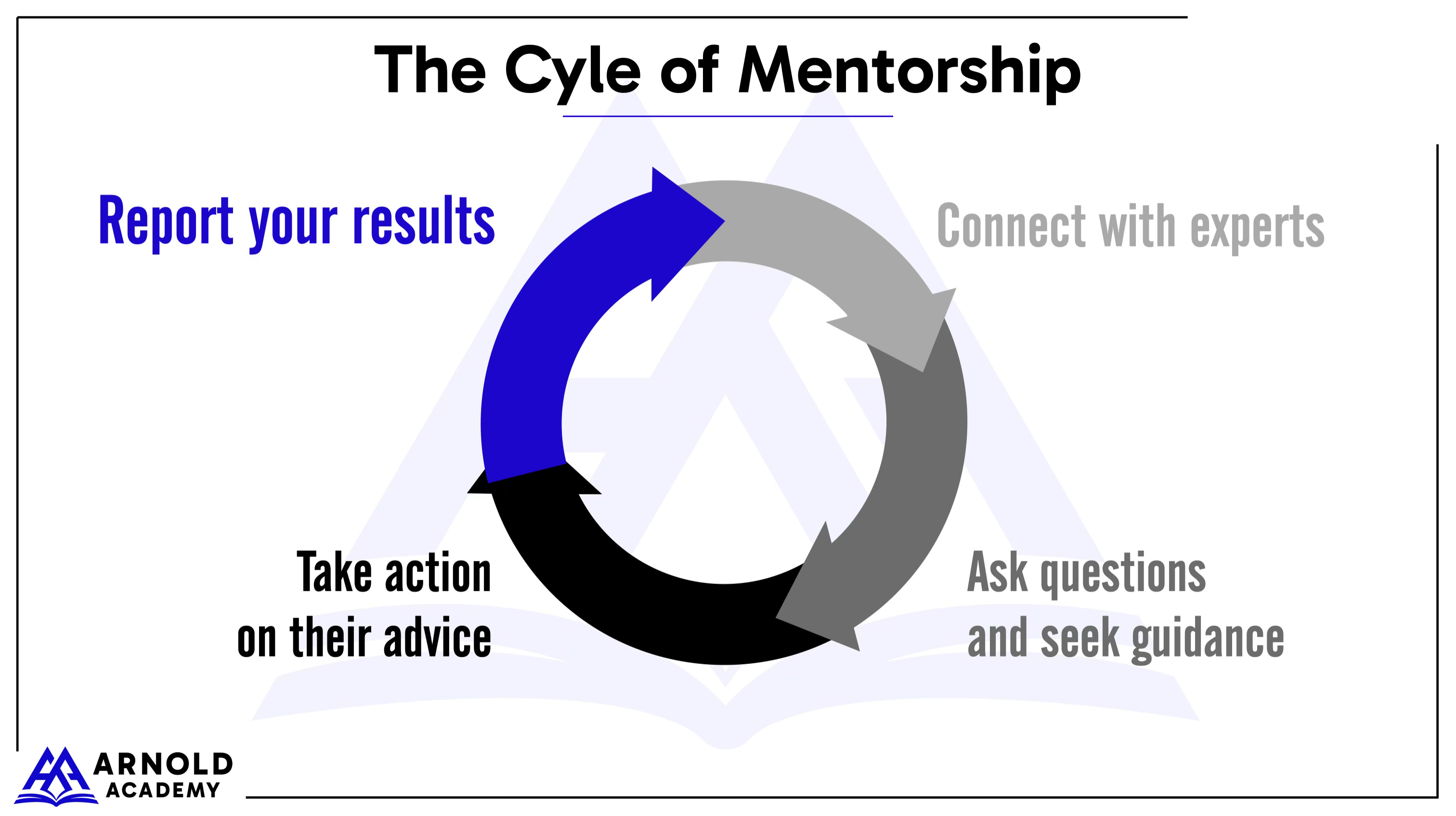
When reaching out to mentors, the story continues to be about your goals and your obstacles. You are the hero, they continue to be your guide.
This is where EVERYONE drops the ball with their outreach. They continue to believe it’s all about them when connecting with potential gatekeepers.
Please consider ME for any upcoming opportunities!
Here is why this opportunity is a good fit for ME!
Buy MY product or service, I’m the best!!!
Time for a harsh (but true) reality check:
Nobody is going to give you an opportunity or buy your product or service because they care about YOUR hopes and dreams.
When you want to connect with the gatekeepers, they are the hero of the story, and you are their guide.
This is where the hero-guide framework gets tricky. In the context of referring you or recommending you, your advocate is neither your “expert” nor your gatekeeper, they are simply the super-connector facilitating a warm (and hopefully enthusiastic) introduction.
So then who is the hero of this story?
When reaching out to an advocate, the hero is…wait for it…the gatekeeper. In order to provide value to the advocate they must see the value you will bring to the gatekeeper first, value you must earn. The real story is about your gatekeeper’s goals and obstacles. And you are potentially their guide.
In the previous four levels, the hero of the story is fairly black and white. When reaching out to peers, however, there are infinite shades of gray in between. The hero of the story depends on the context of your conversation. If you are talking about your goals and obstacles, it’s about you. If in a different context it is about their goals and their obstacles, your peer is the hero of the story.
Most often in a peer-to-peer relationship, you are both the hero of the story. What brings you together as peers are your shared goals and obstacles. Strengthening this kind of relationship is about mutually helping each other achieve both of your goals and overcoming your obstacles together.
Once you’re clear on who the hero of your story is it’s time to make your approach.
So…um…..like…what am I supposed to…..like.....say???
Don’t worry, I’ve got you. To help simplify the process of crafting your approach (and to help you avoid overthinking it!), I’ve provided you with a bulletproof formula that (when executed properly) gets a 70%+ response rate no matter your industry, no matter your craft, and no matter the person you want to approach → VSA.
Value. Story. Ask.
Whether initiating an in-person conversation or sending an outreach message, if you’re not willing to lead with value and give more than you ask for in return, my approach to networking isn’t for you. (And if you think it’s the takers who ultimately succeed in the networking game, bookmark this essay for later and instead go read Adam Grant’s Give and Take). If you’re not willing to do your homework and provide genuine value and appreciation to the person you want to connect with, this approach also isn’t for you. And if you’re looking for the perfect prompt to have the robots write your outreach for you, these aren’t the droids you’re looking for.
But if you’re willing to take the time and really put in the effort to handcraft one simple (but not easy) introduction that shows this person how they have impacted you, then you’re in the right place.
Regardless of the level this person belongs in your network, your value-first approach has one simple objective: Make this person (and their work) feel seen. That’s it. Providing value is not offering to mow their lawn or walk their dog, it’s about reminding them the work they do means something—that the time and energy they’re spending on this planet matters to someone. When executed well, the response to your initial approach will most likely sound something like:
Thank you so much for your kind thoughts and words. You just made my day!
Only once you have provided enough authentic value in your opening paragraph have you then earned the right for a busy (and maybe even an important) person to learn more about your story. The objective of your story is also simple: Make it clear how this person can help you, or how you can help them. Your story should contain three components, and how you approach each will depend on who the hero is of the story. (If you skimmed to this point, go back to the previous section about identifying the hero of the story before proceeding.)
Approaching Experts and Mentors
When approaching both experts and mentors, you are the hero, and the story is as follows:
Here is where I am now.
Here is where I’m going next.
Here is what’s stopping me from getting there.
Approaching Gatekeepers
When approaching gatekeepers, they are the hero, and story is as follows:
Here is where I am now (relevant to where you are now).
Here is where you are (or where I think you might be) going next.
Here is how I can (or think I might be able to) help you overcome your obstacles to get there.
When approaching advocates, the gatekeeper is really the hero. not them. The advocate is simply the super-connector, and the story is as follows:
Here is where I am now (relevant to where the gatekeeper is now).
Here is where the gatekeeper is going next.
Here is how I can help the gatekeeper overcome their obstacles to get there.
When approaching peers, the hero will completely depend on the context of the conversation. But the simplest version of the story:
Here is where we are now.
Here is where we are going next.
Here is what’s stopping us from getting there and how we can help each other.
Once you have crafted a clear and compelling story that either makes it clear how this person can help you—or how you can help them—that fateful time has come…
Asking this person for something in return…
Having coached introverted creatives for over a decade now, I’m confident the fear of asking someone else for, well...anything, is quite possibly the #1 obstacle standing between you and the career, business, and life you hope to build.
Everything you’ve ever wanted is on the other side of fear asking for it.
Assuming you’ve provided enough value when you initiate your approach—and that you’ve told a clear enough story that this person understands how they can be helpful to you—it’s time to make it clear what you want from them.
But hold on a second…
Why would this person want to help little old you?
WHO DO YOU THINK YOU ARE ANYWAYS?!?!
Clearly you’re just bothering this busy and important person.
No doubt you’ll come off as needy and desperate, right?
Or even worse, you might insult them!!!
Given this is your one and only shot to share your life story and ask everything from this person you’ve ever wanted, you’re probably better served giving up and just scrolling Instagram instead, loathing your inability to put yourself out there. You’re just not ready yet, right? And the timing needs to be better?!?!
Let me put this as kindly as I can:
STOP. FUCKING. OVERTHINKING. IT.
The simplest way to provide value to someone
is to make them feel useful.
Underneath all of the fear and uncertainty surrounding not only our current geopolitical landscape but also the prospect of artificial intelligence reshaping the workforce and rendering creatives and knowledge workers obsolete is a much simpler and more primal fear:
Are we even useful anymore?
In our hyper-connected digital hellscape we feel more disconnected than ever, and we’re terrified we can no longer provide value to this world. By reaching out to someone you genuinely admire, your ask gives them the opportunity to make a positive impact and provide use to a fellow human they can empathize with. This “ask first” approach is not just my opinion based on a decade of anecdotal evidence from both my outreach success and the many outreach success stories of my students. This is science.
In 1969, researchers Jon Jecker and David Landy2 discovered the following:
People who were asked to do a personal favor for someone subsequently reported liking that person more than those who were not asked (or were asked indirectly), demonstrating that asking someone for a small favor can strengthen the relationship more than doing something for them.
This counterintuitive approach to building relationships was not first discovered in 1969 but instead dates back hundreds of years to the founding of the United States of America. One of the methods that Benjamin Franklin used to mend fences and build bridges with his political adversaries was asking to borrow a book from them. That’s it. He asked them for something that gave him the opportunity to not only thank them afterwards but also a common interest to discuss. This has become known as “The Benjamin Franklin Effect.”
Knowing you’re asking for something is not only acceptable but also providing genuine value, now the question becomes...what do you ask?
Here is the key with your ask:
Make it easy to respond to quickly.
Don’t ask more than a question or two.
Don’t ask them for their time.
Don’t invite them out to coffee to pick their brain.
And don’t ask them or advice.
What you are asking them for is their story. If you’ve done a good job in your story section, it should not only be clear how this person can be useful to you but also how they can empathize with your challenges (if you’ve done your homework well enough to find someone slightly further along on a similar path). And if you really want to make it easy for this person to respond quickly, you don’t even ask them a question or two. You ask them to ask. This way even if they’re crazy busy when you approach them they can respond quickly (this applies both to outreach and in-person interactions).
When YOU are the hero, your ask is:
Given how busy you must be, would you mind if I asked you a question or two about how you overcame these obstacles and/or achieved these goals?
When you are the hero, the ask is by far the hardest part of your approach. When they are the hero, the ask is the simplest part—IF you nailed it in your story section, that is. Assuming you have made the compelling case for how your skills and experience, your product, and/or your services can help this person achieve their goals and overcome their obstacles,
When THEY are the hero, your ask is:
Given these are your goals, and given I might be able to help you overcome these obstacles, is this worth discussing further?
Which makes it as easy to respond to as “Yes” or “No.”
See, toldja it was simple. 😉
But I also understand there’s a giant chasm between simple and easy, which is why I spend the majority of my waking hours helping creatives just like you devise a clear networking strategy and draft killer outreach that not only gets enthusiastic responses but also leads to calls, meetings, job interviews, and even dream opportunities!
No, seriously...you can do this.
Your introversion may leave you at a disadvantage if the entirety of your networking strategy is noisy spaces, crowded rooms, and mindless small talk with the sole purpose of dancing around the fact you desperately need opportunities. But your introversion gives you not only an advantage but also a distinct edge when networking become about building genuine relationships, having deep and meaningful conversations with interesting people, and giving before you ask anything in return.
You were not born “bad at networking,” you just haven’t found a strategy that works for your unique temperament. In many ways, you were made to crush the networking game! You just need to play a different game by different rules. Your rules.
I promise there is someone you genuinely admire (but are scared to reach out to) who right now needs to be reminded that their work matters and that they are useful to the world.
I promise there is someone genuinely struggling to achieve their goals and overcome their obstacles, and you might just be the solution to their problems.
Tell them.
And when you get an enthusiastic response, let me know in the comments below. 😉
I’ve provided this entire essay as a FREE downloadable PDF which also includes the following bonuses:
The sentence-by-sentence VSA Formula that gets a 70%+ response rate
A cold outreach email before & after teardown
The 17-step “VSA Checklist” to ensure every message you send hits all the right notes (and avoids all of the common mistakes) so people are not only excited to connect with you but also eager to help!
https://www.weforum.org/videos/harvard-conducted-an-85-year-study-on-happiness-here-s-what-it-found/?utm_source=chatgpt.com
https://psycnet.apa.org/record/1970-08381-001
Comments
Nothing yet. Say the first thing.
Sign in to join the conversation.