
All of the content available at Public Theology is for those who identify as Christian as well as those who might be interested in learning about a more inclusive, kind, thoughtful Christianity. To receive new posts and support the work, consider becoming a free or paid subscriber.
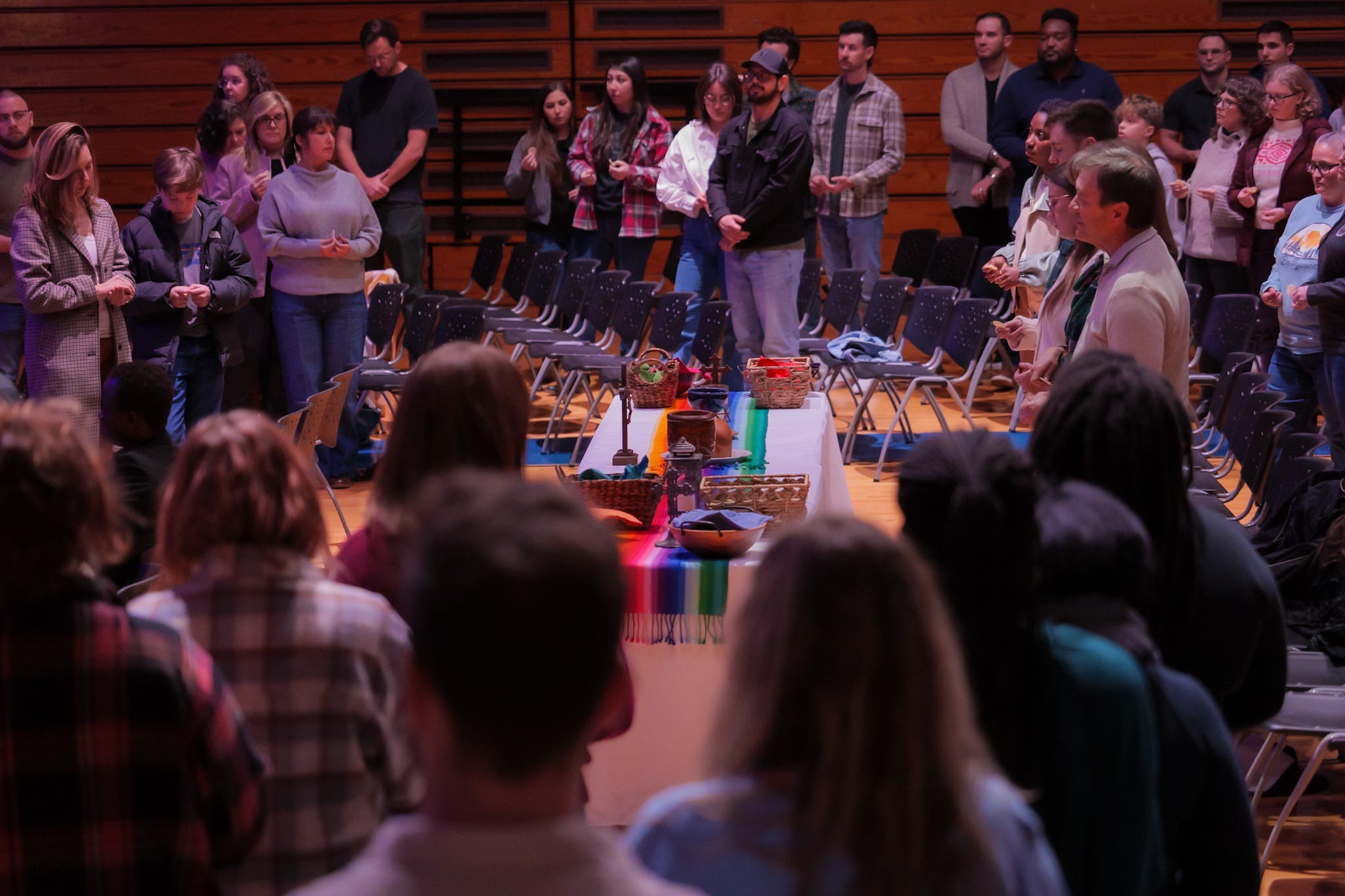
For thousands of years, billions of people have come together around tables to partake in Communion across every part of the globe.
They do this— we do this— because the Communion table is sacred to our faith. The table has always been at the center of human life and it makes sense that this sacrament takes place around a table, too. Since the beginning of time, we have been gathering around tables to eat, drink, share conversation, and tell stories. The table transcends time and place, culture and language; it is an indispensable part of everyday human life.
“We don’t come to the table to fight or to defend. We don’t come to prove or to conquer, to draw lines in the sand or to stir up trouble. We come to the table because our hunger brings us there. We come with a need, with fragility, with an admission of our humanity. The table is the great equalizer, the level playing field many of us have been looking everywhere for.
The table is the place where the doing stops, the trying stops, the masks are removed, and we allow ourselves to be nourished, like children. We allow someone else to meet our need. In a world that prides people on not having needs, on going longer and faster, on going without, on powering through, the table is a place of safety and rest and humanity, where we are allowed to be as fragile as we feel.”
Shauna Niequist, Bread and Wine: A Love Letter to Life Around the Table
The table is a sacred, recurring theme throughout all of Scripture. In fact, the most popular biblical metaphor used to describe God’s family and God’s Kingdom is people gathered around a table!
“This is what God’s kingdom is like: a bunch of outcasts and oddballs gathered at a table, not because they are rich or worthy or good, but because they are hungry, because they said yes. And there’s always room for more.”
Rachel Held Evans
Scripture also describes the moment when Jesus comes back to finish his work of restoration as a huge party centered around a banquet table.
“One day all of us in Christ will sit around an enormous table exquisitely set with a feast of rich foods, prepared in divine kitchens. No one will be left out. No one will be alone. No one will be nameless. No one unknown. No one with nowhere to go. We will finally be home.”
Beth Moore
I look forward to that day but we have plenty of work to do now. Until then, we are going to be pulling up chairs around Jesus’ table at Restore, our church in Austin, and figuratively here online. We are doing everything we can to make sure that anybody who wants a seat has one and that everyone can experience the extravagant love of Jesus. Not for a political agenda. Not because they should. But because the Jesus we find in the Bible provides a better way— a more just, beautiful, loving, and accepting way— than what is being sold in many churches.
Over the past couple of years, we’ve made a decision to be more intentional with how and how often we celebrate Communion at our church. This decision was made after dozens of conversations amongst our staff, leadership, and congregation indicating that our church family would like to celebrate Communion together more often.
I know that we all have different backgrounds when it comes to this. Some of us come from traditions that practice Communion every week while others participated very rarely. Some of you don’t have any experience with it or have had particularly bad experiences.
There can be significant variation between how Communion is practiced, so I want to discuss what Communion is and where it comes from.
Like so many parts of Christianity, Communion has its roots in Judaism. On the night before Jesus was killed on the cross, he and his closest friends gathered around a table to celebrate the Passover meal, and during that meal, which we now call the Last Supper, Jesus changed the Passover for his followers.
Passover was a big deal in the Jewish world. Each year, its arrival was announced by silver trumpets blown from on top of the Temple Mount that could be heard all over the city of Jerusalem. Passover looked backward in time to the freeing of God’s people from slavery in Egypt, but it also looked forward to the coming of the Savior who would free God’s people from slavery to sin.
Unbeknownst to most of the world, this Savior, Jesus, was already with them.
When the hour came, Jesus and his apostles reclined at the table. And he said to them, “I have eagerly desired to eat this Passover with you before I suffer.”
Luke 22:14-15
Jesus had eagerly desired this specific Passover because he knew that this one would change everything. The Savior that had been anticipated for thousands of years was finally here, and he was ready to set people free.
The Passover meal always consisted of the same bread, the same wine, and the same rituals. The people of God had been celebrating their freedom from Egypt the same way for thousands of years, but on this night, Jesus changed things for his followers.
And he took bread, gave thanks and broke it, and gave it to them, saying, “This is my body given for you; do this in remembrance of me.”
In the same way, after the supper he took the cup, saying, “This cup is the new covenant in my blood, which is poured out for you.”
Luke 22:19-20
Bread and wine were prominently featured in the Passover meal. The bread symbolized God’s daily provision for his people as they wandered through the dessert and the wine represented the joy of finding the Promised Land.
But around the table on this night, Jesus changes them. This is a big deal. He says the bread represents his body and the wine represents his blood. He doesn’t say “Remember the Passover,” he says, “Remember me.” Jesus says, “This cup is the new covenant.” Jesus is making a reference here to Jeremiah 31 where God said a New Covenant was coming:
“The day is coming,” says the Lord, “when I will make a new covenant with the people of Israel and Judah. This covenant will not be like the one I made with their ancestors when I took them by the hand and brought them out of the land of Egypt. They broke that covenant, though I loved them as a husband loves his wife,” says the Lord.
“But this is the New Covenant I will make with the people of Israel after those days,” says the Lord. “I will put my instructions deep within them, and I will write them on their hearts. I will be their God, and they will be my people… And I will forgive their wickedness, and I will never again remember their sins.”
Jeremiah 31:31-34
This New Communion represents this New Covenant.
The wine represents the blood of Jesus that washes away every sin.
The bread represents the body of Jesus that gives life to everyone who receives it.
This is the Gospel, the Good News of Jesus Christ. And every time we gather around the Communion table, we remember, celebrate, and proclaim this Good News.
“It’s worth noting that at the center of the spiritual lives of God’s people in both the Old and New Testaments, we find a table: the table of Passover and the table of Communion.”
N.T. Wright
At our church, the table is of central importance. We want Restore to be a place where anyone has a seat at the table and everyone experiences the extravagant love of Jesus.
Communion is one of the ways we make that vision a reality and so we have integrated it into our weekly services. Here’s how we participate in Communion at Restore:
Communion is for everybody who wants to partake. Jesus has made it clear over and over again that anyone has seat as his table and everyone can experience the extravagant love and resurrected life of Christ. Whether it’s the very first time or the thousandth time, taking Communion is open to all people.
But you don’t have to. If you don’t want to receive communion today or any day, that is completely okay. We don’t judge or condemn you. There is no coercion or emotional manipulation.
After everyone who wants to participate has received the elements, we turn toward the Communion table which lives right in the middle of the room. We look at the faces around the table and acknowledge everyone who shares in this communal experience. We are different in age, race, gender, sexual orientation, socioeconomic status, background and belief but, as Scripture says, even though we are many, we are one, united together through Jesus.
The people around the table on the night of the Last Supper were very different, too. In fact, prior to following Jesus, one of them had been a tax collector and another one belonged to a groups called the Zealots who were known for killing tax collectors.
But they were united together through Jesus just as we are. People have been united around Communion tables all over the world throughout human history. For thousands of years, people who are as different as can be have gathered to remember the one who welcomes everyone to his table. We are a part of that tradition, too.
No matter how different we are, Communion is a declaration that we receive the same provision and are in need of the same grace. We can’t police others around the table— that’s not our job— but we can take a moment to say, “This is what I believe, thank God.” Despite our differences. Regardless of how mad that person makes us or how much we vehemently disagree with their positions on X, Y, or Z. For that moment— and as a reminder of our work in every other moment— we give ourselves to God and release the need to control others.
Does this mean that we condone bad behavior? Absolutely not. Does this mean that we don’t continue to work toward justice and dignity for every person on earth? Not at all. Does this mean that we pretend everything is fine in an attempt to be unified? Nope. But it does remind us that we are not in control and we are also in need. There is something necessary and beautiful to seeing ourselves in this way.
Communion reminds us of our rightful place as agents of love and justice amongst all the people of the earth, regardless of their religious beliefs or political opinions or anything else about them. It is a realigning of our priorities and actions. It’s a reorientation to the fact that we are responsible for ourselves and using our agency and whatever privilege we may have to meet the needs of those around us.
No matter how you practice Communion, or if you don’t practice at all, I hope you feel the presence of a good and loving God in your life, today and always. We are in this together for the good of our neighbors because of the great love God has shown us. The bread and the wine (or the cracker and the grape juice) remind us of our rightful place in the body of Christ as a means of hope in the world. What a privilege.
Public Theology is based on the work of Zach W. Lambert, Pastor of Restore, an inclusive church in Austin, Texas. He and his wife, Amy Lambert, contribute to and moderate this account. Zach’s first book, Better Ways to Read the Bible, is now available wherever books are sold. Zach and Amy are currently writing a devotional based on Better Ways to Read the Bible which will release Summer 2027.
We’re happy to cover subscription costs for anyone who wants to subscribe to Public Theology but can’t afford to do so at this time. If you would like to join the Public Theology community and gain access to our paid subscriber content (which we keep behind a paywall for the privacy and connection of our community) but cannot afford to do so, please message Amy Lambert directly.

Lastly, personalized and signed copies of Zach’s debut book, Better Ways to Read the Bible, are currently on sale through Zach’s website for $25 + shipping. It’s also available wherever books are sold.
Comments
Nothing yet. Say the first thing.
Sign in to join the conversation.