
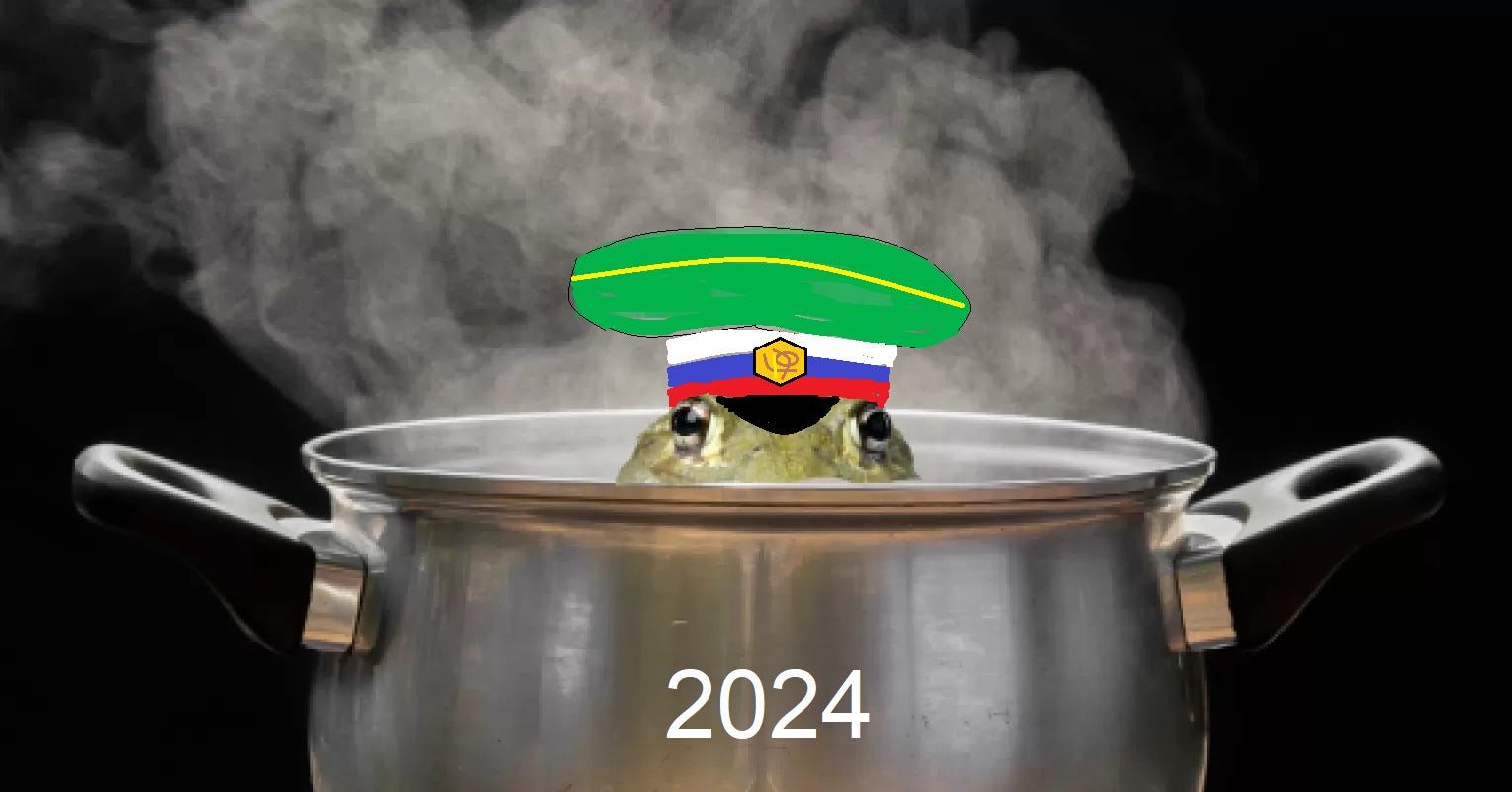
Since my last article, the most important political development in the Russo-Ukrainian War has been the return of Donald Trump to the American Presidency. The brash and outspoken Republican has instigated a whirlwind of diplomatic efforts to end the war, which as of the publication of this article have been unsuccessful. Beginning with the confrontation in the Oval Office on February 28, 2025, between President Trump and Ukrainian President Volodymyr Zelensky, outright U.S. support for Ukraine appears to hang in the balance. Has President Trump’s election changed the calculus of the war in Russia’s favor? What are the prospects for his lifting U.S. economic sanctions on Russia? Moreover, has his election changed American military support for Ukraine? Before I try to answer these questions, I need to review the strategic centers of gravity in this war and my understanding of what can be called Ukraine’s “boiling frog” strategy, which it has pursued since the beginning of the war.
a. Strategic Centers of Gravity.
In my previous article on August 27, 2024, I explored the respective strategic centers of gravity in the Russo-Ukrainian War. Strategic centers of gravity are the vulnerabilities that, if subjected to sufficient stress, expose a combatant to outright defeat. Essentially, that means a loss of the will to fight, whether by the government, the people, or the army. Regarding Russian strategic centers of gravity, I posited that Russia’s key vulnerability was (1) Russian president Vladimir Putin’s need to achieve his minimum war objective – the recapture of the entirety of the Donbas - before (2) the Russian war economy collapses from the effects of stagflation and Western sanctions. For those new to the conflict, the Donbas is the post-industrial rust-belt region in the southeast corner of Ukraine that is composed of Luhansk and Donetsk oblasts. Moreover, (3) sustained Russian manpower recruitment, (4) a loss of confidence in the government following the Ukrainian occupation of Russian territory in 2024, and (5) the centrality of protecting Crimea were also added to the list of Russian pressure points in the war.
I also suggested that Ukraine’s key strategic centers of gravity were (1) its dependency on U.S. weapons and munitions and (2) the failure to mobilize sufficient replacements for its losses in assault infantry. Additionally, (3) internal cohesion in the face of (4) a concerted Russian strategic bombing campaign to destroy Ukraine’s power grid and infrastructure were listed as potential vulnerabilities.
b. Ukraine’s “Boiling Frog” Strategy.
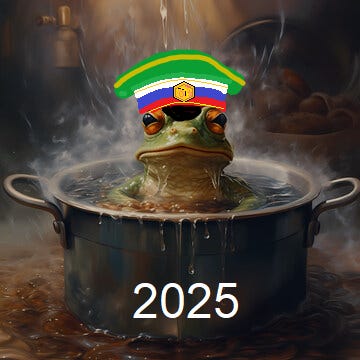
Throughout the war, Ukraine has pursued a strategy of attrition not only of Russian manpower and equipment but also Russia’s economic stamina to stay in the fight. By analogy, this can be called a “boiling frog” strategy. A “boiling frog” analogy assumes that if the temperature in a pot of water increases gradually, the frog won’t notice the change and will eventually get boiled alive. [1] Whereas, if a frog is thrown into an already boiling pot of water, it invariably jumps out because of the heat. Essentially, Ukraine is trying to deny the Russians control over the twin cities of Sloviansk and Kramatorsk - iconic urban centers in northcentral Donetsk oblast that were recaptured from Russian separatist proxies in the first Russo-Ukrainian war in 2014. (In blue square on Map 1 below). Russian voters are familiar with Sloviansk and Kramatorsk from TV news broadcasts from that earlier conflict and are likely to view the war a failure if the twin cities are not recaptured before a peace agreement is reached. The intent is to delay the Russian advance toward the twin cities long enough for the pressure on Russia’s war economy to boil over. Ukraine can afford to sacrifice the Donbas. Of the many regions of Ukraine, the Donbas is the most expendable. The Russian-occupied portion of the region has been turned into a dystopian wasteland by bombing and shelling. It was in a dilapidated state even before hostilities began in 2022. The Donbas would require years of rebuilding and trillions of dollars in investment before regaining some semblance of profitability.
At the start of hostilities on February 24, 2022, much of the Ukrainian standing army was deployed in the southern Donbas to block Russian access to the major cities of Luhansk and Donetsk oblasts, particularly Sloviansk and Kramatorsk. Smaller concentrations of regular troops were situated near Kharkiv in the east, Chernihiv in the northeast, and Kherson and the isthmuses to Crimea in the south. Putin’s gambit of attacking Kyiv from the northwest through the Chornobyl nuclear-restricted zone caught the Ukrainian General Staff by surprise and only the emergency mobilization of tens of thousands of volunteers and improvisation at the tactical level were able to block the threat to the Ukrainian capital. This forced the Russians to withdraw their forces from Kyiv to Belarus and relocate them east towards Kharkiv oblast. Part of the former Kyiv strike force then attacked Sloviansk from the north through Izyum. Arguably, the massing of Ukrainian forces in the Donbas contributed to the early Russian successes in the south at Kherson and Mariupil, since Ukrainian forces were too few and stretched too thin on this vector of advance.
From April 2022 onward, Ukraine traded space for time by retreating through the Donbas with the intent of keeping the Russians away from Sloviansk and Kramatorsk. Bloody battles in the Summer and Fall of 2022 for Lysychansk and Severdonetsk suggest that the Ukrainians were pursuing their “boiling frog” strategy from the start. Moreover, the spectacular Ukrainian counteroffensive in September 2022 towards Kupiansk and Izyum, eliminated the Russian attempt to seize Sloviansk through Izyum. Further defensive battles in Donetsk oblast for Bakhmut in 2023 and Avdiivka in 2024, reaffirm Ukrainian strategic intent. In fact, on August 27, 2024, President Zelensky publicly confirmed Ukraine’s strategy of obstinate denial of territory in the Donbas. [2] If Ukraine can deny Putin possession of Sloviansk and Kramatorsk long enough for disruptions in the Russian mobilization effort and the war economy to create domestic political pressure on the Russian state, it can regain the initiative and negotiate from a position of strength.
One of the criticisms of a “boiling frog” analogy is that in real life a frog jumps out as soon as the boiling water gets too hot. However, because of the botched Russian offensive on Kyiv at the start of the war and Russia’s self-delusion about its great-power status, Putin cannot simply jump out of the boiling pot without first achieving his minimum strategic objective – Sloviansk and Kramatorsk. Otherwise, Putin risks losing his grip on power. Therein lies Ukraine’s window of opportunity to win the war through attrition.
Nonetheless, President Trump insists that “Ukraine has “no cards to play” and is operating from a position of disproportionate weakness. Is that the case? Has the election of Donald Trump affected Ukraine’s “boiling frog” strategy?
c. The Ukrainian “Drone Line” versus Russian (Chinese) Motorcycles.
Ukraine’s incorporation of millions of attack drones during the last quarter of 2024 to compensate for its deficit in infantry – the so-called “Drone Line” - slowed Russia’s offensive in the Donbas to a crawl. [2][3][4][5] In effect, Ukraine replaced men with swarms of cheap machines, which patrol the sky at low-to-mid-altitude above the front lines 20 kilometers deep into the Russian rear and attack enemy troop concentrations well before they reach Ukrainian positions. Russian gains continue but at a slower rate. This is due not only to Russian superior numbers and massed fires but also because of Ukraine’s reluctance to subject its frontline infantry to sustained artillery, drone and fixed-wing aerial bombardment. This causes Ukrainian brigades to conduct periodic withdrawals once Russian firepower destroys towns and trench systems that afford its infantry cover. Ukraine must prioritize preserving its infantry over holding territory. Due to the relative political unimportance of the Donbas to Ukraine, the strategy of gradual retreat does not create inordinate domestic blowback. Moreover, Russian losses, averaging over 1,000 dead and seriously wounded daily, put pressure on Russia’s ability to sustain recruitment of new volunteers. [6]
Also, the steep Russian losses in armored vehicles over three years of high-intensity combat have limited the ability of the Russian General Staff to outfit new regiments and brigades with kit, regardless of how many new volunteers it entices into the ranks through generous signing and death bonuses. This limits the Russian ability to attempt breakthroughs at operational depth, as each major operation requires the sacrifice of hundreds of armored vehicles, which the Russians can no longer squander like they did during the first years of the war. [7] Thus, Russian offensives are mostly infantry affairs. To compensate for the lack of armored protection for their infantry, the Russians have resorted to using speed to outrace Ukrainian drones towards the front lines, by mounting assault troops on cheap Chinese motorcycles. These daredevil tactics more often fail but occasionally succeed, at great cost, if enough motorcycle riders reach the cover of trenches, ruined buildings, and basements at the objective, where they can shelter while waiting for reinforcement from follow-on assaults. Notwithstanding these innovations, the Russians have yet to recapture the entirety of Donetsk oblast, 30% of which remains in Ukrainian hands. (See territory shaded in bright yellow on Map 1)
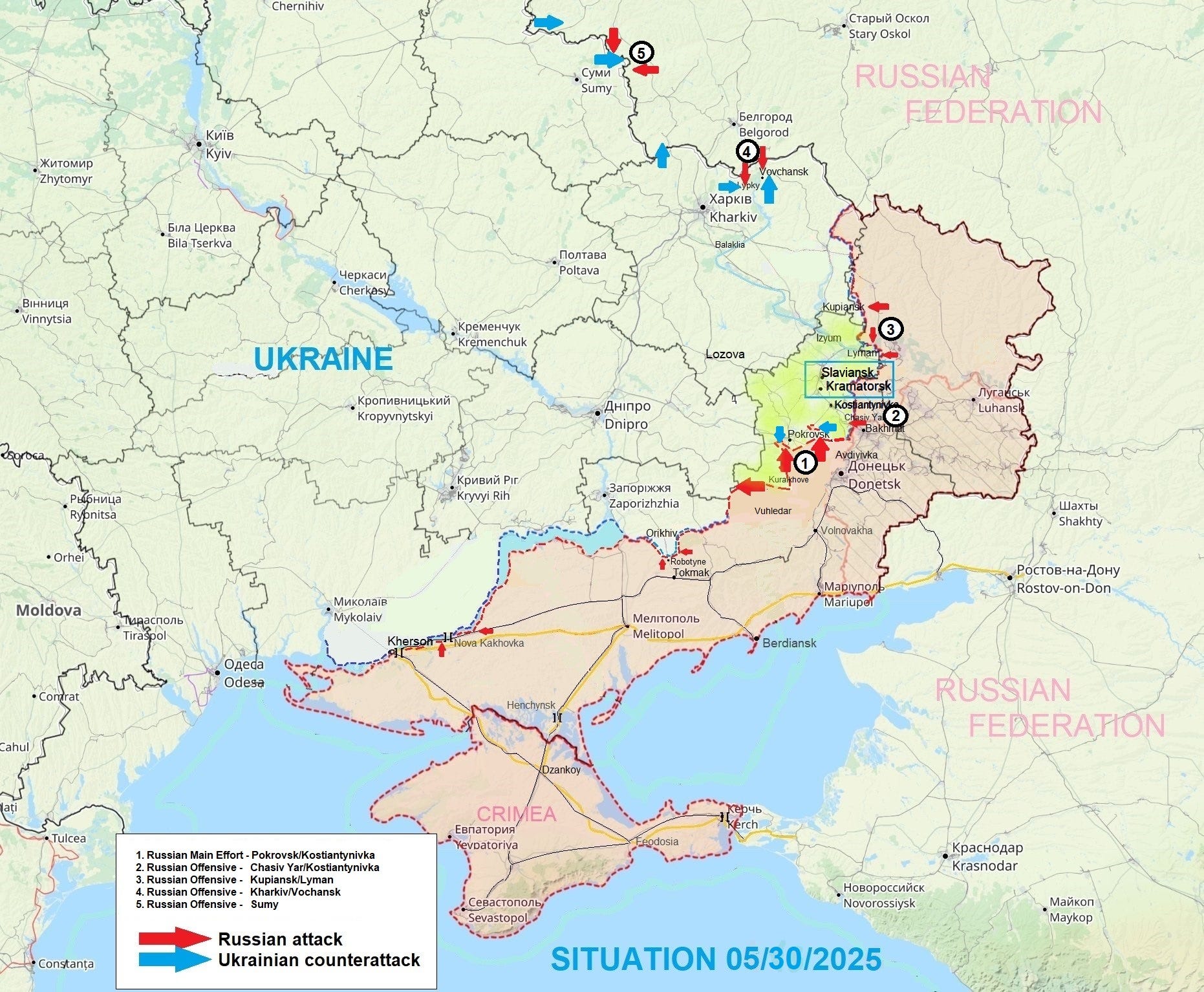
(Map 1)
Based on the current pace of Russian advance, the Russian army is still months if not years from capturing Sloviansk and Kramatorsk. The capture of these symbolic trophies would signal to the Russian public that the objective of liberating the Russian-speaking Donbas has been achieved. This would afford Putin the political space within which to agree to peace terms that fall short of his stated maximalist claims of destroying Ukrainian sovereignty but without a domestic backlash against his regime. Despite being on the offensive and holding the strategic initiative since October 2023, the Russians have yet to capture Pokrovsk, a key logistics center and one of the stepping-stones to Kramatorsk. The Russian army has just launched a new offensive to envelop Pokrovsk from the east, but progress is woefully slow and just as costly as during previous offensives. Similarly, the Russians have failed to take Lyman, a stepping-stone to Sloviansk. [5] The latest fighting suggests that the Russians may be shifting their main effort towards the capture of the town of Kostiantynivka, east of Pokrovsk and south of Kramatorsk., where they had some recent success. [9] But to get there they risk getting ensnared in a salient between Chasiv Yar and Pokrovsk if they allow these towns to remain under Ukrainian control. In any case, the fighting for Pokrovsk, Chasiv Yar, Kostiantynivka, Sloviansk, and Kramatorsk is shaping up to become the Verdun of the Russo-Ukrainian War. [10] Casualties will be horrendous on both sides, but historically the attacker shoulders the majority of the butcher’s bill. Currently, the casualty exchange rate favors Ukraine at least at 1:2 but occasionally as high as 1:7. [11]
d. Tactical events are driven by propaganda objectives.
Vladimir Putin’s major victories in this war have been on the propaganda front – not on the battlefield. As is evident from the Russian obsession with Sloviansk and Kramatorsk, Vladimir Putin’s battlefield objectives in this war are intended more for their propaganda effect than their operational value. Although Russia controls 19% of Ukraine’s territory, including Crimea, it has yet to capture any major Ukrainian city or regional capital. According to the American-based Institute for the Study of War (ISW), “…at the current rate of monthly advance … it would take Russian forces 38 years to capture the remaining 81% of Ukraine, if Russia can sustain massive personnel losses indefinitely.” [12] Russia’s recent territorial gains have been overwhelmingly in the southeast, where Ukraine trades space-for-time in the rust-belt agglomeration of abandoned coal towns and slag heaps of the Donbas.
An example of Putin’s propaganda war is the grandiose Victory Day parade on May 9 in Moscow, which was intended to reassure ordinary Russians that Russia’s status as a great power has not changed and that the “special military operation” in Ukraine is on schedule. However, the parade failed to relay the same message to foreign observers. A view of the reviewing stand during the parade indicates that Russia is weakened, isolated, and in effect, a vassal of China. Besides Xi Jinping of China and Lula da Silva of Brazil, the foreign representatives in attendance were notable for their insignificance. With all due respect to Aleksander Vucic of Serbia and Robert Fico of Slovakia (both came to Moscow to placate the ultra-nationalist pro-Russian wings of their electorates), they do not carry the same political heft. The long list of foreign leaders who declined to attend the spectacle in Moscow includes such usual Putin supplicants as Viktor Orban of Hungary, who decided it was better not to anger NATO and the EU than disappoint Vladimir Putin.
Tactical events in the field have consistently been used by both sides for propaganda effect on a variety of audiences, both foreign and domestic. A prime example is the Ukrainian special operation on June 1 to attack Russian strategic bombers with drones deep inside of Russia as well as the attack on June 3 on the Kerch Bridge that followed. [13] The last such event for the Russians was the withdrawal of Ukrainian troops from Kursk oblast in Russia on March 13, 2025, which was trumpeted to the Russian public as if equal to the iconic Soviet victory near Kursk in World War II. Putin must have taken satisfaction from the fact that Kursk oblast was no longer a bargaining chip to be exchanged for Russian-controlled Ukrainian territory during any peace negotiations. The fact that it took nine months to expel the Ukrainians from Russian soil and that the bulk of 30,000 elite VDV airborne and naval infantry reserves had to be employed to push 12,000 Ukrainians out of Russia was conveniently forgotten. Truth be told, the injection of 12,000 North Korean elite special forces on the side of Russia was the deciding factor in ejecting the Ukrainians out of the salient around the town of Sudzha. In any case, the Ukrainian army still retains favorable defensive terrain inside of Russia and has launched small cross-border incursions north and south of the Kursk salient. This forces Russia to concentrate elite paratroopers and naval infantry near Kursk and away from the Donbas, where they would otherwise be used to exploit a breakthrough towards Sloviansk and Kramatorsk.
e. Has the election of Donald Trump changed the calculus of the war in Russia’s favor?
It appears that Putin scored his greatest political triumph when Donald Trump returned to the U.S. presidency in November 2024. Whether Russian “active measures” in the form of computer bots and social media influencers swung the needle in the Republican candidate’s favor is a moot question. After all, a clear plurality of American voters voted for Donald Trump and his victory in the electoral college was decisive. Suffice it to say, that by favoring Donald Trump in the election Putin raised Russian expectations for favorable treatment from the American president. [14] Therefore, one would expect that the U.S. presidential election resulted in immediate advantages to Russia in the war, especially regarding that major Ukrainian center of gravity – U.S. military support. Although the Trump administration has committed the U.S. to key pro-Russian positions, like the recognition of Crimea as Russian sovereign territory and reaffirmed the Biden administration’s denial of entry for Ukraine into NATO, Russian expectations have not been fully met. As of the date of publication of this article, Ukraine still receives shipments of Biden legacy weapons and armaments. While the tenor of the public statements has remained mostly pro-Russian during the first 100 days of the Trump administration, particularly during U.S. attempts to force a ceasefire and impose an unfavorable peace agreement upon Ukraine, actual policy decisions have not always favored Russia. For instance, in early May 2025, the Trump administration approved the sale of old F-16 airframes to Ukraine (without electronics and hydraulics), which can help Ukraine maintain its existing fleet of operational F-16s. [15] It is important to emphasize the transactional nature of this sale, as it followed on the heels of the signature by Ukraine of a strategic minerals exploitation deal with the U.S. Moreover, the Trump administration gave the green light for the sale of 50 million dollars of additional military aid to Ukraine as part of direct commercial sales that are separate from the earlier Biden allocations. [16] None of these sales have been verified to date and must first be approved by Congress. Most encouraging was a rumor that the U.S. lifted export controls on the transfer of older versions of Patriot surface-to-air missile systems from Israel to Ukraine – according to a statement by Israeli Ambassador to Ukraine Michael Brodsky – but these were later denied by the Foreign Ministry of Israel. [17] After all, export control rules require U.S. State Department approval for weapons systems transfers containing U.S. military technology and components to foreign entities, even if to third parties. [18] Regardless, so far President Trump has ignored Ukrainian offers to buy Patriot missile interceptors that are the ammunition for the Israeli systems. The scarcity of Patriot anti-ballistic missile interceptors will be especially felt as the Russian strategic bombing campaign grinds on against Ukrainian cities and infrastructure. There is no similar weapons system that is effective against Russian ballistic missiles anywhere in the world. Thus, based on the words and actions of the American President so far, future American sales of major weapons programs and large shipments of ammunition to Ukraine appear uncertain.
Donald Trump’s pro-Russian bias was evident on the campaign trail throughout his reelection campaign in 2023-2024. His pro-Putin rhetoric and that of Vice-President J. D. Vance reinforced isolationist tendencies amongst his political base and stoked hostility towards Ukraine and its president, Wolodymyr Zelensky. Thus, Donald Trump’s proclivity to favor Vladimir Putin was expected to resume upon his inauguration on January 20, 2025. Indeed, evidence of bias in favor of Putin manifested itself during the first 100 days of the Trump administration. Firstly, please recall the public tongue-lashing and humiliation leveled at Zelensky on February 28, 2025, during a televised meeting in the Oval Office, when President Trump and Vice-President J. D. Vance attempted to intimidate Ukraine into caving to demands of peace on Russian maximalist terms. Undoubtedly, Putin must have taken delight in Zelensky’s predicament. Second, the decision on March 3, 2025, to interrupt shipments of military equipment and munitions that had been allocated to Ukraine during the last days of the Biden administration sent a chilling message to the Ukrainians about what may follow. [19] Of course, this can be interpreted as a mere negotiating tactic to force Ukraine to accept otherwise unacceptable cease-fire and peace proposals. (There are counter-indications that the halt was ordered by Secretary of Defense Pete Hegseth, who went rogue after misinterpreting statements by the president that were critical of Ukraine. However, this interruption of 11 shipments occurred earlier on February 2, 2025, and resumed on 5, 2025 when the mistake was discovered). [20] In any case, the second interruption of military aid on March 3, was authorized by President Trump. Regardless of who gave the order, the Ukrainian General Staff was forced to adopt a “wait-and-see” approach during the interruptions of arms shipments. It is true that the Ukrainian armed forces began rationing their artillery fires during 2024 and hoarded sufficient reserves of artillery ammunition to defend the front lines, perhaps through the Summer of 2025. Still, future major Ukrainian offensive operations are off the table without sufficient resupply. Another sign of a pro-Putin bias in the Trump administration was the interruption in early March 8, 2025, of the flow of U.S. signal intercept and satellite intelligence to the Ukrainians. [21] This blackout on intelligence coincided with the ongoing Russian operation to expel the Ukrainians from Kursk oblast. The abrupt policy change also complicated the targeting of strategic targets deep inside Russia by Ukrainian drones and cruise missiles. Although the delivery of the Biden aid package and the flow of intelligence resumed on March 11, 2025, after the Ukrainians accepted the U.S. 30-day cease-fire proposal, the Ukrainians cannot take comfort from what the future may hold. [22]
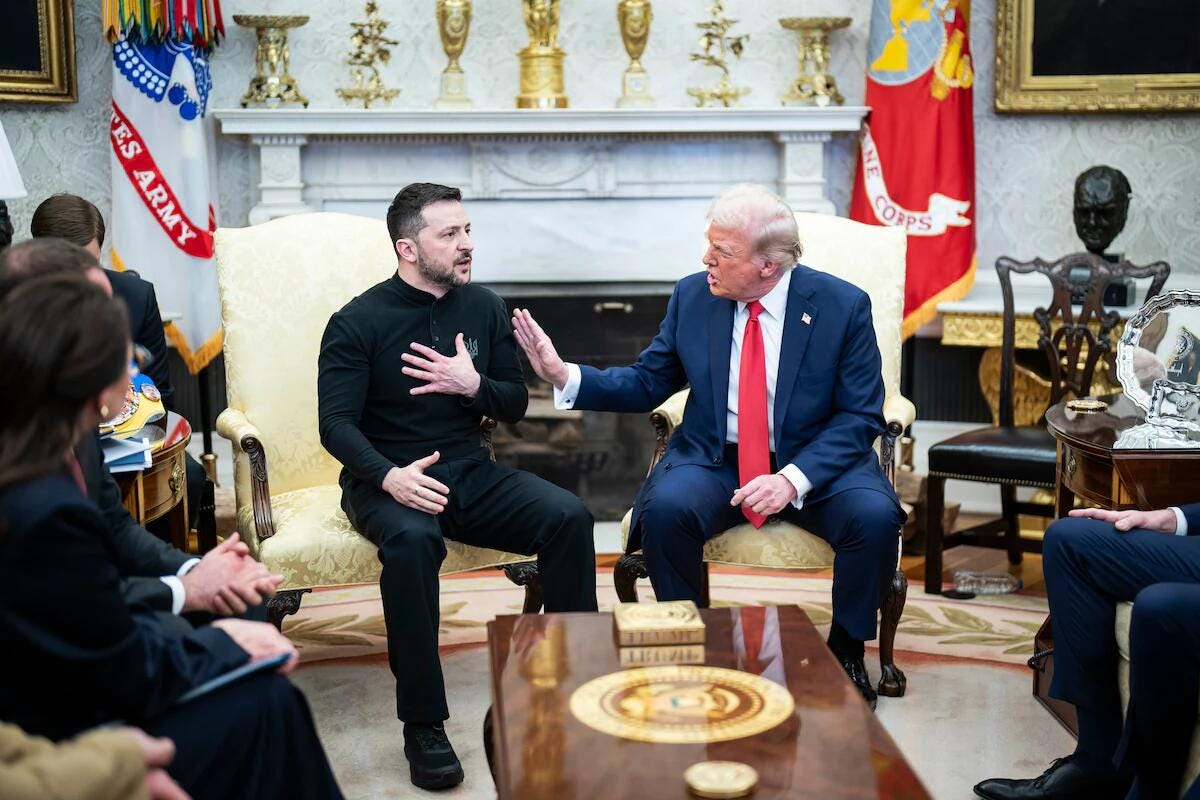
(February 28, 2025 meeting in the Oval Office)
Another strategic advantage that was afforded to Vladimir Putin is President Trump’s decision to publicly weaken U.S. support for NATO. After all, it has been Putin’s ambition to fracture the alliance for close to two decades. Although the Trump administration has remained ambiguous regarding the outright exit of the U.S. from the NATO Treaty, its insistence that the Europeans pick up the cost of Europe’s defense, punctuated by substantial tariffs that have been imposed upon the European economies (albeit suspended for 90 days), leave NATO members bewildered, disoriented and scrambling for alternatives. The verbal threat by the Americans to withdraw American troops from Poland and the Baltics may encourage Putin to test the resolve of the Europeans under Article 5 of the NATO Treaty by attacking the Baltics, to see whether there is a substantive response. Most ominous is the uncertainty over the credibility of a continued American nuclear umbrella over Europe to counteract Russian nuclear saber-rattling, thereby reneging on its decades-long rhetoric to protect NATO members under Article 5. This exposes individual European states to the threat of Putin’s nuclear blackmail in return for unilateral concessions from a position of isolation and weakness.
A disjointed response to Putin’s threats affects the unity of European support for Ukraine’s war effort, both in weaponry and in financial aid. President Zelensky’s primary focus since Donald Trump’s reelection has been to engage in shuttle diplomacy to encourage European unity so that Ukraine can maintain a relationship with European suppliers of arms, ammunition, and funding. The joint statement in Kyiv on May 8, 2025, by Zelensky, President Emanuel Macron of France, Chancellor Friedrich Mertz of Germany, Prime Minister Keir Starmer of Britain, and Prime Minister Donald Tusk of Poland that Europe will impose additional banking and energy sanctions against Russia if it does not agree to an immediate 30-day cease-fire was an unexpected show of unity by the Europeans. [23] However, on May 11 President Trump nixed the imposition of the proposed European sanctions by ordering Zelensky to travel to Istanbul to meet with Putin to discuss peace terms without waiting for a Russian acceptance of a cease-fire, taking Putin’s side, who insisted on peace talks without pre-conditions. “HAVE THE MEETING NOW!” he ordered. [24] Even when on May 15 the Russians made a complete mockery of the proposed peace talks in Istanbul by sending a delegation of third-rate technocrats (neither Putin nor Minister of Foreign Affairs Sergei Lavrov showed up), President Trump excused the no-show, explaining that Putin did not have to appear if he (Trump) was not there, providing the Russians with yet another excuse for their lack of cooperation. He reiterated that view on May 17, explaining that “IF I DON’T GO, PUTIN WON’T – AND HE DIDN’T. I UNDERSTAND. [25] A follow-up peace conference in Istanbul on June 2, between the Ukrainians and the same low-level Russian delegation as on May 15, accomplished little except for an exchange of POWs and an agreement to reschedule the negotiations for some indeterminate date in late June. [26]
Furthermore, the Trump administration’s special envoy for peace negotiations with Vladimir Putin, Steve Witcoff, has invariably favored Russia while simultaneously revealing ignorance of even the most basic underlying causes of the Russo-Ukrainian conflict. Witcoff has repeated Russian talking points about the justification for Russia’s invading Ukraine (the old canard that Putin invaded to protect persecuted Russian speakers) and that these Russian speakers later voted for Russian annexation of five regions of Ukraine (which Witcoff could not name) in supposedly free referendums, absent any Russian duress. Moreover, Witcoff persists in amplifying the image of Russia as an omnipotent nuclear superpower, while Ukraine is perceived as a defenseless non-entity that needs to concede substantial territory if it hopes to remain a rump state. Donald Trump has punctuated Witcoff’s negotiations with rhetoric that mirrors Witcoff’s, indicating that those were his talking points, at least during March-April 2025, when the U.S. was trying to force the Ukrainians to make major concessions in peace negotiations. His public statement that Zelensky caused the war by resisting Russian invasion is perplexing, given that Ukraine faced political decapitation, de-militarization, and cultural extinction if it failed to fight back. Furthermore, the pronouncement by the American President that “60 million Russians died in WWII” (actually, 20 million Soviet citizens died, still a horrendous number) yet failed to acknowledge the eight million Ukrainian military and civilian deaths in the war or that of the Belorussians and other Soviet republics that sacrificed millions of their citizens during the campaign to defeat Hitler. While supporters will stress that these are part of President Trump’s tough negotiating tactics that are creating leverage for an eventual “deal,” so far Ukraine has been expected to make all the territorial and political concessions while Russia merely had to agree to a ceasefire. At a minimum, Ukraine was expected to agree to (1) a de jure recognition of Crimea as Russian sovereign territory, (2) a de facto recognition of present Russian control over portions of Donetsk, Luhansk, Zaporizhzhia, and Kherson oblasts, and (3) to renounce its aspiration to become part of NATO. [27] The Trump administration’s approach to negotiation reveals a “ceasefire-at-all-costs” objective by beating up on the perceived weaker party, Ukraine, while making excuses for the perceived superior party, Russia. Such a policy reveals ignorance of the current relative military strengths of the combatants and their war aims. After all, the war is primarily about Ukrainian sovereignty, not about territory, and Putin’s immediate concern is staying in power after botching the invasion at the outset of the war. Most glaring is that the Trump foreign policy team either (1) fails to understand the minimum preconditions of each combatant in the negotiations or (2) competing factions within the American foreign policy and security establishments prevent the administration from speaking with one voice. For instance, on May 10, General Keith Kellogg, Donald Trump’s specialist on Ukraine, released a statement supporting the European threat to impose secondary sanctions against Russia if Putin fails to accept a ceasefire by the end of May 12. [28] Kellogg repeated his support for the European sanctions on May 14. However, President Trump interjected by issuing a tweet on Truth Social with a demand for Zelensky to meet Putin in Istanbul on May 15, even if Putin refused to accept a ceasefire. Putin never appeared in Istanbul and sent a team of lower officials.
President Trump has favored Putin during the ebb and flow of diplomatic maneuvers regarding peace talks and refuses to join the Europeans in punishing Russia with additional economic sanctions for not agreeing to the American-proposed ceasefire. [29] Meanwhile, Russia bombs Ukrainian cities on a nightly basis while Ukraine responds by targeting military and oil and gas-pumping targets but tries to avoid targeting civilians. The spectacular operation on June 1 by the Ukrainian intelligence service (SBU) to destroy Russian strategic bombers with drones deep within Russia raised Ukrainian morale but incurred disfavor from the U.S. foreign policy establishment, which saw the attacks as too escalatory. [32] On June 3, the SBU also managed to damage one pylon of the strategic Kerch Bridge leading to Crimea with an underwater drone, escalating the conflict even more. [33] Following a telephone conversation with Putin on June 4, President Trump announced that Russia “will have to respond to the recent attack on the airfields” - without condemnation - and failed to impose additional sanctions on Russia for ignoring his repeated entreaties for a ceasefire, even after a bi-partisan bill to impose sanctions on Russia had been prepared in the U.S. Senate by Senators Lindsey Graham of South Carolina and Richard Blumenthal of Connecticut. [34]
Reportedly, over 80 U.S. Senators support the bi-partisan bill of Senators Graham and Blumenthal. Moreover, Speaker of the House of Representatives Michael Johnson of Mississippi stated that a sanctions bill against Russia is appropriate, indicating that he would be open to supporting the bill. [35] The U.S. Senators and Representatives would not support such a sanctions bill unless they were convinced that they had the support of their constituents. Perhaps, President Trump’s open support for Vladimir Putin is tempored by the realization that his bias towards Russia is not shared by the majority of the American people. Of course, there is no doubt that most of his base supports anything he does. Regardless, it is evident that Donald Trump would prefer to favor Russia in the Russo-Ukrainian War but is hindered by behind-the-scene push-back from experienced Senators and Congressmen/women, as well as the traditional foreign policy establishment, who continue to view Russia as a strategic adversary.
It remains to be seen whether the Trump administration will abandon Ukraine outright or maintain some form of military aid as a form of leverage against Putin, who has brazenly ignored American attempts to bring the two adversaries to the negotiating table. Quite the opposite, Putin appears to be dragging negotiations out while the Russian army attempts to seize more land in the Donbas and his missiles and drones attack civilian targets every night. In turn, Ukrainian cruise missiles regularly target Russian military-industrial targets deep inside Russia. It appears that both warring parties appear in no hurry to cease hostilities and are accusing the other of prolonging the war. The apparent objective of both Ukrainian and Russian diplomacy is to appear sympathetic to American peace initiatives so as not to anger Donald Trump while kicking peace talks down the road.
f. Prospects for a U.S. rapprochement with Russia - the “Nixon in Reverse.”
Moreover, hope for a “reset” between the U.S. and Russia to coax Russia away from China, the so-called “Nixon in reverse,” suffered a blow on May 7, 2025, when Putin and Chinese Secretary of the CCP Xi Jianping staged a photo-op and issued a joint statement in which they promised to support each other in their opposition to American global hegemony. [36] It is unclear whether the American political leadership factored in the substantial dependency of Russia on China as a trading partner, oil consumer, banker, and supplier of technology, before deciding to pursue its policy of rapprochement with Putin. Furthermore, the Trump administration may not understand how important it is for Putin to keep the U.S. as an ostensible enemy for domestic propaganda purposes. After all, the narrative fed to the Russian public is that Ukraine is but a pawn in a global Anglo-American conspiracy to destroy the Russian world – the russki mir. [37] Russia’s delusion of great power status precludes Putin from acknowledging President Zelensky as an equal in peace negotiations. Instead, Putin must insist on dealing with President Trump directly - as one world leader to another. In the Russian view, Ukraine has no agency in this conflict. In the minds of not only ordinary Russians but also most of the Russian political elite, Ukraine is not a true state or even a nation but a confused mob of Russians that has been tricked by the West to reject the Russian way of life. After all, Ukraine was Russia’s vassal from 1654 to 1991, and the Russian strategic objective of this war is all about returning it to that dubious status.
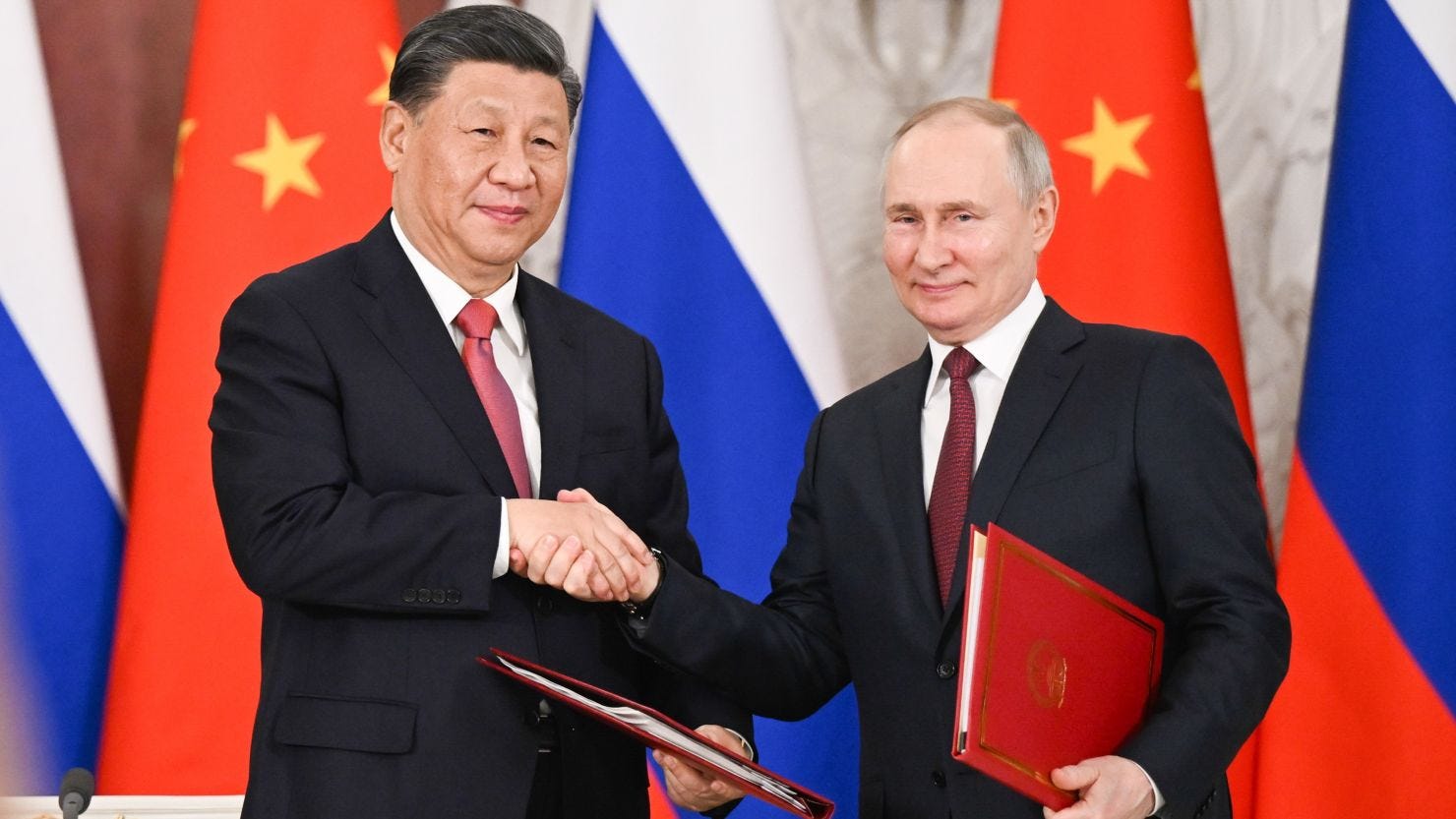
Whether the joint communique of May 7, 2025, by Putin and Xi dissuades President Trump from pursuing a closer relationship with Russia remains to be seen. Perhaps President Trump’s tolerance for Putin’s open defiance of Western peace overtures is grounded in the expectation of eventual lucrative business opportunities in Russia, both for American business and his family business personally. President Trump specifically mentioned the prospects for doing business with Russia as the peace dividend for both the U.S. and Russia after his telephone call with Putin on May 19. [38] Truth be told, there have been subtle indications of Donald Trump’s frustration with Putin through subtle barbs on the social network Truth Social intended to taunt the Russian dictator. For instance, the executive order by President Trump declaring May 8 as Victory Day for World War II to celebrate the “unmatched” contribution of the United States to victory in the war, must not have been well received in the Kremlin, which celebrates May 9 as Russia’s Day of Victory in the Great Patriotic War – also without acknowledging the contribution from other Allied nations. Furthermore, President Trump’s quotes on May 25, that “HE [Putin] HAS GONE ABSOLUTELY CRAZY,” “HE WANTS ALL OF UKRAINE,” and “IF HE DOES, IT WILL LEAD TO THE DOWNFALL OF RUSSIA,” indicate that Trump realizes that he is being played and that his attempt at rapprochement may be dead in the water. [39]
Presently, neither Ukraine nor Russia can agree to a peace accord without facing a domestic backlash from their electorates. Putin cannot agree to a permanent peace accord without first capturing the propaganda trophies of Sloviansk and Kramatorsk, the largest urban centers in the Donbas that remain under Ukrainian control. This was presented to the Russian public as one of the key objectives to be achieved by the war. Otherwise, Putin will anger his influential right-wing nationalist base, many of whom are active or retired military. If the right-wing nationalists turn against the regime, the general Russian public may begin to question the sacrifice in blood and treasure expended in the war. Furthermore, Putin’s economy depends on the continuation of the war. Because Russia converted to a war economy, a lengthy standstill would create undesirable political pressures, especially if it must revert to a peacetime economy. Too many Russians are either directly involved in the war or work in the war-related economy. What to do with the 700,000 Russians who signed up to fight in Ukraine for lucrative wages and signing bonuses (and the death benefits that are promised to their families)? In any case, the Russian army still holds the initiative and continues to advance in the Donbas, albeit incrementally, so Putin has reasonable expectations for further territorial gains, perhaps even a breakthrough of Ukrainian lines that can lead to a capture of Sloviansk and Kramatorsk. Although, given the current tactical balance along the front lines, that is unlikely. (It is entirely possible that Putin’s generals are afraid to tell him about the true state of affairs at the front.)
Meanwhile, President Zelensky cannot agree to a surrender of sovereign territory without an assurance of a sustainable peace. Otherwise, he faces not only a loss in future elections but also civil unrest. Ukraine’s stubborn resistance and Western sanctions during three years of war have built up cumulative pressures on the Russian military, society, and economy, that threaten the eventual collapse of Russian domestic support for the war. A lengthy pause in the fighting will act as a pressure release valve that will allow the Putin regime to “rinse, reset, and repeat” an attack on Ukraine with rejuvenated capabilities and renewed public support. After three years of war, the attrition of Russian manpower and armor, and the gradual buildup of economic pressure on the Putin regime is Ukraine’s greatest advantage. To throw it away by allowing Putin to get a lengthy breather without receiving substantive assurances of lasting peace in return would be akin to admitting defeat.
Unless Zelensky can convince the Ukrainian people that the frontline situation is so dire that a ceasefire is better than a loss of independence, the ratification of a peace agreement will not pass muster in the Ukrainian parliament. Due to Ukraine’s recent ability to slow down the Russian offensive in the Donbas with its “Drone Line” and through a pending structural reorganization of the Ukrainian army into separate corps, Ukraine is still in the fight and the sense of immediate collapse is absent. On the contrary, the spectacular special operation on June 1 by the Ukrainian intelligence service (SBU), which used drones smuggled into Russia to destroy 13 Russian nuclear-capable strategic bombers and 29 other aircraft, and the demolition on June 3 of a concrete pylon on the Kerch Bridge leading to Crimea, has bolstered Ukrainian morale and restored confidence. The vast majority of the Ukrainian people have been able to reconcile themselves with the reality of abandonment by the United States and for want of a better alternative, are resigned to soldier on. There is no indication that support for the war is wavering in any region of Ukraine, even the Russian-speaking East. [40][41]
g. Unintended consequences of President Trump’s tariff policy that hurt Russia.
The election of Donald Trump has also created unintended difficulties for the Russian economy. The Trump administration’s steep tariffs on global trading partners have had the indirect consequence of depressing oil prices below the $60.00 per barrel minimum that the Russian economists calculate is the break-even point for funding the Russian annual budget. Otherwise, the Russian state must run fiscal deficits by borrowing from Russian banks and dipping further into its sovereign welfare fund, which as of June 1, 2025, has been depleted from its pre-war value of 113.5 trillion rubles to 36.4 trillion rubles. This results in less revenue for the Russian budget and fuels even more inflation, which now officially hovers near 10% but in reality is closer to 22%. The Russian central bank has kept interest rates close to 20% for close to a year, which has stalled growth in the Russian economy by tamping down on business lending. Moreover, the escalating trade war between the U.S. and China is reducing the value of the Chinese yuan vis-a-vis the U.S. Dollar, thereby reducing the value of Russia’s sovereign welfare fund, which is partially invested in Chinese banks and repatriated into rubles based on the value of the yuan. Of course, the recent American embrace of mercantilism through the imposition of tariffs has the potential to cause a deep global recession, in which case, oil prices may plunge below $50.00 per barrel. This is the break-even point for American “frackers,” who have a much higher overhead than Russian or OPEC producers because of the technology needed to pump oil from so deep in the ground. Such a development would enable Russian oil to fill some of the void vacated by American shale producers and to capture market share, easing the Russian fiscal crunch - somewhat. However, lower oil prices still mean lower revenues and less funds for Russia’s war budget. The decision by OPEC on June 10, 2025, to hike oil production will lower oil prices even further and likely impose major damage on the Russian budget. Additionally, the trade war between the U.S. and China has reduced Chinese demand for Russian exports, adding recessionary pressures on the Russian economy, which is still trending towards stagflation – the simultaneous presence of inflation and recession. [42][43][44][45][46]
h. What are the prospects for Donald Trump lifting U.S. sanctions on Russia?
Perhaps the greatest future benefit to Putin from President Trump would be the lifting of U.S. sanctions on the Russian banking and energy sectors and the resumption of sales of U.S. technology to the Russian military-industrial complex. So far that has not happened. But President Trump has threatened the Ukrainians with such a change in U.S. policy if they fail to agree to the 30-day ceasefire. Zelensky relented and the threat receded. Nevertheless, it is reasonable to expect such an American change in policy to go into effect eventually, especially as a last-minute inducement to coax Putin into agreeing to a ceasefire or a peace deal. If President Trump follows through on his threat to lift sanctions on Russia, Ukraine would find the temperature of its “boiling frog” strategy lowered. The degree of such a cooling effect would depend on the ability of the Europeans to close ranks and persist with their sanctions. Nonetheless, Russia’s strained economy would find a reprieve from a lifting of U.S. sanctions.
i. Has the election of Donald Trump changed American military support for Ukraine?
So far, the election of Donald Trump has neither resulted in a clear strategic advantage to Russia nor a total disadvantage to Ukraine. There have been instances where the U.S. has allowed the sale of U.S. military equipment to Ukraine through European intermediaries, although the Ukrainian request for the sale of Patriot missile interceptors to Ukraine is still pending export control approval from the U.S. State Department. The American President has favored Putin much more than Ukraine during the recent push for peace talks between the two combatants. All of the territorial and political concessions are expected from Ukraine and all that Russia is expected to do is to agree to a ceasefire, which it continually refuses. Apparently, traditional U.S. foreign policy practitioners have some influence within the Trump administration and have pushed back on efforts to abandon Europe, and by extension Ukraine. Nevertheless, Ukraine will likely find itself under greater stress as its military supplies run down during the latter half of 2025 unless the U.S. continues to allow the sale of U.S. weaponry, whether directly or through European intermediaries. A decision by the U.S. President to throw Ukraine “under the bus” by isolating it from all Western support cannot be ruled out, as this is the ultimate leverage against Ukraine. All that it would take would be the refusal by the U.S. State Departments to relax export controls on equipment that contains U.S. military technology and components, such as Patriot missiles. Moreover, this would be the ultimate inducement for Russia to reach a deal. In which case, Ukraine would find herself isolated without sources of resupply and with the choice of either a desperate defense or a Cartiginian peace. [47]
Despite a few decisions that went Ukraine’s way during the first 100 days of the Trump administration, like the sale of used F-16 airframes and permission for sales of some U.S. weaponry through European intermediaries, Ukraine must brace itself for future disappointments. These favorable decisions by the Trump administration were “punishments” of Putin for refusing to heed the U.S. initiative for an immediate 30-day cease-fire. However, there are no indications that Donald Trump has permanently soured on Vladimir Putin. His insistence that President Zelensky travel to Istanbul for a meeting with Putin on May 15, regardless of Russian acceptance of a 30-day ceasefire, indicates that Donald Trump still hopes to reach an accommodation with Vladimir Putin. Despite a few snarky tweets to Putin on Truth Social, he has yet to initiate additional sanctions against Russia, like restrictions on Russia’s central bank to repatriate oil revenues or against Russia’s “shadow fleet” of oil tankers that ship Siberian crude oil. Notwithstanding his loyalty to Donald Trump, Republican Senator Lindsey Graham of South Carolina continues to be the prime anti-Russia hawk in the Senate. Reportedly, he and Senator Richard Blumenthal of Connecticut have lined up the bipartisan support of over 80 Senators for a tariff of 500% on any nation that buys Russian oil, gas, or uranium. Nonetheless, as of the date of this publication, President Trump refuses to give Graham the green light to introduce the bill and send it to a vote. Despite Ukrainian efforts to meet President Trump’s requirements for peace, he constantly looks for excuses to favor Russia.
However, Ukrainian prospects at present are far from hopeless. As of June 9, the Biden legacy U.S. military aid to Ukraine continues to flow and even a few traces of new sales through European intermediaries are finding their way to the front. Concurrently, the Ukrainians still await the approval of direct sales of Patriot missile interceptors. As the Ukrainians slowly trade space for time in the Donbas, Russia slowly but surely approaches a tipping point where its mobilization will fail to keep up with casualties and the Russian economy reaches a boiling point that the Russian public and elites will not tolerate. Furthermore, a dearth of Russian armor will limit the ability of Russia to raise new mechanized units, which shall limit it to plodding infantry assaults. There is a silver lining for Ukraine with the impending collapse of NATO as the security architecture for Europe. Ukraine is now free to negotiate defense treaties with European powers, such as France, England, Germany, Poland, and Checkia, to create a new mutually assured defense architecture that is not subject to the veto of disrupters in NATO, such as the United States, Hungary or Slovakia. Ukraine can enter new defense treaties as a full-fledged partner based on its military strength. After all, Ukraine fields an army of over 800,000 troops (of which 300,000 are found along the front lines). These act as a defensive shield for the rest of Europe. Of course, Putin will pursue hybrid war against these European actors with a vengance. If Putin believes that he was able to tap into populist grievances to help elect a pro-Russian U.S. President, similar strategies are available to support the right-wing political parties in the European states.
States wage war not because victory is certain but because they believe that there is no better option. The decision to go to war is made from perceived necessity after an assessment of relative strengths and reasonable foreseeability of victory, regardless of how that victory is defined. After all, according to Carl von Clausewitz, chance, uncertainty, and friction are part and parcel of war. [48] Please recall that Nazi Germany was ascendant throughout most of 1942. However, the Allies fought on because defeat was unthinkable and the prospects for a turnaround were still within the realm of reasonable foreseeability. They were rewarded for their pluck with a strategic victory at Stalingrad, which was a turning point in the war. So too in the Russo-Ukrainian War. If you listen to Russian propaganda (as well as the statements of President Trump and Vice President J. D. Vance), Russia is winning. But Ukrainian victory is still within the realm of reasonable foreseeability if Ukraine continues to receive weapons and munitions from the West and the Russian army continues to be attritted during its obsessive grind through the Donbas. Anyhow, peace on Russian terms is unthinkable, since Putin reiterates his ambition to destroy Ukraine, not only as a sovereign state but as a nation. The Ukrainian population may be war-weary but not one region of the country is pressing Zelensky for an immediate peace. Much depends on the mercurial personality of President Donald Trump. He can enable Ukraine to “boil the frog” if he allows it to receive or buy military equipment and munitions from the Europeans or he can force its collapse if he leans on the Europeans to stop providing aid. If Sloviansk and Kramatorsk remain in Ukrainian hands, regardless of the source of military aid, the Russian war effort will hit an eventual point of diminishing returns, likely by 2026. [49] Monthly mobilization will dip well below the level of Russian losses and stagflation will bite painfully into the pockets of business owners and workers alike. Ukraine’s ultimate goal may be to place Putin on the horns of a dilemma - either to order a general mobilization, with all its negative domestic fallout in urban centers like Moscow and St. Petersburg, or begin peace talks. To reach that boiling point, Ukraine may have to order and enforce a general mobilization of its own, something Zelensky has been reluctant to do for domestic political reasons. Only then do substantive peace negotiations have prospects for tangible results.

[1] Henna Inam. Leadership and the Boiling Frog Experiment. Forbes, August 28-29, 2013.
[2] Holovne zavdannia – ne daty RF povnistiu’ okupuvaty Donbas – Zelensky. Cenzor.net, August 27, 2024.
[3] Michael Koffman, Shashank Joshi. Mass, Maneuver, and Modern Warfare. Russian Contingency. April 14, 2025. http://warontherocks.com
[4] David Axe. How Ukraine can win, p. 1: The drone revolution that’s dismantling Russia’s army. Forbes, May 16, 2025.
[5] David Kirichenko. Ukraine’s Drone Forces Are Ready for Russia’s Spring Offensive. The National Interest. April 23, 2025.
[6] David Axe. With or without truce, Russia’s war with Ukraine heading for freeze, analyst says. Forbes, May 16, 2025.
[7] Seth G. Jones and Riley McCabe. Russia’s Battlefield Woes in Ukraine. CSIS, June 3, 1995.
[8] Yevhenia Martyniuk. Putin plans to capture the Donbas in 2025 – despite not capturing it in 2022, 2023, or 2024. Euromaidan Press, May 19, 2025.
[9] Kostantyn Mashovets. Visti z frontiv. 29.05.2025. Tverezyi pohliad. May 29, 2025.
[10] The Battle of Verdun in 1916 was the bloodiest battle of World War I. The intent of the German Chief-of-Staff, General Erich von Falkenhayn, was to seize the symbolic forts at Verdun and then to bleed the French army white with artillery fire as it tried to recapture “sacred” French soil. However, he failed to account for French logistical adaptation to transport artillery and ammunition to the remote battlefield, which was able to offset the initial German advantage in firepower. The struggle turned into a brutal battle of attrition with minimal gains and over 300,000 dead on each side.
[11] Putin’s sickening statistic: 1m Russian casualties in Ukraine. Economist, June 2, 2025.
[12] Nataliya Bugayova and Kateryna Stepanenko. Hiding Russia’s Weakness. ISW, May 9, 2025.
[13] Francesca Ebel and Kostiantyn Khudov. As Russia reels from drone attack, Ukraine targets vital Ukrainian Bridge. Washington Post, June 4, 2025.
[14] Andrei Kolesnikov. Russia’s False Euphoria. Trump’s Outreach to Putin Has Shifted Russian Opinion – But Failed to End the War. Foreign Affairs, May 9, 2025.
[15] Stephen Losey. US Air Force sending ‘boneyard’ F-16s to Ukraine for spare parts. DefenseNews, May 5, 2025.
[15] Ellie Cook. Donald Trump Opens Ukraine Military Sales After Minerals Deal: Report. Newsweek, May 1, 2025.
[16] Olena Mukhina. Europe plans to produce 10,000 missiles annually – including only ones that can stop Russia’s ballistic terror in Ukraine. Euromaidan, May 19, 2025.
[17] Julia Struck. Israel Quietly Supplied Patriots to Ukraine, Envoy Reveals. Kyiv Independent, June 9, 2025.
[18] “Trump pauses military aid to Ukraine after Oval Office argument with Zelensky, White House official says.” CNN, March 3, 2025.
[19] Ellie Cook. Ukraine Reacts to Report Trump ‘Unaware’ of Pete Hegseth Order to Halt Aid. Newsweek, May 7, 2025.
[20] “Ukrainian forces lose access to Maxar satellite imagery via the U.S.” ABC News, March 8, 2025.
[21] Eleanor Beardsley, A. Martinez. U.S. resumes Ukraine military aid and intelligence sharing as Kyiv approves ceasefire. NPR, March 12, 2025.
[22] Barak Ravid, David Lawler. Trump’s deference to Putin stunned European leaders on call. Axios, May 20, 2025.
[23] Volodymyr Ivanyshyn. ‘Have the meeting, now!’- Trump urges Ukraine, Russia to hold direct talks. The Kyiv Independent, May 11, 2025.
[24] X. citing RT, May 16, 2025 @ 07:01 am.
[25] Beryl Eski, Mary Ilyyushina, and Serhiy Morgunov. Ukraine, Russia hold brief talks, agree on prisoner exchange, but little else. Washington Post, June 1, 2025 at 02:14 p.m.
[26] Guy Falconbridge. Exclusive: Putin’s demands for peace include an end to NATO enlargement, sources say. Reuters, May 28, 2025.
[27] Patrick Reilly. Trump considering ‘secondary sanctions’ on Russia ahead of potential high-stakes talks between Putin, Zelensky. New York Post, May 14, 2025.
[28] Yuri Zoria. Trump stalls Senate bipartisan sanctions bill. Euromaidan Press, June 5, 2025.
[29] Michael Birnbaum, Robyn Dixon. Trump, Putin talk as Ukraine and Europe push for immediate ceasefire. Washington Post, May 19, 2025.
[30] Beryl Eski, Mary Ilyyushina, and Serhiy Morgunov. Ukraine, Russia hold brief talks, agree on prisoner exchange, but little else. Washington Post, June 1, 2025 at 02:14 p.m.
[31] Maria Tril. Trump envoy warns Ukrainian strikes on Russian bombers push conflict towards dangerous escalation. Euromaidan Press, June 4, 2025.
[32] Francesca Ebel and Kostiantyn Khudov. As Russia reels from drone attack, Ukraine targets vital Ukrainian Bridge. Washington Post, June 4, 2025.
[33] Bernd Debusmann Jr. Putin will seek revenge for Ukraine drone attack, warns Trump. BBC, June 4, 2025.
[34] Alex Miller. Massive Russia sanctions package stalls as Trump pushes for Ukraine peace talks. Fox News, June 4, 2025.
[35] Greg Sullivan, Henry Mayer. Putin and Xi Tout Partnership Aimed at US-Led Order in Talks. Bloomberg, May 8, 2025.
[36] Xi Jinping has Vladimir Putin over a barrel. The Economist, May 12, 2025.
[37] Jacobus Delwaide. Ukraine as Pawn: The Contentious Causes of Russia’s War. Krytyka, December 2022.
[38] David McHugh, Daria Litvinova, and Kate Marie Davies. Trump and Putin want to talk business once the Ukraine war ends. Here’s why it won’t be easy. AP, May 31, 2025.
[39] Truth Social. Donald J. Trump @realDonaldTrump, May 25, 2025, 07:46 pm.
[40] Olena Mukhina. Russian-speaking Ukrainians overwhelmingly oppose Moscow despite Kremlin protection claims, poll shows. Euromaidan Press, May 27, 2025.
[41] Dmytro Kuleba. Kyiv Won’t Compromise on Its Sovereignty Because It Isn’t Facing Defeat. Foreign Affairs. May 30, 2025.
[42] Russia’s National Welfare Fund at Risk of Depletion By 2026, Economists Warn. The Moscow Times. June 9, 2025.
[43] Russian January-April budget deficit widens to 1.5% of GDP on accelerated spending. Reuters, May 7, 2025.
[44] Yevhenia Martyniuk. Bloomberg: Putin’s strength in Ukraine may be an illusion as Russia’s corporate debt hits $446 billion. Euromaidan Press, February 2, 2025.
[45] Frontline report: Russia faces oil price collapse as OPEC+ hikes production again. Euromaidan Press, June 10, 2025.
[46] John Varga and Alana Loftus. Russian economy in meltdown as crude exports plummet with ‘production in turmoil.’ MSN, June 4, 2025.
[47] Carteginean peace refers to the brutal measures the Roman Republic imposed on Carthage after the end of the Third Punic War in 149 B.C. Essentially, all the men were killed, women and children enslaved, the city of Carthage destroyed and (supposedly) the surrounding fields were sown with salt, so nothing could grow for years.
[48] Carl von Clausewitz. On War, (1832) translated and edited by Michael Howard and Peter Paret. (New York: Everyman’s Library, 1993), p. 101, 138.
[49] Tatarigami. Does Russia face military collapse by 2026? Inside Ukraine’s strategic assessment. Euromaidan Press, October 22, 2024.
No posts
Comments
Nothing yet. Say the first thing.
Sign in to join the conversation.