
I’ve been reading Miyabe Miyuki’s Apparitions: Ghosts of Old Edo lately, and I have to say, it’s pretty good. Most people know Miyabe’s Brave Story, either through its PSP adaption or through working their way through its one thousand or so pages. I didn’t care for Brave Story much, possibly because I feel bogged down with long novels, but whatever the case, Miyabe’s short stories are just the thing. Her style is evenly-paced and thoughtful, and her narrator has a discerning eye towards her character’s self-reflection.
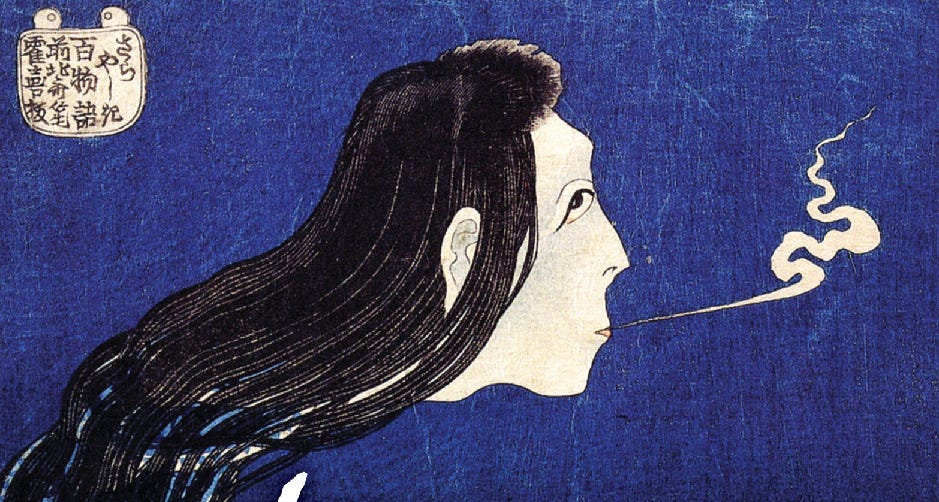
The fantasy elements in Apparitions are light, which might surprise you (it did me) if you go into the stories expecting them to be simply scary stories. Miyabe needs to build character and setting first before she gets into the scary (or, rather, the unsettling) things that happen, so that the stories almost feel like short Icelandic sagas, fleshing out the before and after an event so that the reader gets the fullest picture of what is going on. Maybe this style is why Brave Story is so long; Miyabe sees the value in the long-term narration of how her characters work before the plot really gets into gear.
The “ghosts” in Miyabe’s stories aren’t like Western ghosts, and that’s because the Japanese “ghostly” world works on different assumptions than Western counterparts. In the West, ghosts tend to be the spirits of people, maybe animals, and perhaps the remainder of emotions. In Japan, inanimate objects can have, or become, “ghosts,” or the spirit of a person who isn’t dead yet can wander around and cause problems. The Japanese have a lot more categories of non-human entities that mess with the human world, from foxes to dead people to old, beaten-up umbrellas.
One thing that’s notable about Japanese apparitions (to use a more general term than “ghosts,” which doesn’t really work in the Japanese context) is the effect that they have on a person. Or not necessarily the effect they have on their subjects, but a person’s inability to hold them off. People are often at a loss of what to do to keep apparitions from visiting them and causing them trouble. Even more strangely, some people aren’t able to keep their own angered or slighted spirits from going out and hurting others. In two of Miyabe’s stories, the spirits of characters who have faced insults (one of them already dead, the other still alive) haunt another character and draw their life-force from them. These beings are called 生霊 ikiryou, which literally means “living ghost.” These beings have a long tradition going back at the very least to The Tale of Genji (published some time before 1021), where the Lady Rokujyo torments Genji’s pregnant wife out of jealousy. The wife, Lady Aoi, is so deeply affected by Lady Rokujyo’s spirit that she dies after childbirth.
Did Lady Rokujyo want to kill Genji’s wife? Could we accuse her of murder? Or was O-Chiyo in The Plum Rains Fall responsible for making O-En contract a mental illness (or for her face being disfigured)? The stories don’t really lay a blame on Lady Rokujyo or O-Chiyo, and in a way, insisting that blame be placed, and justice achieved in some way, seems rather Western to me. Part of the eeriness of these stories, in Miyabe’s and The Tale of Genji as well as other Japanese “scary” stories, is the inability to make sense of everything. Humanity is limited, though at the same time these forces have a dire and ready affect on people.
Elsewhere, I’ve seen these ideas about humanity’s openness to what could be described as “spiritual attack” as “the permeable self.” Humans are like sponges, or flower pots with holes at the bottom, or screens in open windows instead of, say, glass windows that are closed. The spiritual, in much of the Japanese imagination, is able to get into people, and there’s very little that people can do about it. People must deal with the repercussions, maybe find a Buddhist priest, and hope for the best.

Western thought is pretty different, generally. Post-modernism argues that there is an unbreachable gulf between the world outside of us and the world inside us. Other people are inscrutable and confusing. We may be living one way, but those around us are thinking and living completely different lives. Superhero movies play off this assumption with their secret identities; put on a mask or glasses, comb your hair differently, and wear a cool outfit and no one will know that you’re not just another silly high school student or a bumbling reporter. In the supernatural world of Western fantasy, there’s always an “out,” usually by fighting something off with one’s fists (again, as in superhero movies) or by the force of someone’s will. In the West, we fear the grotesque. A person’s very will being taken away both baffles and terrifies us.
Generally, that is. There are certainly exceptions (zombies are one of them). One of the most important things for Westerners, however, is the purity and sanctity of a person’s will. Taking away someone’s will is a dire act of evil, and that’s because we feel that a person’s self is sacrosanct. We are self-realized individuals. We fear being misinformed, hood-winked, or tricked, either by the news or politicians or by the supernatural forces that we imagine.
The Japanese are different. Individuality is becoming more and more important, but the Japanese culture is still based on community, not the single person. This is true in day-to-day interactions and in how they imagine non-human, “otherworldly” beings. The Japanese are also a lot more superstitious than Westerners are. I was once accosted by my two Japanese friends when I tried to take a picture of a cemetery (they told me that I’d be haunted, or something like that) and the presence of a red torii gate elicits respect whether they’re placed outside of a Shinto shrine or at a street corner so that drunk people don’t pee there (or at least that’s what another Japanese friend of mine told me was the reason for strapping a tiny torii gate to a telephone pole).
The thing is, “stuff” can get into you in the Japanese imagination. You don’t have a natural, unassailable defense against spiritual things. A curse can get to you whether you will it away (or pray it away) or not. Your own spirit can come out of you and attack people just because you’re feeling slighted. There’s a lot more to the world than just you and some quantum waves that you change into “things” just by looking at them. Even for those of us who are religious, there are more than just humans, gods, demons, and angels, more than just the good and the bad and those being pulled in either direction. The world can be a terrifying place, because we are at the mercy of everything around us, ourselves included.
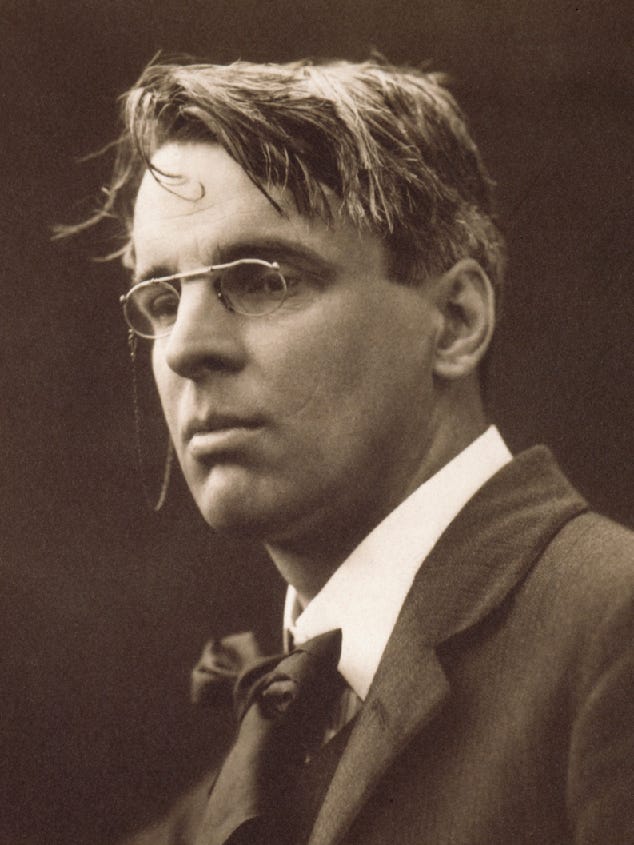
It’s not all bad, though. There are bad things out there, sure, but there are also good things as well. There are, for one, torii gates as in my example above. It’s important to note, however, that it’s not our opinion of these red gates that makes them powerful but something about the things themselves. This is something that many Westerners, I’ve noticed, get uncomfortable about. There is something about torii gates, or religious symbols, or incense smoke that is, at their essence, powerful. Things have a quality to them that cannot be taken away. They have these qualities at the core of what makes them themselves. Most Westerners aren’t essentialists, however, meaning that we don’t think that things have souls or spirits that inform who or what they are. We are products of our DNA or our environment. Nature is dead matter. At the quantum level, everything is empty space. To quote Y.B. Yeats, the center cannot hold.
For better or for worse, that’s not the Japanese world. In the Japanese imagination, the things around us touch our inner selves. And they don’t just touch us, but they change us, too, even if we don’t want to be changed. The manga/anime Mushishi, or most stories dealing with yokai for that matter, are all about strange beings changing who people are, causing them to become lost in strange tunnels, or even taking away their very humanity. In The Third Love, Riko travels back in time to inhabit the bodies and minds of two women, one in the Edo period, another in the Heian period, and her “self” merges with them so that they are not only in conversation with one another but actually become each other. Who Riko is as a person is melted into who the oiran and the lady-in-waiting are. In Otherside Picnic, Sorawo and Toriko explore a world of madness and often risk becoming mad themselves.
But, again, not all of this is bad. Riko’s self-hood merges with the two women she becomes in her dreams, but this merger allows her to heal. Mushishi’s Ginko is able to help and often rescue people who are lost or at risk, because he is kind of half-mushi himself. And in Otherside Picnic, well, okay, maybe all that’s bad. The assumption is that, if you enter into the liminal space between yourself and something good, then you will be healed or bettered in some way. This idea seems to be a hallmark of Japanese literary thought going back to Ki no Tsurayuki’s preface to the Kokin Wakashu (around 900 A.D.), where the author/poet emphasizes the interaction between what the poet sees and experiences, the poet themself, and the poem itself. The world, art, and the person are connected by a continuous flow of affect.
In a way, I think this is part of what makes Japanese fantasy so effective. We are supposed to change by witnessing it. Art is supposed to enter into us, mix up our soul and change us to our core, and lead us to some other way of being. That’s why Japanese horror is so unsettling and why the natural landscape in Japanese art can be so refreshing.
No posts
Comments
Nothing yet. Say the first thing.
Sign in to join the conversation.