
Like many people in my generation (I’m a millenial), I started playing Final Fantasy games halfway through the series. I started with Final Fantasy VI (1994), then IV (1991), then VII (1997), and so on. It wasn’t really until the remakes of the original games in the series were already old that I started to think about making my way through Final Fantasy I - III and V, and it’s only recently that I started really thinking of the individual games as part of a series.
Any series, be it in gaming, literature, music (think albums), or any other type of art, has certain assumptions that come with it. When you pick up any Dragon Quest game, you pretty much know that you’ll be getting a colorful world, a silent protagonist, and vignette storytelling. I recently started playing Trails games (starting with Trails of Cold Steel (2013) and am now playing Trails of the Sky, First Chapter (2004, remake 2025)), which are similarly colorful, have great characters, and are more interested in politics than Dragon Quest games. Xeno- games have deep lore. Star Ocean games have fun combat and questionable story-execution. Even Final Fantasy games, as different as they are, have certain staples or similarities that bind them together, albeit loosely.
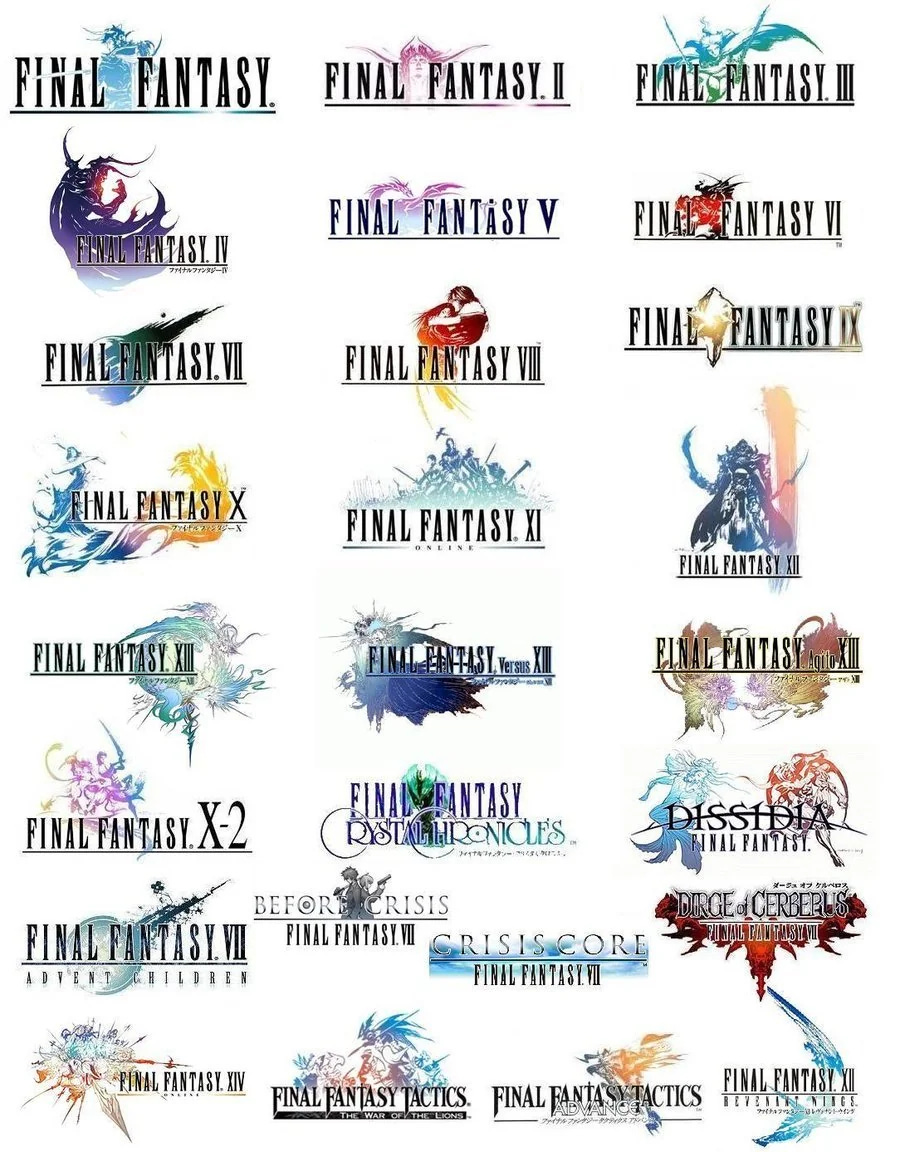
There is also trajectory. Each new piece in a series “points” in a particular direction of development and sets expectations and standards not only for the series itself but also the genre of which it is a part. There is a certain school of thought in literature studies (it’s called “genre theory”) that suggests that each new piece in a genre recreates the genre and establishes new or augmented expectations for that genre. Think of it like this: Toby Maguire was a particularly youthful, thoughtful, and earnest Spider-man in Spider-Man (2002). This was slightly different from the smart-talking Spider-man of the previous decade. Maguire’s Spider-man was not simply lovable but also kind of a dork. I think audiences believed in him as Peter Parker, but he didn’t always come off as the best Spider-man. Tom Holland is different. He’s also lovable, but somehow he also pulls off Spider-man, too; his performance makes us believe that he’s both a kid and a hero. I feel bad for the next person to take up the role. The expectations are pretty high!
What do individual games make us expect games to be like in the future? Final Fantasy IV and VI made us expect a certain level of storytelling in Final Fantasy games but also in RPGs. Final Fantasy VII met those expectations, whereas Final Fantasy VIII (1999) did not (for some people. I loved it). In a way, we would not have Final Fantasy VI if we didn’t have Final Fantasy IV - we would not have the expectations of storytelling and a huge class until a game pushed the boundaries of what gaming could be (what things we could expect as standard). This is what the phrase “standing on the shoulders of giants” means: without the examples of the past and the courage of developers to make things new, we wouldn’t have the amazing things we have now.
Not all trajectories in genre are a straight line. In many cases (really, in most cases), the individual choices made when development a game do not change the genre. Or, they may cause the genre to develop in a different direction. Squall in Final Fantasy VIII (1999) was another brooding protagonist like Cloud, but audiences in the United States thought he was just a bit too much of a jerk. After Terra and Cloud, having another quietly suffering character was one “…” too far, and so in Final Fantasy IX (2000) we have Zidane, and in X (2001) we have Tidus, both upbeat and positive heroes, even when they carry huge burdens on their backs. Final Fantasy VIII had so many dead-end ideas that didn’t work for fans that Square touted IX as being a sort of “back to basics,” a recreation of what Final Fantasy “was,” even as IX made a number of changes to the formula itself. Now, I loved VIII. I think we’re all a bit too hard on it, though it is kinda weird. It’s just that what it tried to do (time travel, weak side-characters, the draw system, etc.) didn’t make fans yearn for more; they made players want to go back to something familiar, something that they knew. Thus are genres built.
One of the most interesting parts about the early Final Fantasy games (and I mean I - VI here) is that, when playing them, you can watch both a series and a genre being formed. There weren’t many other RPGs back in the late 80s and early 90s. There wasn’t even a single definition for “RPG” at all (though some might say that we’re in the same boat in 2026). Everything was open and up for grabs, and with each new entry in Final Fantasy, Dragon Quest, or Phantasy Star, players formed firmer and similar understandings of what it meant to buy an RPG from Japan (or a video game at all). These expectations, further, were muddied by the different player-bases in Japan, the U.S., and the rest of the world. Japanese RPGs were brighter in color-palatte, easier to approach, and generally focused more on world-building than dungeon crawling when compared to their Western counterparts. It took a while, too, before Japanese developers began to consider their non-Japanese player-base, and some developers, both Japanese and Western, still only think of their own culture’s expectations when making games (I actually think this is a good thing. We should want diversity in gaming. Otherwise all games would be the same).
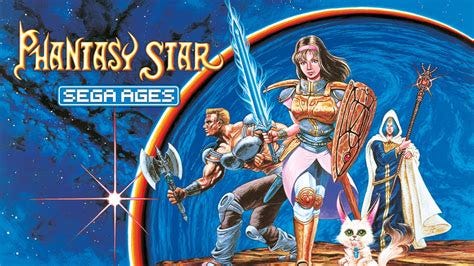
As anything is being built, there are certain constraints at the same time as there is great freedom. Yes, developers of early RPGs could really do whatever they wanted when making their games, but they also wanted to sell those games. Square needed to establish a certain level of quality in their games for their company and their various IPs to be trusted. They wanted gamers to play Final Fantasy I and yearn for more, and in many ways they needed to meet those hopes in Final Fantasy II. With Dragon Warrior games, Enix stuck pretty close to its established types in order to help players feel at home with each new iteration, while Square set the expectation that each new Final Fantasy would be a little bit different than the previous one. Even so, Square did a lot to lay specific groundwork in each new Final Fantasy game to set certain expectations. In a way, each new Final Fantasy game was training players to be better and better at playing Final Fantasy games, and in so doing, because of the popularity of Final Fantasy, they also trained developers to adhere to Square’s expectations and standards - if, that is, other developers wanted to sell games.
The question “what makes a Final Fantasy game a Final Fantasy game” has always been somewhat contentious. With a series that changes so much with each new entry, there’s not much to grab hold of. There are certain themes that run through the games (such as the desecration of the land by chaos, political stories with supernatural influences, and the mystery of one’s own identity), but as games, Square seems pretty happy to let each new development team take the series in whatever direction they want.
There is, however, a lot more to Final Fantasy game than a loose connection of themes and a general interest in things that can kinda-sorta be classified as “crystals.” There are trajectories of gameplay that are established, tested, tweaked, continued, and done away with. Final Fantasy as a series isn’t defined by trajectories (again, all series have them), but when discussing Final Fantasy as a series, it’s important to look at these trajectories, how they’re established, why some continue and others end, and how the genre is shaped by such choices.
When looking at Final Fantasy VI in particular, it’s essential to look at the trajectories set up in the previous five games. The most obvious is the battle system: Final Fantasy I established turn-based battle systems as the standard for the series. This standard continued for a long time, coming to an end with Final Fantasy XI (2002), but it was also tweaked throughout its lifetime, particularly with the ATB system first established in Final Fantasy IV. There are also classes, tweaked with Final Fantasy VI and VII but never entirely disappearing until, possibly, Final Fantasy XII (2006) or maybe Final Fantasy XV (2016). There are summons, which didn’t appear until Final Fantasy III (1990) but have continued through pretty much each entry since. Each of these are well-known as core components of Final Fantasy games as games.
There are, however, a number of aspects of these games that are often overlooked. One aspect is PC hit points, which are often exaggerated. Table-top RPGs needed to keep HP somewhat low in order to make die rolls make sense; rolling a six-sided dice for damage didn’t mean much if a character had 5,000 HP. Most games handled this transition from table to console by keeping HP low, though Final Fantasy bumped HP totals up with each new entry. A player could beat Final Fantasy I with PC HP at around 500 to 800, depending on the class, whereas I beat X-Death in Final Fantasy V recently with my character’s HP in the 3000s (in the Pixel Remaster at least). The idea is, I think, that with higher HP totals, PCs feel more powerful. Bigger numbers mean bigger power which means bigger heroes.
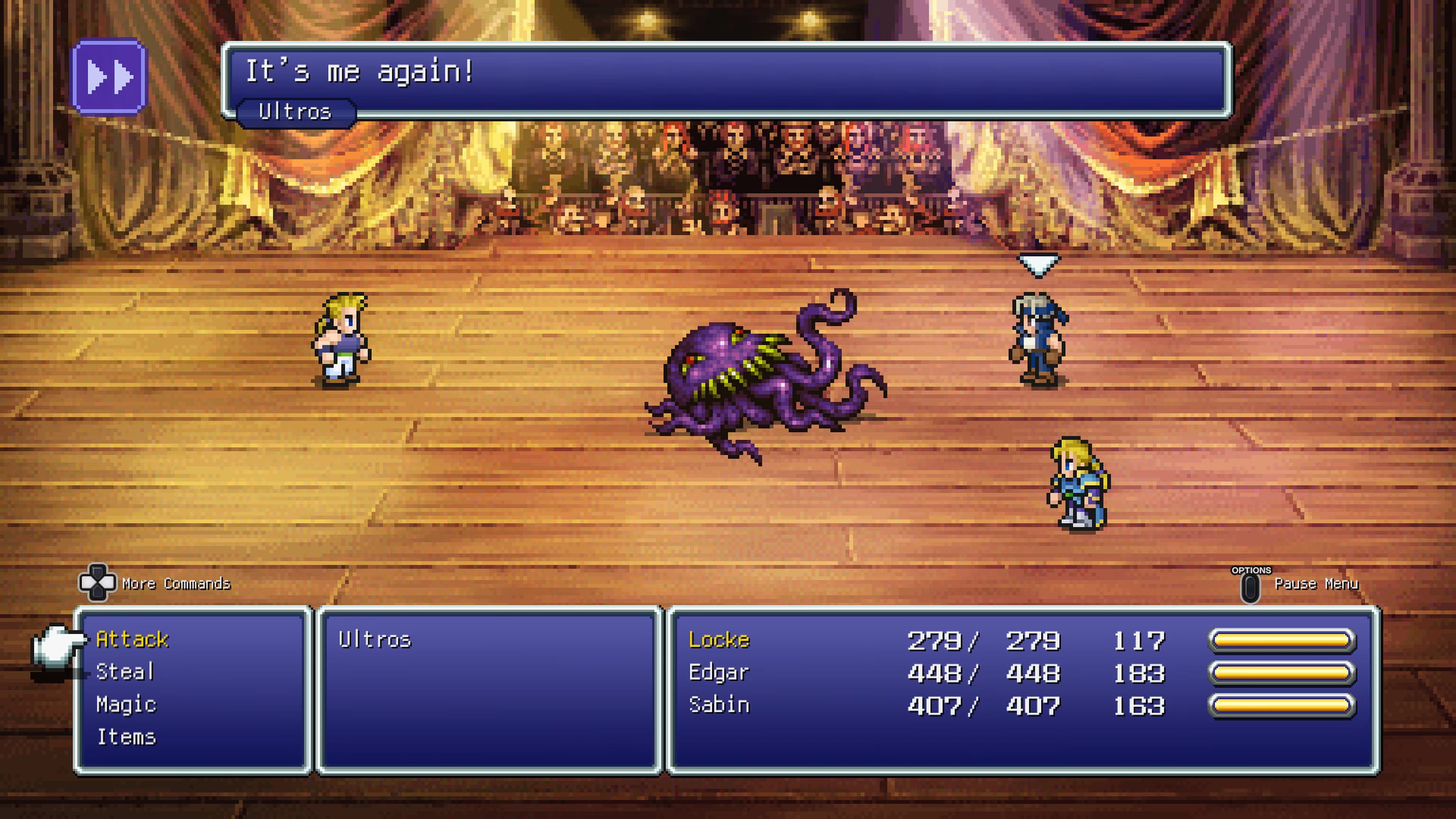
HP totals, however, became a problem when it came to items. Potions in Final Fantasy I healed 50 HP, and High-Potions healed 150 HP. This is great in the early parts of the game, when HP totals are in the 100s, but items become less useful with higher totals. Later in the game, magic becomes more important for healing but also for doing substantial damage. And that makes sense, and it actually follows from Dungeons & Dragons, where (at the time) low-level mages were pretty weak but became incredibly powerful at higher levels (nowadays, in 5th edition D&D, each class is balanced at each level, which is both fun and also a loss).
This is fine for Final Fantasy I, but as the series continued and HP totals got higher and higher, potions and high-potions became less and less useful. Healing 50 HP when a character had 3,000 HP was kind of pointless, and as HP totals scaled up much more quickly in later games, healing items became less useful more quickly. Other RPG series solved this problem by making items heal a certain percentage of total HP, but for some reason Square didn’t seem to be bothered by this issue and so didn’t change it, though they continued to have healing items in their games. When it came to Final Fantasy VI, where it was not unusual to have HP totals in the 4,000s and 5,000s, and where grinding allowed totals to reach up to 9,999, healing items became a strange, vestigial component that sat in games without much of a point.
Here is where I get to the rationale behind this article’s title. Final Fantasy developed, as a series, certain expectations and standards that became less productive as other aspects of the games changed. More and more of these vestigial standards stuck around until, by Final Fantasy VI, there’s a pile of game components that just don’t make sense. Potions are just one example of aspects of the game that really don’t need to be there but are there because they came to be expected in both Final Fantasy games in specifically and JRPGs in general. You can get through most of VI without using a potion at all.
Another example of this piling-up of vestigial standards is the class system. Up until VI, the odd entries in Final Fantasy games were based in changing classes. Even Final Fantasy I had class upgrades, and the best iteration of classes in the whole series is Final Fantasy V (though I would personally say it’s Final Fantasy Tactics (1997)). The even numbered games had characters with singular classes or, in the case of II, no class at all. Everyone in Final Fantasy IV is an example of a single class (Cecil is a dark knight then a paladin, Rosa is a white mage, Kain is a dragoon, etc.), and while this sorta continues in Final Fantasy VI (Strago is a blue mage, Shadow is a Ninja, Umaro is a beserker, Cyan is a samurai), most characters become red mage/summoners. Many of the class-specific abilities, instead, were outsourced to relics, which had been a developing game system since Final Fantasy I. Anyone could become a dragoon with dragoon boots, and the Cover ability that Cecil had in IV and Knights had in III and V became the True Knight/Knight’s code relic that anyone could equip. Setzer could be given the $Toss ability associated with Samurai in V (though the samurai in VI, Cyan, can’t gain this ability). Relics like Earrings and Gold Hairpins can turn anyone into an effective mage, and the Sniper Eye/Sight is the Aim ability from Rangers in V.
All of this is actually a part of a trajectory first established in Final Fantasy III but really explored in V. If characters can change classes and bring along abilities from previous classes, then why not allow a character to be a mage-dragoon-fighter-samurai? Everyone can use magic and cast summons, which is pretty cool and works wonderfully with the game’s world and story, but this also makes the ability to cast magic and summon monsters less of a game component. If anyone can do it, then there’s less customization, not more. Also, why can’t everyone dance in Final Fantasy VI? I could see a relic called something like Fairy Shoes or Red Slippers that allow even Shadow to pull out some moves. And why aren’t there bards? Or bows, which made putting people in the back row a more obvious tactical advantage? Rows themselves becomes a sort of vestigial game component by lacking many weapons that made rows interesting in the first place. In all, classes are kinda a mess, stuck between the fun mix-and-matching of Final Fantasy V and Final Fantasy VII, where classes are completely outsourced to materia.
Certain classes are also much more powerful than others. At certain parts of the game, it’s rather silly to make Edgar hang out in Narshe instead of coming along with the party, because he’s just so powerful. Mog has always been my favorite character (and I am mercilessly teased by certain people, my wife and the author of Library of Lewis and Tolkien for my Mog-devotion; at least my godson understands me, sniff), but there’s really no need to use his dancing ability when he can throw Ultima around. Relm is sweet but also pretty useless in battle. I don’t know anyone who doesn’t have Terra, Celes, or both in the final battle, but I’ve never seen anyone bring Umaro to the final showdown. In a sense, this tracks with Final Fantasy V. I wouldn’t make Bartz a berserker for the final battle with Neo X-Death. Classes that are just for fun is also a staple of Final Fantasy games. There are, though just too many poor choices to make in VI and so many obvious choices.
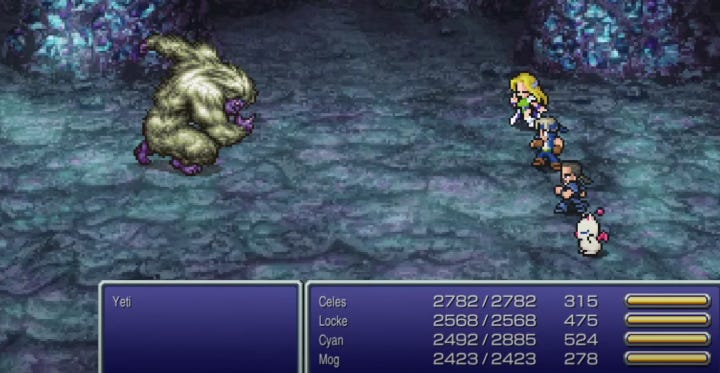
All of this makes Final Fantasy VI an unfortunately easy game. This may be coming from someone who has been playing the game since it came out in 1994, but after a game like Final Fantasy V, which takes a bit more thought and consideration to party makeup, VI is kinda a walk in the park. All you really need to finish the game is a party of mages who have access to Meteor or, better yet, Ultima, and before that there’s not much reason to switch up characters for certain dungeons or bosses (except to grind 12 our of the 14 of them for the final dungeon).
This doesn’t mean that I don’t like the game. Far from it. Final Fantasy VI is, I think, the best of the series, and personally it’s my favorite game besides Xenogears (1998) (though Xenogears is in a class all of its own). The collection of characters, the depth of storytelling, the ability to have your favorite characters in your main party regardless of their questionable secondary abilities, the pure insanity of Kefka, the music, and much more make this game a spectacular and highly influential game in its series and among RPGs as a whole - but it’s also a really strange game. So much works, but there are a bunch of these little vestigial nodes that make it seem like a middle child who is searching for their own identity. It could easily have failed had the story, music, and everything else not been so spectacular. Which is an interesting thing to think about. What if VI didn’t pan out as a foundational game for the genre? What if we didn’t have the expectations of deep storytelling and the troubling outcome of Kefka’s insanity? Would we have gotten a character like Cloud, who himself is always searching for his own identity? Would we have gotten mako reactors and the plate falling on Midgar? Would the natural devastation that we see even as far away as Final Fantasy XVI have been as developed? I don’t think so. It could have happened differently. Sure, another game would have come along to push the boundaries of what games can do in terms of telling stories and developing characters, but it might not have gone as we know it.
No posts
Comments
Nothing yet. Say the first thing.
Sign in to join the conversation.