
In this article I write about Auguste from Octopath Traveler 0 (2025) and will mention a number of spoilers. I don’t talk much about later parts of the game, though, so if you’ve gotten through Auguste’s part, you’re safe. I also talk about the end of Lord of the Rings (1954-5) and Avengers: Infinity War (2018).
In a game filled with all sorts of creepy characters, Auguste made me feel the most uncomfortable. There are many kinds of antagonists in RPGs: evil deities, arrogant kings; bloodthirsty savages, and the like. Most of these don’t live with these kinds of maniacs breathing down our necks, and so in a way we can feel distant from their evil. There is something particularly awful, however, when an antagonist comes a bit too close to home. Jeckt in Final Fantasy X (2001) is a great antagonist partly because most of us have known bad dads or bad father figures. He’s close to home, and that’s what makes Tidus’ quest so personal (and also so effective). That said, at the end of the day Jeckt isn’t all that bad of a person, though he remains a jerk.
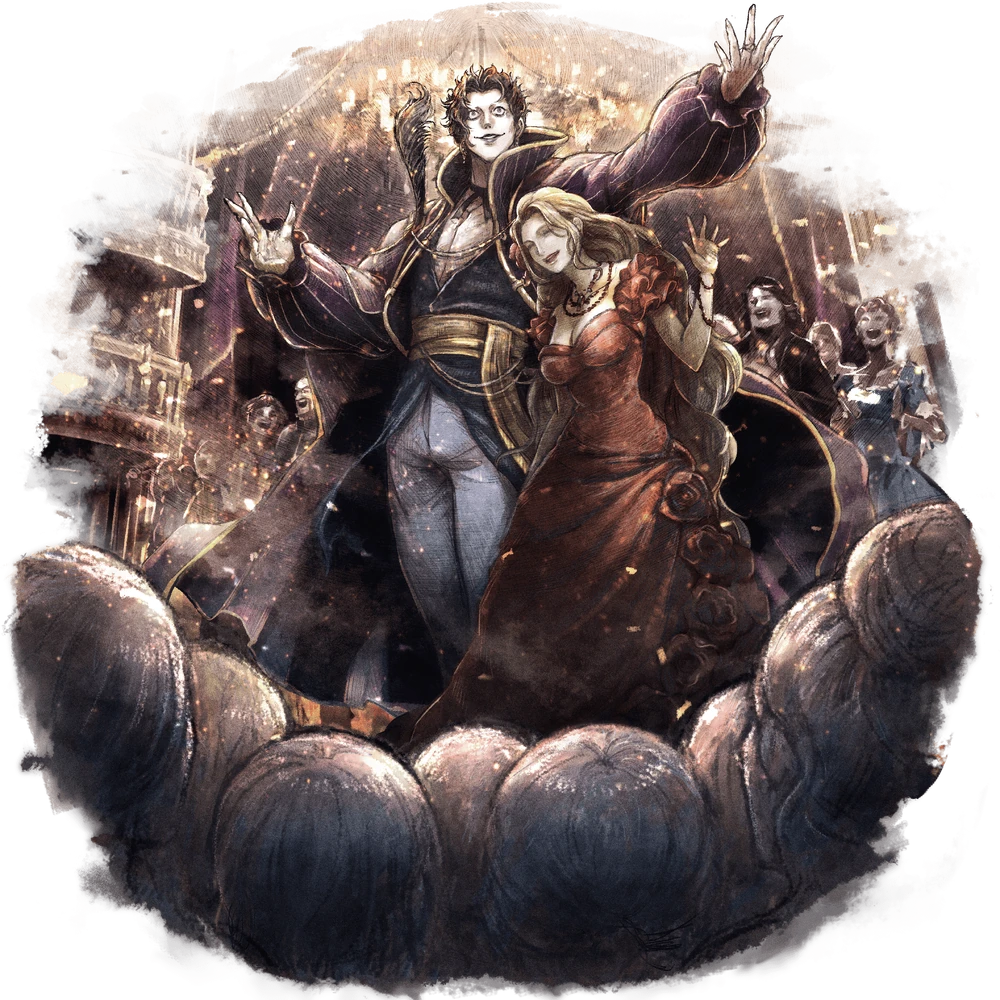
Auguste, however, is a bad person, and he gets way, way to close for comfort. There’s something seriously wrong with him internally and spiritually, as there is with all of the other antagonists. One of the interesting parts of the antagonists in Octopath Traveler 0 is finding out just how twisted and snapped these people are - and, of course, so much the better that we get to bring them down. Auguste is, however, particular. He isn’t a warlord like Tytos or a obsessed with money like Herminia. He is an actor and a playwright whose muse is not some beautiful woman or idyllic memory of the past but acts of tragedy that he himself creates. If he needs to write a murder, he has someone murder someone else - or he does it himself. If he is writing a play about betrayal, he sets someone up to be betrayed, or again he does this himself. During the game’s plot, he goes so far as to poison both himself and his son, then gives his lover and the boy’s mother only enough antidote to cure one of them. Who will she choose. It is this kind of real-life tragedy that gives Auguste his inspiration to create plays that are startlingly close to those scenes that he creates and then witnesses.
On the one hand, Auguste’s story is the most contrived of any chapter in the game. It’s a rare person who has to choose between curing their lover or their son. The classic “train problem,” in which a person has choose between the life of the person most dear to them or ten complete strangers, is an incredibly unrealistic situation. Most of the time, compromise is possible, and it’s surprising how often both parties can be happy. There is also the possibility of real self-sacrifice to save others. The train problem, as well as the decision that Auguste forces on Francesca, is completely unrealistic, but it does show us how twisted Auguste is in fixing the situation so that there really is only one solution.
The interest in Auguste’s story, though, comes from seeing a man who can only find artistic inspiration in the real possibility that he, or his son, will die. I don’t believe for a second that Auguste has any concern whatsoever for his son, but dying in this experiment of evil aesthetics would probably be too simple and secretive an end for Auguste to feel comfortable with. The man bets his life, and it is here in this moment that he can write such magnificent plays.
This space that the writers of the game have created, in which art is found in imitation of humanity, reminds me something of the theories of Zeami, a scholar of Noh theatre from the 14th and 15th century. Let’s take a few minutes and think about how Zeami depicts a perfect actor.
Now, before we begin, I have to note that I don’t know of any statement or interview in which the creators of Octopath Traveler 0 said they drew on, or even read, anything that a medieval playwright wrote. I don’t know if anyone in modern Japanese theatre, let alone anyone but medieval scholars, even thinks about Zeami. I have only played the game and read a description of what Zeami thought (in a magnificent book called Literary and Art Theories in Japan by Makoto Ueda). My guess is that people in Japan know as much about Zeami as most people know about Shakespeare - they may have read his plays in high school but haven’t thought of him since. Whatever the case, something in what Zeami writes about with Noh drama sounds very similar to how Auguste finds his inspiration.
First, if you’ve never seen Noh theatre before, go on YouTube and search “Noh theatre example” or something like that. Take some time and watch a whole scene. Don’t go thinking that you’ll understand anything of what’s going on, but just go for the experience of seeing it.
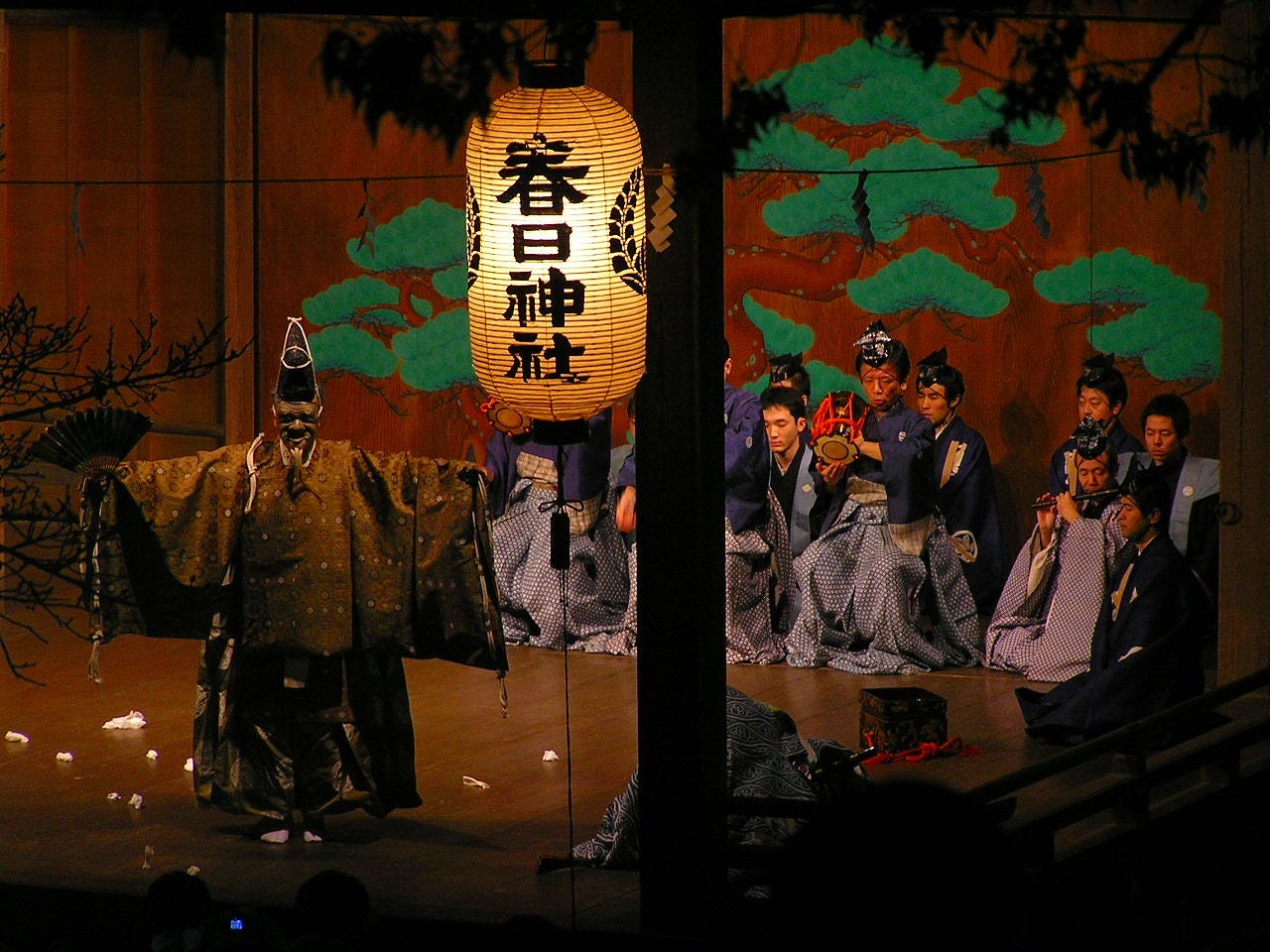
Noh is Zeami’s thing. He was trained in it by his father, and he gave his own skills to his students. And he wrote about how to think about it, how to act in it, what it means and how it makes meaning, and why it’s so important to watch a Noh play with an open and learned mind. I don’t know enough about Noh to teach you how to watch a play, but I can explain some of what Zeami thought about this type of theatre.
For Zeami, imitation is everything. If a person is playing a samurai, they had to become a samurai. If they were playing a woman (all Noh actors were men), they had to become women, even to the point in which they feel as if they had been born a woman. The actor was to become identical with the thing or person he was playing, so that he himself became nothing and the role became everything. He needed to reach into a thing or a role and understand its “true intent” and to make that true intent his own.
This may seem like the Western model of acting, or certain types of acting, but in fact it goes counter to much Western philosophy and specifically the philosophy of art. In his Republic, Plato famously banishes art from his perfect society, because it is imitative. He imagines sacred and pure ideals of everything - trees, people, chairs, dogs, frying pans - and each individual instance of a thing (John the man, Rover the dog, that cherry tree across the street) are only themselves in as much as they take part in those sacred ideals. The ideals, not us, are what is real. One of Plato’s students, Augustine, complicated this philosophy, and later writers such as St. Augustine and St. Thomas Aquinas continued to modify it (especially in Christian contexts), but until the Renaissance was in full swing and materialistic science gained ascendency in Western culture, the individual object was not as good as the original and eternal, be that the perfect chair or tree or God himself. Even during and after the so-called Enlightenment, the arts and literature were deemed less important a pursuit of the sciences, especially if that piece of art was in any way fantastic. <rant> One of the reasons that fantasy and science-fiction is still seen as lesser writing and art than, say, realistic fiction or drama, is that it doesn’t represent anything real. It’s only for the imagination to play in, which is kids’ stuff. Adults like serious, gritty, realistic art, not dragons, elves, and outer space whales </rant>
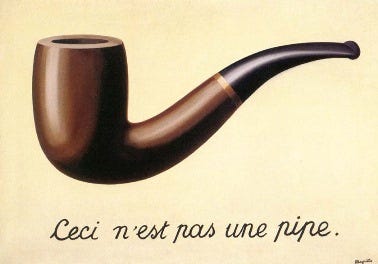
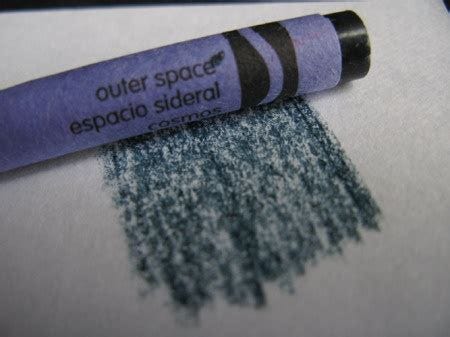
Imitation is pretty suspicious in the West (look at the picture above this paragraph; the French means “This is not a pipe.” Of course it’s not, it’s a picture. But the point of the piece is to prove that art isn’t real. Thanks Magritte), but for Zeami, imitation is so incredibly important that you should actually lose who you are as a person in your imitation. When an actor is able to obtain such identification with a role, they can find its inward reality and spirit, which looks to the hidden beauty of reality. To paraphrase Ueda, yūgen is the type of beauty that Zeami encourages his actors to reach. The word is difficult to define, so Ueda splits it up into two parts: yū meaning deep, dim, or difficult to see, and gen originally describing the “dark, profound, tranquil color of the universe” (60). What in the world could that be. My daughters’ crayons box has a color “outer space,” but I don’t think that’s what Zeami is getting at. No, he’s describing a “profound, mysterious truth of the universe” (61). Later, Ueda describes this beauty as austere, “deep, tranquil, and awesome” (64).
That’s a rabbit hole I want to continue going down, but most descriptions of yūgen are found in untranslated tomes on Japanese aesthetics, and I’m still learning the language. And we’re talking about video games. Zeami has, though, two more things to say in our context here. First, the cosmic truth of humanity, for Zeami, always points towards our sad destiny. Yūgen is a beauty of universal sorrow. Cherry blossoms are beautiful in the spring, but they are gone so quickly - just like the lives of we lost humans, Zeami would say. Japanese literature if rife with images of the beautiful ending too soon. To quote Ueda again, “Noble court ladies are gracefully beautiful in themselves, but they would be even more lovely when they suffer under some strange power beyond their control, under some mysterious force hidden in the universe…Yūgen is the beauty of seeing such an ideal person go through an intense suffering as a result of being human” (61).
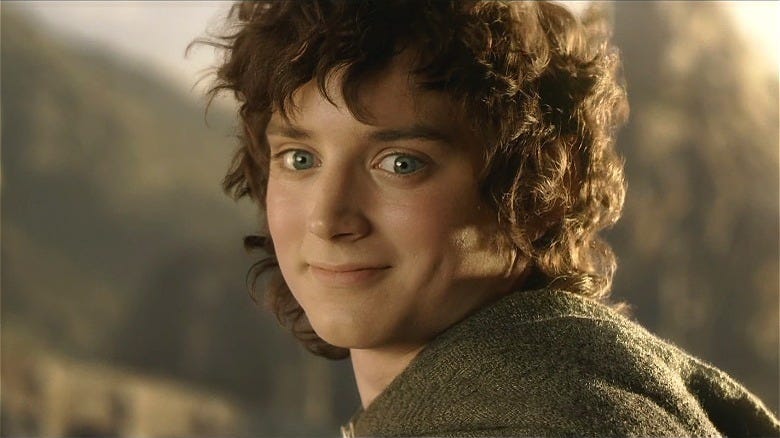
Now, if you feel like this is kinda morbid, then I’m with you. But ideals of beauty are grim in many cultures. Think of Frodo in Lord of the Rings: he may destroy the ring, but he is so broken from his quest that he can’t really stay in the Shire anymore. Or think of Avengers: Infinity War. I really didn’t like seeing so many characters wisp away into nothingness, and even though I knew in the back of my mind that the creators would save everyone (this is Hollywood, after all), it was both a horrifying thing to watch and something that geared me up for the sequel. We also have our own morbid senses of beauty. In a way, they help us understand death and especially our own death, and they point to a reality beyond this world where such pain and suffering are no more (for both Western and Eastern art).
Second, there are some roles that one cannot imitate, such as the role of a demon. As Zeami writes, and Ueda quotes, “By its very nature, imitating a demon involves great difficulty, for the more faithfully the actor imitates the demon, the less entertaining his performance will be. The ‘true intent’ of the demon lies in its horrifying quality” (59). As a Westerner, I would say that this is because a demon is “evil,” but I don’t want to project my idea of what a demon is onto a man living in Japan in the 14th and 15th centuries. Whatever the inner nature of a demon is, in part they are essentially horrifying creatures, and they therefore cannot entertain.
If you’ve ever watched Japanese cinema, you may wonder at this. I’m a scaredy-cat, and I can’t watch Japanese, horror because I know that I would never be able to sleep again. I have heard that it is creepy, weird, and unnerving, and for that it is also entertaining. This is one reason why we cannot insist that every playwright, director, or game creator knows and follows Zeami, only that he is present in the great ocean of tradition in Japan. For Zeami, though, you can’t horrify your audience, and if you’re an actor you definitely don’t want to identify with something horrifying. That wouldn’t be yūgen.
I’m with Zeami, but I’m a chicken. Auguste, I think, is quite a bit like Zeami, but a twisted one. Auguste is all about imitation. He wants to be in the world which is steeped in sorrow and longing and hatred, and in being a force of tragedy in the world he believes that he can come to the pinicle of what it means to be a human being. Above, I mentioned that he might feel a sense of horror to think of himself dying in an experiment of tragedy, because he, a great man, must die in a truly magnificent and terrifying way. That’s the way the guy wants to go out, because that’s what makes him a great man.
Auguste, though, is written by a modern Japanese writer for a modern Japanese audience, and for that writer and that audience (and for us in the West) horror is entertaining, and so Auguste follows suit. He literally becomes a demon to live out his ideas of art, even to become his own muse. All that is demonic, and all that Zeami stresses cannot be truly imitated, is what Auguste embodies. The evil that he writes, he then becomes, so that he can write more and, in his mind and in his world, become that much a better playwright and a better man.
And we take part in this. As icky as it may sound, we are Auguste’s audience just as we are the audience of Octopath Traveler 0. We are entertained by his evil, even though we cheer when he dies. In a game about people who are mythically evil, evil beyond the normal bounds of what it means to be human, Auguste fits right in. He becomes a universal, almost a Platonic ideal of what it means to betray and kill. Each time I met a new antagonist, I wondered how much more evil they could be - and the creators always pushed the idea of evil just a little bit more. These people weren’t really human anymore (no, not even the one who joins the good guys towards the end). They have become Something Else, something utterly dark, basically evil, a force of nature and super nature that seeks not just to destroy but enjoys the evil and the destruction that they create. They become demons, and that is part of what makes playing Octopath Traveler 0 so very unnerving.
No posts
Comments
Nothing yet. Say the first thing.
Sign in to join the conversation.