
If you have been reading about nutrition lately, you probably have been told to look after your gut flora. In certain articles and journals this can be referred to as microbiome or gut microbiota. These terms are often used interchangeably. The point is that that there is so much research going on about this flora.
Why?
Because it heavily impacts our health in general. More specifically, it impacts immune system and recently we have been reading in the medical journals that it may even impact our mood. So obviously this created a lot of hype and many our now ‘experts’ in gut health! (self proclaimed experts I would dare to say).
There are microbiome tests, probiotic supplements, gut cleanses and powders promising to feed your “good bacteria”. Some of these products may have their place, but the marketing has moved considerably faster than the science.
The gut microbiota is the community of microorganisms that lives in our digestive tract. Most are bacteria, although viruses and other microrganisims may also be present. These microorganisms are not simply passing through. But they’re in the gut to stay.
They infact are said to colonize the gut!
They interact with food we consume. They interact with the cells lining the intestine and our immune system, and they produce compounds that can be absorbed or used locally in the gut. They release different chemicals including acetic acid. Acetic acid is an acid as the name implies. This acid lowers the ph of the intestines rendering it inhospitable to certain bacteria including pathogenic bacteria. Pathogenic bacteria are those bacteria that can make us sick such as E.coli.
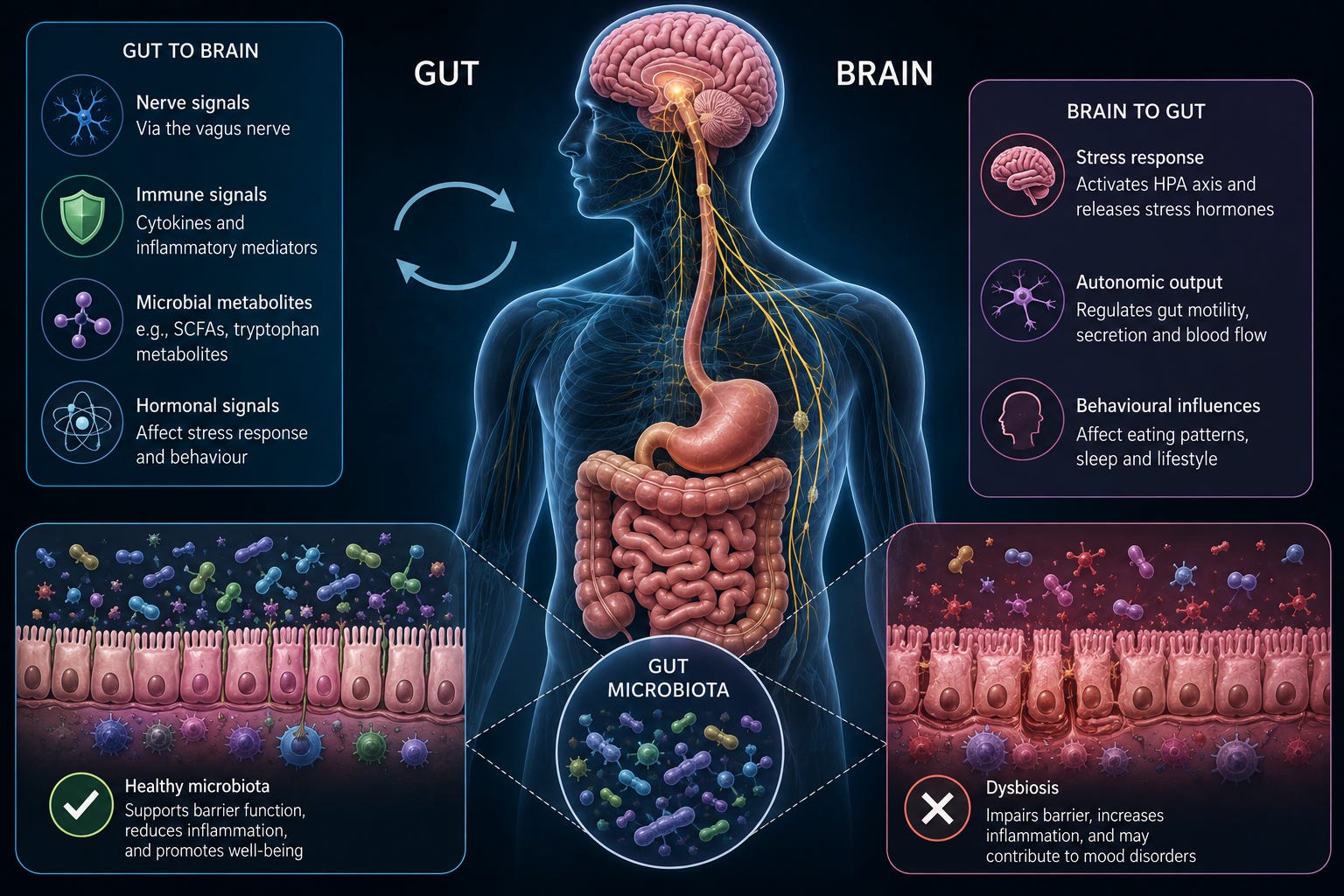
Researchers have been studying these relationships for years, and it has become increasingly clear that our microbes are involved in many aspects of normal physiology. [1]
That doesn’t mean we have worked out what the ideal microbiome looks like.
Its an enormous jigsaw puzzle that we’re trying to solve here. Infact we haven’t managed yet.
What we can say with considerable more confidence is that diet matters.
One of the best examples is fibre. Some fibres reach the colon without being completely digested, where they become food for intestinal bacteria. During fermentation, bacteria produce short-chain fatty acids, including acetate, propionate and butyrate. Butyrate is particularly interesting because cells lining the colon can use it as an energy source. Indeed even the cells of the intestine need energy and these by products from bacteria are used as a source of energy by intestinal cells.
Nature indeed is amazing!!
So just this is one reason describing fibre, as something that prevents constipation quite frankly undersells it considerably.
So if you’ve been following me, you’ve probably seen some of my articles about beans, lentils, chickpeas, oats, barley, whole grains, vegetables, fruit, nuts and seeds. Yes because these provide different types of fibre and resistant carbohydrates. Rather than concentrating on one supposedly exceptional “gut health” food, it makes more sense to eat a reasonably wide range of these foods over the course of the week. I’ll be linking some of these articles below in case you want to continue reading more about this topic.
Fermented foods have attracted attention too. In a Stanford dietary intervention, participants were assigned diets rich in either fermented foods or fibre. Some most popular examples of fermented foods include yogurt. These contain health bacteria.
Several studies suggest that consuming these fermented foods increased microbiome diversity and reductions in several inflammatory markers in the studied group.
This shouldn’t be translated into “eat sauerkraut and prevent inflammation”. It was a relatively small intervention, and microbiome research is notoriously difficult to generalise. First of all because there are so many variables. What it does give us is another reason to consider fermented foods as part of an otherwise healthy diet.
The same caution applies to probiotics. Asking whether “probiotics work” is a little like asking whether “medicines work”. Different probiotic products contain different organisms and strains, most of the time in different quantities. We now know that different bacteria or probiotics confer different health benfits. So we cannot generalize one size fits all! Evidence supporting one strain for a particular clinical indication cannot simply be applied to every product sitting on the shelf. For a healthy person who simply wants a healthier gut, I would put far more emphasis on the overall diet than on automatically taking a probiotic every morning.
The Mediterranean diet has been extensively studied about this matter. (Maybe I’m a bit biased about the Mediterranean diet because I’m Mediterranean 😉)
But think about it!
The Mediterranean has a lot of blue zones where there are a lot of Centenarians. So there must be something good won’t you agree?
Vegetables, legumes, fruit, whole grains, nuts, seeds and olive oil already feature heavily in the Mediterranean way of eating. Many of these foods supply fibre and plant compounds that intestinal microbes can metabolise. The Mediterranean diet also has something microbiome supplements generally don’t: decades of evidence linking the overall dietary pattern with better health outcomes.
So we already know that a substantial amount of immune activity takes place around the intestine.
But you are probably reading this article because you want this question answered right?
There is a real biological basis for the gut–brain connection.
The intestine and brain communicate in both directions through several overlapping systems: the vagus nerve and enteric nervous system, immune signalling, stress hormones, circulating metabolites and microbial products. (I apologize for the medical jargon but certain things I cannot change but this is basically the ‘connection ‘ between the brain and the gut ). This network is usually called the microbiota–gut–brain axis.
Studies have found differences in gut microbial composition between people with and without depression. A large microbiome-wide association study also identified bacterial groups associated with depressive symptoms. Association, however, is not proof that those bacteria caused the depression. Diet, medication, sleep, stress and depression itself can all alter the microbiome.
Probiotics are also being investigated. Recent meta-analyses suggest that certain probiotics may produce modest improvements in depressive or anxiety symptoms, particularly as an adjunct in people with diagnosed conditions.
So the most accurate conclusion is not that your gut “controls your mood.” It is that your gut microbiota appears to be one participant in a much larger biological conversation involving the brain, immune system, nervous system, metabolism and stress response. They are chatting together! 😂 Could also to some extent explain why our gut suffers when we’re stressed. (Control your stress with my Stress management handbook (75 pages) )
Researchers increasingly think this relationship matters, but we are still working out how important it is in individual people and how safely it can be used therapeutically.
Perhaps that is the most interesting part of the gut–brain story: feelings that seem to belong entirely inside the brain may, in part, be influenced by signals arriving from much farther down the body.
So what do I actually recommend to someone who wants to look after their gut?
Nothing fancy!
Eat vegetables and fruit regularly. Include beans, lentils and other legumes. Choose whole grains more often. Eat nuts and seeds. Vary the plant foods you eat instead of relying on the same few choices every day. If you enjoy yogurt, kefir or other fermented foods, they can be useful additions. Exercise, sleep and avoiding smoking still matter too.
Most importantly, don’t assume that a supplement can compensate for an otherwise poor diet.
There is still an enormous amount we don’t understand about the organisms living inside us. That is precisely what makes this field so interesting!
A healthy gut is not created by a single probiotic capsule or the latest social media “gut cleanse.” It is the cumulative result of consistent dietary and lifestyle habits supported by high-quality scientific evidence as highlighted in my Video presentation, gut health extends far beyond digestion! It influences multiple systems throughout the body, making it one of the cornerstones of overall health and wellbeing.
Around 70% of your immune cells reside in the gut.
My Video presentation highlights many more amazing facts and evidence including
how to improve gut health naturally
how to improve your gut microbiome naturally
what is a healthy gut microbiome
signs of an unhealthy gut
symptoms of poor gut health
how to restore gut health
best foods for gut health
foods that improve gut microbiome
how to increase good gut bacteria naturally
Here are some useful links:
Another gut health article to continue reading about this topic
Donate a coffee to support the author
The healthy gut blueprint (40 minute mini-course)
Stress management handbook (75 pages)
References:
Appleton J. The gut-brain axis: influence of microbiota on mood and mental health. Integr Med (Encinitas). 2018;17(4):28-32.
Rosas-Sánchez GU, Germán-Ponciano LJ, Puga-Olguín A, Flores Soto ME, Nápoles Medina AY, Muñoz-Carillo JL, et al. Gut-brain axis in mood disorders: a narrative review of neurobiological insights and probiotic interventions. Biomedicines. 2025;13(8):1831. doi:10.3390/biomedicines13081831.
Bautista J, Hidalgo-Tinoco C, Di Capua Delgado M, Viteri-Recalde J, Guerra-Guerrero A, López-Cortés A. The gut-brain-circadian axis in anxiety and depression: a critical review. Front Psychiatry. 2025;16:1697200. doi:10.3389/fpsyt.2025.1697200.
Carabotti M, Scirocco A, Maselli MA, Severi C. The gut-brain axis: interactions between enteric microbiota, central and enteric nervous systems. Ann Gastroenterol. 2015;28(2):203-9.
Foster JA, Rinaman L, Cryan JF. Stress & the gut-brain axis: regulation by the microbiome. Neurobiol Stress. 2017;7:124-36. doi:10.1016/j.ynstr.2017.03.001.
Foster JA, McVey Neufeld KA. Gut-brain axis: how the microbiome influences anxiety and depression. Trends Neurosci. 2013;36(5):305-12. doi:10.1016/j.tins.2013.01.005.
Comments
Nothing yet. Say the first thing.
Sign in to join the conversation.