
I’m seeing four emerging public health threats in California this week— two viruses, a parasite, and our weather. We’ll start with a virus.
Last week, I described why I think we’re in for a rough West Nile virus (WNV) season. The activity over the past week has me even more concerned. Here’s how the numbers changed since my last post. From the July 17 to July 24 state report dates, all the main indicators are trending upward.
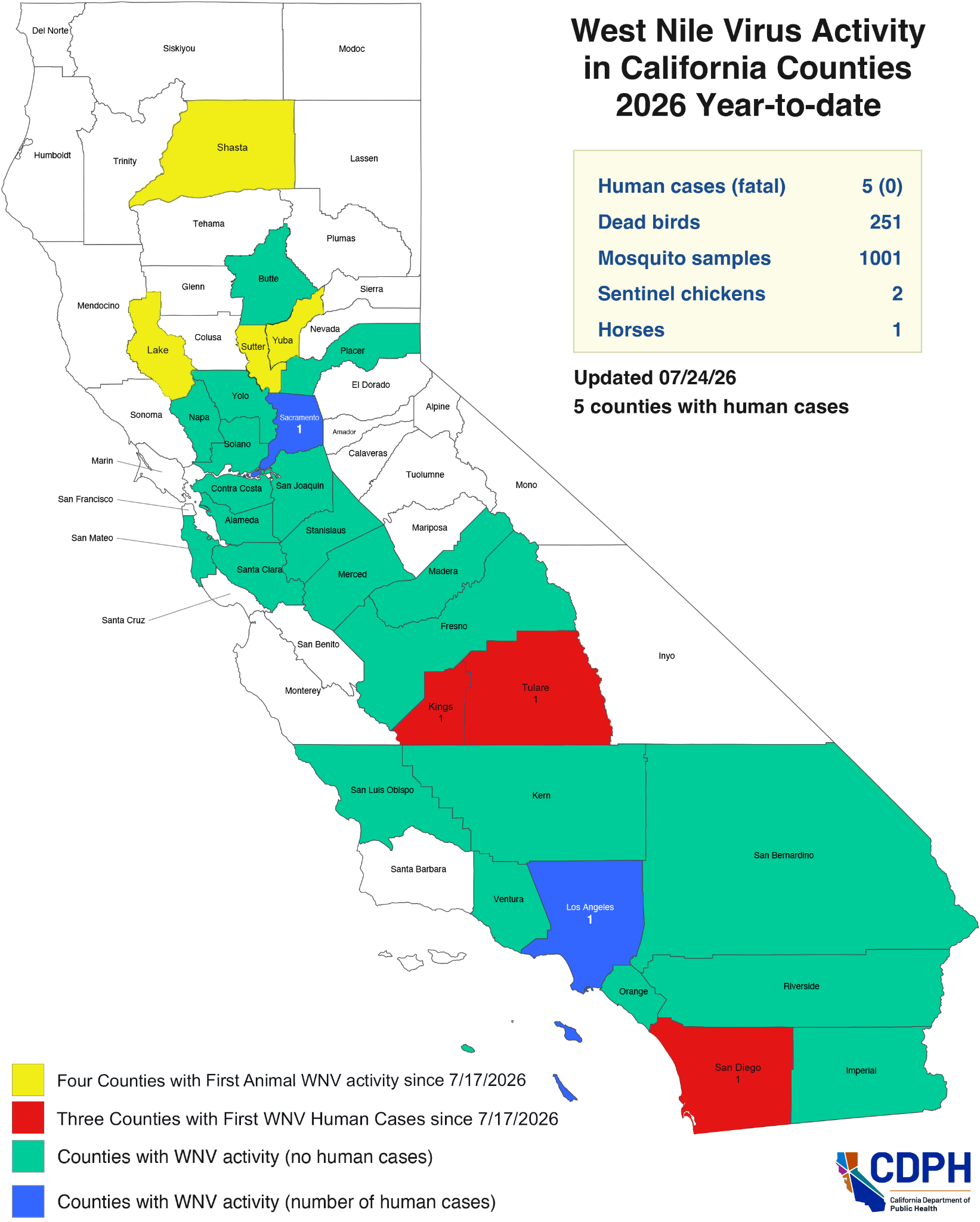
Human cases: 2 → 5. Three new cases were reported in Kings, San Diego, and Tulare counties, each county’s first human case of the year. Still small numbers, but twice the average for this time of year.
Dead birds: 205 → 251—a 22% jump. Sutter and Yuba counties reported their first positive birds of the season, bringing the state to 20 counties with detections.
Mosquito samples: 670 → 1,001. Lake and Shasta counties found their first positive mosquito pools of the year; 25 counties are now confirmed to have infected mosquitos.
This map shows the progression of WNV in California from July 17 to July 24, 2026, calling out the counties with first detections in humans or animals this year.
This tracks with the national pattern: as of July 28, the CDC reported 113 human cases, with 76 being neuroinvasive, a 20-year high for this point in the season.
Northern counties impacted. All four counties with first-time detections in birds or mosquitoes this week are in the North—Sutter, Yuba, Lake and Shasta. This is a sign of the usual northern migration of WNV in California through summer into fall. Heat accelerates both mosquito breeding and the speed at which the virus replicates inside the mosquito, so as hotter temperatures push north, viral activity tends to follow.
What you can do: You can help with the surveillance that makes control possible. Vector control districts can drain standing water, treat catch basins, or spray for mosquitoes if they know where the virus is active—but that picture comes largely from the public. Two ways to contribute:
Report dead birds. A dead crow, jay, magpie, raven, sparrow, finch, or hawk is often the first sign WNV has arrived in an area. Call 1-877-WNV-BIRD (1-877-968-2473)— they’ll decide whether to send someone to retrieve and test the bird. They want birds that look like they might have “fallen from the sky” and have very recently died— not birds that are decomposing, or have another obvious cause of death (like a being hit by a car.)
Report unusually high mosquito activity. If your yard or neighborhood suddenly has far more mosquitoes than normal, that’s worth a call to your local vector control district. They can inspect the area and treat breeding sources directly. Find your district by zip code at mvcac.org.
Bite prevention: Remember the basics: dump standing water around your home at least weekly (flowerpots, pet bowls, old tires, anything that collects rain or hose runoff), make sure screens are intact, and use an EPA-registered repellent during dawn and dusk, when Culex mosquitoes—the species that carries WNV—are most active. There’s no vaccine and no treatment for WNV, so avoiding the bite is the best protection.
The national cyclosporiasis outbreak continues to evolve, with more recalls and more communities impacted. It can be confusing to know where we stand.
The simple take-home is that California still isn’t implicated. The source of the largest outbreak has been identified: Taylor Farms products shipped as Marketside-brand iceberg or shredded lettuce to 27 states, but not California. The 1,947 cases and 98 hospitalizations (no deaths so far) in the outbreak cluster in the Midwest and mid-Atlantic.
Distribution of recalled products
There have been no additional cases reported in California since the outbreak began. One interesting wrinkle is that Taylor Farms is actually a California company, located in Salinas. The culprit product was grown and shipped from their facilities in Mexico into the Midwest and East, and not to California.
The summer Covid-19 wave is here, but it’s not roaring. Activity is gradually increasing, with ED visits and hospitalizations still low statewide. Wastewater levels are still low, with a few regional hot spots like Santa Clara County. Vaccine dilemma. A few of you have asked: should I just get the current vaccine now, as activity rises, or wait for the updated fall version? I can’t give you a confident answer, because it’s hard to know how long that wait might be. Here’s why. In May, FDA’s advisory committee recommended switching this fall’s formula to target the XFG strain, and manufacturers said they’d be ready—Moderna indicated mid-August. Since then it has been oddly quiet. There’s no rollout date or public timeline. This is the first time we’re heading into August without a plan and clear messaging for the new vaccine. I don’t have a good explanation, beyond the consistent heel dragging from federal leadership in every facet of vaccine policy this year.
If you’re lower-risk and comfortable riding out a mild case, waiting a few more weeks to see whether the new formula materializes is reasonable. I’ll provide updates on vaccine availability, and any changes in virus activity locally. You can find pharmacies and clinics that provide vaccines in California at the
California is heading into another heat wave, with risk building through the weekend. Sacramento Valley cities expected to hit 104–108°F starting Friday. In Southern California heat warnings are posted for the Inland Empire and highs near 110°F are possible in the Antelope Valley.
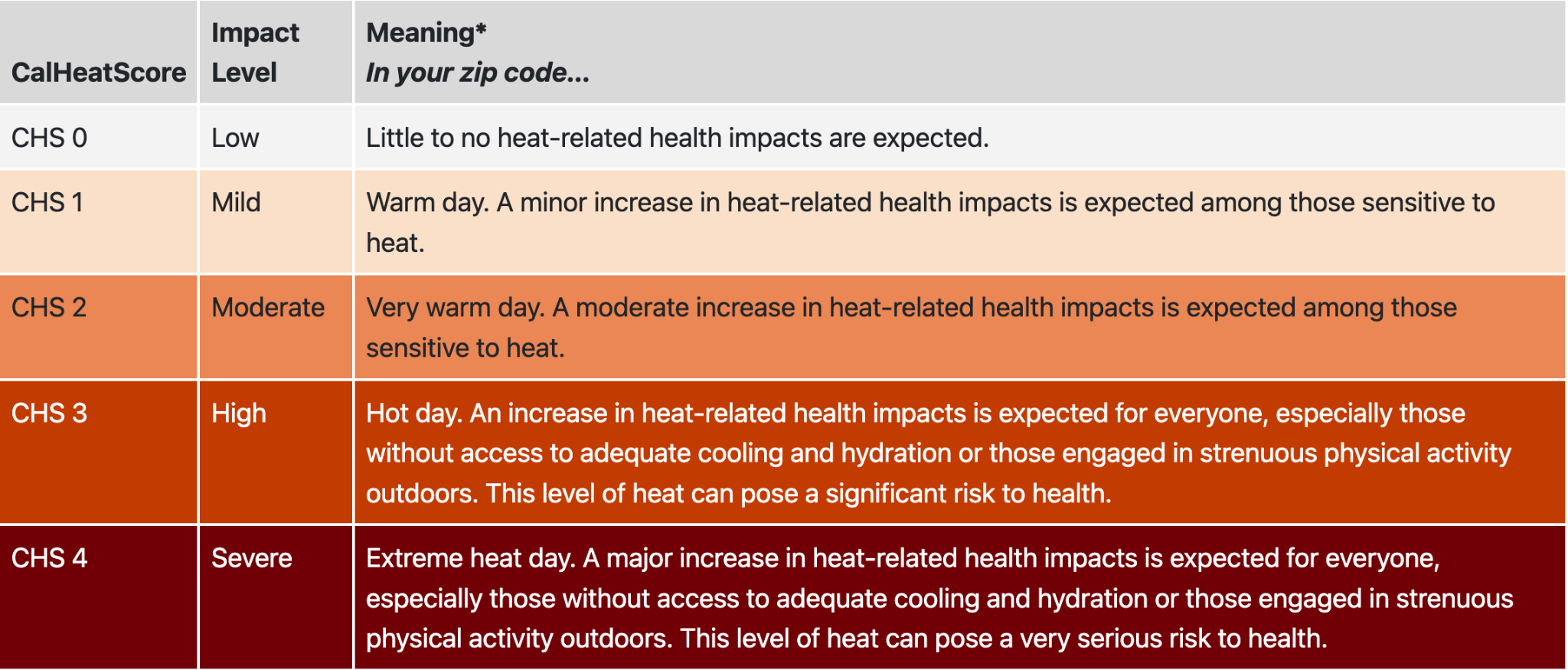
California’s new heat warning tool. CalHeatScore, built by the state’s Office of Environmental Health Hazard Assessment, gives every zip code a daily 0–4 risk score for the week ahead, built from local ER visit patterns for heat-related illness rather than temperature alone. Check yours at calheatscore.calepa.ca.gov.
The site also lists to registered cooling centers in your region.
This HeatScore map shows much of our state will be in the moderate to severe heat impact level this weekend. Here’s how the state describes the risks associated with different California HeatScore (CHS) levels.
Under-recognized risk: There’s a vulnerability factor for heat illness that doesn’t get enough attention, in my mind. Most heat deaths don’t happen outside. A CDC study showed 69% of heat-related deaths occur at home, and none of of ten of those homes had no working air conditioning—and most who died were living alone.
The common thread is social isolation. Someone checking in daily, a working AC unit, a ride to a cooling center—these often determine who lives through a heat wave.
Steps we can take:
Stay connected: If you have an older relative, neighbor, or friend who lives alone—especially anyone managing a chronic condition or without reliable air conditioning—call or knock on their door today, not after the heat arrives. And confirm their AC works. In Maricopa County (Phoenix area) AC units were present in over 90% of indoor heat deaths, but not running in three out of four of those cases.
Stay cool. Spend as much time as possible in air-conditioned spaces. If your home doesn’t have working AC, don’t wait it out—a few hours at a mall, library, or cooling center makes a real difference. Fans alone stop being protective once temperatures climb into the high 90s and beyond.
Stay hydrated. Drink water throughout the day, before you’re thirsty. Skip alcohol, go easy on caffeine and sugary drinks—both can work against you. Electrolyte drinks like Gatorade can be useful if you can’t avoid heat for long periods. I did a deeper dive on hydration in a prior post.
California is a big and beautiful state, and there’s always something important and interesting happening that impacts our health. I never know what’s going to be popping in any given week. This week, the focus is on emerging communicable diseases we’re facing, and our climate. I value your feedback as I balance coverage of longer term policy concerns with guidance for today’s health challenges. Stay cool and we’ll see you next week!
Love,
Matt
Dr. Matt Willis is the author of Your Local Epidemiologist in California. A California native, he’s served as a primary care physician, CDC epidemiologist, and public health officer for Marin County, where he guided the pandemic response. He lives in Marin with his family and their dogs Teddy and Ramona. A special thanks to Emely Bonilla, Masters in Public Health candidate at UC Berkeley and summer intern at YLE, for her contributions to today’s edition.
Comments
Nothing yet. Say the first thing.
Sign in to join the conversation.