
I don’t watch much reality TV, but I am online, and therefore see pretty much everything. And Love Island is inescapable right now, partly because of the sheer volume of episodes (it airs almost daily) and partly because the show has mastered short-form in a way that means even if you don’t watch, you’re seeing clips of it constantly.
And what strikes me, watching this kind of reality TV, is how obvious it’s become that most of these people are not going on the show for love. They want to become famous. And fame, in this economy, is a money strategy.
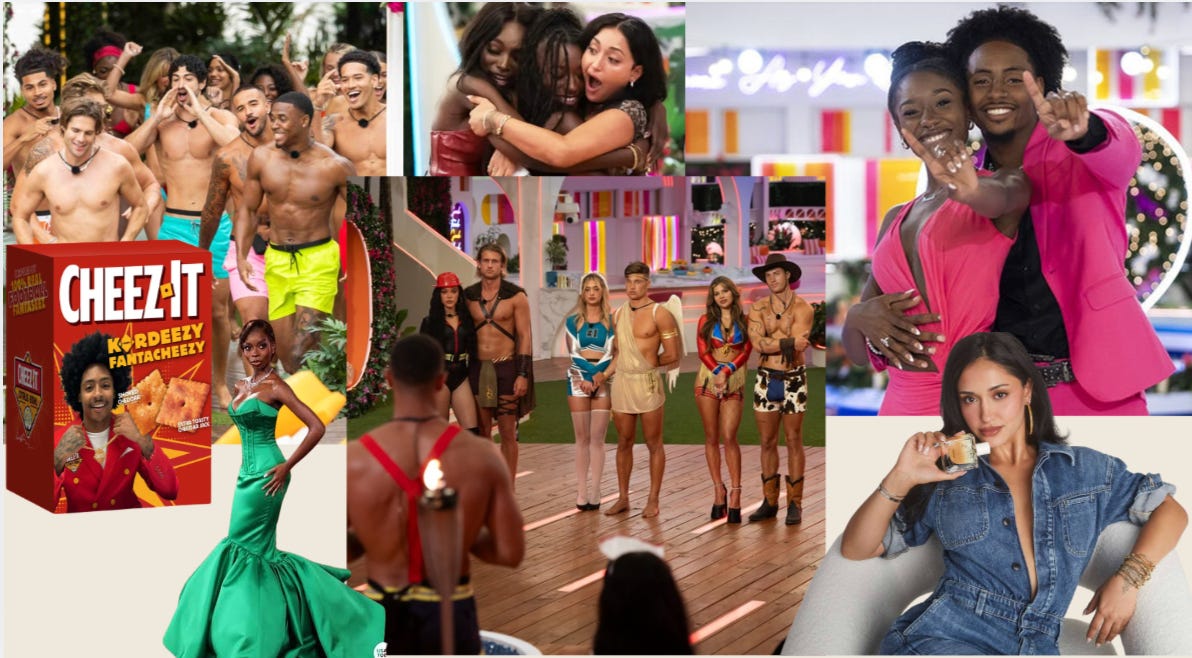
Sure, people have been using reality TV as a launchpad for at least a decade. But in the past few years there’s been a palpable shift in how visibly the contestants perform for the camera. A recent piece in Trill Mag described this season’s cast as having “an acute awareness that they are not just playing a dating game but are managing a public identity that will outlast the season by years.”
Love Island is a dating show on paper. But in practice, it’s capitalism in a bikini, a show that takes a basic human desire and turns it into a competition for visibility. The self becomes the product, attention becomes legitimacy, and fame becomes the end goal.
Here’s how Love Island works, for the uninitiated: a group of hot people (Islanders) live together in a villa. People couple up based on first impressions. New entrants (bombshells) disrupt existing relationships by introducing competition, and the public votes on who stays. There are ridiculous challenges, tears, drama, etc. When someone’s perceived desirability drops, they get dumped from the island.
The winning couple (again, voted by the public) gets $100,000 with a “split or steal” trust test. Which, is good money, but certainly not quit-your-job and retire money.
Dating has always been somewhat of a market, but what makes Love Island (and shows of that ilk) different is that this market is actively being filmed, consumed, and monetized in real time.
And ultimately, the public is the ones who decide who stays and who goes. And they’re not always voting for the couple that seems the most in love. Oftentimes, they vote for the people they like watching. The people who are funny, chaotic, loyal, wronged, hot, dramatic, relatable, or [insert adjective here].
This incentive structure rewards attention-seeking behavior the same way a social media algorithm does.
So you see contestants approach the show with boardroom-level strategy, curating whatever personality they think will get them the most air time, eyeballs, fan edits, and memes.

Despite the tracking shots of beaches and slow-mo pool shots, these shows do not look like fun to be on. Love Island particularly feels to me like a tropical Stanford Prison experiment, where no one has access to the outside world, never knows what time it is, and are constantly being surveilled by what I assume are hundreds of cameras. You’re in a controlled environment designed to produce maximum emotional volatility for entertainment purposes.

jp@excesstential
Love Island is interesting bc it’s evil but it’s also refreshingly honest. There’s no facade of sincerity like the Bachelor: the show itself is an openly hostile cosmic force against the contestants, the islanders subject to the whims of invisible viewers and a disembodied voice
3:09 PM · Jul 1, 2026 · 112K Views
9 Replies · 490 Reposts · 10.3K Likes
So why are people lining up to do it?
Because it’s not about the $100,000. It’s not even about the $50,000 (which is closer to $30K after taxes). It’s about what comes after.
Brand deals, podcast invites, fashion partnerships, a pivot from whatever job you had before into a career where your personality, face, and following are the product. Going on reality TV can now catapult you into serious wealth: former islanders are regularly making six figures for a single sponsored post. Leah Kateb, who came in second on Season 6, reportedly earns $1.6 to $2.7 million annually from Instagram alone.
And boy, is there money in the apparatus around them. This season alone has 21 brand partners — CeraVe, Maybelline, Coffee Mate, Motorola, Poppi, Cuervo, Smirnoff. The contestants are literally living inside a branded environment, using sponsored skincare, drinking sponsored coffee, and participating in sponsored date nights. (Truman Burbank would have loved Love Island.) Season 8 debuted with 824 million minutes watched in three days, making it Peacock’s biggest original launch ever. Over 2.3 billion minutes in its first two weeks, up 50% from last year. 59% of viewers are 18–34. This is a multi-billion-dollar attention machine.
I’ve written before about the commodification of self, the idea that we’re all startups to be iterated on, the gospel of “personal brand.” Love Island is the most vivid, almost grotesque illustration of this because you can literally watch it happening. These people are building their personal brand on camera, in real time, with the explicit goal of turning attention into money.
I don’t think the contestants on these shows are all stupid, or shallow, or incapable of genuine feeling. Some of them are there for a mix of reasons, and maybe one of those reasons includes actually wanting to meet someone. But I do think that going on Love Island (or The Bachelor, or Perfect Match, or Too Hot to Handle) at a minimum, is about wanting attention.
They want to be perceived, to be visible, to matter in the specific way that social media has taught us that mattering looks like. Which, in this economy, is not an unreasonable thing to want.
We’re in an environment where visibility can function as a form of career protection, where a large following gives you options that a regular job increasingly does not. That might explain why more than half of Gen Z says they’d become an influencer if given the chance, and why kids now list it as their dream job ahead of being a doctor, lawyer, or teacher. (More recent surveys suggest this may be starting to shift, but the underlying logic hasn’t changed.)
Are the kids just delusional? I think they’re looking at the current economy and drawing conclusions. (The old appeal of the 9-5 was stability and autonomy, and for a lot of young people, that deal no longer holds.) When you can see that the “traditional” path doesn’t seem to lead anywhere, and the influencer path at least looks like it leads somewhere exciting, you wonder if it’s time to pick up the camera and start filming.
The amount of aspirational labor that goes into this is staggering. Love Island contestants reportedly spend thousands of dollars on their appearance before the show. They take weeks or months off work. Many leave their current jobs entirely (most employers don’t let you take six weeks off to go to Fiji). All of this happens before they’ve earned a single dollar.
I get the appeal of it all. Fame looks fun. The parties, the travel, the gifted clothes, the VIP access: there’s a fantasy of a life where money, status, and enjoyment converge, and that fantasy is tantalizing because ordinary life for most young people is expensive, precarious, and exhausting. If someone offered me a villa in Fiji and the chance to never think about my rent again, I’d at least consider it.
But there’s a real risk to pursuing attention and fame that’s harder to measure. Contestants are gambling with their privacy, reputation, and dignity when they sign away control over their image to production companies. Fame is a depreciating asset, and the window between relevance and irrelevance is shrinking. The creator economy is also oversaturated: Most people who go on Love Island will not become Molly-Mae. But even the ones who do are trading something they can never fully get back.
You don’t have to go on Love Island for Love Island to affect how you think about money.
Just watching it, or seeing clips of it, or consuming the discourse around it, does something to your relationship with spending, ambition, and worth.
These shows teach us that visibility is a prerequisite for a good life. If you want to build wealth, escape the grind, or access something better, you’re pushed to commodify yourself, brand yourself, perform yourself. The contestants who “win” Love Island are not necessarily the people who had the strongest relationship. They’re often the people who became the most watchable. Our culture has normalized this logic, and Love Island is just a dramatic, bikini-clad version of what’s happening on every platform.
This changes how people spend. If your face, body, lifestyle, and personality can all become part of your “brand,” then spending on yourself starts to feel like investment rather than consumption. Comparison culture intensifies as people chase certain aesthetics or lifestyles to gain visibility online. Virality becomes the get-rich-quick scheme of the attention economy, and if traditional wealth-building feels too slow or too impossible, the appeal of a shortcut grows, even when that shortcut is statistically unlikely to work.
All of this reinforces the idea that attention is one of the most valuable things a person can have. Is that true? Arguably, in this economy, sometimes. But a culture that rewards visibility above everything else is a culture that teaches people to optimize for being watched rather than for being good at anything. And it produces an audience (all of us) that has internalized those same values, even if we’d never go on the show ourselves.
Unless you live in the woods without a phone, you have a digital version of yourself. We’re all, to some degree, performing versions of ourselves for an audience.
Your personality, your appearance, your relationships, your sense of humor, your vulnerability … all of it can become part of the portfolio if you let it. But what do you lose when your identity becomes a product? Is the version of you that’s optimized for attention is the same person you are when nobody’s watching?
Perhaps the economy we’ve built (one that increasingly rewards being seen over being good) is producing people who know how to perform a self but not how to have one.
Comments
Nothing yet. Say the first thing.
Sign in to join the conversation.