

Picture a scenario playing out across communications teams right now: A junior team member sends over a clean, organized, and current media list. Bravo! You then ask how long it took to pull (typically a task that can easily eat up an entire work day). “Twenty minutes,” they say. They had AI pull the contacts and cross-reference them. They just cleaned it up.
Or this: A first draft of a press release lands in your inbox an hour after you handed off the brief to a coordinator, and it’s not bad. Actually, it’s pretty solid. They used AI to draft it, and they shaped it. So, you open it up to start editing, only to realize you’re not really editing so much as reviewing.
Or the market research summary that would have taken a week to compile is in your hands within 24 hours. Synthesized, organized, and ready to present. One person with one AI tool. Done.
And underneath the surface of these moments, simmers the unspoken question humming along: What exactly am I leading now?
I’ve been sitting with it for a while, and I’m guessing a lot of senior communicators are too.
PRWeek ran a piece in March (by Chris Daniels, worth tracking down if you have access as it’s paywalled) documenting the emergence of brand new AI job titles across communications and marketing: AI Ethics Officer, AI Solutions Architect, AI Acceleration Lead. New roles, new org chart lines, new budget conversations. At the same time, traditional junior comms roles such as the coordinator, the assistant, the associate are being restructured or simply not backfilled now when someone leaves.
And, while most of the coverage in this piece frames this as an entry-level work issue, the reality is that it isn’t confined to the bottom of the org chart. It’s working its way up, and the question it raises at the senior level is a harder one.
For most of my career, earning praise in communications meant mastering execution. Fast, accurate research. Strong first drafts. Tight media lists. Sharp monitoring. Booking the interview. The ability to synthesize complicated information and turn it into messaging that actually made sense.
That competence was how you built credibility. You moved up because you were fast, reliable, and consistently produced strong work. You earned the senior seat by becoming excellent at execution first, then eventually building and leading the team doing the work you once did yourself.
Now AI can do a version of almost all of it.
Not perfectly. Not without human oversight. But well enough, and fast enough, that execution is no longer the differentiator it once was. Which means the definition of senior-level communications value is changing in real time.
But, here’s what I don’t hear enough people saying directly—it’s not just junior roles that are being compressed, but also the traditional pipeline for developing senior communications talent. The work that once built judgment including the drafting, the research, the monitoring, the grinding through endless media lists until you instinctively understood the beat landscape, is exactly the work AI is starting to absorb.
Which raises a complicated question: if emerging communicators aren’t building judgment through that executional foundation, what does the path to senior leadership actually look like? And on the other end of the org chart, what does the CCO role become when the team you’re leading is increasingly a blend of humans, AI agents, and automated workflows rather than a traditional junior-to-senior hierarchy?
I don’t think anyone has fully figured that out yet. I certainly haven’t.
But, I do think communications leaders need to start wrestling with those questions now, before the structure of the profession gets reshaped for us instead of by us.
Ragan published their 2026 Communications Benchmark Report in late April, and there’s a stat I keep coming back to: only 5% of communicators said they are reducing headcount because of AI. The report then implies this moment as a “window of opportunity” to redeploy communications teams toward more strategic value. While I love this, I also know exactly what it means— figure this out now, before the window closes.
“More strategic value” can sound abstract, though, until you name it concretely. One place that strategic value is becoming increasingly tangible is earned media. Communications strategist Zen Media’s Sarah Evans recently published a framework reexamining how organizations should think about media coverage in the AI era, and it reframed something important for me: AI systems are now a primary layer through which buyers and audiences discover information, and those systems have a specific (and nontraditional) content preference. They weight transcripts. They favor LinkedIn, YouTube, Substack, and niche trade publications. And, they prioritize recency, with content updated in the last 30 days earning significantly more AI citation eligibility than older material.
What this means for communicators is that earned media now carries two kinds of value: the traditional visibility and reach, and something newer: citation eligibility inside AI-generated responses.
A thoughtful feature in the right trade publication, a well-placed podcast interview, a LinkedIn article from an executive — all of it feeds the information layer AI systems increasingly pull from when someone searches a category, company, or topic.
And, this changes the strategic importance of communications work.
Building media relationships, crafting smart pitches, and securing coverage in indexed, transcribed, citable outlets is not something AI can meaningfully replicate on its own. It requires human credibility, human relationships, and human judgment about what angle will resonate with a specific journalist, at a specific outlet, at a specific moment.
And as AI-generated content floods every other channel, that kind of trusted, attributable visibility only becomes more valuable.
Here’s where I’ve landed, at least for now.
✍🏻️📰You’re the editor. When AI produces a draft, a media list, or a research brief, your job is to interrogate it. Is this accurate? Is it useful? Is it appropriate for this moment, this audience, this relationship? That editorial judgment is yours, built from experience, and it isn’t automatable.
☝🏻️🤖You’re managing AI outputs alongside human ones. This is new. And honestly, it’s weird. Nobody trained us for it. Managing an AI-assisted workflow is a different skill than managing a person.There’s no relationship to develop, no professional growth happening on the other end, no “walk me through your thinking.” There’s just output, and either it’s right or it needs to be fixed. Doing that quality-control function well requires deep subject matter knowledge, which brings us back to experience.
⚖️✊🏻 You’re justifying the function in a new way. At some point, someone — a CFO, a CEO, a board — is going to look at the communications team and ask what it does that AI can’t. Your ability to answer that question clearly and specifically is now a core professional skill. “We provide strategic counsel” is not an answer. The earned media and AI citation argument is an answer. Human relationship networks are an answer. Crisis judgment under pressure is an answer. Get specific, and have it ready.
The Ragan benchmark report identifies integrated communications planning, relationship building, business fluency, and emotional intelligence as the top strategic competencies for communicators right now. But, none of those are AI-native skills. All of them take years to build. This is what we need to focus on rebuilding and reprioritizing within the comms “ladder.”
Back to those PRWeek job titles: AI Ethics Officer, AI Solutions Architect, AI Acceleration Lead. These aren’t just new roles for new people, they’re signals about where organizational leadership thinks value is being created. Senior communications professionals who can’t engage in the conversation about AI governance, AI integration, and how AI affects organizational reputation and communications strategy will find themselves edged out of the rooms where those decisions get made. You don’t need to become a technical expert (that’s genuinely not the point) but you do need to be able to hold your own in the conversation.
Tool: Final Layer (finallayer.com) — an AI agent for LinkedIn personal branding and content creation. $30/month for the Plus plan.
Goal: After going deep on LinkedIn’s 360Brew algorithm shift last week, I wanted to test whether an AI tool could help me build a consistent LinkedIn presence without the time investment that 3-4 posts per week realistically requires.
The Setup: Final Layer asks you to link your LinkedIn profile and load in your resume, preferred news sources (e.g. New York Times, Wall Street Journal, Fast Company, Wired, Business Insider, Marketing Brew, Axios), target audience (Chief Comms Officers, CEOs, comms professionals), and content pillars (my career and story, communications and PR, leadership and people, AI for communications professionals, and vision and predictions) before it starts generating.
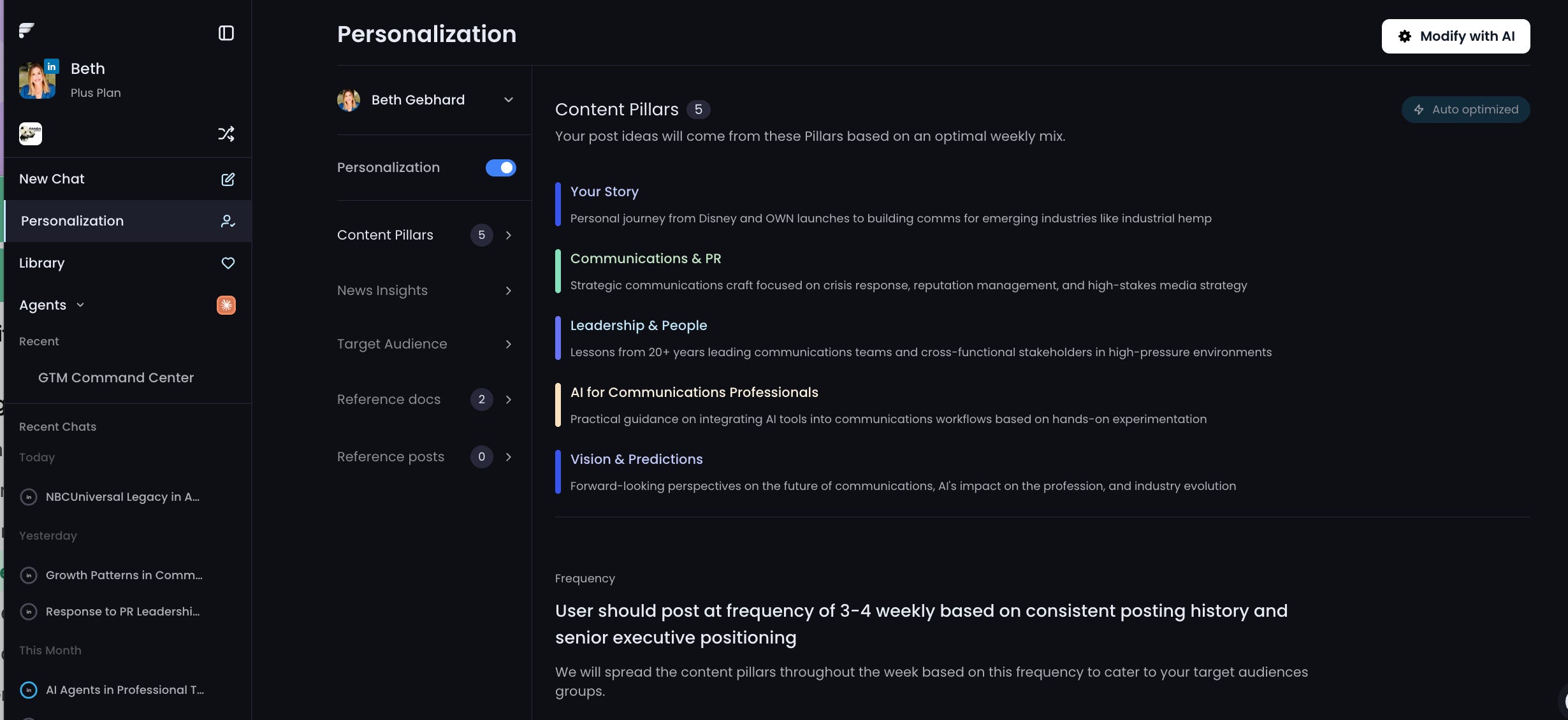
It recommends posting 3-4 times per week to build executive authority on the platform. Once configured, it offers two posting tracks— “Posts” for original content ideas and “Community” for engagement opportunities based on others’ content— with 14 ideas queued at any given time and a refresh option for 14 more (and more …).
The Experiment: The volume of ideas alone has real value. Coming up with 12-16 original LinkedIn post concepts per month on your own is genuinely taxing, and Final Layer removes that friction. It’s also a solid industry news aggregator. I’ve found myself better-informed on relevant trends even when I didn’t end up using the suggested ideas. And, the scheduling feature is practical: you can batch-prep a week of posts in one sitting.
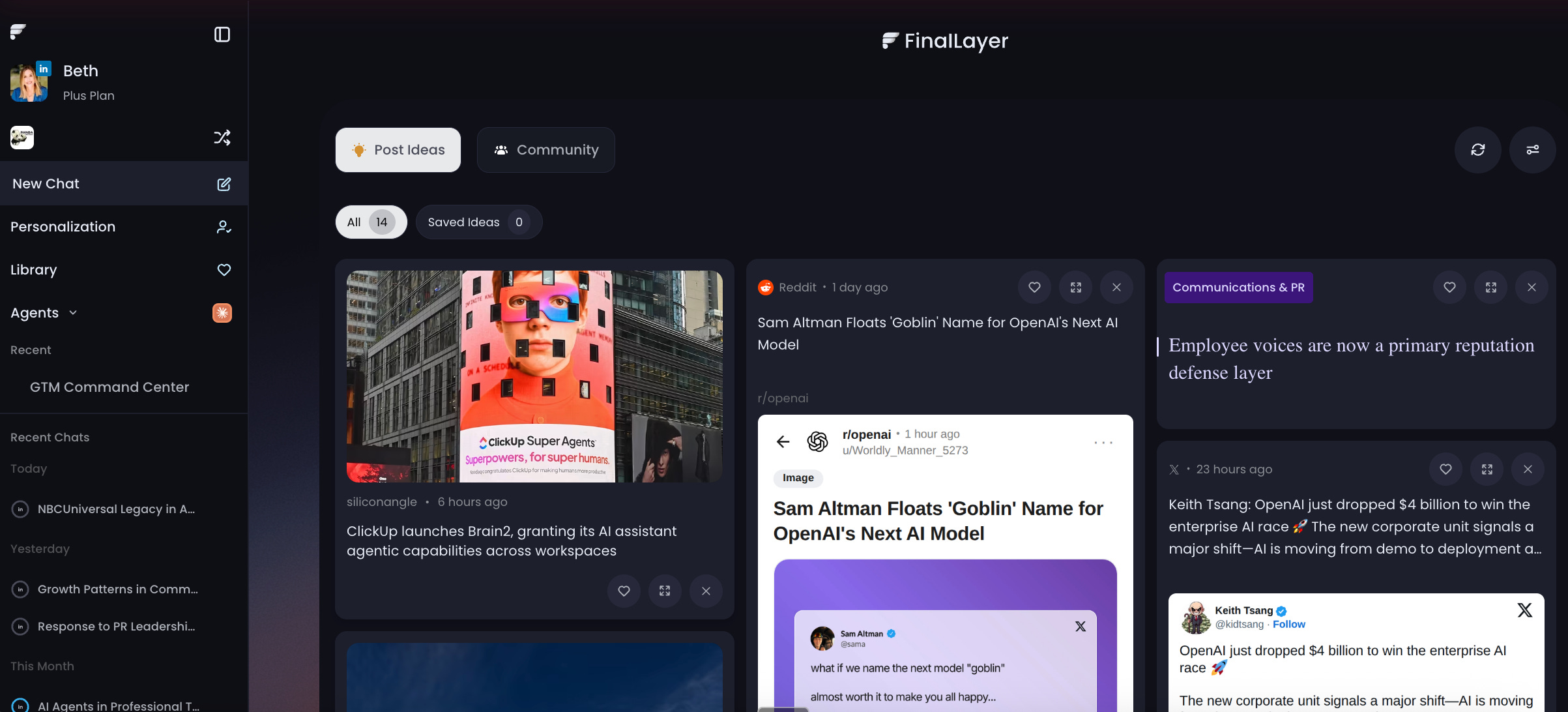
The posts themselves, though, are generic. Even with detailed personalization inputs and heavy editing options, the output consistently feels like a polished version of someone who sounds like me but isn’t quite me. I’ve honestly scrapped most of what it has suggested. And, the Community track hasn’t surfaced content I’d actually want to engage with, though I’m genuinely uncertain whether that’s a calibration issue that improves over time.
The question I keep sitting with is one I didn’t expect: how much do I want AI representing me on a platform that’s fundamentally about professional credibility and human connection? 🤔The efficiency argument is real. The identity question is also real. I haven’t resolved it, and I’m not sure I’m supposed to have resolved it yet.
Verdict: The jury’s out. The trial is ongoing. But that conundrum feels like a preview of a bigger question the whole industry is going to have to answer.
Pick one of these three new AI job titles and spend 20 minutes actually understanding what it means.
AI Ethics Officer: This role owns governance questions — bias in AI outputs, data privacy, transparency in AI use, policy compliance. Communications professionals should care because the reputational risk of getting AI ethics wrong is fundamentally a communications problem.
AI Solutions Architect: This is the person designing how AI tools and workflows integrate across an organization. Understanding their relationship to the communications function, and how your team’s AI tool stack fits into the broader organizational picture, matters if you want a seat in that conversation.
AI Acceleration Lead: This role drives adoption and change management around AI. Communications owns internal communications and culture change. There’s significant overlap here that most comms pros haven’t claimed yet.
You don’t need to become an expert. You need to be able to ask an intelligent question in a meeting. That’s the bar, and it’s a reasonable one to clear this week.
Sources: Ragan 2026 Communications Benchmark Report, Mike Prokopeak, April 30, 2026. PRWeek AI job titles, Chris Daniels, March 2026 (paywalled, worth seeking out if you have access). Sarah Evans / asksarah.ai, CEO Operating Note No. 01, Q2 2026.
What version of “what do I actually lead now?” are you sitting with? I’d genuinely like to know where other senior communicators are landing on this. Drop it in the comments.
You Beta Believe It is a newsletter for communications professionals about learning AI in public, in real time. If this one made you think or you enjoyed it, please share it!
Comments
Nothing yet. Say the first thing.
Sign in to join the conversation.