
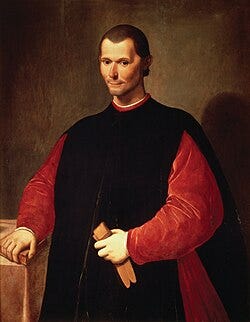
In Discourses on Livy (written c. 1513–1519), Niccolò Machiavelli examines the institutions, conflicts, and political customs that allow republics to acquire power and preserve their liberty. Although his analysis remains characteristically unsentimental and pragmatic, compared with The Prince, the Discourses reveals a more expansive side of his political thought, being less preoccupied with the survival of a single ruler than with civic liberty, institutional balance, and the conditions under which a political community can endure over time.
“I must say, therefore, that the defect for which writers blame the crowd can be attributed to all men individually and most of all to princes, for each person who is not regulated by the laws will commit the very same errors as an uncontrolled crowd of people. And this can be easily understood, for there exist and have existed many princes, and the good and wise ones have been few in number...
Such a comparison must be made with a multitude likewise regulated by laws, just as they are, and that same goodness we find in these kings will be seen in that crowd, and we shall see that it neither rules arrogantly nor humbly obeys, just like the Roman people, who never humbly served nor arrogantly ruled, while the republic endured uncorrupted; indeed, with their institutions and magistrates, they held to their ranks honourably...
I conclude, therefore, contrary to common opinion that says that peoples (when they hold power) are variable, changeable, and ungrateful, affirming that in them there exist no other sins than exist in particular princes. If anyone were to blame peoples and princes alike, he might be telling the truth; but he would be deceiving himself by excluding princes, for a people that exercises power and is well organized will be stable, prudent, and grateful no differently from a prince, or better than a prince, and will even be considered wise; and, on the other hand, a prince freed from the restraint of the laws will be even more ungrateful, variable, and imprudent than a people. The variation in their conduct arises not from a different nature (for this in all men is the same, and if there is a surplus of good, it resides in the people), but from having more or less respect for the laws under which one or the other lives.”
Niccolò di Bernardo dei Machiavelli (1469–1527) was a Florentine diplomat, author, political thinker, and historian of the Italian Renaissance. He served for many years in the government of the Florentine Republic, undertaking diplomatic and administrative missions. He is best known for The Prince, written around 1513, and for the Discourses on Livy. He is widely regarded as one of the foundational figures of modern political thought and political science.
Comments
Nothing yet. Say the first thing.
Sign in to join the conversation.