
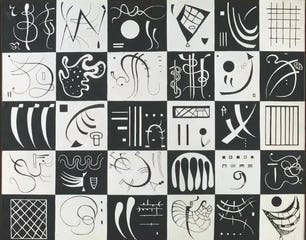
In Concerning the Spiritual in Art (1911), Wassily Kandinsky argues that painting should not be imitation of the visible world but instead serve to manifest the inner spiritual reality. Written in an era that WK perceived as materialistic, the following passage uses the metaphor of a slowly ascending triangle to explain why the pursuit of such expression is often met by resistance from society.
“The life of the spirit may be fairly represented in diagram as a large acute-angled triangle divided horizontally into unequal parts with the narrowest segment uppermost. The lower the segment the greater it is in breadth, depth, and area. The whole triangle is moving slowly, almost invisibly forwards and upwards. Where the apex was today the second segment is tomorrow; what today can be understood only by the apex and to the rest of the triangle is an incomprehensible gibberish, forms tomorrow the true thought and feeling of the second segment.
At the apex of the top segment stands often one man, and only one. His joyful vision cloaks a vast sorrow. Even those who are nearest to him in sympathy do not understand him. Angrily they abuse him as charlatan or madman. So in his lifetime stood Beethoven, solitary and insulted. How many years will it be before a greater segment of the triangle reaches the spot where he once stood alone? Despite memorials and statues, are they really many who have risen to his level?
In every segment of the triangle are artists. Each one of them who can see beyond the limits of his segment is a prophet to those about him, and helps the advance of the obstinate whole. But those who are blind, or those who retard the movement of the triangle for baser reasons, are fully understood by their fellows and acclaimed for their genius. The greater the segment (which is the same as saying the lower it lies in the triangle) so the greater the number who understand the words of the artist. Every segment hungers consciously or, much more often, unconsciously for their corresponding spiritual food. This food is offered by the artists, and for this food the segment immediately below will tomorrow be stretching out eager hands.
This simile of the triangle cannot be said to express every aspect of the spiritual life. For instance, there is never an absolute shadow-side to the picture, never a piece of unrelieved gloom. Even too often it happens that one level of spiritual food suffices for the nourishment of those who are already in a higher segment. But for them this food is poison; in small quantities it depresses their souls gradually into a lower segment; in large quantities it hurls them suddenly into the depths ever lower and lower. Sienkiewicz, in one of his novels, compares the spiritual life to swimming; for the man who does not strive tirelessly, who does not fight continually against sinking, will mentally and morally go under. In this strait a man’s talent (again in the biblical sense) becomes a curse—and not only the talent of the artist, but also of those who eat this poisoned food. The artist uses his strength to flatter his lower needs; in an ostensibly artistic form he presents what is impure, draws the weaker elements to him, mixes them with evil, betrays men and helps them to betray themselves, while they convince themselves and others that they are spiritually thirsty, and that from this pure spring they may quench their thirst. Such art does not help the forward movement, but hinders it, dragging back those who are striving to press onward, and spreading pestilence abroad.”
Wassily Wassilyevich Kandinsky (1866-1944) was a Russian painter and art theorist active in Germany during the late Belle Époque and Interwar eras. Kandinsky is generally credited as one of the pioneers of abstraction in Western art. Born in Moscow, he began painting studies (life-drawing, sketching and anatomy) at the age of 30.
Comments
Nothing yet. Say the first thing.
Sign in to join the conversation.