
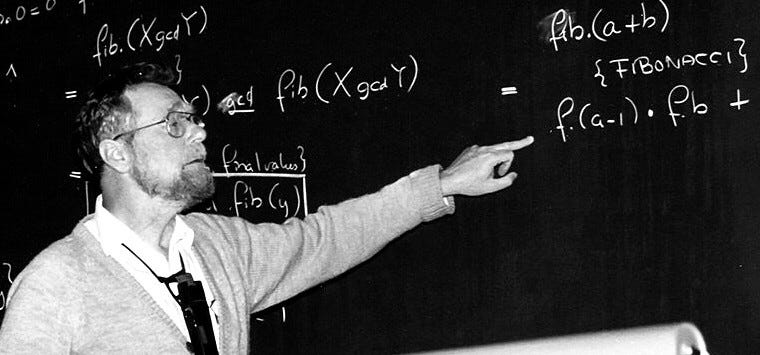
In this position paper for a panel discussion on "Computers and Society" (EWD867, 1983), Edsger Wybe Dijkstra argues that computers were systematically oversold. In light of today's AI hype, EWD was clearly identifying a recurring pattern. Yet putting emphasis, as he suggested, on computing's influence on mathematics instead may ironically itself swing too far the other way, rather than exploring practical applications that create real value. And while COBOL did not fulfill the grand promises made for it, it still remains a part of critical infrastructure. Hype aside, computing can, one step at a time, in some form, indeed be expected to transform societies.
“[…] and even Alan M. Turing allowed himself to be drawn into the discussion of the question whether computers can think. The question is just as relevant and just as meaningful as the question whether submarines can swim. […]
The first way of overselling computers was to postulate their universal usefulness and to present them as The Philosopher’s Stone that at the same time would cure all our ills and would turn anything into gold. As an example from those days I remember the recommendation that such-and-such computer could take for you “200.000 business decisions per second”.
The second way of overselling computers was by contrasting them to people –machines are fast, while people are slow, machines are reliable whereas people make mistakes, etc. – and in general suggesting that machines are very good at whatever we are poor at.
The third way of overselling computers was by reassuring every potential customer that programming the machine would be no problem. To this end, programming was presented as “a translation problem” – remember that FORTRAN stands for FORmula TRANslation! – of which the machine itself could take care. […]
Let us take a better known one: COBOL. COBOL’s explicitly stated major objective was to circumvent the need of the professional programmer: it should be so much like ordinary English that without any further education or training the average military officer or business manager could use it. Today we need 80 per cent of the professional programmers for our struggle with COBOL programs.
[…] Ideally, people would understand that, in the decades to come, computing science can be expected to have an influence on mathematics in general at least as profound as the influence physics has had on analysis during the last century.”
Edsger Wybe Dijkstra (1930–2002) was a Dutch computer scientist, programmer, mathematician, and science essayist. He formulated and solved the shortest path problem in 1956, and in 1960 developed the first compiler for the programming language ALGOL 60, and in 1972 he received ACM Turing Award for “fundamental contributions to programming as a high, intellectual challenge”.
Comments
Nothing yet. Say the first thing.
Sign in to join the conversation.