
(…continued from Part 3…)
Ukraine
On 5 August, none of the 24 ballistic missiles and 4 hypersonic missiles were intercepted. 98 of the 115 drones were shot down. At least 17 people were killed. A train depot, a brewing company and civilian warehouses were hit. At a 28 July meeting, Trump told Zelensky that they would not provide any Patriot missiles. He also broke his promise to allow Ukraine to produce Patriot missiles. Zelensky said, “Partners who are not ready to help more actively with interceptor deliveries right now can help through new sanctions measures. A significant part of Russia’s ballistic missile production is not under sanctions. Still.”
Russia attacks Kyiv with cluster munitions. These cause limited damage to buildings but are deadly to people.
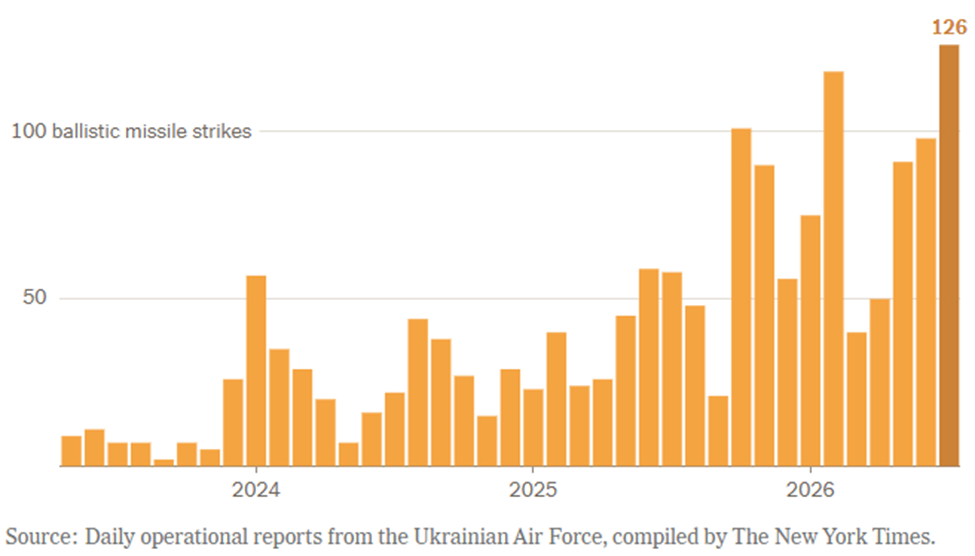
North Korea provided 15,000 troops to fight in Kursk as well as missiles, millions of artillery and mortar rounds, and other equipment. About 9,500 North Koreans are still in Kursk but have not crossed the border. Now they are sending a missile unit with six launchers and 120 ballistic missiles. Ukraine says that 30-50,000 more North Korean troops will be received in Voronezh, 200 km from Ukraine. Two possible options for using these troops are combat operations inside Ukraine, which would cross a new threshold, or stationing them on the border so that other Russian troops currently on the border could be sent into Ukraine.
A warehouse that stores electrical cables for vehicles was hit.
Ambassador to the UK and former Commander-in-Chief Zaluzhny told Zelensky that he would run for president if elections were held in the fall. He also said that Ukraine would never join NATO because of its low standards and doctrines dating back to WW2. He later clarified his remarks by saying that he’s been a strong supporter of NATO going back to 2019 when it was an unpopular view but that NATO needs to modernize.
“Scientific and technological progress is moving forward. In 2026, Ukraine used virtually every type of weapon – except Tomahawk missiles, nuclear weapons, aircraft carriers and F-35s that are in NATO service. The resource has been exhausted. Russia has found countermeasures to all of this,” Zaluzhny said. “The Armed Forces of Ukraine have reached a completely different level. NATO has no choice but to move to entirely new standards. Only then will NATO be ready for Ukraine’s accession.”
He also wants to create a new security bloc centered on Europe.
Two more ships were struck in Ukrainian ports and one sailor was killed. Since July, 67 port facilities, 35 ships in port and 22 ships at sea have been attacked.
90% of Ukraine’s agricultural exports went through the Black Sea. The loss of the Odesa ports means there is no cheap way to move Ukrainian wheat. Rail can only handle 50-55% of the Black Sea port capacity while adding $45-50 per ton in transportation costs, plus there is a shortage of drivers. Shipping the grain to Danube river barges is not currently an option due to the drought and low water levels, and that won’t change until October, if it rains then. There will also be a shortage of storage capacity. Prices were at $185-200 per ton and have dropped to $160 a ton and are still declining, and may end up lower than the cost to produce the crops. Losses for Ukraine’s farmers could reach $1.5-3 billion this year. Ukraine provides 6% of the world wheat exports and 11% of the world’s corn. They are also a major exporter of oilseeds and vegetable oils.
About 250 Ukrainian gas stations have been attacked in the last few months, and 194 of them were between the beginning of June and 27 July. FPV drones hit gas stations that are close to the front line and Shahed-type drones hit the rest. Fuel-truck drivers that resupply gas stations are increasingly refusing to service the most dangerous locations.

In addition to endangering civilians, they remove refueling sites for the military’s logistical vehicles and generators. Russian soldiers also require gas for their vehicles and generators and Ukraine started to attack gas stations in Belgorod recently, including at least one attack when several civilian cars were present.
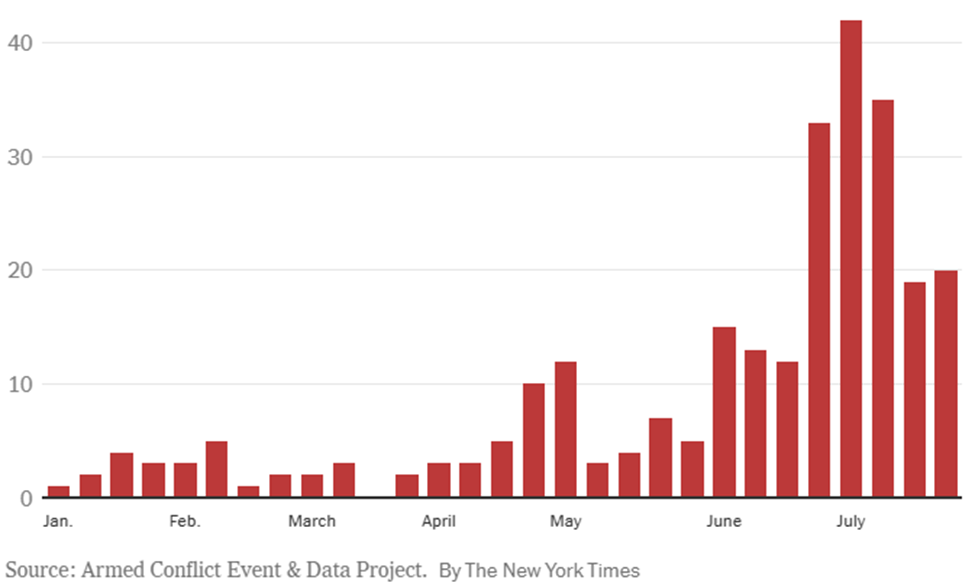
Some are damaged, others are destroyed, and many have sandbags at their entrance. Known for spotless bathrooms, coffee, hot dogs and other amenities, they were a social gathering place for civilians and soldiers alike. Drivers within range of the drones now minimize their stops, avoid bathroom breaks and carry extra fuel cans in their car. Some that stop to fuel then move away from the pumps to wait until their tanks are full. Employees take cigarette breaks at some distance away from the stations. At one station, when soldiers were filling up a truck, the employees left the station to watch from 500 meters a day.
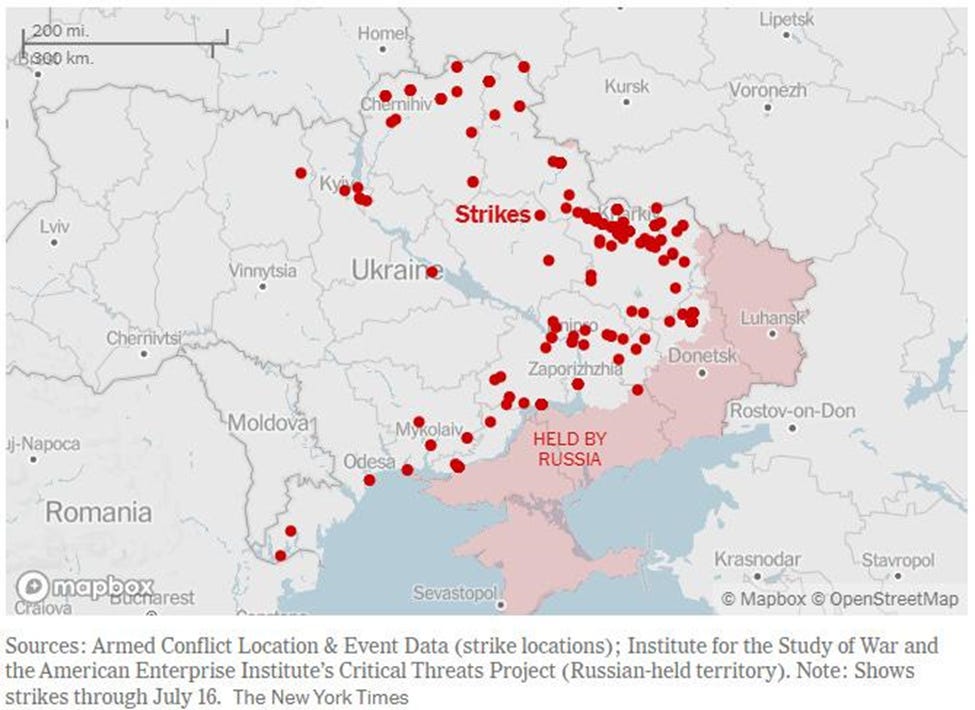
In the city of Trostianets, south of Sumy and 30 km from the border, the government is providing mobile fueling stations. The location of the small refueling vehicles is always changed and they are never in one location very long. Customers have to pay with cash and no fuel will be sold during air raids.

The State of Command
General Drapatyi continues his assessments and reorganization since taking command.
As reported earlier, the 225th and 425th assault regiments are not allowed to accept any replacements as they are already the size of divisions.
Srysky wanted to create more brigades by pulling personnel from existing brigades and weakening them. There now seems to be five that were forming: The 29th, 50th, 55th, 76th, and 167th Mechanized Brigades. The 50th was showing footage of drone attacks from a transferred drone unit to try and create a public image. The 29th Mechanized Brigade was almost completely formed and it will become a new unit. The other four brigades will be disbanded and their soldiers assigned to existing brigades as reinforcements. It is not known if they will be returned to the units from which they were pulled.
The head of Logistics Forces Command, Gen. Vladimir Karpienko was dismissed. He had been distributing supplies to corps and brigades based on loyalty to Syrsky rather than actual needs.
The chief of staff of the Ground Forces, Gen. Oleksandr Guziewicz was dismissed. During discussions with Drapatyi he repeatedly said that his superior was Syrsky.
The expanded reports of the 225th Assault Regiment command climate has a lot of parallels to the 425th Assault Regiment with regards to beating and torturing their own personnel. The two main differences is that there are no reports, as yet, of 225th soldiers dying in training as there was with the 425th. And there are no reports, as yet, of the 425th assigning blocking units to kill retreating soldiers, as has been reported for the 225th.
A battalion of the 39th Marine Infantry Coastal Defense Brigade was assigned to the 225th Regiment as part of the Szkval battalion made up of convicts that were released from prison to join the army. The Marines were told that they were headed to a shitshow. The Marines had served on the right bank of the Dnieper and took part in Krynky, in which some were in basements, other in the swamps, and they were pounded relentlessly by artillery and glide bombs. The Marines interpreted the warning as maybe it was going to be a difficult assignment.
It was as if they were in a different army. None of the planning for combat or logistics that they knew was conducted in that battalion. The atmosphere was oppressive. The Marines had their phones confiscated and they were placed in a basement with an armed guard at the entrance. Sources place the number of troops in the basement at 40-70. Anyone that was going on a mission would exit the basement, get their weapons and gear. When they were not on a mission they were sent to the basement. A sergeant said the commanders and guards spoke to them exclusively in Russian and cursed at them, treating them “like cattle, exactly as shown in videos with the orcs.”
The Marine said that in three weeks of operations under the 225th they suffered twice the number of casualties as when they were fighting at Krynky and on the islands in the Dnieper in three years.
That was the 225th. Thorkill reports that unconfirmed data from 2025 indicates that the 425th had around 10,000 killed and missing in action.
It is an understatement to say that things are expected to be different under Draypatyi. He is not perfect. He is not a magician. But he recognizes that soldiers perform best when they are treated with respect, trained, given clear objectives and held accountable.
Procurement Wars
Ukraine has been fighting for its survival as a nation for over four years now, but for some, the far more important battle is control over government contracts.
In 2022, Yegor Skalykha headed a location scouting company called At Point that worked with Zelensky in 2016 when he was an actor. Iryna Terekh had a business manufacturing concrete furniture. In 2023, they founded Fire Point, in 2025 they had $1 billion in contracts, and now build more than 60% of Ukraine’s long-range drones with 7,000 employees. Terekh says the possibility of producing 100,000 drones in 2026 “looks realistic.” In April 2026, NABU (anti-corruption) wiretaps seemed to reveal that the actual owners were the Mindich group, consisting of Timur Mindich, a co-owner of a television studio started by Zelensky and a target in a $100 million corruption scheme, and two brothers, Oleksandr and Mykhaylo Tsukerman, wanted in the same scheme.
After accusations of a connection to Mindich came out in October 2025, former CIA director and Secretary of State in Trump’s first administration, Mike Pompeo, joined the Fire Point advisory board.
Denys Shtylerman, the chief designer and co-owner, says they never received state funding for development and they have a 21.52% profit margin with 25% allowed. NABU confirmed there were no cases against Fire Point and its management. Shtylerman and Terekh are often promoting their products. Terekh lied once, saying that Fire Point was producing 100 FP-1 drones and one Flamingo missile every day before saying those were the numbers they could produce, not the ones they were actually producing. Last October, Shtilierman said they were producing 2-3 missiles a day but the number of Flamingos launched do not even support a claim of one missile per day for the last year.
There have been numerous accusations of Fire Point receiving preferential treatment and critics say that by monopolizing the market, they hurt the drone industry. The head of parliament’s anti-corruption committee believes that how Fire Point was awarded contracts should be investigated. Some have called for nationalizing Fire Point because of its connection to Mindich.
Oleksandr Konotopski founded Skyfall Industries and builds the P1-SUN interceptor and the Vampire “Baba Yaga” drone that has its own $900 million contract, which is the second largest behind Fire Point. He just revealed a drone with a 600 km range, 40-50 kg warhead and a $25-30k cost. Both sides have covert lobbyists that pose as journalists and industry experts to argue their case in public. One compared the Skyfall drone to the $55k, 75 kg FP-1 from Fire Point and said the cheaper drone was the way to go. Many former commentators point out that the two drones have different characteristics, such as a heavier warhead and a 3,400 km range for the FP-1.
For comparison, the basic Russian Shahed drone costs $35,000, has a 50 kg warhead and a range of 2,000 km.
The Fire Point drones have reached Omsk and have been responsible for much of the attacks on Russia’s refineries. The few Flamingo missiles that have been launched, and weren’t shot down, and didn’t narrowly miss the target, caused significant damage with their 1,150 kg warhead. The P1-SUN interceptors are highly effective at a low cost when intercepting drones and they improved their speed from 310 kph to 370 kph. The Vampire drone has been dropping heavy loads of munitions or transporting supplies and weapons for the infantry for some time now.
All these weapons are needed to defeat Russia. A lot of producers are focused on the fight. It would be nice if they all were.
The State of Command
General Drapatyi continues his assessments and reorganization since taking command.
As reported earlier, the 225th and 425th assault regiments are not allowed to accept any replacements as they are already the size of divisions.
Srysky wanted to create more brigades by pulling personnel from existing brigades and weakening them. There now seems to be five that were forming: The 29th, 50th, 55th, 76th, and 167th Mechanized Brigades. The 50th was showing footage of drone attacks from a transferred drone unit to try and create a public image. The 29th Mechanized Brigade was almost completely formed and it will become a new unit. The other four brigades will be disbanded and their soldiers assigned to existing brigades as reinforcements. It is not known if they will be returned to the units from which they were pulled.
The head of Logistics Forces Command, Gen. Vladimir Karpienko was dismissed. He had been distributing supplies to corps and brigades based on loyalty to Syrsky rather than actual needs.
The chief of staff of the Ground Forces, Gen. Oleksandr Guziewicz was dismissed. During discussions with Drapatyi he repeatedly said that his superior was Syrsky.
The expanded reports of the 225th Assault Regiment command climate has a lot of parallels to the 425th Assault Regiment with regards to beating and torturing their own personnel. The two main differences is that there are no reports, as yet, of 225th soldiers dying in training as there was with the 425th. And there are no reports, as yet, of the 425th assigning blocking units to kill retreating soldiers, as has been reported for the 225th.
A battalion of the 39th Marine Infantry Coastal Defense Brigade was assigned to the 225th Regiment as part of the Szkval battalion made up of convicts that were released from prison to join the army. The Marines were told that they were headed to a shitshow. The Marines had served on the right bank of the Dnieper and took part in Krynky, in which some were in basements, other in the swamps, and they were pounded relentlessly by artillery and glide bombs. The Marines interpreted the warning as maybe it was going to be a difficult assignment.
It was as if they were in a different army. None of the planning for combat or logistics that they knew was conducted in that battalion. The atmosphere was oppressive. The Marines had their phones confiscated and they were placed in a basement with an armed guard at the entrance. Sources place the number of troops in the basement at 40-70. Anyone that was going on a mission would exit the basement, get their weapons and gear. When they were not on a mission they were sent to the basement. A sergeant said the commanders and guards spoke to them exclusively in Russian and cursed at them, treating them “like cattle, exactly as shown in videos with the orcs.”
The Marine said that in three weeks of operations under the 225th they suffered twice the number of casualties as when they were fighting at Krynky and on the islands in the Dnieper in three years.
That was the 225th. Thorkill reports that unconfirmed data from 2025 indicates that the 425th had around 10,000 killed and missing in action.
It is an understatement to say that things are expected to be different under Draypatyi. He is not perfect. He is not a magician. But he recognizes that soldiers perform best when they are treated with respect, trained, given clear objectives and held accountable.
Procurement Wars
Ukraine has been fighting for its survival as a nation for over four years now, but for some, the far more important battle is control over government contracts.
In 2022, Yegor Skalykha headed a location scouting company called At Point that worked with Zelensky in 2016 when he was an actor. Iryna Terekh had a business manufacturing concrete furniture. In 2023, they founded Fire Point, in 2025 they had $1 billion in contracts, and now build more than 60% of Ukraine’s long-range drones with 7,000 employees. Terekh says the possibility of producing 100,000 drones in 2026 “looks realistic.” In April 2026, NABU (anti-corruption) wiretaps seemed to reveal that the actual owners were the Mindich group, consisting of Timur Mindich, a co-owner of a television studio started by Zelensky and a target in a $100 million corruption scheme, and two brothers, Oleksandr and Mykhaylo Tsukerman, wanted in the same scheme.
After accusations of a connection to Mindich came out in October 2025, former CIA director and Secretary of State in Trump’s first administration, Mike Pompeo, joined the Fire Point advisory board.
Denys Shtylerman, the chief designer and co-owner, says they never received state funding for development and they have a 21.52% profit margin with 25% allowed. NABU confirmed there were no cases against Fire Point and its management. Shtylerman and Terekh are often promoting their products. Terekh lied once, saying that Fire Point was producing 100 FP-1 drones and one Flamingo missile every day before saying those were the numbers they could produce, not the ones they were actually producing. Last October, Shtilierman said they were producing 2-3 missiles a day but the number of Flamingos launched do not even support a claim of one missile per day for the last year.
There have been numerous accusations of Fire Point receiving preferential treatment and critics say that by monopolizing the market, they hurt the drone industry. The head of parliament’s anti-corruption committee believes that how Fire Point was awarded contracts should be investigated. Some have called for nationalizing Fire Point because of its connection to Mindich.
Oleksandr Konotopski founded Skyfall Industries and builds the P1-SUN interceptor and the Vampire “Baba Yaga” drone that has its own $900 million contract, which is the second largest behind Fire Point. He just revealed a drone with a 600 km range, 40-50 kg warhead and a $25-30k cost. Both sides have covert lobbyists that pose as journalists and industry experts to argue their case in public. One compared the Skyfall drone to the $55k, 75 kg FP-1 from Fire Point and said the cheaper drone was the way to go. Many former commentators point out that the two drones have different characteristics, such as a heavier warhead and a 3,400 km range for the FP-1.
For comparison, the basic Russian Shahed drone costs $35,000, has a 50 kg warhead and a range of 2,000 km.
The Fire Point drones have reached Omsk and have been responsible for much of the attacks on Russia’s refineries. The few Flamingo missiles that have been launched, and weren’t shot down, and didn’t narrowly miss the target, caused significant damage with their 1,150 kg warhead. The P1-SUN interceptors are highly effective at a low cost when intercepting drones and they improved their speed from 310 kph to 370 kph. The Vampire drone has been dropping heavy loads of munitions or transporting supplies and weapons for the infantry for some time now.
All these weapons are needed to defeat Russia. A lot of producers are focused on the fight. It would be nice if they all were.
No posts
Comments
Nothing yet. Say the first thing.
Sign in to join the conversation.