
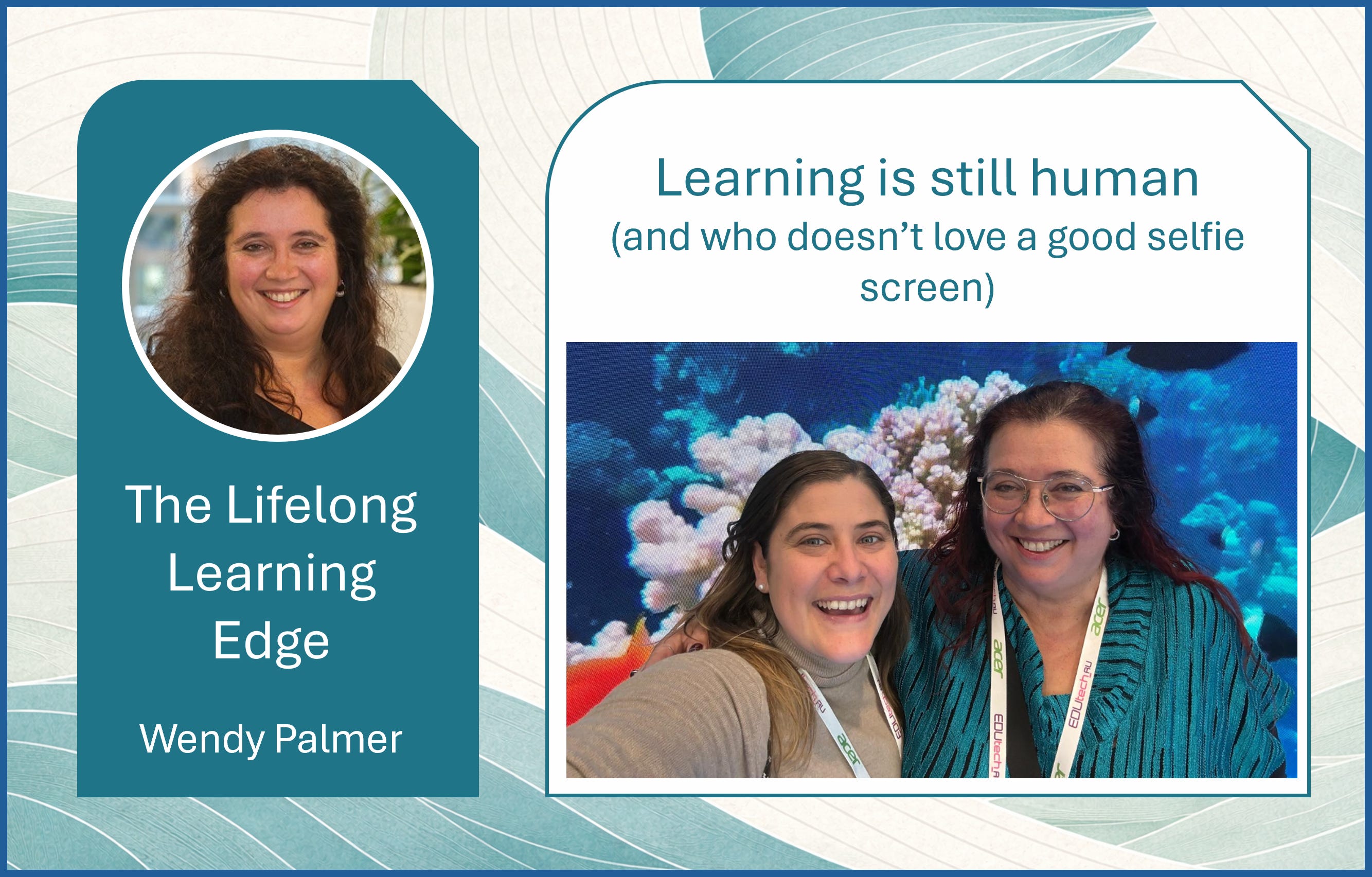
Last week Hannah Brown and I reflected on 10 years at Deakin and some of the lessons learned whilst we were attending EduTech. When Hannah and I compared notes after EduTech, we we had gone to different sessions but had landed in a very similar place.
One of the threads that Hannah picked up on was the “The human in the loop is not optional.” I know that sounds like a very AI conference thing to say, but actually it was less about technology and more about learning. Andy Hargreaves talked about craft, relationships and the idea that teaching is deeply human work. Rose Luckin talked about how humans live their learning. We learn through touch, smell, movement, relationships, practice, failure, care and all the messy experiences of being in the world.
AI does not do that. It can process information at extraordinary speed. It can generate text, summarise, organise, pattern match and produce something that looks very convincing. But it does not learn from life. Hannah put it well when she said that treating AI as though it is a brain is probably the central conceptual error. AI may be powerful, but it does not have the sensory, social, lived foundation of human intelligence.
And I think that distinction matters, because if education is only content transfer, then AI disrupts it very quickly. But if education is about judgement, practice, meaning-making, identity, confidence, feedback, community and becoming capable, then the human does not disappear. The human actually becomes more important.
The other place where this tension really showed up was assessment. Hannah saw this as the sharpest edge of the conference, and I think she is right. Again and again, sessions circled the same questions.
What is the student doing?
What is AI doing?
What counts as cheating?
What counts as support?
What are we actually trying to assess?
Hannah’s synthesis was that some of the learning analytics work was starting to show something important: AI may not have changed how students learn as much as it has changed what they submit and that’s a different problem.
I keep thinking that if the easiest way to respond to an assessment task is to get AI to generate the answer, maybe the problem is not only the student. Maybe the assessment needs another look.
I know that sounds blunt, but if you give someone a task and there is a useful tool sitting right beside them, why wouldn’t they use it? It is a bit like saying, “Build this thing, but don’t use the tools in the next room.” And in the workforce they will be expected to not only use those tools, but use them well.
What I think we need is less stigma and more honesty.
This is how I used AI.
This is what it helped me with.
This is what is still mine.
This is where it helped me organise my thinking, test an idea, find a gap, improve clarity, or reduce some of the administrative load.
That is a very different conversation from simply trying to catch people out.
Hannah connected this to the idea of shifting from authorship verification to comprehension verification.
Not just, “Did you write every word yourself?”
But, “Do you understand this? Can you explain it? Can you defend it? Can you apply it? Can you show the thinking behind it?”
Which I think is a more constructive position than the spiralling approach of evolving cheating detection to combat increasingly sophisticted AI tools. And it also recognises something else. AI is not going to sit still while we work out the perfect policy response. We cannot take 18 months to define the problem, because in 18 months the tools will have changed again.
So perhaps the work is not to “solve AI”, but to learn how to live with it, use it well, and keep asking what needs to remain human.
Hannah also noticed a gap between what institutions measure and what they say they value. We say we value capability, judgement, creativity, communication, confidence, professional identity, learner agency and lifelong learning. But often we still measure attendance, completion, compliance and the production of an artefact at a point in time.
This is where my skills literacy obsession comes back in.
A credential can help make learning visible, but only if the learner can connect it to their own story.
What did I learn?
What can I now do?
Where is my evidence?
How does this connect to where I want to go next?
That also brought both of us back to one of the big lessons from our Deakin and FutureLearn work.
When we started we designed beautiful and elegant learning pathways. Do this MOOC, then this one, then move into this subject, then into this degree. It was elegant, scaffolded and logical but also mostly ignored.
Only about 4% of learners followed the pathway we designed. The other 96% took their on pathways. At the time that was a bit confronting, but it taught us something important. Learners do not move through learning in neat lines just because we draw them that way.
They follow curiosity, confidence, work, timing, life and whatever feels useful at the time. In other words, learning pathways are often less like a train line and more like winding roads, especially when the learners don’t even want to all get to the same place.
That is why the conversations at EduTech about VET, higher education, degree apprenticeships, tertiary harmonisation and lifelong learning were so interesting. They pointed to the same structural problem from another direction.
The system still wants tidy pathways but real people need choice and flexibility. They need stepping stones. They need ways to pause, return, change direction and have what they have already learned recognised. However we also learnt that whilst the want flexibility they still want some structure, make it too open and people wander around in circles. For us good communication and student support became the key. Self paced learners still require support.
Hannah picked up the policy side of this very clearly. The current tertiary harmonisation conversation is important, but much of it still seems to centre on credit recognition and pathways. That matters, but it is not enough on its own.
If we are serious about lifelong learning, we need to think about modular credentialing, learner agency and cultural change at scale. We also need to be honest about system timing:
Technology moves quickly.
Policy moves slowly.
Capability takes time to build.
Learning impact takes even longer to see.
And electoral cycles do not line up neatly with any of it.
Which brings me to a small thing that I probably noticed more than most people would. After EduTech, I was sent a certificate of attendance. It is perfectly fine. It does what it says. It confirms I attended (however it didn’t mention I was a speaker).
But I am a little frustrated, I mean really, at a conference full of conversations about skills, AI, learning, assessment and the future of education, this felt like a missed opportunity. Where was the digital credential? Not because I need another badge for turning up. But because this is exactly the kind of moment where we could be thinking differently about recognition and modelling and demonstrating it.
A certificate says, “I attended.”
A good digital credential could help say, “This is what I engaged with. This is what I reflected on. These are the themes I explored. This is how this experience connects to my professional learning.”
It could also give the learner more agency and that was the bit I kept coming back to. We talk a lot about learning, but not enough about the learner’s agency to own the story of their learning.
Hannah’s final reflection was that the conference named the problems more confidently than it resolved them. I agree with that.
The AI conversation is still messy.
Assessment is still unresolved.
The lifelong learning ambition in policy still feels smaller than the need.
The technology sector is still pulled toward the things that are commercially easy to describe, while the deeper human dimensions of learning are harder to see, harder to measure and easier to ignore.
AI is forcing us to ask what is human and its impact on assessment is challenging us to ask what we really value. Skills pathways are forcing us to admit that people do not move in straight lines and the rise of the skills-based economy is asking us whether learners have enough agency to tell their own story.
That’s the conversation I want to continue. Because if we are serious about lifelong learning, the end point can’t be just a polite certificate. It needs to help people make sense of where they have been, what they have learned, what they can now do, and where they might go next.
Over the coming months, I am looking forward to continuing these conversations through ePIC APAC: Unlocking Human Potential and my FutureLearn courses on skills literacy and lifelong learning.
ePIC APAC: Unlocking Human Potential is a 1.5-day event in Melbourne in August, bringing together people from across the credentialing ecosystem who are actively shaping these conversations in practice. I’m thrilled to see leaders like Bill Shorten, Claire Field and Jan Owen headlining the event as registration officially opens. Register here.
At the same time, my new FutureLearn course Lifelong Learning: Recognise and Articulate School Skills has commenced, exploring how we help learners recognise and articulate their skills more effectively. In many ways, it sits at the heart of this same conversation. If you are involved in high school education, I encourage you to join me in this online course. A course for higher education is coming soon.
Learning has never been separate from life, but as we move further into a digital age and a skills-based economy, we need to become better at recognising the threads that connect our experiences, capabilities and growth across the whole of life.
Subscribe for free to continue exploring the learning, ideas, stories and recognition practices shaping the future of lifelong learning.
Comments
Nothing yet. Say the first thing.
Sign in to join the conversation.