
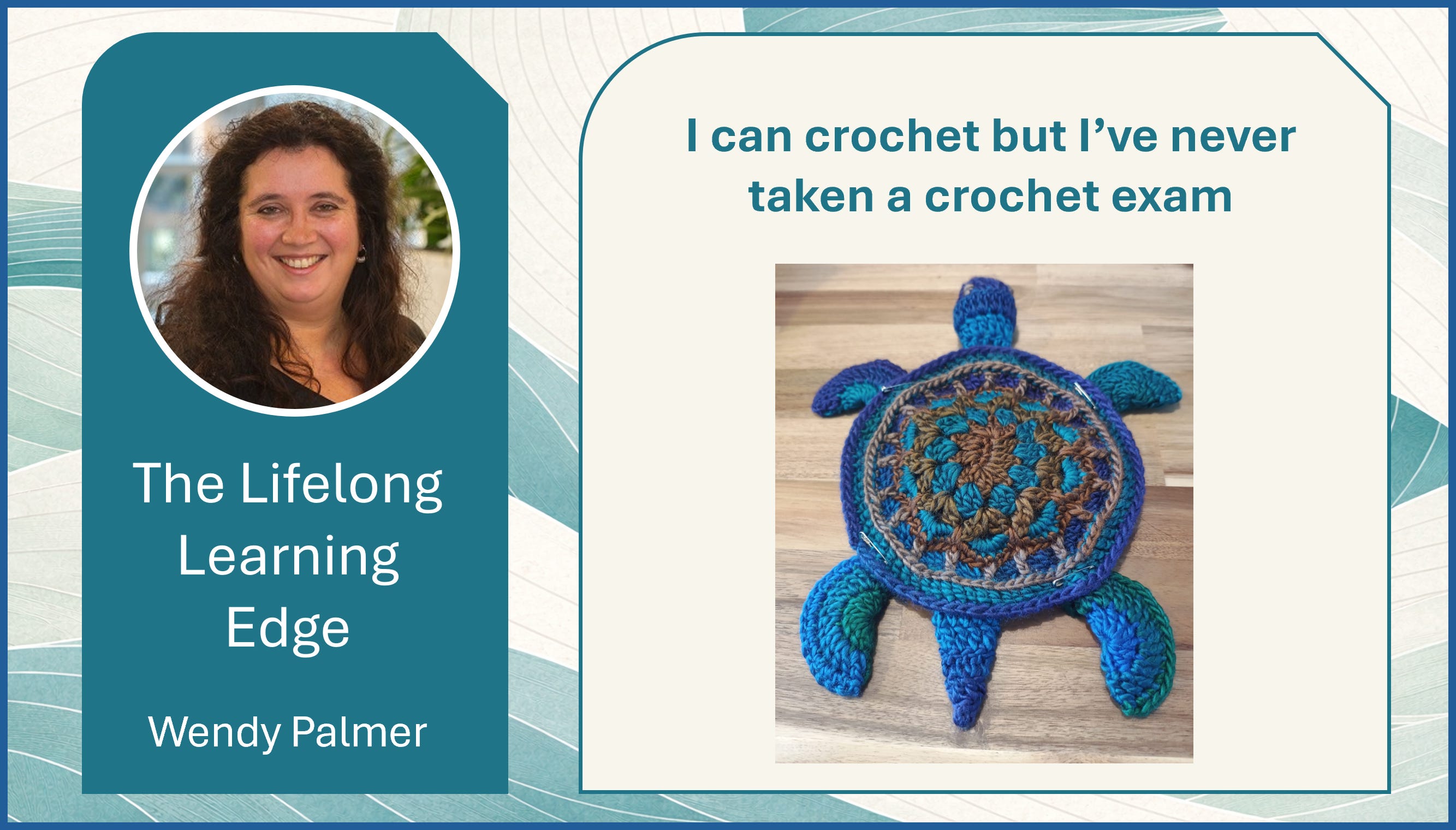
I’ve never taken a crochet exam. But I have plenty of evidence that I can crochet.
The turtle in the photograph above is one of my works in progress. I have been crocheting for years, and I am still learning. New stitches, new techniques, increasingly complicated patterns, and quite a lot of pulling things apart and starting again. Nobody has ever formally assessed any of it.
So if nobody assessed it, did I still learn it? Of course I did.
It seems like an obvious answer, and yet as I have been working on the final preparation for ePIC APAC next week, I have found myself thinking about this.
The theme of the conference is Unlocking Human Potential: All Learning Counts, which has got me thinking more broadly than a lot of the work I do in micro-credentials.
Microcredentials generally sit in a relatively comfortable space for our education systems. There is learning, defined outcomes and assessment. Someone makes a judgement about whether the learner has met a particular standard, and there is a credential to recognise it.
But that is only a small part of how we learn.
We learn through work. Through volunteering and caring for others. Through hobbies and interests. We develop our skills by trying something, getting it wrong and trying again. Sometimes we deliberately set out to learn something and sometimes we only realise much later how much we learned along the way.
Nobody necessarily assesses any of it. So how much of what we are capable of sits outside the things we can formally prove?
At We Are More in Canberra recently, we talked about the invisible skills young people develop across different parts of their lives and how we might connect extracurricular experiences back to formal learning.
This question also connects strongly with my work on skills literacy. Before we can articulate or provide evidence of a skill, we first have to recognise that we have developed it.
And I keep thinking about conversations I have had with Nan Travers about what our systems are good at capturing. We are good at quantifiable information:
What qualification did you earn?
How long did you work there?
What was your job title?
How many years of experience do you have?
These things fit neatly into databases. They give us fields we can populate, sort, compare and verify.
But they tell us surprisingly little about what somebody can actually do.
The interesting information is often qualitative. It is in the stories about what happened, the problems we encountered, the decisions we made, what we tried, what failed and what we did next.
Think about a job interview. We don’t simply verify someone’s qualification and employment dates and stop there. We ask questions:
Tell me about a time when...
Give me an example of...
How did you deal with...
We are trying to uncover the learning and capability hidden behind the data.
I have learned a lot through crochet over the years and I am still learning. I try new stitches, new patterns and new techniques. I make mistakes, undo things and work out how to do them differently.
Nobody assesses me. But I can show you something I have made. The artefact itself becomes evidence. You can look at it and make some judgement about what I must be capable of doing to produce it.
That seems reasonably straightforward. But what happens when the capability is less tangible? What does the artefact of problem solving look like? Or adaptability, or collaboration?
Often there isn’t a neat object we can point to and say, “there, that’s the evidence”.
Perhaps there is a story. Perhaps somebody else witnessed it. Perhaps there are traces of the work scattered across different places. Perhaps the individual simply knows, through experience, that this is something they can do.
Does evidence always have to be independently verified before it has value?
Could a collection of stories, artefacts, reflections and experiences gradually build a credible picture of capability, even when no single piece of evidence proves it?
I don’t know that we have worked this out yet.
This is another distinction that I think is important. Assessment is not what teaches us something or develops a skill.
Learning happens through doing, thinking, practising, experiencing, reflecting, experimenting, failing, adapting and doing again.
Assessment is a judgement made about that learning.
At its best, assessment can certainly contribute to learning. It can provide feedback, prompt reflection and reveal gaps in our understanding. But ultimately it gives us a point at which somebody can say: *we have enough evidence to judge that you can do this to this level.*
That is useful, but not enough. Perhaps one of the limitations of our current recognition systems is that we have become very good at recognising the measurement points, while much of the learning that happens between and beyond them remains invisible.
This is the question I’m looking forward to grappling with at ePIC APAC next week.
What would it actually mean to say all learning counts?
Not that everything needs a badge. Not that every experience needs to become a microcredential. And certainly not that we should spend our lives collecting evidence of everything we do.
But perhaps we could become much better at helping people recognise the learning that is already there.
Perhaps new technologies will help us make sense of some of the qualitative information our existing systems struggle to hold. Conversational AI, for example, creates interesting possibilities for helping people explore their experiences, identify patterns and surface capabilities that might otherwise remain hidden.
There are bigger questions about evidence, trust and whose judgement counts:
How much evidence is enough?
When does a story become evidence?
When is self-attestation valuable?
What needs independent verification, and what doesn’t?
And how do we make informal and experiential learning more visible without turning every part of our lives into an assessment exercise?
I don’t have neat answers to those questions yet and I know that many others are wrestling with the same questions.
But I am increasingly convinced that if we genuinely believe in lifelong and life-wide learning, we need recognition systems capable of seeing more than the learning somebody else has formally assessed.
Because even if nobody assessed it, I still learned it.
If you would like to participate in this conversation come and join us at ePIC APAC, still time to register.
https://apac.openrecognition.org/
Comments
Nothing yet. Say the first thing.
Sign in to join the conversation.