
Winter is my favorite season. I love the cold, always have. Growing up in Kolkata, the chill was fleeting. The magic number was 13°C as I recall; anything below and the city went berserk—the papers used words such as bitter and bone-chilling, people on the street burned trash for warmth, fashionistas of all ages shivered in their monkey caps. As for me, winter was the only time of year I felt truly comfortable, wrapped in layers, sans fusty armpits; the only time of year I could hide my body without effort.
In the winter of 2009 I was applying to colleges in America. My first contact was Dartmouth College, and the alum assigned to interview me spent several minutes extolling his high-flying life—India to England, old Hampshire to new, Olympic swimming, horses!—before suddenly enquiring what drew me to Dartmouth. I knew next to nothing about American colleges back then, about the country’s fixation on free will neither. It was a balmy February day, the annual chill already behind us; for the interview I had chosen a foolish blazer and I was already sweating underneath, and all this called to mind a picture on Dartmouth’s website: the campus draped in white.
Why Dartmouth? “Because it snows!” I said and was rejected a month later.
Boo-hooey! Dartmouth meant little to me back then, as did Brown, the school where I would eventually end up. In my circles in India you only heard about Harvard, Yale, Princeton, MIT. Sometimes Stanford, but that was it. It was a short list that ended suddenly. Of course I knew there were other schools, but I didn’t aspire to attend them. Word of mouth meant everything. I didn’t apply to UPenn because no one really talked about it, and I had somehow convinced myself that Columbia the school was in Colombia the country; prestige whore that I was, I didn’t apply to Columbia either.
I remember the first time I heard about Brown: in breezy early December, three weeks before the application deadline. At my friend A’s home I happened to meet an aunt of his who was visiting from America. This aunt was a Brown alum; she had studied economics and liked it quite a bit. What an odd name, I remember thinking. Brown like the color? Later that night, I googled the school and found another photo of a campus swaddled in snow and decided to apply. In the end it was the only school that accepted me and offered me enough aid.
Brown has been on the news a lot, most recently for a campus shooting—that national cancer. The school has been on my mind, too. I have nothing original to say about gun violence or mental illness, but I am moved to take a moment to tell you how much Brown means to me. I learned a great deal there, and unlearned even more: prestige is overrated, as is success; religion can be scary, weirdness can be fun; the reason for the season is the tilt of Earth’s axis, plus rotation and revolution, plus volcanoes, albedo, the Milankovitch cycles, dot dot dot.
Of all of Brown’s lessons the one I’ve been thinking about lately is institutional compassion. My brother is two years younger, and when he was about to head off to college in 2016, Brown sent my parents a letter. It came in the mail carrying a startling message: an offer to increase my financial aid to ease the burden on my family. The school knew my brother was college-age—it was part of the data it had collected when I matriculated, and now that data was being put to use. My father was deeply moved by that letter. We all were.
I read of people being snatched off the streets, of sluggish courts, dead-end relief, corporate greed and government corruption. I think of that desperate final line in A Streetcar Named Desire, delivered by Blanche in the throes of a breakdown, “I have always depended on the kindness of strangers.” But it doesn’t have to be this way. That letter from Brown was typed and printed, stamped with a generic signature. We were not the only family who received it. Here was a faceless institution that somehow had a heart. What an idea!
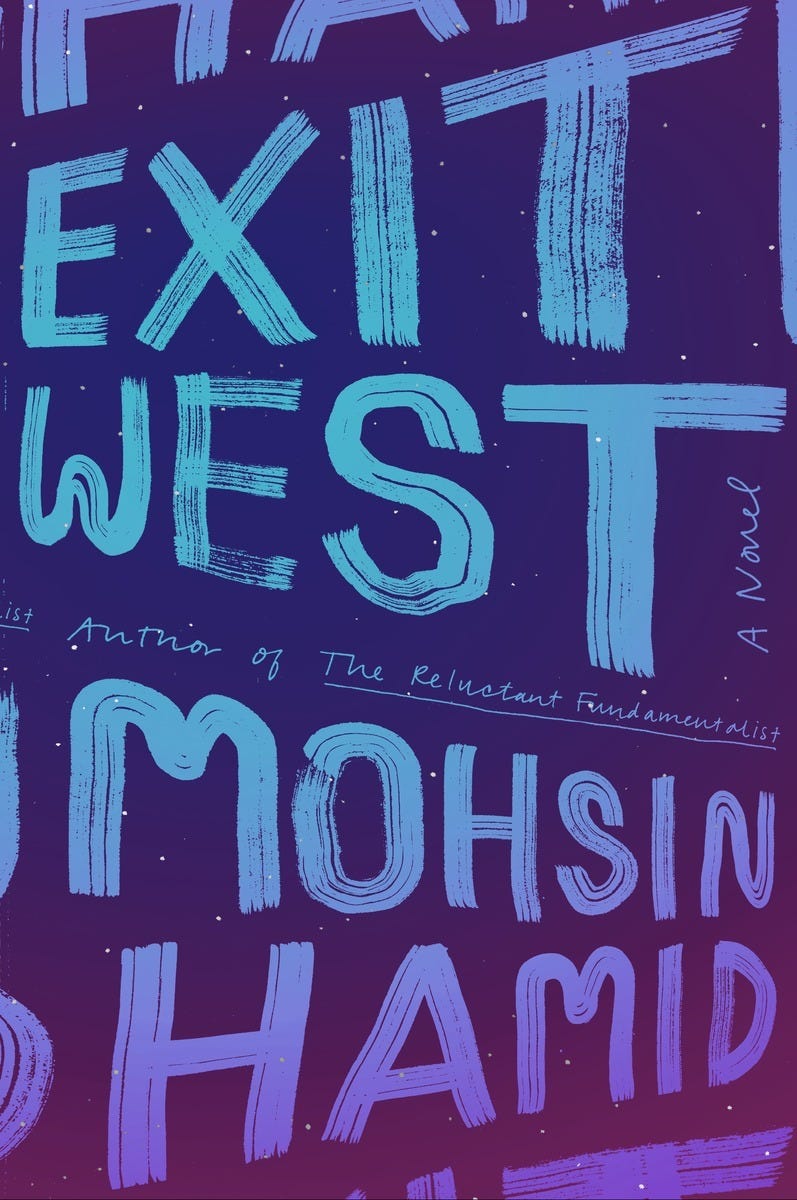
I was drawn to “Exit West” by the cover: the shades of blue, the stars, the imperative title. Exit! Run! I judged the book to be exquisite based on the cover alone, and for once I was right. Here is a remarkable novel, an easy read, a fantasy and love story both, a fable in the ancient tradition.
A non-complete list of the things you’ll find in “Exit West”: a sweet boy devoted to his parents, a sassy girl who bikes in her burqa, civil war in all its banality—until tragedy strikes, that is—plus a world filled with magic doors that transport you vast distances in an instant. “We are all migrants through time,” Hamid writes, and in his novel he explores what it means to escape one’s life again and again, on a global scale, with the trials of the journey taken out. Hamid is primarily interested in what happens when we are done traveling, when we have arrived at the hallowed place. What next? What do we win? What do we lose?
“We are all children who lose our parents,” he writes, “all of us, every man and woman and boy and girl, and we too will all be lost by those who come after us and love us, and this loss unites humanity, unites every human being, the temporary nature of our being-ness, and our shared sorrow, the heartache we each carry and yet too often refuse to acknowledge in one another.”
Comments
Nothing yet. Say the first thing.
Sign in to join the conversation.