
Congratulations on surviving yet another Turkey Month, No Shave November, NaNoWriMo (National Novel Writing Month), or what have you. The high holidays are upon us once again, and the news is full of articles about how to cook the perfect turkey (too many to cite), how to talk about politics at dinner, how to let your brother carve the turkey, how to eat what you kill, how to be grateful when you’re struggling, etc.
In the midst of this I want to offer a little nod to the ungrateful among us. Here are some facts that will rile you up a bit:
Economic inequality in India is higher today than at any point during the British Raj (see Al Jazeera, Indian Express, Economic Times).
A college student in Boston who has lived in the U.S. since age seven was detained by immigration agents on her flight home to Texas for Thanksgiving and summarily deported to Honduras.
Tanzania is in the process of evicting over 100,000 members of the indigenous Maasai in part to make way for a private game reserve linked to the royal family of Dubai.
Trump’s recent gutting of USAID has already killed hundreds of thousands of people around the world.
I could go on.
Some people believe we have a lot to be grateful for. Good for them. For me, it has always felt strange to say that I’m grateful. Grateful for what? Grateful to be the cream of my pubescent nation’s riotous inequality? Grateful that I’m not being evicted from my ancestral land? Grateful that I cannot yet be seized and deported by ICE? It feels strange to say I’m grateful to have escaped arbitrary misfortune even as that same misfortune befalls others.
So: I am not grateful. I am angry. Maybe you are too. There’s a lot to be grumpy about. Write to me with your own grumpy news. I want to hear!
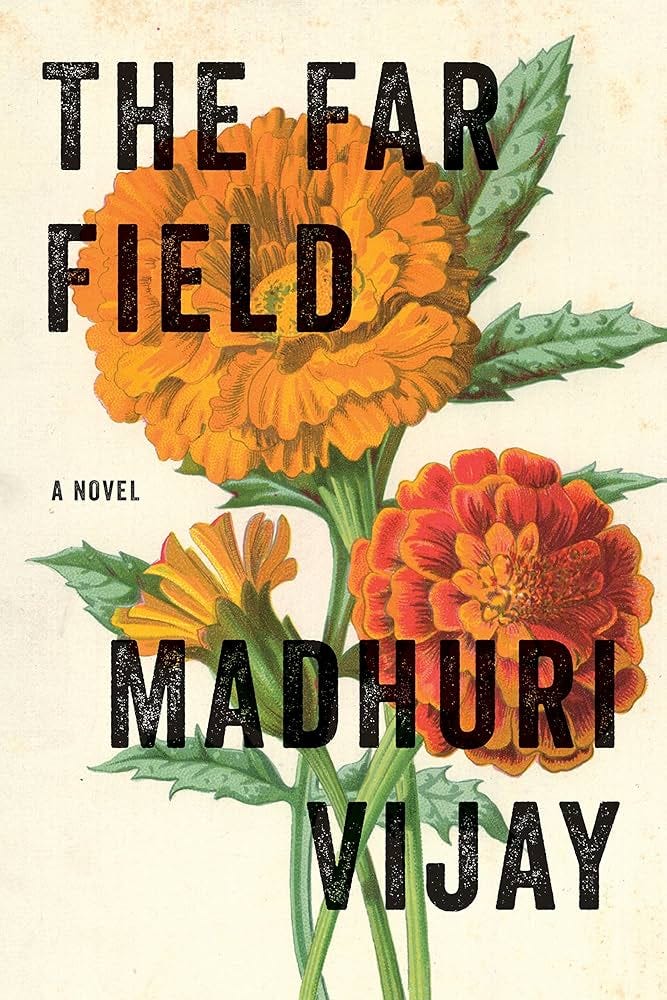
Vijay’s debut novel came out in 2019 and follows Shalini, a young woman from Bangalore who travels to Kashmir in the wake of her mother’s sudden death. Shalini is Hindu and rich, wracked by grief, well-meaning for the most part, educated and thoughtful and aimless. She writes:
This country, already ancient when I was born in 1982, has changed every instant I’ve been alive. Titanic events have ripped it apart year after year, each time rearranging it along slightly different seams and I have been touched by none of it: prime ministers assassinated, peasant-guerrillas waging war in emerald jungles, fields cracking under the iron heel of a drought, nuclear bombs catering the wide desert floor, lethal gases blasting from pipes and into ten thousand lungs, mobs crashing against mobs and always coming away bloody. Consider this: even now, at this very moment, people are huddled in a room somewhere, wanting to die.
In Kashmir, Shalini aligns herself with the impoverished locals, besieged by the army and militancy both. She is looking for her mother’s friend, Bashir Ahmed, and she hopes that finding him will bring her peace and meaning, something to hold on to. But she is wrong. She leaves a trail of ruin in her wake, and along the way she reminds us, without meaning to, to always resist simplicity. Simplicity is fascism: X is good, Y is bad and so on. The real world is unendingly complicated. In the far field beyond the fence the grass has many colors.
A parting quote:
“I find that different languages are useful for different things. For instance, it is best to write poetry in Urdu. Urdu words are made for poetry and songs. For stories, Kashmiri is the best.”
“And English?”
“English?” He smiled. “English is excellent for signboards and maps.”
Comments
Nothing yet. Say the first thing.
Sign in to join the conversation.