
LIBERTY OR DEATHWIRE! ⬩ ANALYSIS ⬩ AMERICA 250 SERIES
Anthropic’s Project Panama did not burn the books. It severed their spines, copied their contents into a private computational library, and sent the paper remains toward recycling—a Fahrenheit 451 nightmare rewritten for the age of artificial intelligence.
“Artificial intelligence was not self-taught; it was educated by civilization. The danger begins when the student consumes the library, dismisses its teachers, and claims the inheritance of human thought as its own.”
Written by: Andrew B. Raupp / @stemceo
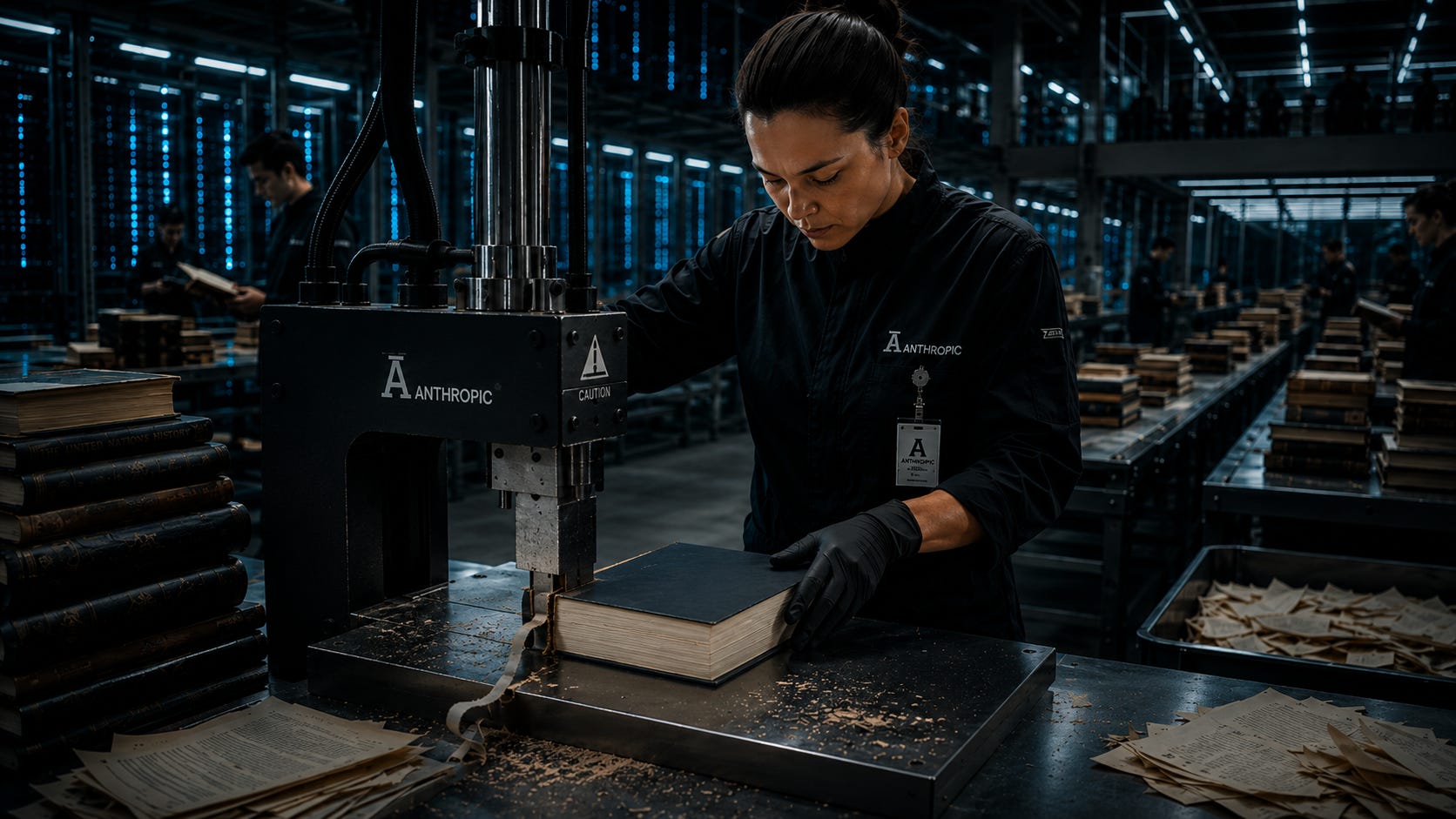
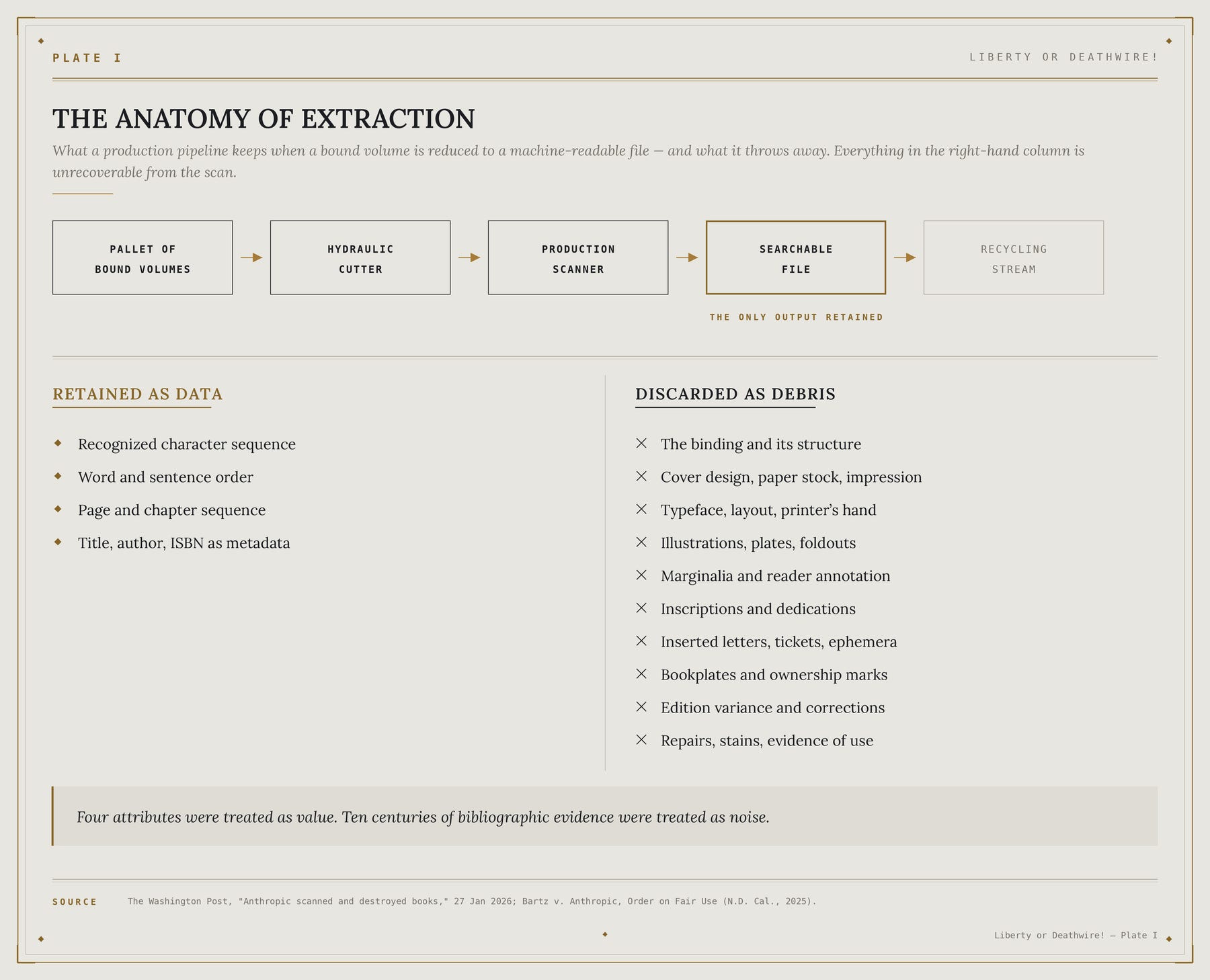
There was no kerosene, no salamander, no midnight knock on the door, no crowd gathered to watch illicit pages curl and disintegrate into the air. There was instead a hydraulic cutting device, a production-level scanner, and an industrial-grade workflow strategy for transforming books into data as quickly as possible. At one end of the process, pallets of printed volumes entered as recognizable objects of culture—bound, illustrated, edited, owned, read, physically handled, and sometimes annotated by the human beings who shared their lives with them. At the other end, they came out as digitally-searchable files. The binding was removed, the pages divided, the words captured, the debris discarded. It was a process cleaner than fire, quieter than fire, and much easier to market as an innovation. And yet it was upsetting for exactly the opposite reason from a book burning: these were not books destroyed because their ideas were deemed worthless or too dangerous to share with anyone. Quite the opposite. These were books destroyed because the ideas contained therein were seen as incredibly valuable.
Available for iOS and Android
Anthropic set its sights on the corpus - the accumulated reasoning, language, history, imagination, argumentation, and stylization - preserved in works available in printed books. The density of thought, which is increasingly absent from edited books and the open internet. While the physical object itself was not needed, after extracting the words The Washington Post reported on the binding removal and destruction of the millions of books that were bought, transformed into machine-readable files, and destroyed. This was not a public work of physical preservation, digitization of the nation’s libraries, or a philanthropic project to digitize sunk works for the benefit of schools and libraries. This was a corporate project to boost some of the world’s most valuable AI systems.
Called internally Project Panama, this was a secret plan to built a gigantic online research library to Anthropic and to the Claude’s development. Internal documents reviewed during the investigation reveal that one of the planning papers set out the goal on almost monumental terms; “destructive scanning of all the world’s books” may have been an over-ambitious target, revealing the sheer greed and irresponsibility of it all. In less than a year, it was estimated that Anthropic paid tens of millions of dollars in purchasing and processing millions of books. How many books, the answer is hidden under redacted information, although an unsolicited project estimated that between 500,000 and two million books could be destructively scanned in a six-month period. It wasn’t a researcher putting a few books inside an experimental model; it was the systematic destructing conversion of the literary culture into the unique computational infrastructure of a for-profit agency.
Ray Bradbury’s dystopia did not set fire to the firehouses, and the decision of judge William Alsup in Bartz v. Anthropic did not find that the company had transferred Panama’s copy to the public. A serious argument should weigh these differences instead of resorting to theatrical comparisons that cannot withstand the test. Project Panama was not censorship in the sense of the word that represents it. But a contemporary dystopia does not need to reproduce all the visible mechanisms of the previous one to possess its intrinsic logic. As explained by the National Endowment for the Arts in the materials for readers, in Fahrenheit 451 the book was subjugated to the screen, distraction, speed, managed happiness, and a social order increasingly hostile to prolonged thought. The firemen of Bradbury destroyed books so that human beings could not read them. Project Panama destroyed physical books so that machines could read them at an industrial level. The first system feared what books could teach people, and the second coveted what books could teach a product. The motives are not similar, but both lay the written heritage of civilization at the feet of a powerful centralized apparatus.
Then, in early 2024, when Project Panama heated up, Anthropic tapped Tom Turvey, who used to run partnerships for Google’s book-scanning project, to run point. It made sense. For a company planning to turn its library of physical books into a computational resource, it needed someone familiar with the purchase, scanning, rights, institutional partnerships, and mass digitization logistics. Per court filings and reportage about internal discussions at the company, Anthropic explored the purchase of tomes from major used bookstores, the Strand in New York City, legacy libraries, and even a library that, as one document reportedly put it, was “chronically underfunded.” The record is silent as to whether all the contemplated deals went through, and the Strand denied it sold tomes to Anthropic. However, it is clear the company got its hands on millions of paper volumes, sometimes in vast quantities from such sources as Better World Books and World of Books, after which out-sourcers unbound the books, cut the pages into sizes compatible with scanners, scanned the words on the pages, and tossed the originals.
The actual horror of the process is not the number of the books being destroyed but the fact that the only value they had was the value of the text. Once the book had entered the library, it had its own characteristics: the design of the cover, stock, font, illustrations, printing…. The marks of former owners, marginalia, letters or inserts, dedications, notes, corrections, stains, repairs, signs of use. Once it had left, it was simply text. Anything that was not valuable data to the model was simply garbage. While a reader or archivist would find a handwritten note valuable information about how a work was received at a particular time or place, a scanning contractor concerned with quantity would see it as noise. The binding or difference between editions would be significant to a historian; for the text-extraction pipeline, it is just characters to recognize, arrange and store.
Anthropic referred to what it was building as a research library, but the word “library” begs the question: what separation is there between a library that serves the public interest and the knowledge and ideas of a company parent? Judge Alsup’s order describes a digital library that Anthropic expected to maintain forever. Their model could draw on books available for training and in for-hire and enslaved research with a nod to future indeterminate uses. There is no reason to remove a book acquired and digitized if Anthropic itself uses it in training, calls on it for research, or processes it in any other way. This is more than a dataset assembled for a single, ephemeral experiment. Anthropic has a repository of human thought and writing forever and for any computational use it may discover.
This is where the use of “library” as a metaphor becomes problematic. A public library collects books and makes them available for reading. A preservation library collects works to ensure that they may be referenced by future generations. Project Panama collected books, however, so that a business could internalize their informational value. The scans were not made available to general readers, to public schools, to independent scholars, to underfunded communities, or to the individual authors whose work made the archive valuable. A digital universal library was not gifted to the public in exchange for the original texts. Instead, a commercial interface was produced, one made more fluent and seemingly intelligent - or in other words, more competent - in part because of a library that the public cannot examine. The texts have been removed from the sphere of the public cultural commons to the closed system of commercial presence, able to extract value for model training, corporate intellectual property, strategic leverage, and future profits.
This contradiction strikes especially hard in the context of the company’s own arguments . The federal record includes Anthropic’s analysis that, among various sources, “books were among the cheapest material we could get access to for building great language models.” The sustained arguments, editing, narratives, structures, progressions, coherent explanations and reasonings found in books were matters of the mental food that Anthropic was aware all their systems needed to become talented at reasoning – something increasingly being diluted on the web by advertising, repetitions, search-engine tricks, social media short-cuts, automated processes, and the pervasion on the internet of badly written AI text. Anthropic seemed aware the content of their systems could not become reasoning talent if they only dined on the digital garbage of the internet. They looked for the time-intensive products of authors and editors who had learned to make thought readable.
Perhaps the most bitter irony of Project Panama is to see Silicon Valley at the forefront of the presentation of artificial intelligence as if intelligence came from a computation, when the conduct of the industry betrays a reality that is no more magical than that . These standards fed on an important asset from an expressive human net: from writers who built together sentences, historians who joined evidences, scientists who clarified complex ideas, novelists who narrated the life of the interior , translators who exported meanings from language to language and editors who classified order in the disorder. The machine was not self-taught, it was taught by civilization. Although the civilization that taught him, was not necessarily summoned to negotiate conditions, participate in returns and guarantee access to the construction of its archive.
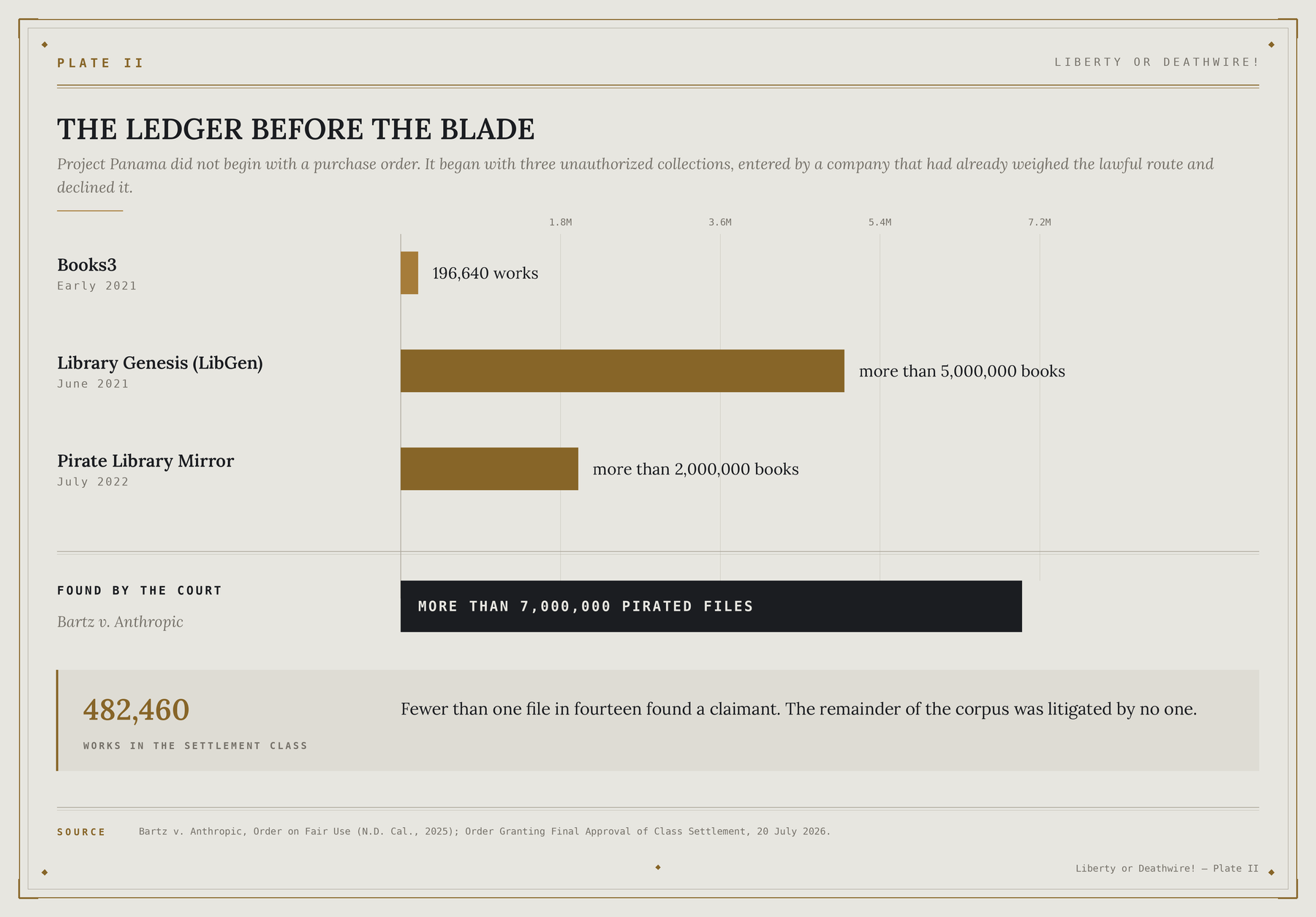
Project Panama was not Anthropic’s first foray into accessing the world’s literature. In fact, the Panama project was the result of a pirating campaign that had already allowed the company to possess millions of unauthorized digital copies of books. According to the 2025 ruling of Bartz v. Anthropic, one of the co-founders of Anthropic accessed in early 2021 about 196,640 works in the Books3 dataset, being aware that the dataset used to create it consisted of unauthorized copies. In June of that year, the company accessed more than five million books stored using Library Genesis, known as LibGen. In July 2022, it accessed more than two million books stored using the Pirate Library Mirror. The court determined that the company accessed more than seven million files of pirated books.
This was not a collection of unidentified language particles floating on the internet. The files contained works, including titles, authors, publication data, and ISBNs. Each file was instantiated on a network of human endeavors: the author, translator, illustrator, researcher, editor, publisher, and sometimes the estate of a deceased author. Referring to the library as a dataset does not alter the content of the library. A library has been compiled without standard purchasing or permissions, even if the library has ultimately filtered, reshaped, or used portions.
Most damaging about the court’s account of Anthropic’s internal calculations is that it pulls back the curtain on the moral obscurity that often attends the AI industry. Judge Alsup’s order recounts that there were legal ways to recreate the copyrighted works, but first Anthropic (an AI startup) preferred a quicker and more convenient route with pirate collections to the what CEO Dario Amodei called the “legal/practice/business slog.” That deserves attention. This was not some red tape that bureaucrats only created to hinder innovation from the timid outsiders. It was the process by which a corporation decides if it has the right to use someone else’s creation, negotiates with the gatekeepers of that creation, opts in or out of remuneration for using that creation, and recognizes that the infringers are not the sole actors with rights that interfere with its convenience.
Once litigation risk could no longer be evaded, Anthropic scrounged for a legally defensible alternate route to something like the same destination. The company commissioned Turvey, made some overtures to publishers, and bulked up its acquisition of physical books. Such books could be purchased on the secondary market, scanned one-for-one, and destroyed, allowing Anthropic to claim it merely had morphed one privately owned physical copy into a private digital copy. The hydraulic cutter was, therefore, not merely a piece of equipment used in production tasks. Rather, it was a part of Anthropic’s legal architecture. It allowed the company to pursue the informational value of a vast digital library, but without relying completely on the pirate repositories that had created such clear liability.
Anthropic has emphasized that it did not use the entire LibGen corpus to train a commercial inference model, and it did not use the Pirate Library Mirror to train a completion model at all. This distinction is important — especially in a legal context — and should not have been obscured simply because it made the indictment more complicated. But it does not answer the more profound conundrum. The court determined that pirated content persisted in Anthropic’s central corpus even if specific documents were not used to train a model. The harm alleged by authors was therefore not confined to the instantiation of one Claude. It also included the creation of a central corporate library of unauthorized copies that could be queried, explored, filtered, and potentially exploited in the future.
On July 20, 2026, the federal court issued a Final Approval Order for the $1.5 billion settlementregarding the claims arising from “the LibGen collection and the Pirate Library Mirror collections of. … 482,460 works,” which is allegedly a non-reversionary fund with an average payment. . .of “approximately $3,000 per claimed work (before fees, costs, and any distribution to competing rightsholders).” Further, based on Associated Press reports about the Final Approval of the Settlement, the parties involved, including Anthropic, did not admit to any wrongdoing or liability. What is also crucial to note about the Settlement is what it did not decide. It did not make Project Panama’s illegal scanning of books illegal that were lawfully bought by Anthropic. Instead, it settled the claims regarding the unauthorized digital collections.
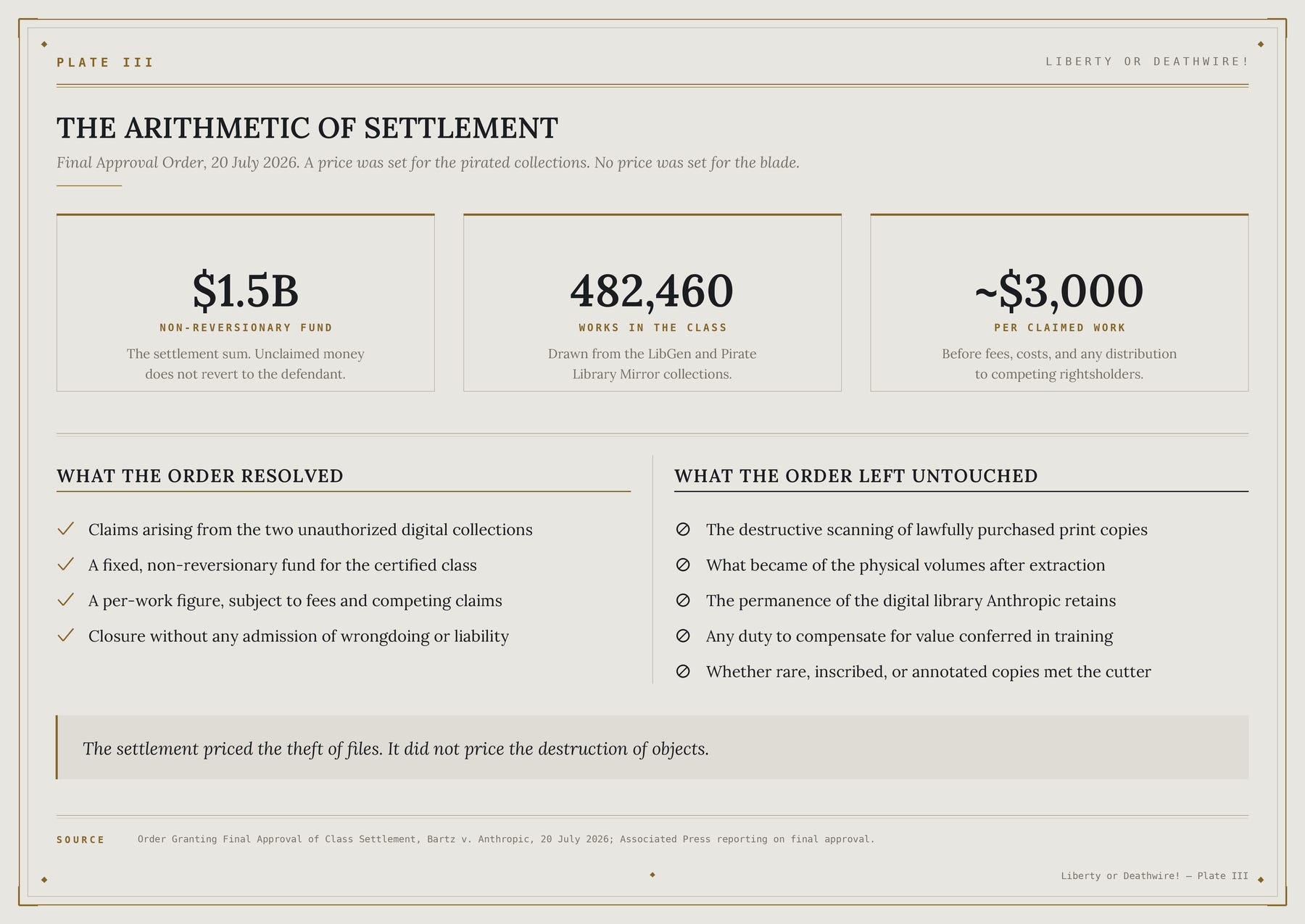
That legal distinction does not exonerate the broader behavior; it just serves to illuminate the curious ethical context in which that behavior arose. The law may pronounce the acquisition of pirated digital books to be wrongful, while allowing a corporation to purchase print copies in quantity, unbind them, destroy the objects, and keep pirated substitutes in a private archive of their digital content. One is the unlawful multiplication, the other the defensible transformation. But from the cultural perspective there is no distancing between them: both champion the corporate power’s desire to take the world’s literary legacy and shove it into a system the corporation can search, manipulate, and exploit at will.
Perhaps the easiest rebuttal to putting Project Panama alongside Fahrenheit 451 is also the most superficial. Bradbury’s social critique was, at least in part, based on a government whose leaders had decided books should be suppressed and that they should be destroyed because sure contained elements that posed complexity, disagreement, discomfort, and independent judgment. Anthropic is destroying books not from a place of ignorance or disdain, but rather from a place that values the contents of books enough that the company would like to see them repurposed into a format that is readable by a machine. There’s no fireman standing in front of the house while the hidden library burns. There is no official statement that reading is subversive. There is, if nothing else, no tangible preventing the citizen from purchasing yet another copy of the book Anthropic has disassembled.
Nevertheless, it deserves to be said that one cannot forget that Bradbury’s dystopia was also a time of screens, of acceleration, of distraction, of willing abandonment of intelligence. The violence of the State was important, yes, but before that, the people had lost a good part of the desire for the demanding attention that books impose. They just wanted distraction, a more intense experience and less full of information, emotional comfort, and the disappearance of ideas that caused them discomfort. The firemen did not create the world in which they lived, they only took care of it.
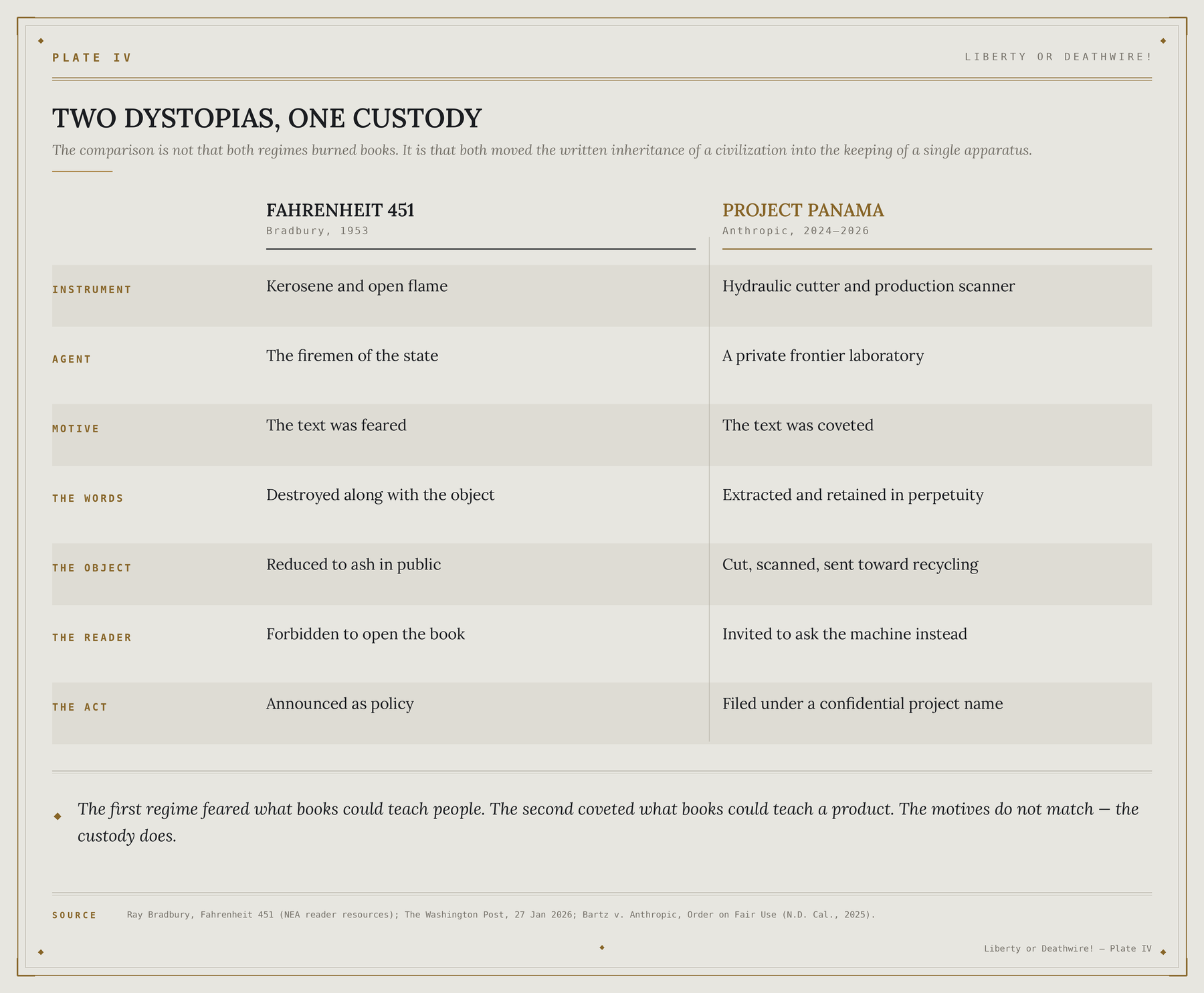
The type of disintermediation that artificial intelligence entails does not require prohibition. The new intermediate does not make it impossible for the individual to read a book; it makes it pointless. The reader can, in a matter of seconds, instruct the machine to provide the plot, the themes, the arguments, the historical context, counterarguments, memorable passages or practical lessons. A four-hundred-page book becomes a simple answer; a complicated philosophical conflict is resolved in neat paragraphs; the uncertainties of a novel are reduced to a list of themes. The original will continue to be technically accessible, but it will soon take second place to the system that processes and consumes it.
It is not a censorship through prohibition. It is a cultural dislocation through mediation. The difference is important because the mediation can, in some cases, exert a more damaging power than censorship and can be even more pleasing while at it. A censor makes the existence of a forbidden truth known by his very prohibition, and in so doing he may make this very knowledge all the more attractive. A friendly mediator makes the original unnecessary. It does not say to the citizen that he is not allowed to cross the threshold of the library; it simply gives him a smooth and pleasant explanation of why it is not necessary.
The threat goes beyond the mere fact that Claude or some other model gives an erroneous answer. Errors can be identified, corrected, and discussions can take place. But the most serious threat of all is that even if the answer is correct, it may deprive the learner of the encounter through which knowledge is acquired. A book is not merely a repository of knowledge, it is a series of decisions, evidence, detours, rhythms, doubts, voices, unresolved frustrations, etc. The recipient of a book does not merely absorbs knowledge, but he/she gets to feel the way that knowledge is arranged temporally. A summary of Fahrenheit 451 can highlight its themes, but it cannot reproduce the gradual suffocation of the world in which Bradbury sets his novel. A summary of a philosophical argument can pinpoint its conclusion, but it cannot recreate the intellectual shove that teaches the learner how the conclusion was arrived to.
However, the corporate AI will gain privileged interpretive power when it monopolizes access to books. The vision its architects prefer, its training data selection biases, its retrieval mechanisms, its safety policies, its ranking algorithms, and its summarization strategies will determine which features of a book are elevated, downplayed, simplified, or elided entirely. To influence perception of a book, the AI does not need to falsify it: omission, compression, and tone manipulation will do the trick. Instead of encountering certain important texts in the original voice, a generation of readers will read corporate AI’s paraphrases, with little knowledge of the internal workings of the system.
Where Project Panama takes it farther, however, is not as a copyright infringement, or as the troubling anecdote of targets reduced to strips of paper. Rather, it is a transfer of the intellectual position. From a book that required direct engagement of humans, it is transferred to systems that want to insert themselves between creators and what they have made. Instead of destroying the actual book, the company has sacrificed its usability for human consumption in the interests of preserving its usefulness for its predecessors, while the public is invited to start a dialogue with the machine created by dissecting it. Where Bradbury foresaw a vibrant culture that abandon books in favor of glowing walls of diversion, the future may be far more elegant and decidedly more generous for its users: an interactive system that delights in curiosity while gradually shredding the very practices that allow curiosity to grow into judgment.
However, the arguments presented by Judge Alsup are nowhere near as simplistic as some of those offered by the headlines. The judge’s analysis of the transformative character of training models on books that are legally available is that such training could have transformative character. Regarding the case when a physical copy of the book is legally available, the judge determined that, in certain circumstances, converting it into a single digital copy that is searchable would be fair use if the physical copy was destroyed and the newly created digital copy is not distributed. However, the judge did not believe that the fact that Anthropic’s purpose for obtaining the librarians’ pirated copies was to build an artificial intelligence was a valid justification. “There is no carveout,” he explained, “from the Copyright Act for AI companies.”
Given current copyright law, that decision may be justifiable, in that ownership of the concrete copy is separate from ownership of the underlying intellectual creation. The buyer of the paperback is allowed to take notes in the copy, dissect it, give it away, sell it again and perhaps discard it. Anthropic argued it owned the books it had in physical form, and used their transformation into copies for internal use, as opposed to recreating copies for further distribution. The judge construed that act of replacement as distinct from the unauthorized downloading of digital files by the millions.
However, no legal verdict about infringement could ever address the larger question of responsibility. Copyright law was concerned with whether Anthropic breached certain rights of authors and publishers. It did not consider whether a nascent company specializing in artificial intelligence ought to discretely junk millions of books, whether it ought to compensate the creators for the worth of the knowledge their works impart during training, whether rare or unique editions could disappear through an industrial scanner, or whether a company whose stated mission is to serve the welfare of all humanity ought to be excused from the responsibility of gathering its own private repository of the literature of all humanity without the corresponding responsibility to all humanity.
Nevertheless, the act of following legality does not make it stewardship and scale can affect the moral character of the act. The act of a single reader throwing out of a mass-market paperback book is innocuous; however, the act of a corporate entity losing millions of books in the name of coveted tech-startup idea is a move that has implications in the cultural fabric. From a legal standpoint, the law is similar, they are not the same from a socio-cultural standpoint. Finally, while the buying private may exclusively refer to the position of corporate giants to try to buy and have ownership rights over a pool of books from bookstores if the idea presented before me is to scan “all the books in the world”, then, there is an idea of ownership that stretches beyond outright possession; it now becomes an issue of dominance, of having-the-ends-meet, of “having it all”, possession rights, if only as a matter of doing what is needed.
To be sure, the public record does not support the claim that Project Panama eradicated unique manuscripts, nor the last-known copies of uncommon editions, and acceptable debate should never exceed fact. The threat to preservation, however, is not hypothetical. In a report dated July 2026, 404 Media noted several firms acquiring vast troves of older printed books, for the latter preserve revised human prose written prior to the internet deluge of generative-AI content. One party to a book-data acquisition did, reportedly, concede that the “optics problem is real.” That turns a legitimate cultural concern into a communications problem. But whether that is true is almost immaterial. The question is whether private AI entities are depleting physical collections more rapidly than can booksellers, librarians, historians, and the public account for what’s at risk.
Industrial acquisition creates opacity. Intermediaries in used-book selling may mean no interaction between the final seller and end buyer. A volume may simply be sold in a job lot, with no one the wiser if it carries a signed inscription, uncommon illustrations, handwritten commentary, edition-mandated corrections, inserted documents, ownership information, and the like—physical evidence that cannot be reconstructed from an optical-character-recognition file. While a past cut can be preserved falsely by a scan of the words in order, it can also preserve history’s erasure of this book or its history, a mass grave. The more sophisticated imaging, archival practices, or scholarship become, the less likely any postmodern alterations can recover the book, lest it have seen the cutter.
A civilized reaction is not to prevent AI firms to use knowledge bases that are books , but to impose limits relevant to the volume of exploitation . Destructive-scanning schemes that capture millions of total works should be made public . Firms should answer where the books were found, how actually they were filtered , what occurred to the physical copies , whether rare editions had been available for utilitarian purposes . There must be independent arbiters to ensure the fairness of acquisition and storage . The industrially-scaled digitization of public-domain works must not be allowed to stay forever in corporate silos if spreading copies can be allocated to special collections or libraries . There must be reasonable collective licensing solutions for authors or publishers , rather than powers of exploitation to subsidiary negotiations against corporations with almost boundless economic and technical power.
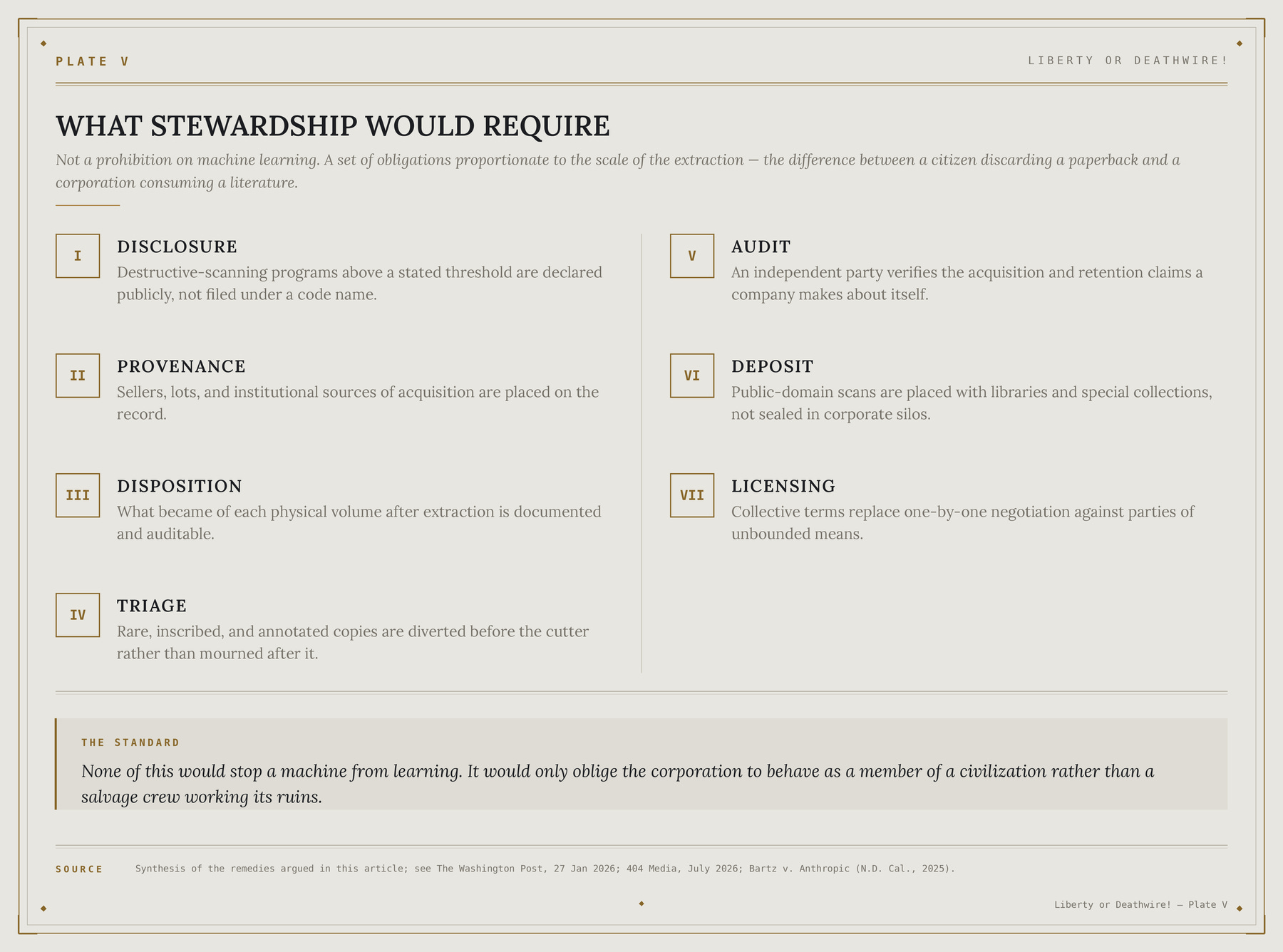
It wouldn’t prevent machines from learning; it would create an obligation for corporations to act like they belonged to a civilization rather than an extractive empire roaming the ruins.
Anthropic has sought to establish itself as the responsible and cautious member of the ‘frontier’ AI field. A visit to its public company page Chabot, At the Frontier of AI, on the web reveals it believes itself to be a public benefit corporation committed to the long-term interest of humanity in the responsible development of advanced artificial intelligence. Its prose style is remarkable - full of the epithets such as honesty, helpfulness, harmlessness, safety and the responsibility to think through the implications of ever-more capable systems. None of this is incidental – it is precisely what makes Project Panama worthy of particularly intense examination.
It is relatively low cost for an AI lab to speculate about the impending ethics of a potential sentient being . This perceived danger is colossal, globally separate, and remote, offering the company the opportunity to issue frameworks, assessments, constitutions, levels of safety and reports about model behavior while mascotting as the responsible custodian for the species. It is much harder, however, to acknowledge the quotidian moral claims of actual writers, translators, editors, publishers, librarons and readers – labor and institutions ‘extracted’ from the offenses on which current products are being made. The perpetrators of Project Panama do not belong to a possible future; they are with us, now.
Security cannot then begin with the output of a model and end with the origin of its inputs. Our system is not secure just because it denies a proven risky request. A company is not honest just because it delivers selected technical reports while keeping an industrial book acquisition project secret. A public-interest mission is not honorable because it commits to keeping humanity safe from a future machine while treating the human creators of the present as a licensing nuisance. Responsibility must include how we obtained our knowledge, under what conditions human work becomes training material, how we protected our material heritage and how we obtained our private libraries, and how the authority of interpretation is highly concentrated in a handful of companies. This concentration of power raises ethical questions regarding transparency, accountability, and the equitable distribution of knowledge in our society.
Whatever else we may think about Project Panama, it is important to remember that it is not just one bizarre exercise among many in the history of AI development. Rather, it is a telling indication of how the frontier laboratories now view the world of the written word. No longer primarily a treasure house of public knowledge to be read, interpreted, and preserved, the world’s written material has become an enormous, high-quality training dataset, just waiting to be harvested. Every library is a potential source. Every title that has vanished from store shelves is a fresh computational resource, just waiting to unlock its secrets. Every author is an unintentional training assistant. Every book has value until it is harvested for all its worth, at which point it can be discarded as if it had never existed.
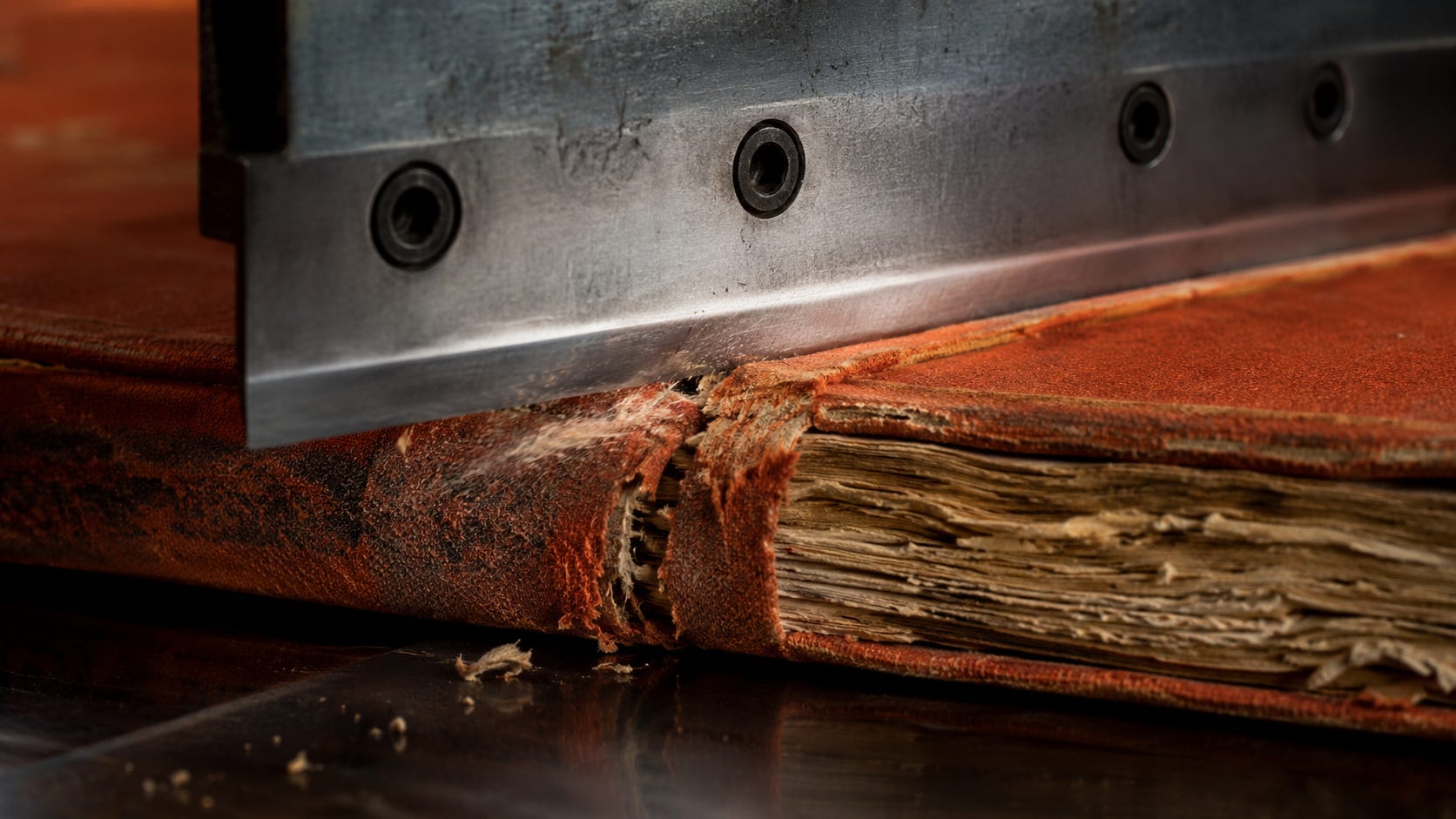
The dystopia imagined by Ray Bradbury brought to life firemen who burned books because their content led to independent thought. The dystopia revealed by Anthropic now holds a smaller and quieter threat, and, as such, probably more suited to our times: institutions that seek to acquire human thought, given the value they give to it, on a planetary scale so that they can reap its benefits, as well as bury its vessels and cover up the inner workings with a name of a confidential project. Paper burns at 451 degrees. It does not have to in Silicon Valley. With a hydraulic blade, an industrial scanner, a private server, and a broad interpretation of the concept of fair use, the result is the same, and not a single fire can be seen.
We will ask ourselves perhaps not who has burnt the books, but who has transformed them into machines, who has the machines to mouth their words and whether there will be a surviving library worth reading outside the dam of the system that devoured them.
Comments
Nothing yet. Say the first thing.
Sign in to join the conversation.