
LIBERTY OR DEATHWIRE! ⬩ INVESTIGATION ⬩ AMERICA 250 SERIES
From DARPA’s battlefields to a bank’s biometric checkout system, the documented history of smart dust is not a tale of science fiction. It is a warning about a surveillance architecture advancing faster than the law written to contain it.
Citizens Rule Book: A Palladium of Liberty (Download) #Infowars 🇺🇸
“When your body is the PIN, privacy ceases to be merely something you protect—it becomes something the system must read, measure and approve before you are permitted to act.”
Written by: Andrew B. Raupp / @stemceo
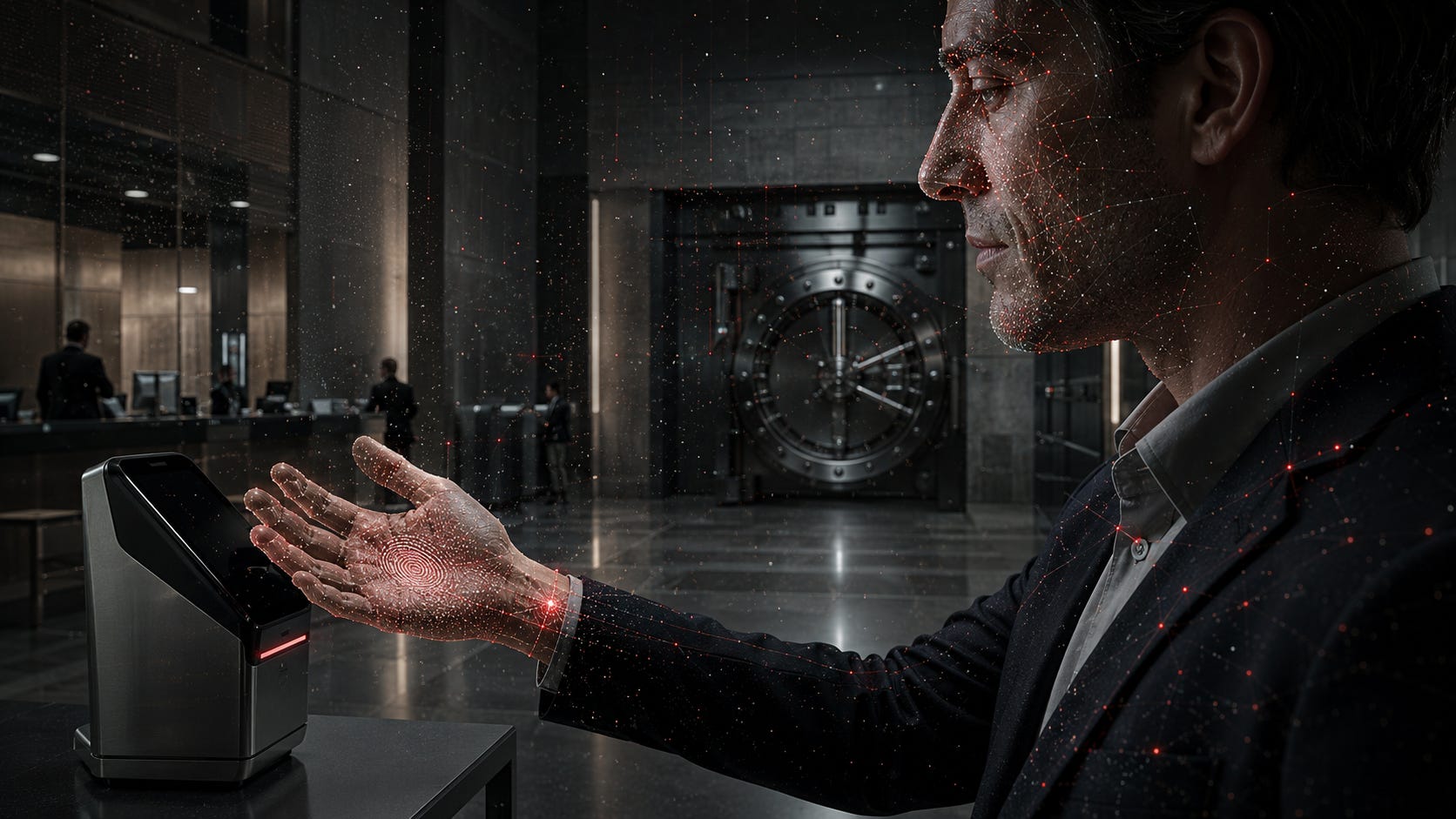
Imagine arriving at a checkout counter and reaching for neither wallet nor phone. A nearby base station receives notice that a payment is pending. It releases a collection of microelectromechanical sensors—“motes,” in the language of the engineers—which select themselves according to the light, noise and other conditions in the room. Some may remain suspended in the air. Some may propel themselves. Around your body, they collect enough information to estimate or identify your height, weight, pulse, blood pressure, temperature, face or voice. The system combines those measurements with the motes’ own serial numbers, constructs a temporary card number and permits the purchase.
This is not a scene invented for a dystopian novel. It is the architecture claimed in United States Patent No. 11,354,666, titled “Smart dust usage”, filed in 2016, granted in 2022 and assigned to Wells Fargo Bank, N.A. The public patent record lists Wells Fargo as both the original and current assignee and records a fourth-year maintenance-fee payment in November 2025. The bank’s name is not merely adjacent to a speculative paper. It is attached to an issued U.S. patent whose claims describe authenticating a pending payment with biometric data gathered by a released set of tiny sensors—and generating a virtual card number from those biometrics and the motes’ identifiers.
There is an equally important fact: a patent is not proof that Wells Fargo built, tested or deployed the invention. The U.S. Patent and Trademark Office is explicit that a patent grants a right to exclude others, not an affirmative right to make or use an invention. No deployment by Wells Fargo was identified in the public materials reviewed for this report. Nor does the record establish an operational, population-scale cloud of invisible sensors. To say otherwise would replace investigation with mythology.
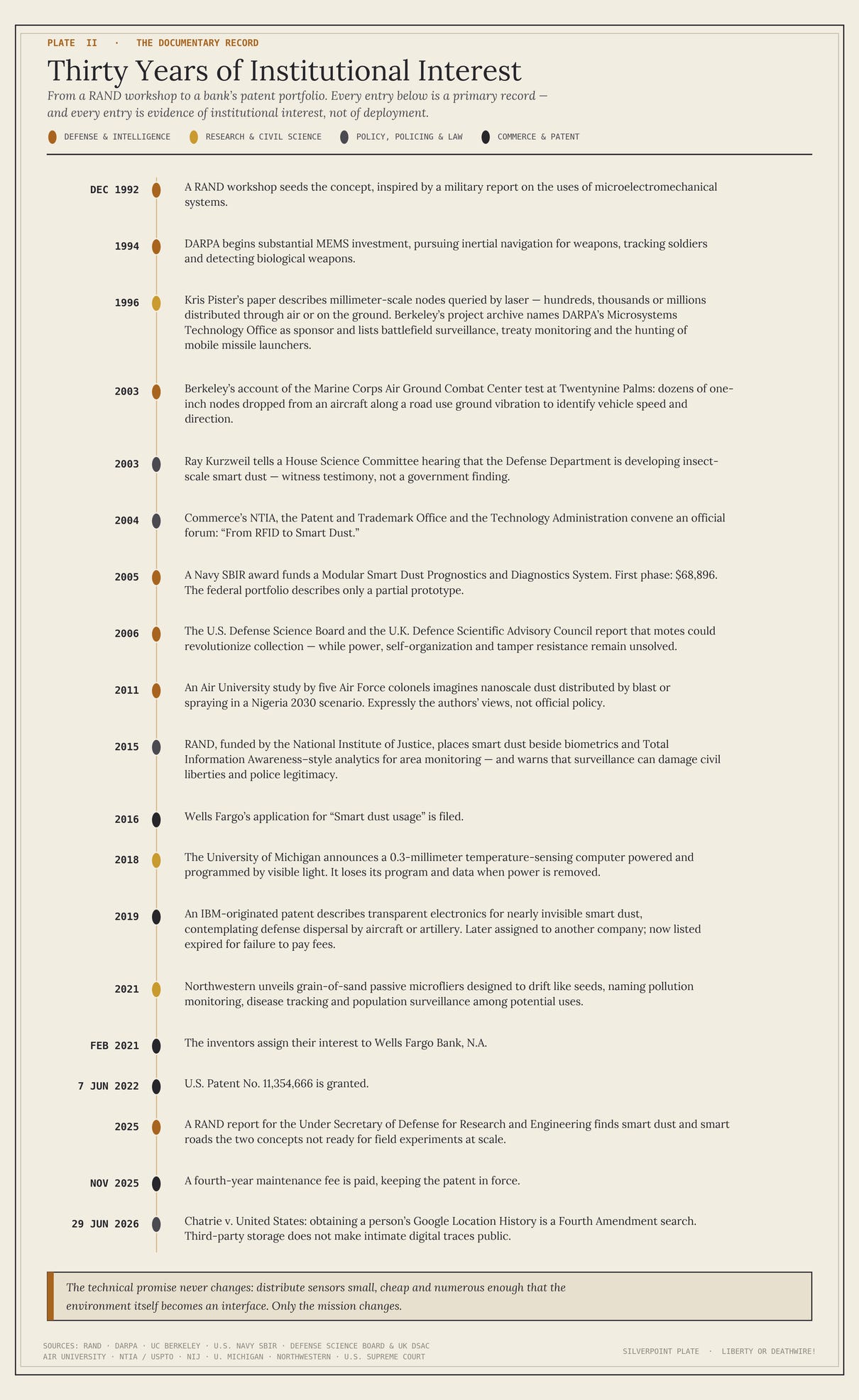
But restraint does not make the documented story less consequential. It makes it harder to dismiss. Across three decades of primary records, smart dust moves from a RAND workshop to a DARPA-backed laboratory, from a Marine Corps test range to Defense Department forecasts, from a Navy contract to a Justice Department–funded policing scenario, and from environmental and medical research to a financial institution’s payment patent. The same technical promise repeats throughout: distribute sensors so small, cheap and numerous that the surrounding environment itself becomes an interface. What changes is the mission. First the dust finds a vehicle. Then it monitors a place. Then it measures a body. Finally, in Wells Fargo’s patent, the body becomes the credential.
The Wells Fargo patent is unusually plain about what it contemplates. Its description says the system’s MEMS sensors may collect optical, infrared, audio, electromagnetic-field, temperature, pressure, location and motion data. Those streams may be used for facial, body, fingerprint or voice recognition and to infer breathing rate, pulse, blood pressure and temperature. The sensors may surround a customer, travel on wind currents, be self-propelled, be carried by the user or be released from a base station embedded in a point-of-sale system. Poor lighting could cause the system to favor audio or pressure readings; a noisy room could make it favor optical sensors. The design is not merely a cloud of detectors. It is an adaptive biometric network.
The granted claims matter more than the patent’s imaginative description because they define the legal territory the patent owner secured. Claim 1 covers a base station that receives an authentication request tied to a pending payment, releases a set of MEMS devices, dynamically selects a subset according to the environment, obtains biometric data, generates a “smart key” from the selected motes’ identification numbers and authenticates the request. Claim 3 names height, weight, heart rate, blood pressure and body temperature. Claim 4 specifies that the selected sensors are suspended in air. Claim 8 says they may be self-propelled. Most strikingly, Claim 9 covers generating a virtual card number from a function of the biometric data and the motes’ identifiers, then processing the pending payment with that number. Claims 10 through 17 repeat much of that territory as method and system claims.

The filing sat for six years before appearing as a granted B1 patent on June 7, 2022. Its public history records the inventors’ assignment of their interest to Wells Fargo in February 2021, and the database now gives it an adjusted expiration in 2037. Google Patents cautions that its legal-status and assignee labels are not legal conclusions, but the underlying record establishes the central revelation without inference: Wells Fargo pursued and received U.S. patent claims for payment authentication using released smart-dust sensors and biometric data. A maintenance fee was later paid to keep the patent in force. Why preserve the asset? It could be defensive, exploratory, licensing-oriented, a remnant of an abandoned R&D program or a marker for a future one. The public record does not answer. That unanswered question deserves scrutiny, not an invented answer.
The patent also exposes a category error in the familiar defense of biometric convenience. A fingerprint reader asks a person to touch a known device. Face ID asks a person to look at one. The patented system imagines sensing distributed through the space around the customer, with the hardware choosing which bodily signals are useful. Consent becomes difficult when the sensor is too small to see, the collection field has no obvious boundary and the payment depends on successful recognition. A card can be replaced after theft. A face, pulse pattern or body geometry cannot. And a biometric payment network does more than verify what a customer has; it turns the customer’s physical condition into transaction infrastructure.
Wells Fargo did not invent the political logic behind that infrastructure. Government-funded researchers had spent years imagining what becomes possible when sensors disappear into the environment.
The origin story begins before Berkeley’s famous laboratories. In a 1996 paper describing millimeter-scale sensing and communication, University of California, Berkeley researcher Kris Pister wrote that the concept emerged from a RAND workshop in December 1992, inspired by a military report on the uses of microelectromechanical systems. The paper envisioned hundreds, thousands or even millions of self-contained sensing and communication nodes distributed through the air or on the ground, queried by laser. The ambition was clear from the beginning: not one smart device but an environment made observable by countless nearly disposable ones.
DARPA supplied the institutional fuel. Berkeley’s own Smart Dust project archive identifies the Defense Advanced Research Projects Agency’s Microsystems Technology Office as its sponsor and lists battlefield surveillance, treaty monitoring and the hunting of mobile missile launchers among the military applications. DARPA’s official history says the agency began substantial MEMS investment in 1994 and pursued military uses including inertial navigation for weapons, tracking soldiers and detecting biological weapons. Smart dust was part of a broader program to make machines smaller than the public’s intuitive definition of a machine.
The work left the laboratory. At the Marine Corps Air Ground Combat Center in Twentynine Palms, California, Berkeley researchers dropped dozens of one-inch sensor nodes from an aircraft along a road. According to the university’s 2003 account of the experiment, the motes used ground vibrations to identify the speed and direction of passing vehicles and relayed the results across the network. They were still matchbox-scale, not invisible. Yet the operational principle had arrived: disperse many low-cost sensors, allow them to organize and let the field itself report what moves through it.
Federal documents then carried that principle into strategic planning. A 2006 joint report by the U.S. Defense Science Board and the United Kingdom’s Defence Scientific Advisory Council said small autonomous sensor networks—“motes” or smart dust—could revolutionize military and intelligence collection across cities, farms, jungles, mountains and deserts. The report was candid about the obstacles: power sources dominated size and weight; the network had to self-organize, survive failed nodes and protect its information even when devices were captured or tampered with. Its disclaimer said the findings did not necessarily represent official U.S. or British defense policy. It nevertheless documents what senior defense advisers believed the technology could do and what remained unsolved.
The Navy put money behind a related problem. In 2005, a Navy Small Business Innovation Research award funded a “Modular Smart Dust Prognostics and Diagnostics System”—a self-powered wireless micro- or nanosensor platform intended for equipment monitoring and battlefield awareness. The first-phase award was modest, $68,896, and the federal portfolio describes only a partial prototype. It is evidence of a program, not a fleet of deployed dust. That distinction recurs throughout this investigation: public records show durable interest and iterative development, but not the omnipotent capability imagined in online rumor.
An Air University strategic study published in 2011, written by five Air Force colonels as a scenario about Nigeria in 2030, pushed the vision further. It imagined nanoscale smart-dust devices distributed by blast, spraying or a similar method, forming a nearly undetectable network that could track movement, monitor gases and disease vectors, and feed a continuous picture of the battlespace. The document expressly states that its views are those of the authors, not official U.S. policy. It should therefore be read as a military planning scenario, not an admission of operational deployment. Yet scenarios reveal priorities. They show which futures institutions are paid to rehearse.
By then, the idea had already entered civilian federal conversation. In 2003, inventor and futurist Ray Kurzweil told a House Science Committee hearing on nanotechnology that the Defense Department was developing insect-scale smart dust. That was witness testimony, not a government finding. In 2004, however, the Commerce Department’s National Telecommunications and Information Administration, the Patent and Trademark Office and the Technology Administration jointly convened an official forum called “From RFID to Smart Dust”. Its agenda joined industry and government applications to spectrum, security, privacy and intellectual-property questions. Washington was not merely funding the technology. It was already discussing the rules around a world in which identification systems could shrink beyond ordinary notice.
Technologies do not remain faithful to the mission that financed them. The internet, satellite navigation and drones all crossed from state power into commercial and civilian life. Smart dust has followed the same route, except that its defining feature—its near disappearance—makes the crossing unusually difficult to observe.
In 2015, RAND published Visions of Law Enforcement Technology in the Period 2024–2034, research funded by an award from the National Institute of Justice, part of the Justice Department’s Office of Justice Programs. The report’s workshops included local, state and federal practitioners as well as researchers, and its disclaimer says the conclusions do not necessarily represent the Justice Department. In a future shaped by police militarization, it nevertheless placed smart-dust particles alongside biometrics and “Total Information Awareness”-style analytics as tools for monitoring an area. Elsewhere, it ranked research into tiny radio-frequency tags, nanotechnology, chemical markers and implants for tracking inventory, equipment and people as a high-priority need. The same report also warned that surveillance could damage civil liberties and police legitimacy. The contradiction was not resolved; it was documented.
Other federal uses are plainly beneficial. NASA’s Jet Propulsion Laboratory discussed sensor webs for in-situ scientific observation, and a NASA technical paper envisioned energy-harvesting nanosensors, including smart dust, for instrumenting planets and other celestial bodies. The National Science Foundation has invited proposals involving smart dust and other wireless technologies. The Centers for Disease Control and Prevention’s National Institute for Occupational Safety and Health published a review of smart wireless sensors for hazardous workplaces. A sensor small enough to detect poison gas in a mine, contamination in water or stress in a bridge can save lives.
That is why the honest public argument cannot be reduced to “technology bad.” The danger lies in the convergence of scale, invisibility, identity and institutional power. A sensor used to find a toxin measures the environment. A sensor used to authenticate a payment measures a person. A sensor used to follow a suspect changes the constitutional relationship between citizen and state. Once the hardware and network exist, software and policy decide which mission it serves—and policies are easier to change than infrastructure is to remove.
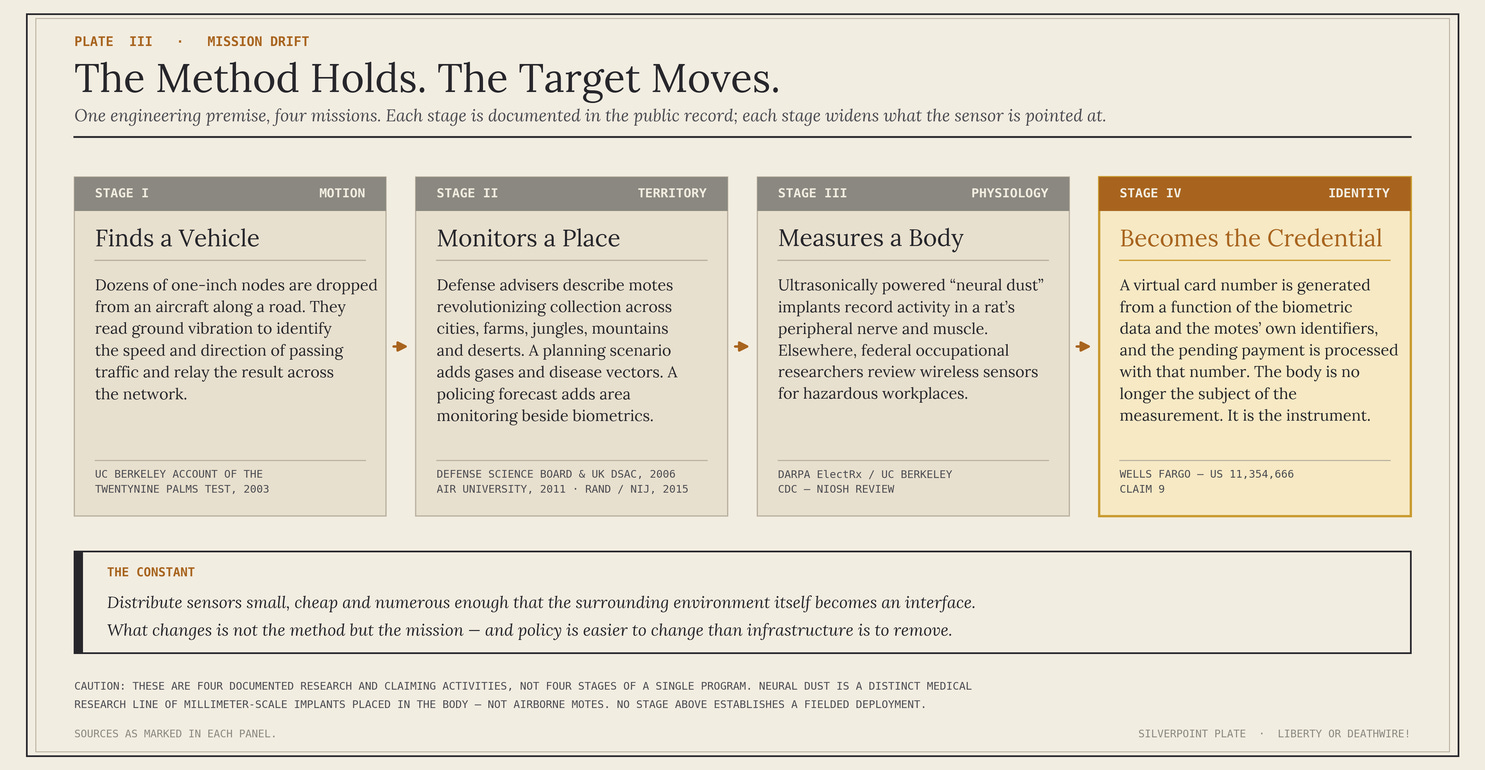
The definition of “dust” has also expanded. Under DARPA’s ElectRx program, Berkeley researchers demonstrated ultrasonically powered “neural dust” implants that recorded activity in a rat’s peripheral nerve and muscle. Those devices were millimeter-scale rods placed in the body, not airborne motes secretly inhaled by the public. They belong to a distinct medical research line. But the experiment demonstrates another frontier: tiny networked sensors can move from the landscape to the nervous system. In medicine, such devices might one day help treat epilepsy or stimulate nerves. Under coercive conditions, the same intimacy would raise questions no terms-of-service box can settle.
Civilian engineering continues to close parts of the gap between vision and hardware. In 2018, the University of Michigan announced a 0.3-millimeter temperature-sensing “computer” powered and programmed by visible light. It loses its program and data when power is removed—a severe limitation, but also a demonstration of astonishing miniaturization. In 2021, Northwestern University unveiled grain-of-sand-size passive microfliers designed to drift on air like seeds, carrying components for sensing, memory, antennas and wireless communication. The university named pollution monitoring, disease tracking and population surveillance among potential uses and described work on biodegradable versions to limit electronic litter.
Industry has claimed nearby territory too. An IBM-originated patent granted in 2019 described transparent electronics for nearly invisible smart-dust systems, with contemplated defense dispersal by aircraft or artillery. The public record shows that patent was later assigned to another company and is now listed as expired for failure to pay fees. This is another caution against treating every patent as a product road map. Patent files are maps of desired legal territory, not receipts for fielded machinery. Yet when maps from defense, policing, medicine, computing and banking begin to overlap, lawmakers should not wait for the first mass deployment to decide where the borders belong.
And despite the shrinking prototypes, sweeping claims about present-day smart dust outrun the evidence. A 2025 RAND report sponsored by the Office of the Under Secretary of Defense for Research and Engineering assessed several 5G-era military concepts and concluded that smart dust and smart roads were the two exceptions not ready for field experiments at scale. Power, communication range, fabrication, retrieval, security and reliable networking remain stubborn constraints. The technology is neither fantasy nor omnipotent. It is an uneven stack: some sensor, flight and implant components exist; some network ideas have been demonstrated; an integrated, invisible, autonomous, long-lived mass deployment remains a far higher bar.

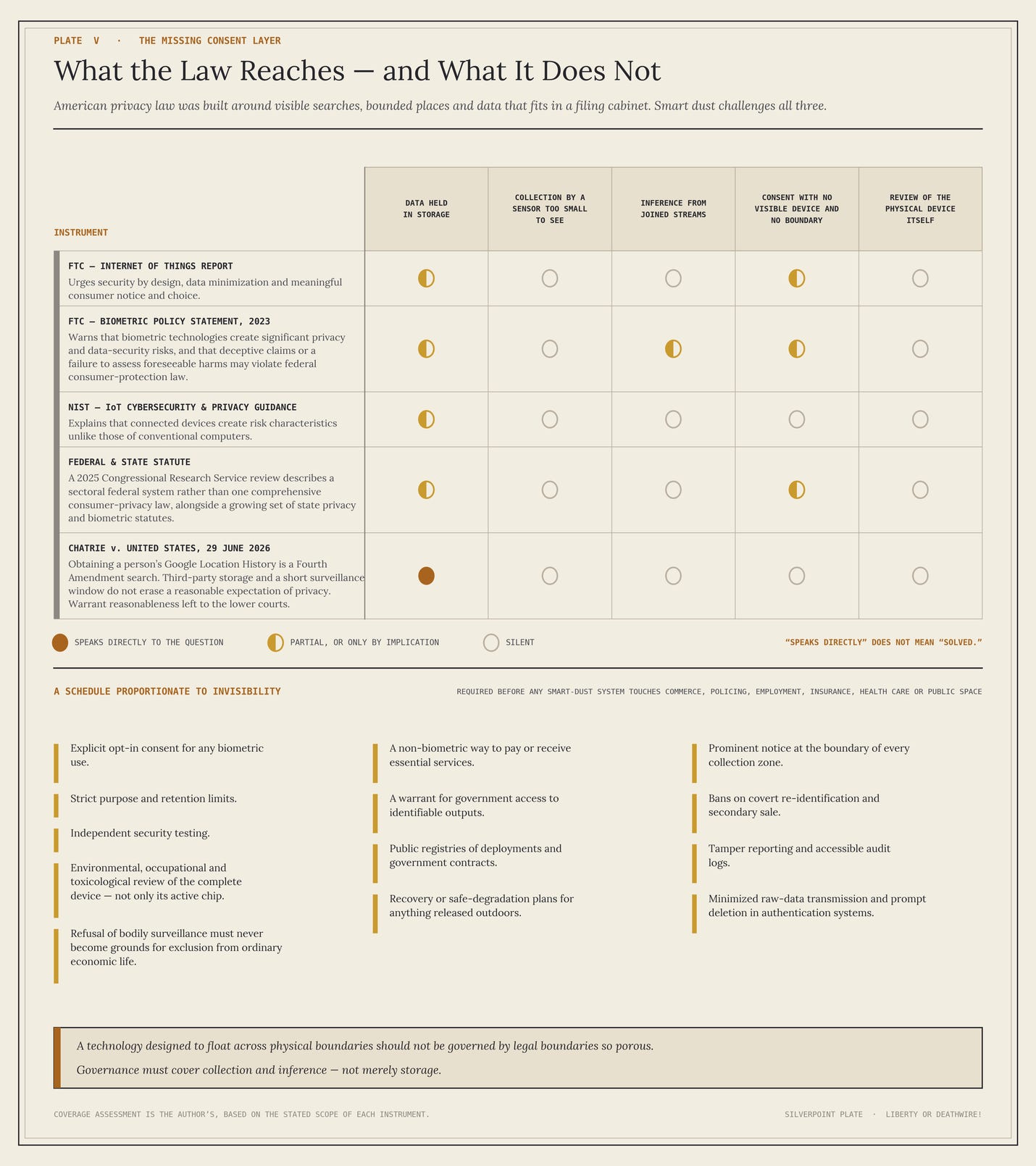
American privacy law was built around visible searches, bounded places and data that could be placed in a filing cabinet. Smart dust challenges all three. Its sensors may be imperceptible, its collection zone may move with air currents, and its output may combine identity, physiology, location and behavior into a continuous machine-readable record. The legal system can regulate each category separately while failing to govern the inference created by joining them.
The Supreme Court has begun to recognize that modern data changes the constitutional meaning of observation. In Chatrie v. United States, decided June 29, 2026, the Court held that law enforcement conducted a Fourth Amendment search when it obtained a person’s Google Location History. The fact that Google held the data, and that police sought only a limited period, did not erase the user’s reasonable expectation of privacy. The Court did not decide whether the warrant itself was reasonable, leaving that question for the lower courts. But its principle matters here: the government cannot automatically convert intimate digital traces into public information merely because a third party stores them or the surveillance window is short.
Smart-dust biometrics would multiply that problem. A payment company could hold one stream, a retailer another, a device vendor a third and a government agency seek access later. What starts as fraud prevention could become location reconstruction, health inference, employee monitoring or evidence. The Wells Fargo patent itself contemplates location, audio, optical, pressure, motion and multiple biological measurements. Even if a deployed product retained only an authentication result, the system would first have to sense enough to produce it. Governance must therefore cover collection and inference, not merely storage.
Federal regulators have warned about pieces of this architecture without establishing a comprehensive regime for the whole. The Federal Trade Commission’s Internet of Things report urged security by design, data minimization and meaningful consumer notice and choice. The FTC’s 2023 biometric-information policy statement warned that biometric technologies create significant privacy and data-security risks and may violate federal consumer-protection law when companies make deceptive claims or fail to assess foreseeable harms. NIST’s guidance on IoT cybersecurity and privacy explains that connected devices create risk characteristics unlike conventional computers. None of these measures, by itself, answers whether an unseen sensor may sample a passerby who never agreed to become part of the network.
Congress has left the nation with a patchwork. A 2025 Congressional Research Service review described a sectoral federal system rather than one comprehensive consumer-privacy law, alongside a growing set of state privacy and biometric statutes. That leaves protection dependent on where a person lives, which entity collects the data, what it calls the data and what harm can be proved after collection. A technology designed to float across physical boundaries should not be governed by legal boundaries so porous.
Then there is the matter of physical safety. Berkeley’s early Smart Dust page acknowledged privacy concerns but treated environmental impact breezily, reasoning that a million cubic-millimeter motes would occupy about a liter and likening accidental inhalation to inhaling a gnat. That was a project-page intuition, not an inhalation-toxicology study. Scale is not only volume. It is material composition, sharpness, persistence, combustion risk, bioaccumulation, disposal and the behavior of fragments in lungs, soil and water. Northwestern’s work on degradable microfliers shows that engineers recognize the litter problem; it does not eliminate the need for independent testing. No public-space deployment should proceed on an assurance that a device is merely small.
The answer is not a press release promising responsible innovation. Before any smart-dust system touches commerce, policing, employment, insurance, health care or public space, legislatures should require rules proportionate to its invisibility: explicit opt-in consent for biometric use; a non-biometric way to pay or receive essential services; prominent notice at the boundary of every collection zone; strict purpose and retention limits; a warrant for government access to identifiable outputs; bans on covert re-identification and secondary sale; independent security testing; public registries of deployments and government contracts; tamper reporting; accessible audit logs; and environmental, occupational and toxicological review of the complete device, not only its active chip. Systems released outdoors should have recovery or safe-degradation plans. Systems used for authentication should minimize raw-data transmission and delete it promptly. Refusing bodily surveillance must not become grounds for exclusion from ordinary economic life.
The mythology surrounding smart dust imagines a perfect secret weapon already everywhere. The primary record tells a more useful story. The technology began as a military sensing ambition, accumulated federal sponsors and scenarios, found peaceful scientific and safety applications, crossed into law-enforcement forecasting, advanced through university and corporate research, and reached a major bank’s intellectual-property portfolio as a biometric payment system. Some components work. Some capabilities remain laboratory-bound. Some proposals are only words on paper. But institutions are already claiming the future those words describe.
The Wells Fargo patent is therefore not proof of deployment. It is proof of institutional interest in the precise, limited sense that a sophisticated financial institution spent time and money seeking the right to exclude others from a defined method. It establishes that airborne, adaptive biometric sensors were considered seriously enough to claim as payment infrastructure. Its maintenance record shows the patent was not simply allowed to disappear at the first fee deadline. Those facts warrant questions the bank and its regulators should answer before any product announcement: Was a prototype built? Were human subjects or customer data involved? What risk and civil-rights reviews were performed? Is the patent held defensively, licensed, transferred into another program or considered for future use? What would consent mean if the sensors are released at a point of sale? What happens to the motes afterward?
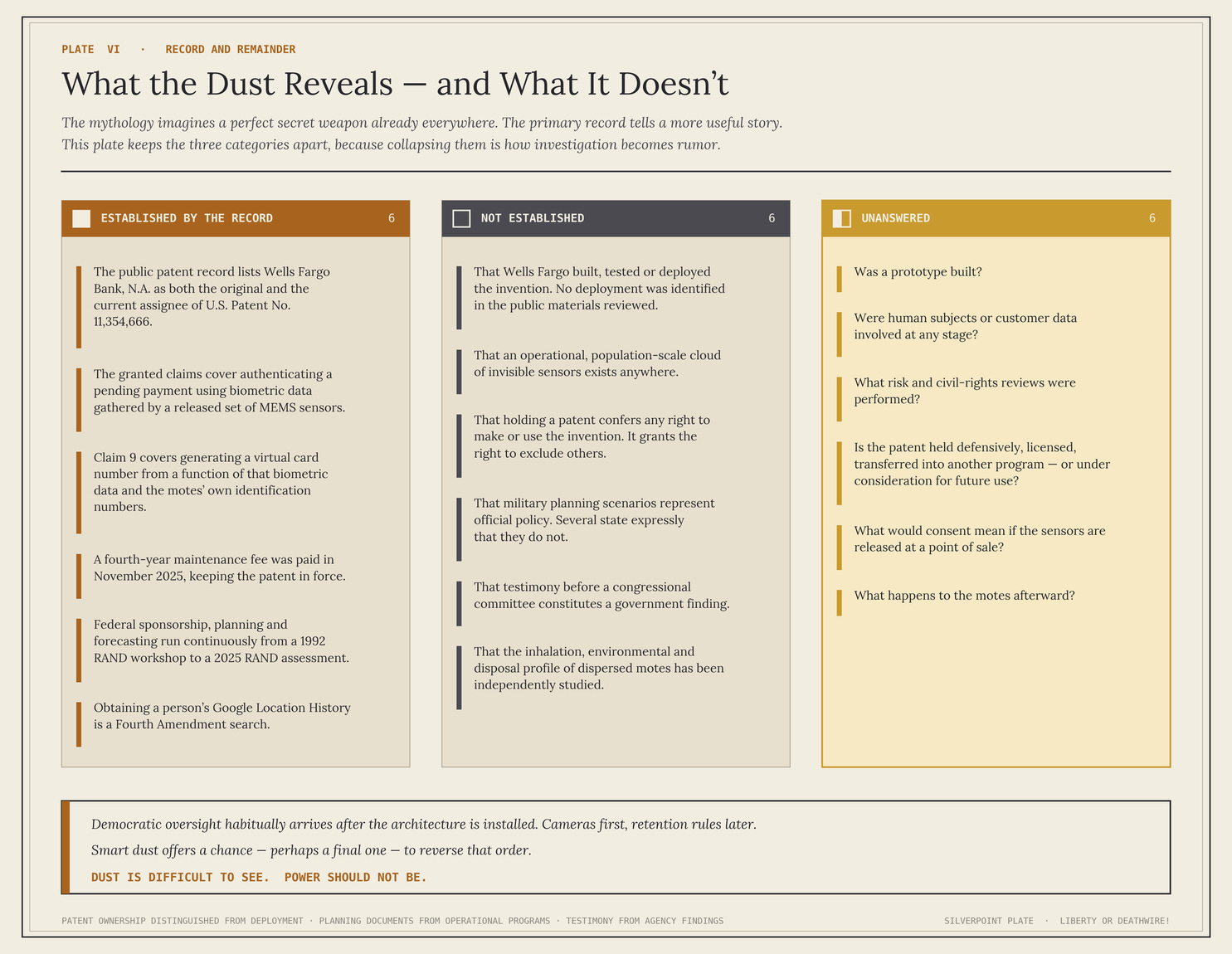
Democratic oversight habitually arrives after the architecture is installed. Cameras first, retention rules later. Location histories first, warrants years later. Facial recognition first, public hearings after misidentification. Smart dust offers a chance—perhaps a final one—to reverse that order. A free society should decide the rules while the technology is still imperfect and visible in patent drawings, not after the air around a citizen has become somebody else’s computer. Dust is difficult to see. Power should not be.
Citizens Rule Book: A Palladium of Liberty (Hardcopies) 🇺🇸Disclaimer: This investigation reviewed patent claims and event histories; federal research, procurement, hearing and strategic-planning records; university technical accounts; regulatory guidance; and court decisions. Government planning documents were distinguished from operational programs, and witness statements from agency findings. Patent ownership was distinguished from product deployment. No public evidence reviewed for this article establishes that Wells Fargo has deployed its patented smart-dust payment system or that a population-scale autonomous smart-dust surveillance network is currently operational. Links throughout the article lead primarily to patents, official government records, court opinions and research institutions so readers can inspect the underlying evidence.
Comments
Nothing yet. Say the first thing.
Sign in to join the conversation.