
Written by: Andrew B. Raupp / @stemceo
Author’s Note: Never did I feel so free as I did in my days working at the University of Michigan-Dearborn greenhouse and on the Henry Ford Estate as a student field ecologist. There was something sacred in that work. The soil, the glasshouse air, the living architecture of plants, the discipline of observation, the quiet authority of nature itself — all of it taught me that freedom is not an abstraction. Freedom is the ability to understand the living world around you, to work with your hands, to grow, to repair, to preserve, and to provide.

Available for iOS and Android
During that time, Professor Don Miller, who oversaw my work, opened a door I have never closed. He introduced me to a library’s worth of books that changed my life. These were not decorative volumes for a coffee table. They were manuals of independence. They taught me that knowledge is a tool, and that a person who knows how to grow, tend, identify, heal, conserve, and harvest is not easily ruled by fear.
One of the great gifts Professor Miller gave me was an original copy of The House Plant Expert by D. G. Hessayon. That book became more than a plant guide to me. It was a revelation in practical knowledge. Its encyclopedic format, clear plant profiles, photographs, drawings, and plainspoken instructions on light, water, fertilizer, and common plant problems made the living world feel knowable. It did what every great guide should do: it gave confidence to the beginner while still earning the respect of the experienced grower. It proved that expertise does not have to be buried in jargon. It can be handed to ordinary people and put to work.
Below, I share other gems — some preserved freely on the Internet Archive — because these books still matter. They are fragments of a harder, wiser America, an America that knew how to plant, preserve, improvise, repair, and endure. We must recover that knowledge now. We must become food independent to survive the rough times ahead, and to maintain our sovereignty, personal autonomy, and dignity as free people. A people who cannot feed themselves will soon find themselves managed by those who can. A people who return to the soil return to power.
With Eternal Vigilance,
Andrew B. Raupp ✍️
Citizens Rule Book: A Palladium of Liberty (Download) #Infowars 🇺🇸
A government that takes an interest in a man’s bean patch has already told you too much about its appetite. The old tyrants marched with bayonets and tax collectors; the new ones arrive with databases, drones, food codes, land-use boards, “sustainability” decrees, and soft language polished clean of blood. They do not always begin by burning the barn. They begin by mapping it. They do not always forbid the harvest. They begin by asking who planted, where, how much, and why. The question every free household must now ask is simple: when did a tomato vine become suspicious?
That question came roaring back after AlexJonesLive.com reported on a viral video in which a man claimed that a Freedom of Information Act request produced drone footage of his own backyard garden. According to the report, the man said the video showed surveillance of his private property “looking for food” and “looking for me growing food on my private property.” The article also noted that an overlay on the footage referred to a “Dept of Homestead Security Surveillance Drone Unit,” while making clear that no such agency exists. The same overlay reportedly labeled the yard as “suspected food production.” Whether the video proves what the man claims, whether it is satire, or whether it exposes something more sinister, the phrase itself should detonate in the mind of every citizen who still understands liberty: “suspected food production.”
There it is, written like a charge in some rotten provincial court of empire. Not theft. Not assault. Not treason. Food production. A citizen growing food on private land is not a criminal act. It is one of the oldest marks of civilization. It is older than the courthouse, older than the police file, older than the zoning map, older than the bureaucrat whose hand shakes when he sees a people feeding themselves without permission. If the garden is watched, the issue is not vegetables. The issue is sovereignty. The issue is whether the household remains a fortress of private life, or whether the state and its corporate partners may peer through the fence and inventory the means by which a family survives.
This is not a small matter dressed up for outrage. Food is power. Whoever controls access to food controls the pace of obedience. A hungry man is easier to herd. A dependent family is easier to threaten. A nation whose bread, meat, seed, fertilizer, grocery shelves, logistics, and pricing are locked inside concentrated systems has been trained to mistake convenience for security. The U.S. Department of Agriculture’s Economic Research Service has documented increased concentration in major agribusiness sectors, including seeds and agricultural chemicals, meat and poultry processing, and food retailing. The agency’s 2023 report states plainly that these are sectors where concentration has increased over time, especially seeds, meatpacking, and food retail.
That record matters because centralization is not theory when the supply chain itself has fewer hands on the wheel. It is not a campfire warning when seed markets consolidate, meatpacking narrows, and food retail power gathers into fewer commanding towers. The official language calls it concentration. The citizen feels it as fragility. The farmer feels it as dependence. The family feels it as higher prices, fewer choices, thinner shelves, and a growing sense that life itself is being routed through systems they do not control. USDA’s own summary of agribusiness concentration says mergers among competitors played a significant role in increasing concentration in the seed sector and a contributing role in food retail.
This is why the backyard garden is no quaint ornament of the retired and harmless. It is a direct answer to the age of consolidation. It is the family declaring that the power to eat does not begin in a boardroom, a federal office, a digital wallet, a ration scheme, or a supply-chain dashboard. It begins in soil. It begins with compost, saved seed, rain barrels, fruit trees, hens where lawful, herbs in windows, potatoes in sacks, beans on poles, squash along the fence, and neighbors who still know how to trade abundance without an app mediating the exchange. A garden is not just food. It is memory made edible.
The great offense of the modern independent gardener is not that he grows too much. It is that he needs too little. He chips away at the empire of dependence. He buys fewer processed meals. He asks fewer favors from distant systems. He teaches children that food is not born shrink-wrapped under fluorescent light. He proves that land, even a little of it, can become a treasury. He proves that discipline can become supper. He proves that liberty has a smell: wet soil after rain, basil bruised between fingers, garlic curing in a shed, beans drying for winter, apples stacked for sauce, tomatoes sealed in jars like captured summer.
And here is where the argument grows darker. Many patriots now see the documented centralization of food as part of a longer war against human independence, one that does not stop at profit or efficiency but aims at a smaller, more manageable, more obedient population. Call it depopulation by policy, by deprivation, by engineered scarcity, by sterilizing despair, by making family formation unaffordable, by degrading health, by attacking rural life, by choking small producers, and by teaching whole populations to accept dependence as normal. The centralization is documented. The ultimate purpose is the charge history will weigh. But any people who surrender the means to feed themselves have already handed their enemies the lever.
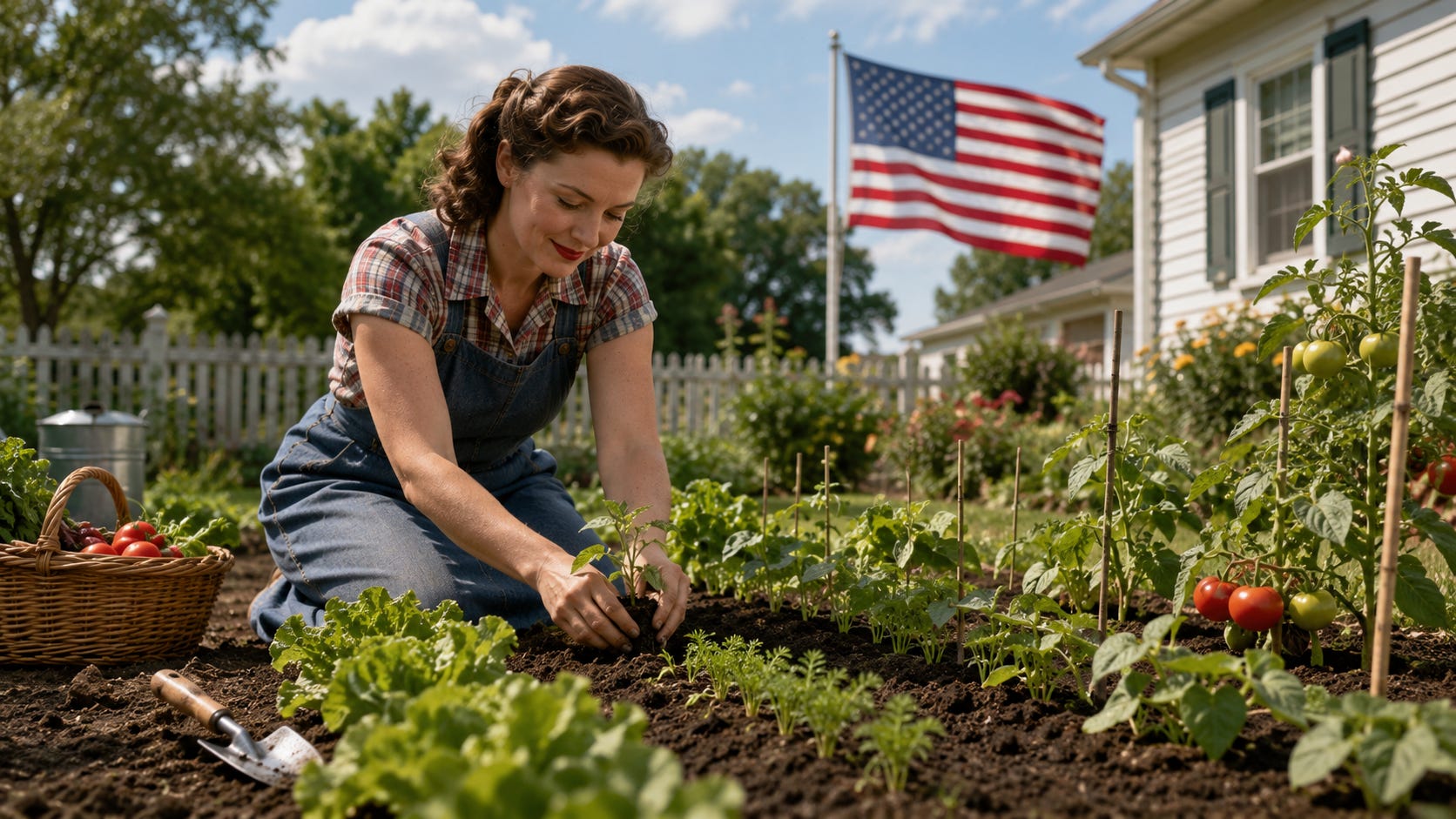
There is an American answer to this, and it is not new. During World War II, citizens planted Victory Gardens in backyards, city lots, rooftops, farms, public lands, window boxes, and vacant spaces. The National Park Service describes those gardens as a home-front force that freed up agricultural produce, packaging, and transportation resources for the war effort while strengthening nutrition, morale, patriotism, and community. The old lesson is severe and beautiful: the republic did not ask every citizen to become helpless while experts handled the food. It asked citizens to become useful.
The numbers still shame our modern dependency. USDA’s Agricultural Research Service recounts that archived USDA fact sheets recorded more than 20 million Victory Gardens in 1943 producing 10 billion pounds of food; by 1944, gardens supplied around 40 percent of the U.S. vegetable supply. The National Park Service likewise notes that near the end of the war there were approximately 20 million Victory Gardens producing 40 percent of the vegetables consumed in the United States, with gardeners canning surplus food for winter. Let no pampered mouth call the household garden symbolic. The household garden once helped feed a nation under pressure.
That achievement did not require laboratories of dependency. It required grit, instruction, seed, and public spirit. It required mothers, fathers, children, widows, clerks, mechanics, schoolteachers, factory workers, shopkeepers, and old men with battered hats showing the young how to thin carrots and hill potatoes. The Victory Garden was patriotism with mud on its boots. It was not a slogan. It was calories. It was discipline. It was the household joining the national defense without waiting for a uniform. It declared that a free people do not outsource survival and then call themselves secure.
So return to our roots — yes, pun intended — and return with books in one hand and tools in the other. Begin with Crockett’s Victory Garden by James Underwood Crockett, published by Little, Brown and Company in 1977, a practical guide from the original host of the public television gardening tradition that taught Americans month by month rather than drowning them in abstractions. Listings and archival references identify the work as a 1977 Little, Brown publication, and WGBH’s Open Vault notes that Crockett hosted the series that offered practical advice on vegetable and flower gardening and aired nationally beginning in 1976. (Between the Covers)
Then take up The Original Victory Garden Book by M. G. Kains, Maurice Grenville Kains, a volume cataloged by the Internet Archive as a 1978 Stein and Day publication on vegetable gardening and fruit culture. Do not let the date fool you. Old does not mean obsolete when the subject is soil, sunlight, pruning, succession, storage, thrift, and household competence. The old garden writers assumed the reader was capable of learning. That alone makes them more revolutionary than a thousand modern lifestyle pamphlets.
Seek also Your Victory Garden: Compiled to Assist the Victory Garden Volunteer by E. L. D. Seymour, published in 1943 by J. G. Ferguson & Associates for Planters Peanuts, a wartime manual from the age when ordinary citizens were expected to act, not spectate. Rare-book listings identify it as a 64-page softcover revised edition prepared for Victory Garden volunteers. (Between the Covers) That little phrase — “Victory Garden Volunteer” — is worth recovering. It tells us the garden was not private escapism. It was service. It was civil defense. It was a pledge made with seeds.
Add to that arsenal Victory Garden: Leader’s Handbook, issued by the United States Department of Agriculture in 1943, a wartime manual built not for spectators but for organizers, instructors, and citizens willing to turn knowledge into harvest. Its purpose was plain: to guide those leading the national Victory Garden drive and warn them against common errors that wasted seed, fertilizer, land, and labor, because in a serious hour waste itself becomes an enemy. That lesson belongs in our own age with brutal force. A people trying to restore food independence cannot afford laziness dressed as freedom, or ignorance dressed as rebellion. The patriot gardener must be disciplined. He must learn the soil, plan the rows, guard the seed, use the land wisely, and teach others to do the same. This USDA handbook is valuable because it proves that once, in a time of national danger, the official expectation was not helpless dependence but organized household production. The citizen was not treated as a passive mouth waiting to be fed. He was treated as a producer, a defender, and a necessary part of the nation’s survival. That spirit must return, not as museum dust, but as marching orders for every family ready to make the backyard, the church lot, the schoolyard, and the neighborhood acre stand again as living ground in the fight for self-rule.
The call now is not to romanticize poverty, nor to pretend that a few raised beds can replace every farm, ranch, orchard, dairy, mill, cannery, and market. The call is to rebuild the missing layer of resilience that centralization has stripped from daily life. Grow what you can. Preserve what you grow. Support local farmers. Learn seed saving. Learn composting. Learn canning. Learn dehydration. Learn how to build soil instead of poisoning it. Learn which plants belong in your climate and which are vanity projects. Learn what your grandparents knew before the age of dependency taught people to laugh at competence.
The patriot’s garden is not a retreat from politics. It is politics at the root level. It says the family is not livestock. It says the citizen is not a managed consumer. It says the land still has a voice. It says the old virtues are not dead: patience, thrift, courage, neighborliness, stewardship, and refusal. When a people can feed themselves, barter with one another, preserve surplus, and teach children how abundance is made, they become harder to threaten and harder to deceive. Their kitchens become supply rooms. Their sheds become arsenals of peace. Their fences become borders of independence. Their harvests become declarations.
Let the watchers watch. Let the centralizers scheme. Let the soft-handed managers of human life file their reports, polish their phrases, and invent new suspicions. A free people should answer in the oldest language left to them: plant corn, plant beans, plant squash, plant fruit trees, plant herbs, plant potatoes, plant hope with calloused hands and a stubborn heart. Fill the pantry. Fill the cellar. Fill the neighborhood with the knowledge that no power on earth owns the harvest of a free citizen who refuses to kneel.
Patriots worldwide, take back the food line before it becomes the chain around your children’s necks. Break the spell of dependency. Reclaim the yard, the lot, the rooftop, the acre, the orchard, the seed box, the rain barrel, the pantry, and the kitchen table. The fight is not only in parliaments, congresses, courts, and streets. It is also in the furrow. It is in the row. It is in the jar sealed for winter. Stand firm. Grow food. Feed your families. Feed your neighbors. Feed the resistance of free men and women everywhere.
Citizens Rule Book: A Palladium of Liberty (Hardcopies) 🇺🇸
Comments
Nothing yet. Say the first thing.
Sign in to join the conversation.