
By Ru Johnson
It is mid-August 1944. Despite weeks of relentless fighting, there is always more to come.
Over Normandy, the air is filled with the screech of radial and Merlin engines and the violent roar of Typhoon rockets. Below, the engines of thousands of tanks and trucks idle incessantly. In this once-peaceful Bocage, silence is dead. And if you listen closely over the roar, you can hear General George S. Patton Jr. blowing a gasket.
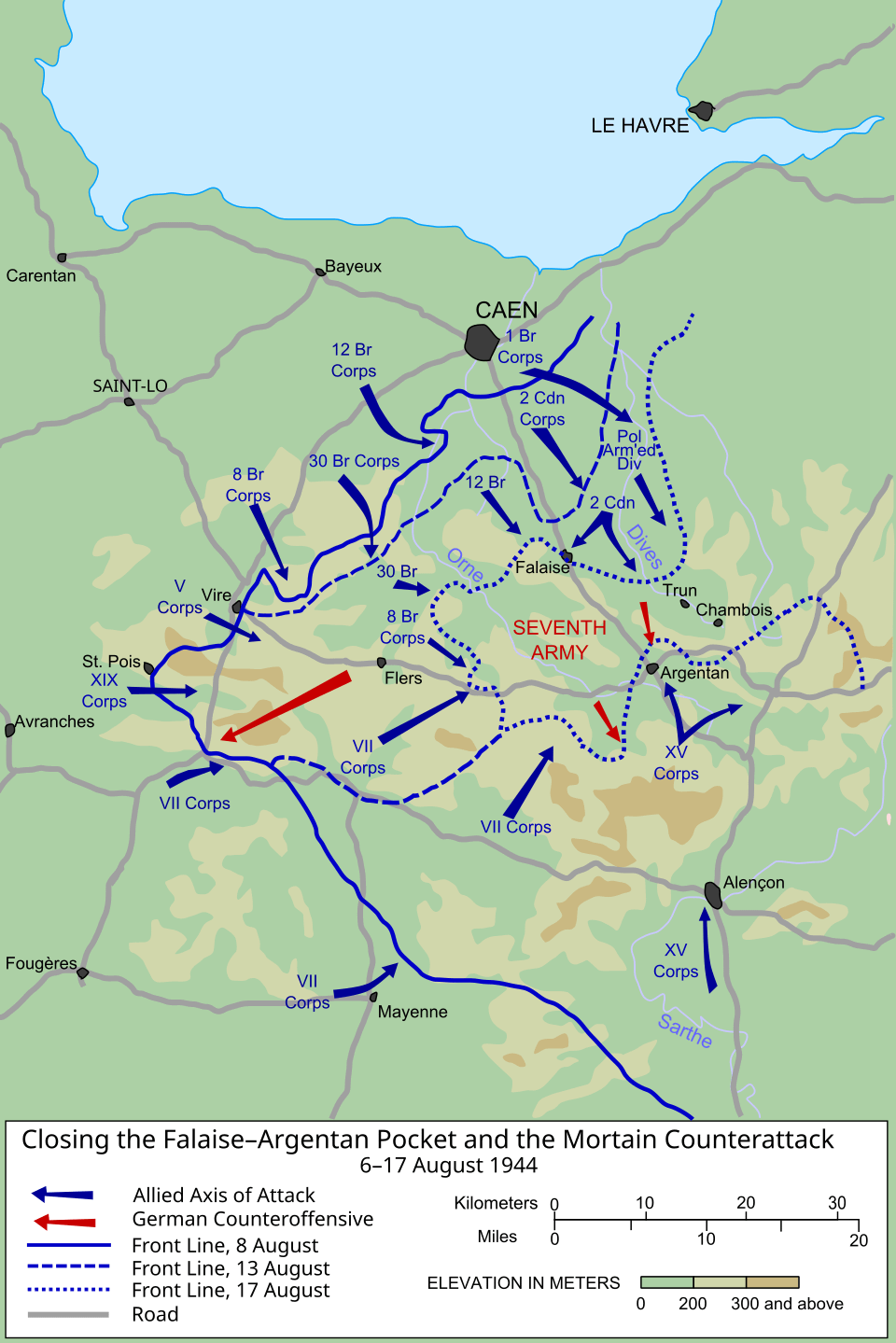
The German 7th Army and 5th Panzer Army had been hammered into near-submission, their surviving formations being squeezed into a shrinking pocket around the River Dives. Patton’s US Third Army was charging north toward Argentan like a runaway freight train, eager to meet the Canadians and Poles grinding down from Falaise to deliver the knockout blow.
All that was needed to slam the iron door shut on the Wehrmacht was a single green light from high command.
Instead, General Omar Bradley pulled the emergency brake.
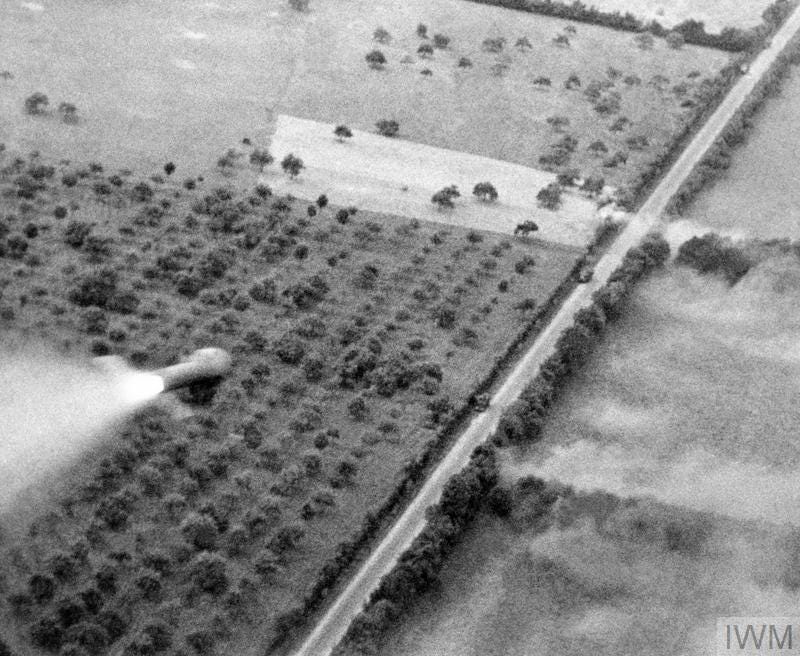
On the night of August 12–13, 1944, Major General Wade H. Haislip’s XV Corps—the tip of Patton’s spear—was halted just short of Argentan. Roughly twenty miles separated Patton’s forces from the Canadians advancing toward Falaise.
Fifteen miles is nothing on a paved highway. But throw in German infantry hidden in thick woods, anti-tank weapons lurking around every bend, and two Allied armies converging on the same narrow battlefield, and fifteen miles may as well be fifteen hundred.
Closing the jaws completely could have destroyed much more of the German 7th Army and made the German retreat dramatically more difficult. Patton knew it. Haislip knew it. Every GI who had scraped his knuckles through the hellish hedgerows knew it.
Patton reportedly told Bradley that if he were allowed to continue north, his men could “drive the British into the sea for another Dunkirk.”
Then came the order from Bradley’s headquarters:
Halt.
“I would rather build a solid shoulder at Argentan than take a chance on a head-on collision between the two Allied armies.”
— General Omar Bradley
Bradley feared two things. First, a catastrophic—and entirely possible—friendly-fire nightmare between American and British artillery firing into the same choked corridor. Second, a desperate German armoured thrust punching through Haislip’s thin, overextended flank.
It was a decision that prioritised caution over opportunity—and historians have argued over it ever since.
The Gap
The gap between Argentan and Chambois stayed open for days. While Allied artillery and rocket-firing Typhoons turned the bottom of the pocket into Dante’s Inferno—filled with smashed wagons, burning tanks, bloated draft horses, and rotting flesh—thousands of experienced German officers, NCOs, artillerymen, and specialist cadres abandoned their heavy kit and scrambled east across the Dives on foot.
The Allies won a staggering victory inside the pocket. But by pulling Patton’s leash at the critical moment, they let part of the human framework of the German Western Army slip away—men who would help rebuild formations that would later strike back in the freezing woods of the Ardennes.
While the high command argued over operational boundaries on grease-pencil maps, the men in the turret hatches still had to clear the path.
Normandy had one final, brutal kick in the teeth for Allied armour. On August 16, the Sherwood Rangers Yeomanry (SRY) were thrown into the fighting around Berjou in support of the 43rd (Wessex) Division—the “Wicked Wyverns.”
Their task: clear the steep, wooded slopes overlooking the River Noireau and secure the crossings to allow the British advance to continue east.
Vicious terrain. Steep, muddy tracks wound through dense woodland, while visibility collapsed to a few yards. Dug into the heights were determined German rearguards. Royal Engineers had to throw Bailey bridges across the Noireau under direct mortar fire before the Shermans could even begin the climb. In this confused, wooded terrain, the Allies’ overwhelming air power was of limited use; there were few clear targets, and the close confines made air-to-ground attacks far more difficult to coordinate.
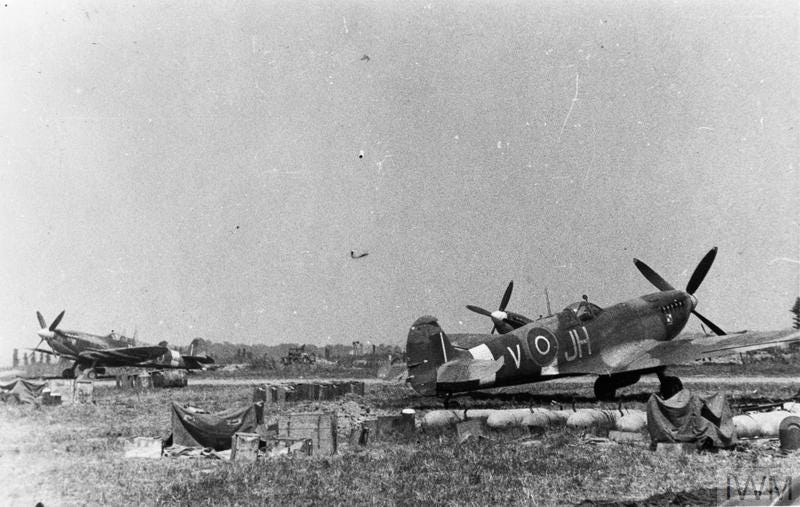
SRY Tanks crawled up the narrow tracks, radial engines screaming in low gear as mortar bombs rained down like heavy hail. Seven machine-gun nests were wiped out at point-blank range; concealed anti-tank weapons damaged seven SRY tanks.
Veteran tank commanders fell on the eve of total breakout, including Lieutenant Frank Galvin and Sergeant Saunders, who was killed trying to rescue a wounded crewmate. The fighting continued into August 17, when Wessex infantry, supported by the SRY and artillery, completed the capture of the Berjou Ridge.
Berjou Ridge fell, but so did many ordinary men.
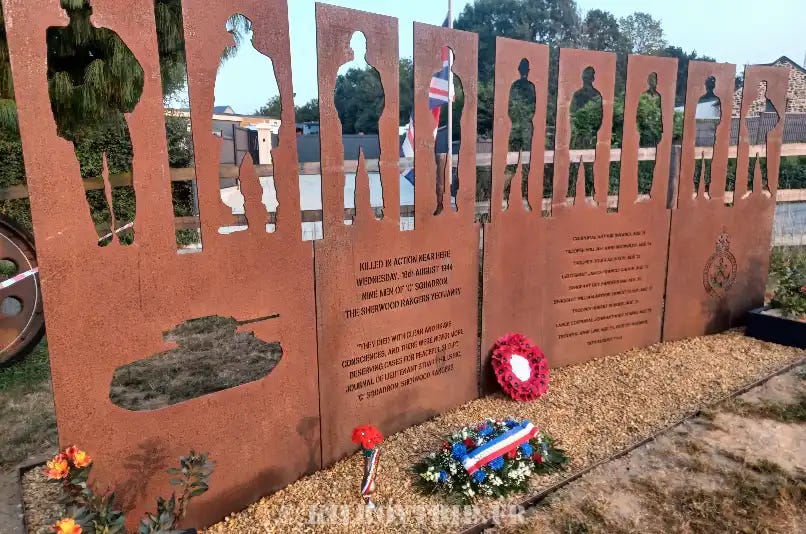
CORPORAL ARTHUR BROOKS, AGE 21
TROOPER WILLIAM JOHN BROWNLEE, AGE 24
TROOPER DOUGLAS DIXON, AGE 23
LIEUTENANT JAMES FRANCIS GALVIN, AGE 24
SERGEANT GUY SANDERS MM, AGE 35
SERGEANT WILLIAM ARTHUR ERNEST SLEEP, AGE 32
TROOPER ROBERT WRIGHT, AGE 28
LANCE CORPORAL JOHN ANTHONY YOUNG, AGE 21
TROOPER JOHN LAW, AGE 23, DIED OF WOUNDS, 29TH AUGUST 1944
See video of memorial unveiling here.
Once the Falaise pocket collapsed and the Germans began their retreat toward the Seine, the war changed overnight.
Forget the two-mile-a-day grind through claustrophobic hedgerows. Forget the blinding white dust and the constant terror of anti-tank ambushes behind every thicket. The Allied armies hit open country, slammed their foot to the floor, and accelerated.
This was The Great Swan.
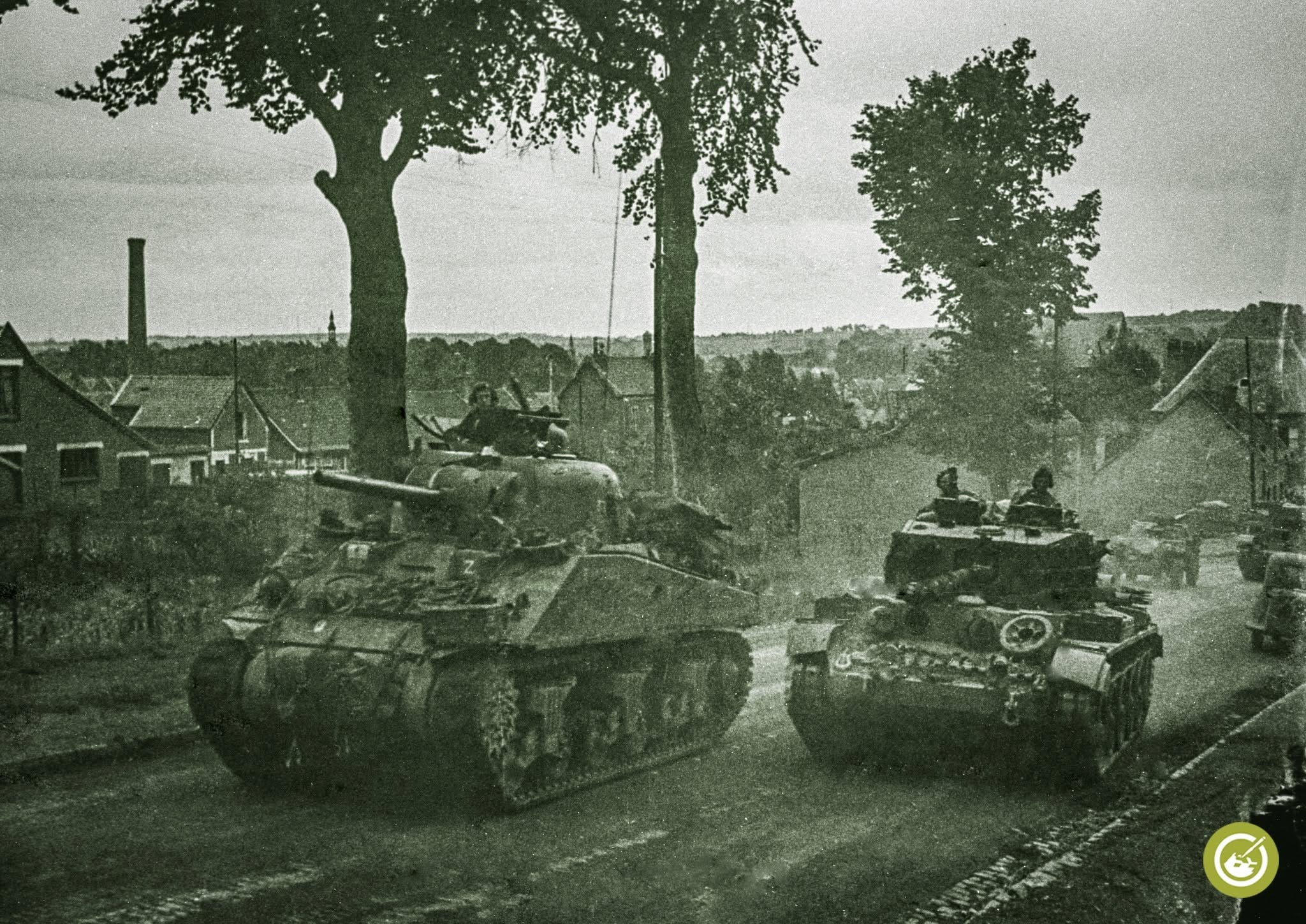
Armoured columns poured east down paved French highways at speeds that would have seemed extraordinary to men who had spent weeks inching their way through Normandy. For crews holed up in the Bocage for two long, bloody months, this was what tanks were built for:
Operational movement.
French villages erupted into scenes of hysterical delirium. Civilians lined the roads by the thousands, throwing peaches, baguettes, and bottles of cognac directly onto the engine decks of moving Shermans and Cromwells. Women climbed onto moving vehicles to kiss dust-covered commanders leaning out of their hatches.
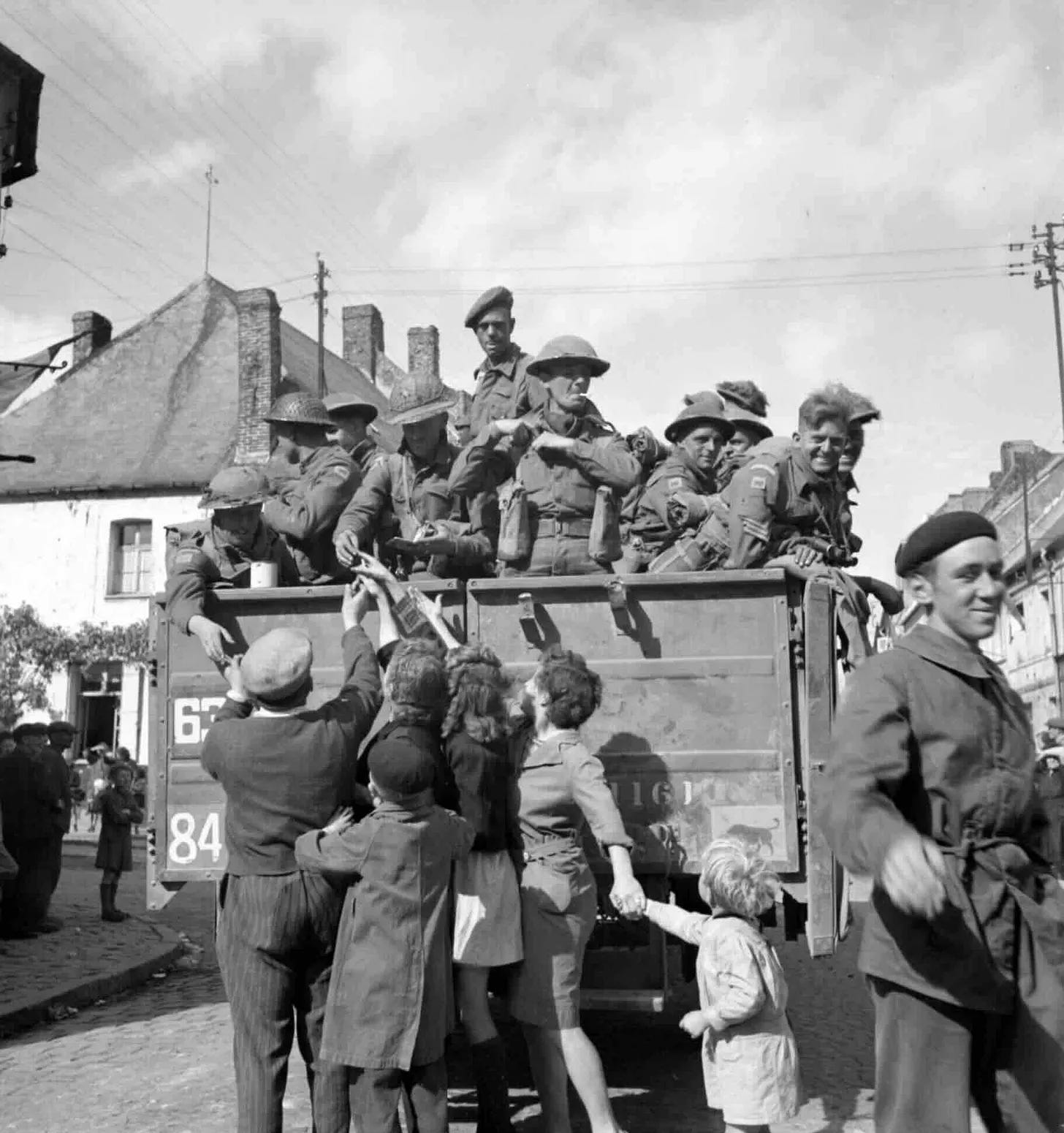
Behind the wild celebrations lay total operational collapse for the enemy.
The German 7th Army was falling apart at the seams, with no seamstress in sight.
Roadblocks were bypassed or pulverised by sweeping armoured spearheads, while RAF Typhoons and USAAF P-47 Thunderbolts hunted German movement from the air.
Tank crews slept two hours a night—sitting upright in their hatches or curled under their hulls in damp grass—running on black coffee, cigarettes, adrenaline, and pure momentum.
If you would like to support this publication, feel free to buy me a coffee.
Thank You!
Velocity creates its own ruthless enemy: logistics.
By late August, Patton’s Third Army and Hodges’ First Army were consuming roughly 800,000 gallons of gasoline every day.
That is about 3 million litres of petrol every twenty-four hours—enough to fill roughly 1.2 Olympic-sized swimming pools.
And every one of those gallons had to be moved forward.
Enter the legendary Red Ball Express.
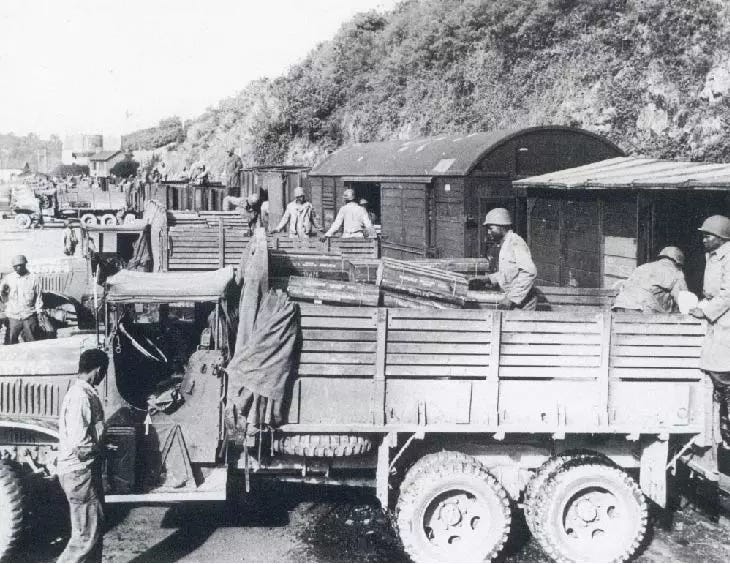
Beginning on August 25, more than 6,000 trucks were organised into a dedicated supply pipeline, racing hundreds of miles along French roads to keep the advancing American armies fuelled and armed. Most of the truck drivers were African American. The US Army was segregated, and Black soldiers were disproportionately relegated to support and service units rather than combat formations. Yet the men of the Red Ball Express continually delivered the supplies the advancing armies desperately needed, often under dangerous conditions and despite the discrimination they faced.
“We often refuel and rearm even while fighting. That takes guts. Our Negro outfits delivered gas under constant fire. Damned if I’d want their job. They have what it takes.“
– Stars and Stripes newspaper August 31, 1944
Drivers worked around the clock, hauling petrol, ammunition, food and spare parts eastward while the combat formations surged ahead. Between August 25 and November 16, the Red Ball Express moved an astonishing 412,193 tons of supplies to the advancing American armies.
The numbers reveal the hidden cost and limitations of the Great Swan.
The tanks might have been racing across France, but behind them came an endless river of trucks carrying the fuel, ammunition and food that made the advance possible.
The Allied juggernaut wasn’t just advancing; it was outrunning its own blood supply.
As the German front dissolved like an effervescent tablet, the Allied High Command ran into a classic luxury problem.
Back in Berlin, Hitler was sacking and replacing field commanders like disposable batteries—swapping Rundstedt for Kluge, and Kluge for Model.
By contrast, the Allied dispute was the high-octane argument of commanders squabbling over how best to deliver the knockout blow before winter.
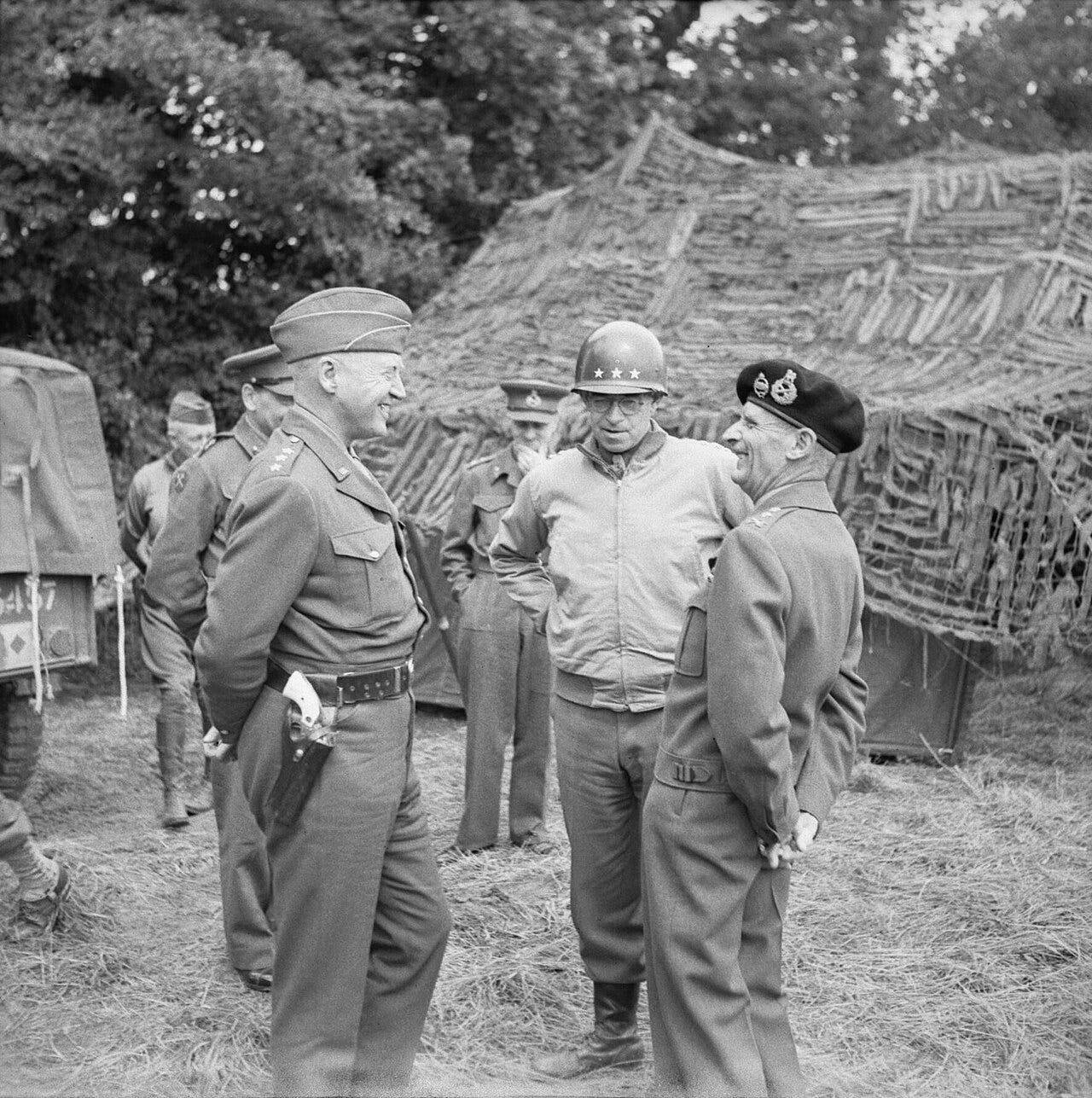
Field Marshal Bernard Montgomery: Favoured concentrating Allied strength in the north for a powerful thrust through the Low Countries and across the Rhine into the Ruhr, arguing that a single concentrated advance offered the best chance of ending the war quickly.
George S. Patton & Omar Bradley: Favoured maintaining pressure and exploiting the German collapse across a broader front, with Patton convinced that his Third Army could keep smashing east before the Germans recovered.
Supreme Allied Commander Dwight D. Eisenhower was caught in the middle—less a commander-in-chief and more a high-stakes referee trying to keep competing strategic visions from tearing the coalition apart.
Fuel was rationed by the gallon, and staff briefings turned toxic.
And right in the middle of this strategic feud sat the ultimate political prize:
Paris.
Strategically, Eisenhower did not originally want to make Paris the immediate objective. It was an expensive operational distraction.
His plan was simple: bypass the capital, cross the Seine, and chase the broken enemy into Germany before they could reorganise.
General Charles de Gaulle, leader of the Free French, had zero interest in Allied logistics. For him, French sovereignty and historical honour eclipsed operational theatre maps.
From August 18, the French Resistance rose openly across Paris. Barricades of torn-up cobblestones went up across the capital. German positions were attacked, and the streets became a battlefield.
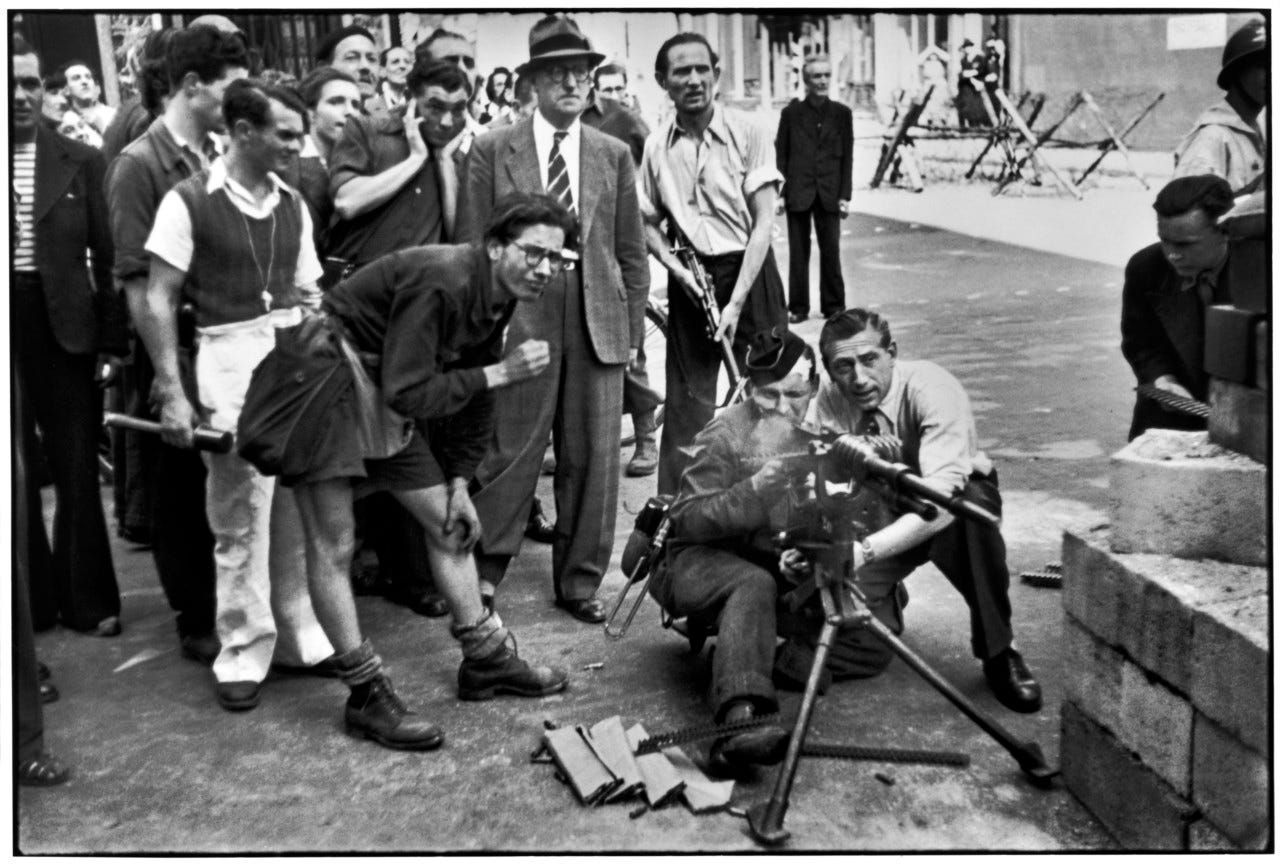
In Berlin, an enraged Hitler ordered the military commander of Paris, General Dietrich von Choltitz, to hold the city and prepare it for destruction.
De Gaulle pressed Eisenhower relentlessly to send Allied troops into the capital. Leclerc, meanwhile, was already determined to liberate Paris with the 2nd Armoured Division.
With the Resistance uprising threatening to turn into a bloodbath, and de Gaulle arguing for intervention, Eisenhower finally gave the green light for the French 2nd Armoured Division and the US 4th Infantry Division to advance.
Leading the vanguard into the capital was Captain Raymond Dronne’s 9th Company—La Nueve.
Many of its men were Spanish Republican veterans who had fought Franco, lost their country, and spent years in exile before joining the Free French. Their half-tracks carried names that reflected their exiled past: Guernica, Madrid, and Teruel.
On the evening of August 24, Dronne’s column punched through German resistance in the southern suburbs and became the first elements of the Allied force to reach the heart of Paris.
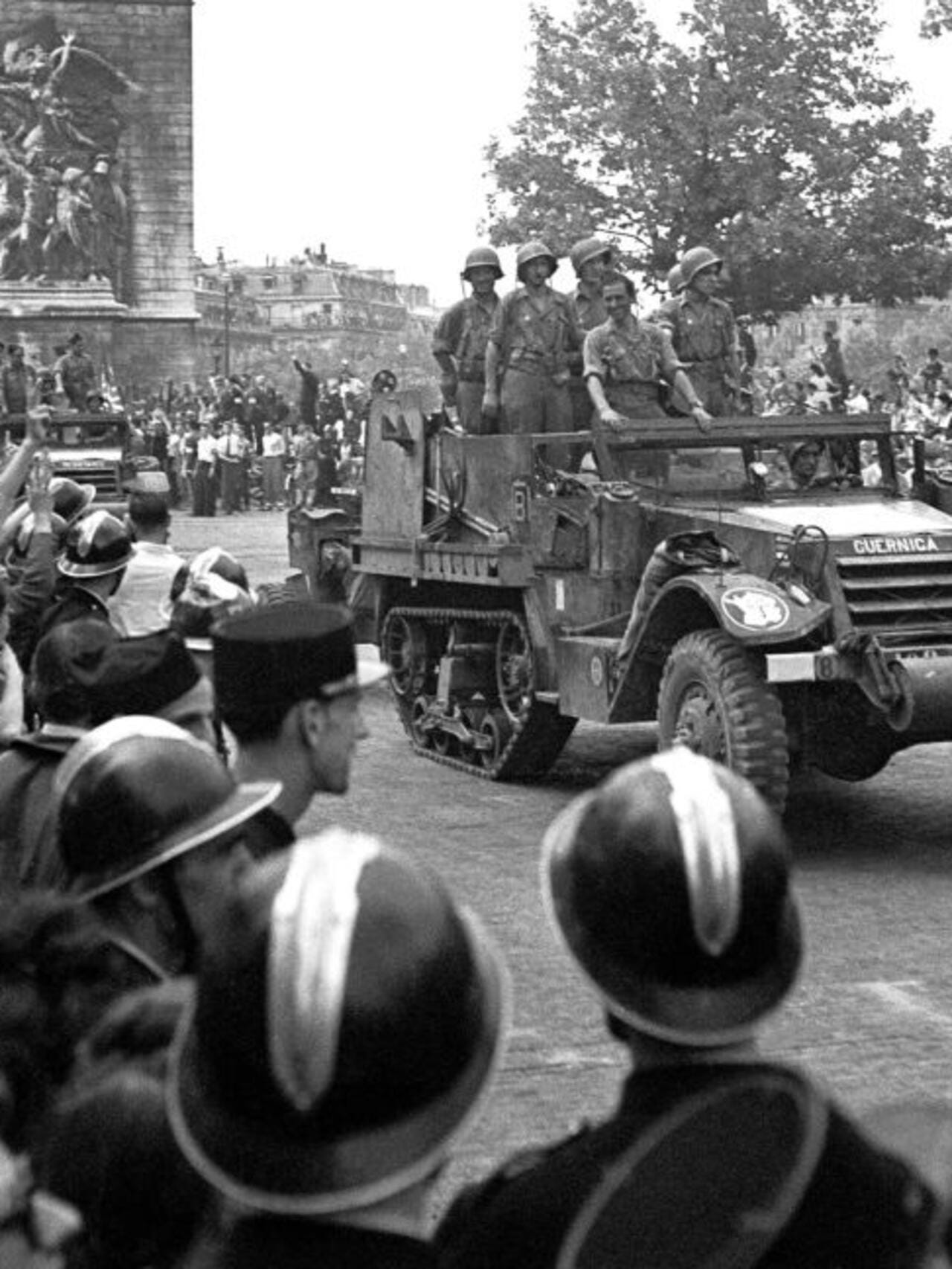
Night falls over the southern approaches to the French capital.
The low rumble of Chrysler twin-six engines vibrates through the suburban asphalt. French and American crews sit atop warm armour, smoking cigarettes under a clear summer sky, listening to the soft crackle of distant small-arms fire.
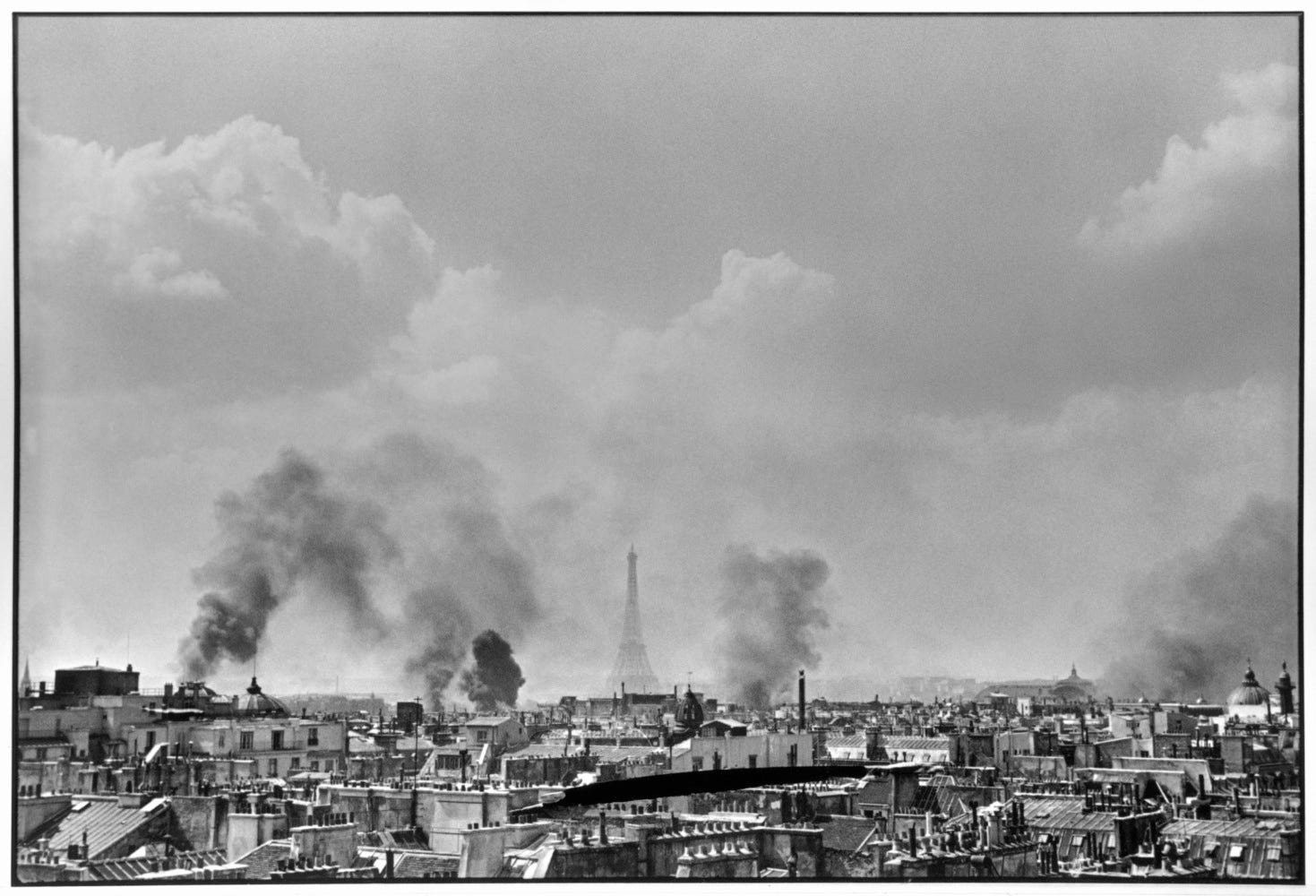
In the distance, rising above the low summer mist, looms the dark silhouette of the Eiffel Tower.
Inside the city, Resistance fighters hold barricades with Molotov cocktails and captured German rifles. In his headquarters at the Hôtel Meurice, General von Choltitz knows the city is slipping from his grasp.
The demolition orders are in his hands, yet the bridges still stand.
The campaign that began miles away on the blood-soaked beaches of Normandy has reached its climax in the French capital.
The Free French and the GIs are already inside Paris.
Next stop: Liberation.
Thank you kindly for reading and joining me in this journey; you are all very appreciated.
Until next time
Ru
No posts
Comments
Nothing yet. Say the first thing.
Sign in to join the conversation.