
Welcome to our Summer Throwback series… Every Thursday June - August, we will revisit some of the articles that launched our platform…
While your here visit the Literacy Underground… this is a place where I post print and go lessons, and an occasional PD… but that’s not the exciting part… the Literacy Underground is a grassroots movement that quietly funds student access to explicit literacy instruction. It’s where the real work happens.
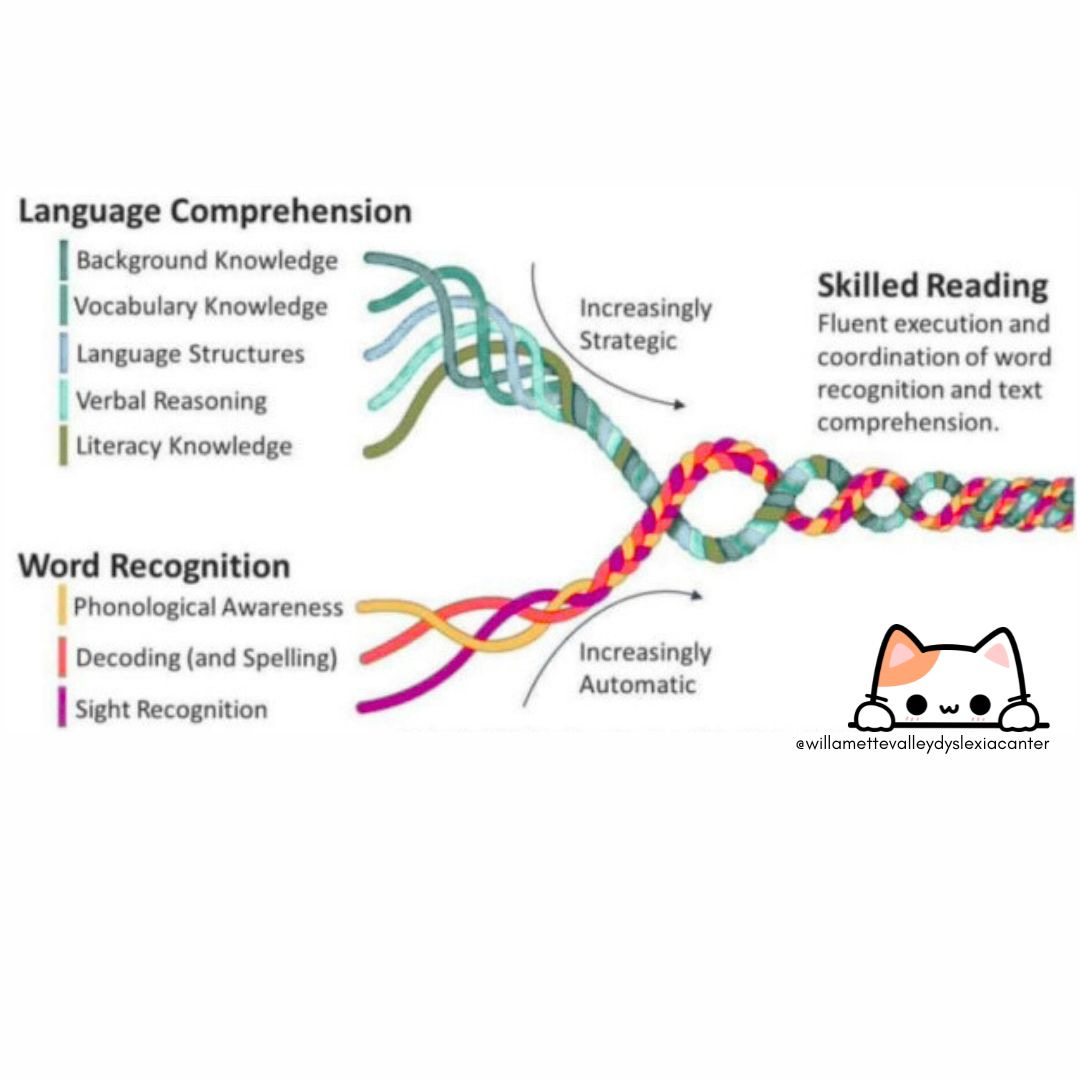
When it comes to helping students become skilled readers, few models are as enduring—or as powerful—as Scarborough’s Reading Rope. First introduced in the early 2000s, this model visually captures what research has shown for decades: reading isn’t a single skill, but a woven combination of many.
At its core, the rope helps us understand that reading comprehension is the result of two major skill sets coming together: language comprehension and word recognition. Each is made up of smaller, interdependent threads—and both are essential to fluent, meaningful reading.
Scarborough’s Rope is made up of two tightly intertwined strands. Let’s take a closer look at what each one includes:
This strand represents the skills required to understand spoken and written language. Unlike decoding, these are mostly developed through indirect learning—via conversations, storytelling, read-alouds, and experiences. The components include:
Background knowledge – What students already know about the world; helps them make sense of what they read.
Vocabulary – The words students understand and use; strong vocabulary supports better comprehension.
Language structures – Understanding how sentences are put together (grammar, syntax, sentence types).
Verbal reasoning – The ability to infer, predict, compare, and reason with language.
Literacy knowledge – Knowing how books and text work (e.g., directionality, genres, print concepts).
These skills grow over time and require purposeful exposure, especially for students who come to school with fewer language-rich experiences.
This strand includes the skills that allow students to read printed words accurately and automatically. Unlike language comprehension, word recognition must be explicitly and systematically taught. The components are:
Phonological awareness – Recognizing and working with sounds in spoken language (rhyming, syllables, blending sounds).
Decoding – Matching letters to sounds and blending them to read unfamiliar words (also called sound-symbol correspondence).
Sight word recognition – Instantly recognizing words that are familiar and frequently encountered, without needing to sound them out.
These foundational skills are especially important in the early grades and for any student who struggles with reading. Without them, fluency and comprehension break down.
In the early stages of reading, children’s skills are like loose threads—developing independently and unevenly. A kindergartner may have strong oral language but limited phonemic awareness. Another child may decode words fluently but struggle to explain what they read. As instruction progresses and students grow, these strands begin to tighten and work together—that’s where the rope analogy shines.
Here’s how that progression often looks:
Learning that spoken words are made up of sounds (phonological awareness).
Developing print awareness—knowing how to hold a book, recognize letters, and understand that print carries meaning.
Gaining vocabulary and background knowledge through read-alouds and conversation.
Beginning to match sounds to letters (phonics foundations).
Actively blending sounds to decode words and building a bank of known words.
Developing basic fluency—reading with some accuracy and expression.
Practicing oral retelling and beginning to answer comprehension questions with support.
Strengthening language structures through exposure to both narrative and informational texts.
Increased automaticity—many high-frequency words are recognized instantly.
Fluency develops in both word reading and phrasing.
Students start using background knowledge, vocabulary, and verbal reasoning to make inferences and synthesize ideas.
The two strands of the rope—word recognition and language comprehension—are now more intertwined, working together to support deeper comprehension.
The emphasis shifts from learning to read → reading to learn.
Skilled readers efficiently pull from both strands simultaneously: decoding multisyllabic words, making sense of figurative language, navigating complex texts, and making connections across content areas.
Deficits in either strand become more apparent—and more consequential—as texts become more demanding.
When both strands develop together, readers gain the efficiency, accuracy, and understanding they need to tackle any text. But if even one thread is weak—poor vocabulary, weak decoding, limited background knowledge—it affects the strength of the entire rope.
That's why intentional, balanced instruction is key. We don’t just teach phonics or vocabulary—we teach children to build a strong, flexible reading rope that supports them for life.
As you plan your week, try this:
Select one strand from each half of the rope—Word Recognition and Language Comprehension—and name exactly how you're addressing it. This might sound like:
Word Recognition: “My small group will work on blending with short vowels during phonics.”
Language Comprehension: “We’ll build background knowledge by exploring informational texts on animal habitats.”
By naming and claiming each strand, you'll naturally begin to balance instruction and identify where students need the most support. Over time, this kind of intentional planning becomes second nature—and your rope gets stronger.
The next time you're reading with your child, pause to explore new words or ideas together. You might say, “Have you ever seen a canyon before?” or “Let’s look at this word—can you guess what it means by the picture?”
This isn’t limited to reading time. You can use brief, everyday moments to build the comprehension side of your child’s reading rope. No worksheets required—just talk, curiosity, and connection.
Want visuals, a short explainer video, and downloadable tools to explore the rope in more depth? Check out our Thinkific Summer Literacy Pass.
https://thedyslexiacenter.thinkific.com/
Comments
Nothing yet. Say the first thing.
Sign in to join the conversation.