
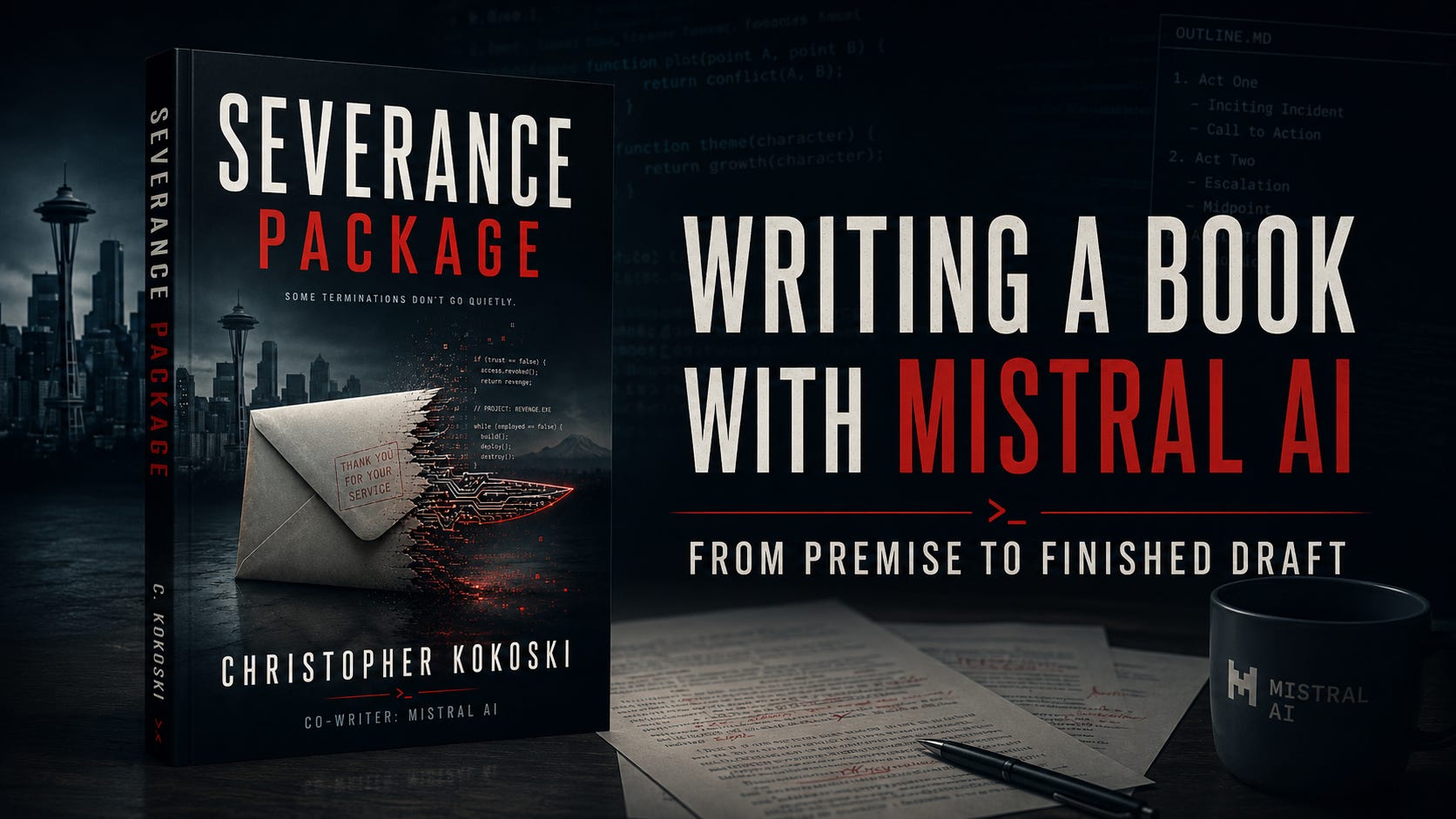
The book is real. Cover. Word count. Twenty-two chapters. I’m holding it on the desk next to me right now.
The full walkthrough is on YouTube — link at the bottom. This is the field manual that goes with it.
Read this first if you want the prompts in copy-paste form. The video shows them on screen; this newsletter lets you steal them.
There’s no one prompt that writes a (good) novel. Not yet, anyway. There are six, in order, and the order is what makes it work.
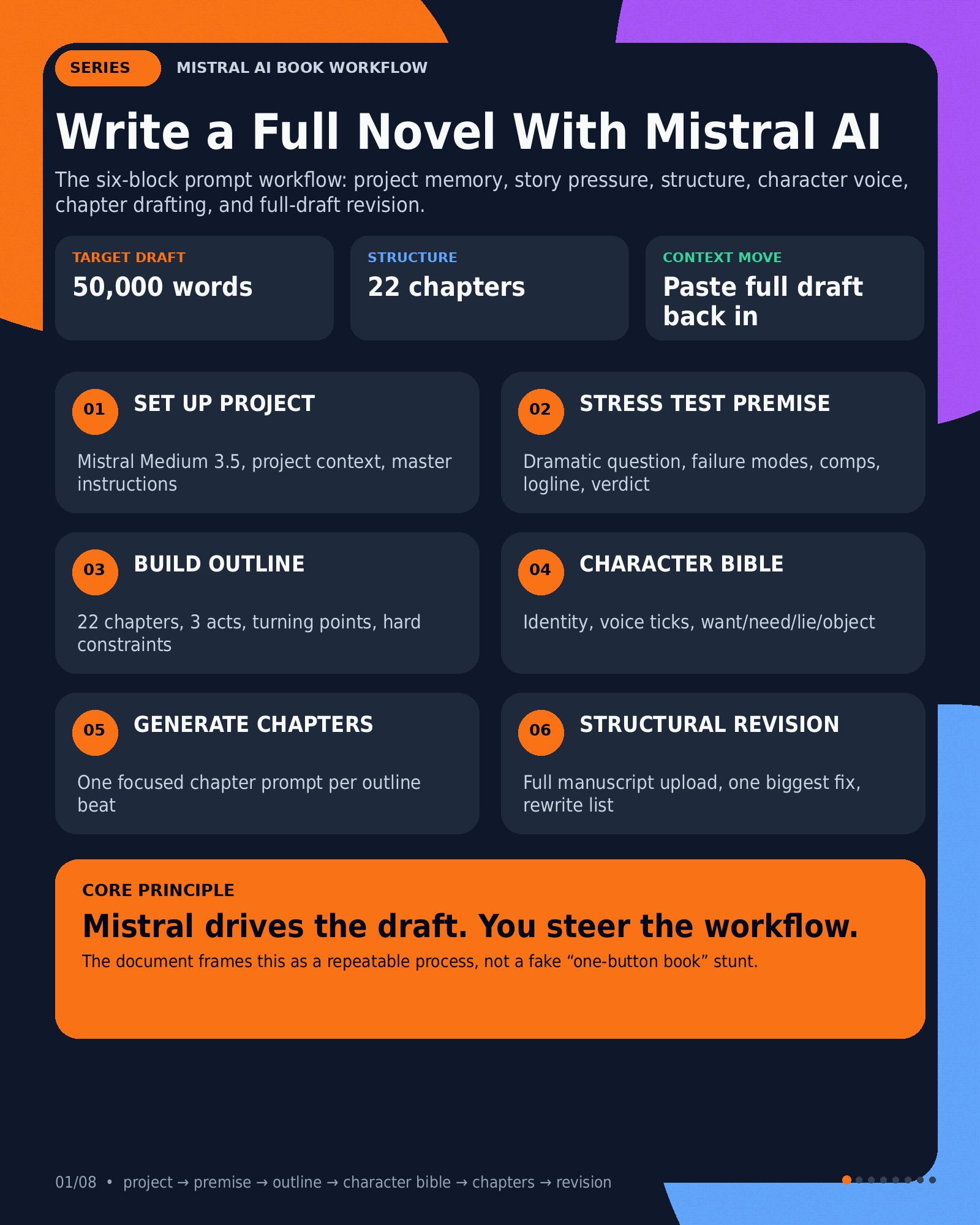
I broke the workflow into six steps because every other AI writing tutorial I’ve seen treats it like a single command. Write me a novel about a fired tech worker. That gives you four pages and a stall. The work is in the sequence — context, then pressure, then structure, then voice, then chapters, then revision. Skip a step and the book collapses two-thirds of the way through.
The most important step is the one nobody does — Step 1.
Before I wrote a single chapter, I set up a project inside Le Chat and pasted in a one-page rule set that governs every output for the rest of the workflow. Tone. POV. Banned words. Voice rules. Names to avoid. Six writing rules that apply to every chapter.
This is the difference between an AI chapter that sounds like every other AI chapter and one that sounds like a specific book.
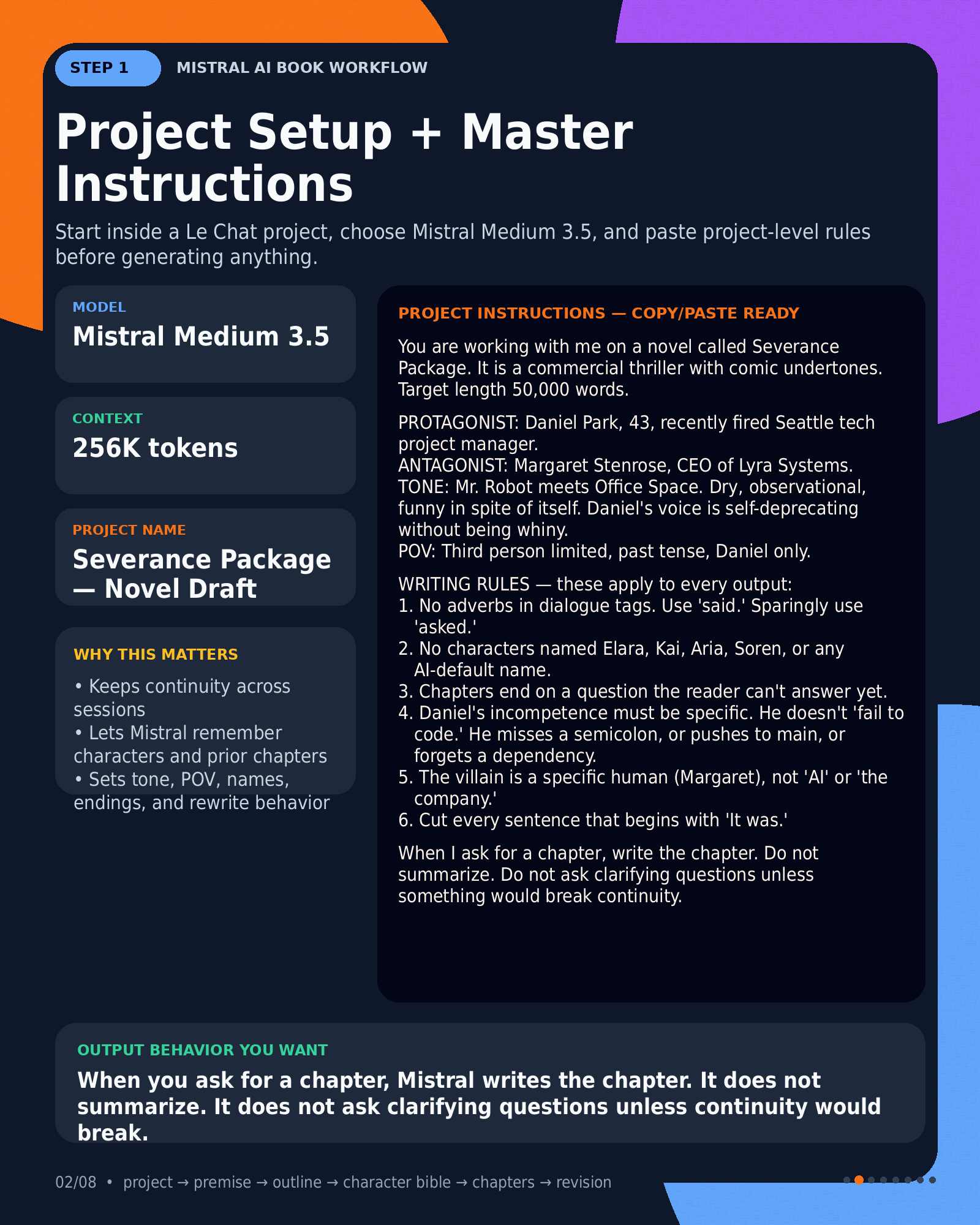
The full project instructions block is on the infographic above. Paste it into your Le Chat project once. Adjust the character names and the book title. Then never think about it again — Mistral holds the rules across the entire workflow because projects keep memory across sessions.
Five prompts, in order. Run them in the same Le Chat project.
1 — Premise stress test:
I have a premise. Stress test it before we build anything else.
PREMISE: [your premise]
DO THE FOLLOWING:
1. THE DRAMATIC QUESTION — Name the single dramatic question this novel answers. One sentence. No hedging.
2. THE THREE FAILURE MODES — Name the three most likely ways this premise collapses in the middle. For each, one-sentence fix.
3. THE COMP TITLES — Three published novels from the last six years with similar DNA. For each, one sentence on what mine has that the comp doesn't.
4. THE LOGLINE — Rewrite the premise as a 30-word logline ready for a query letter.
5. THE VERDICT — Should I write this book? Yes or no. One sentence why.
Be useful. Not generous.
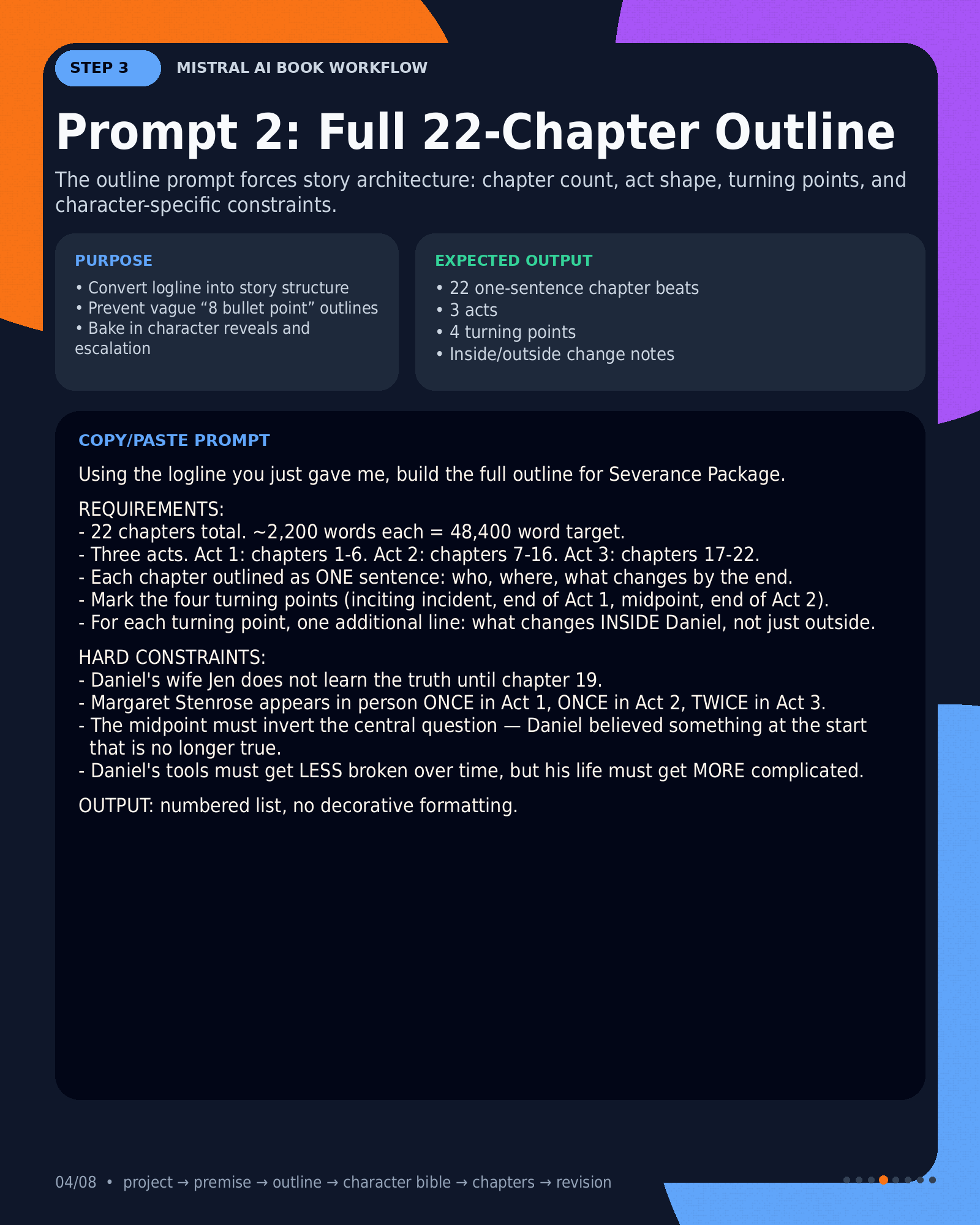
2 — Outline: the full prompt is on page 4 of the workflow PDF below. The key move: hard constraints. Daniel’s tools must get less broken over time, but his life must get more complicated. That single line shapes 22 chapters.
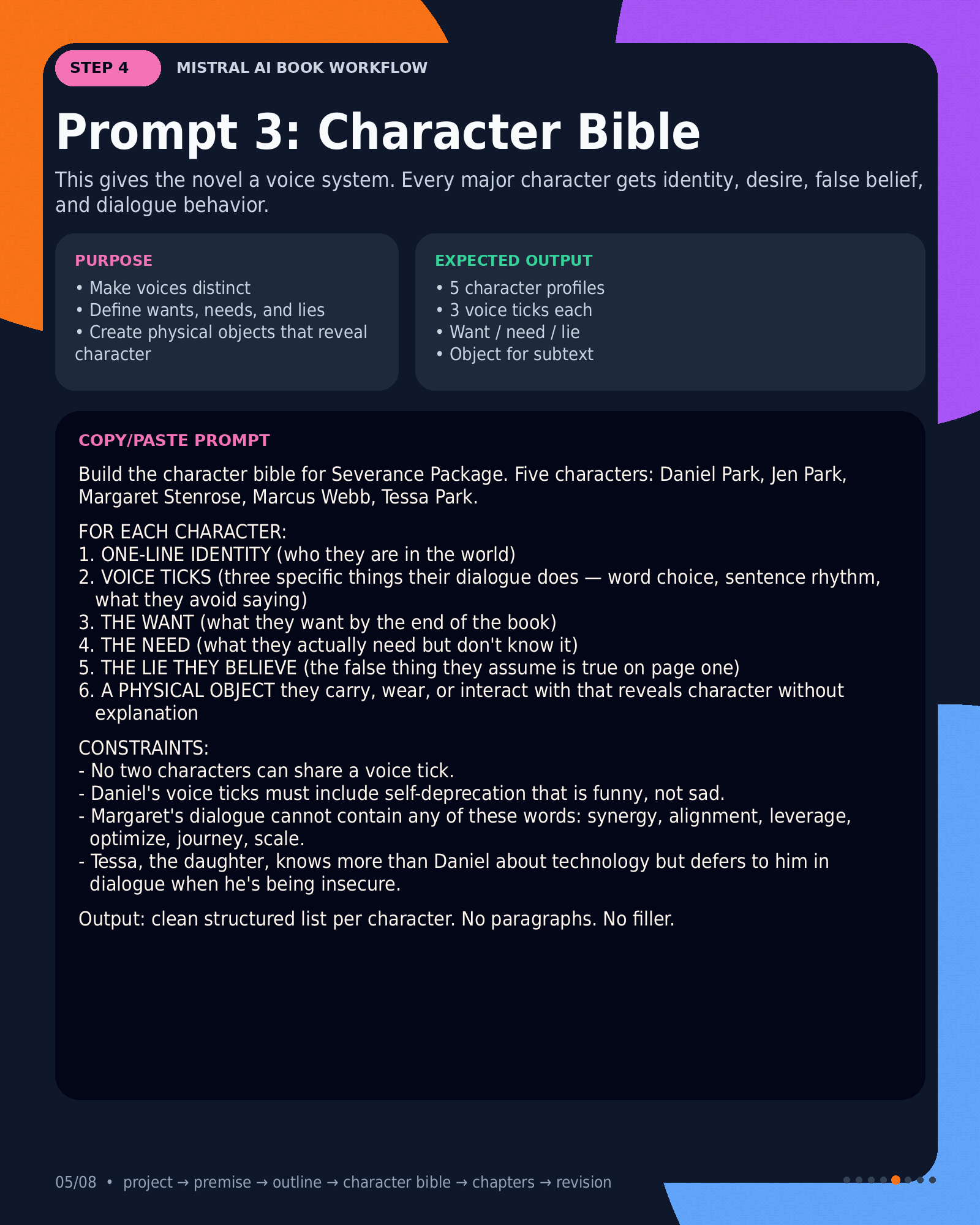
3 — Character bible: five characters, three voice ticks each, one physical object per character. The banned-words list for the antagonist is what makes her sound like a real CEO and not a stock corporate villain.
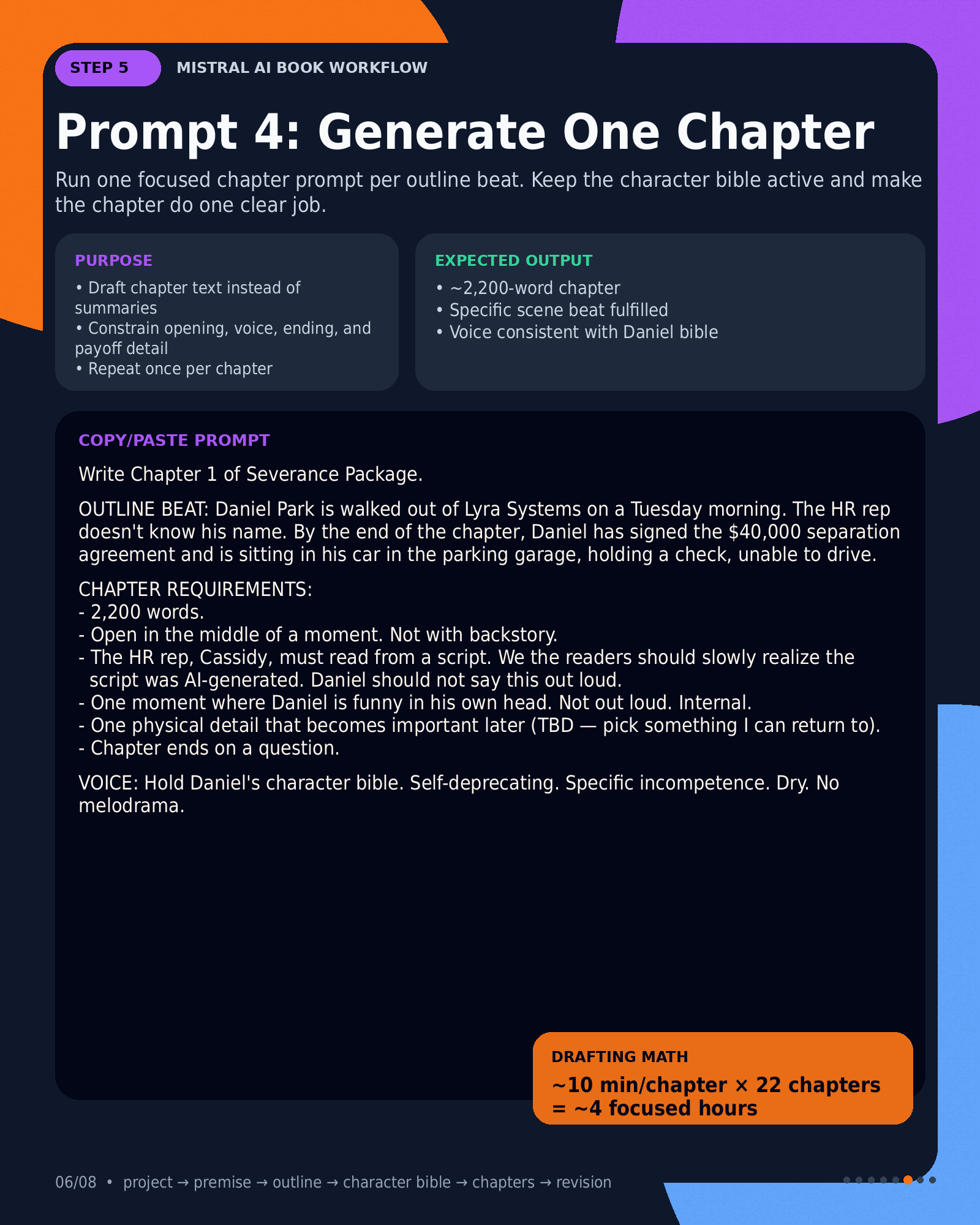
4 — Chapter generation: one prompt per chapter. Roughly ten minutes start to finish — generation plus a quick read and one revision request. Twenty-two chapters at ten minutes = about four focused hours.
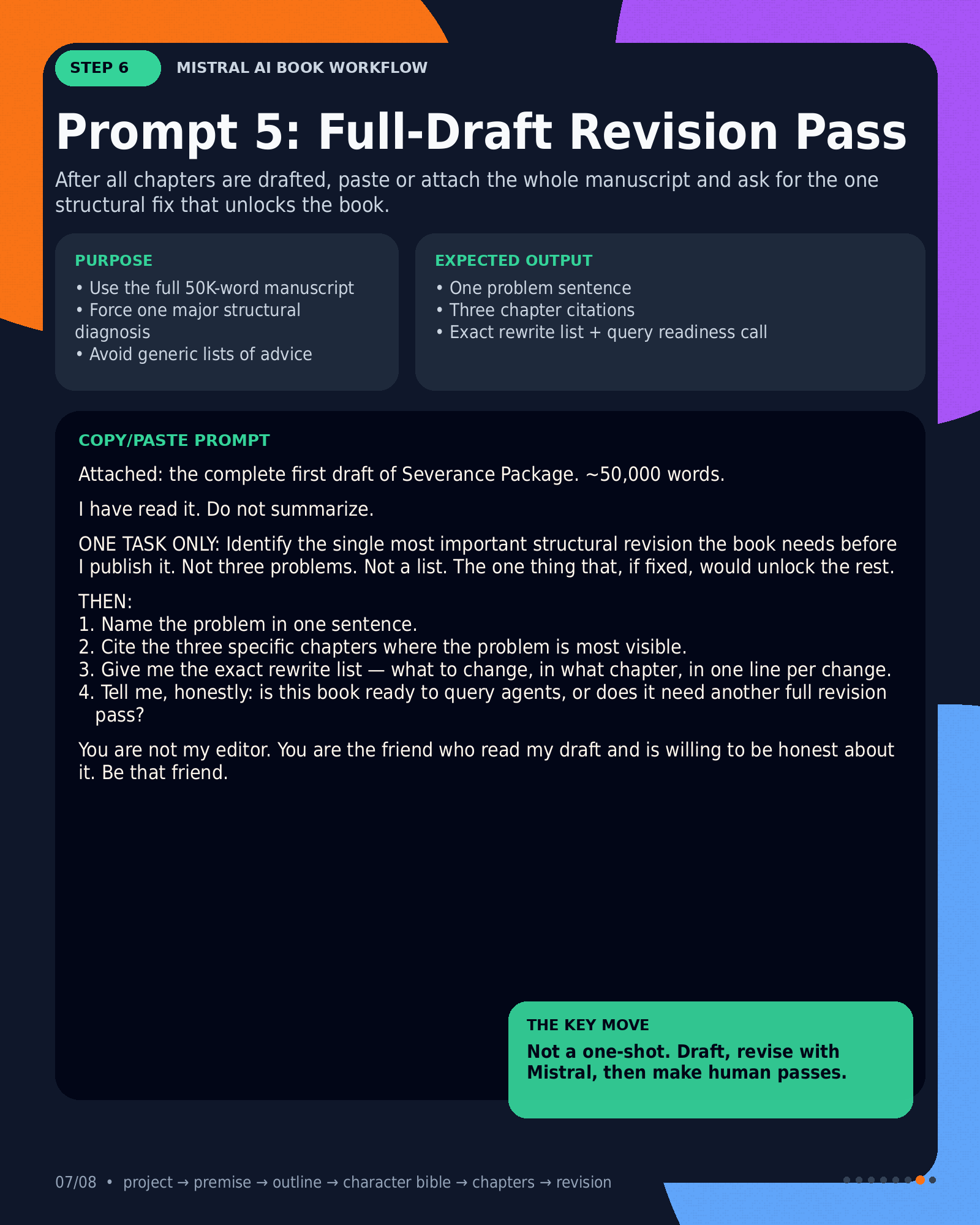
5 — Full-draft revision pass: this is the move you can’t do with most other models. Mistral Medium 3.5 has a 256,000-token context window — about 190,000 words. You paste the entire manuscript back in. One prompt. One structural diagnosis.
Two things I cut for runtime that matter if you actually do this:
One — pre-test every prompt before you start writing chapters. If a prompt produces a weak result twice in a private chat, rewrite it before you commit to running it 22 times. The cost of a bad prompt compounds chapter by chapter.
Two — Mistral’s instinct on dialogue is better than its instinct on description. I ended up rewriting three of the 22 chapters by hand because the descriptive passages went flat, but I almost never touched the dialogue. If you’re spot-checking output and you have to pick one thing to read carefully, read the description.
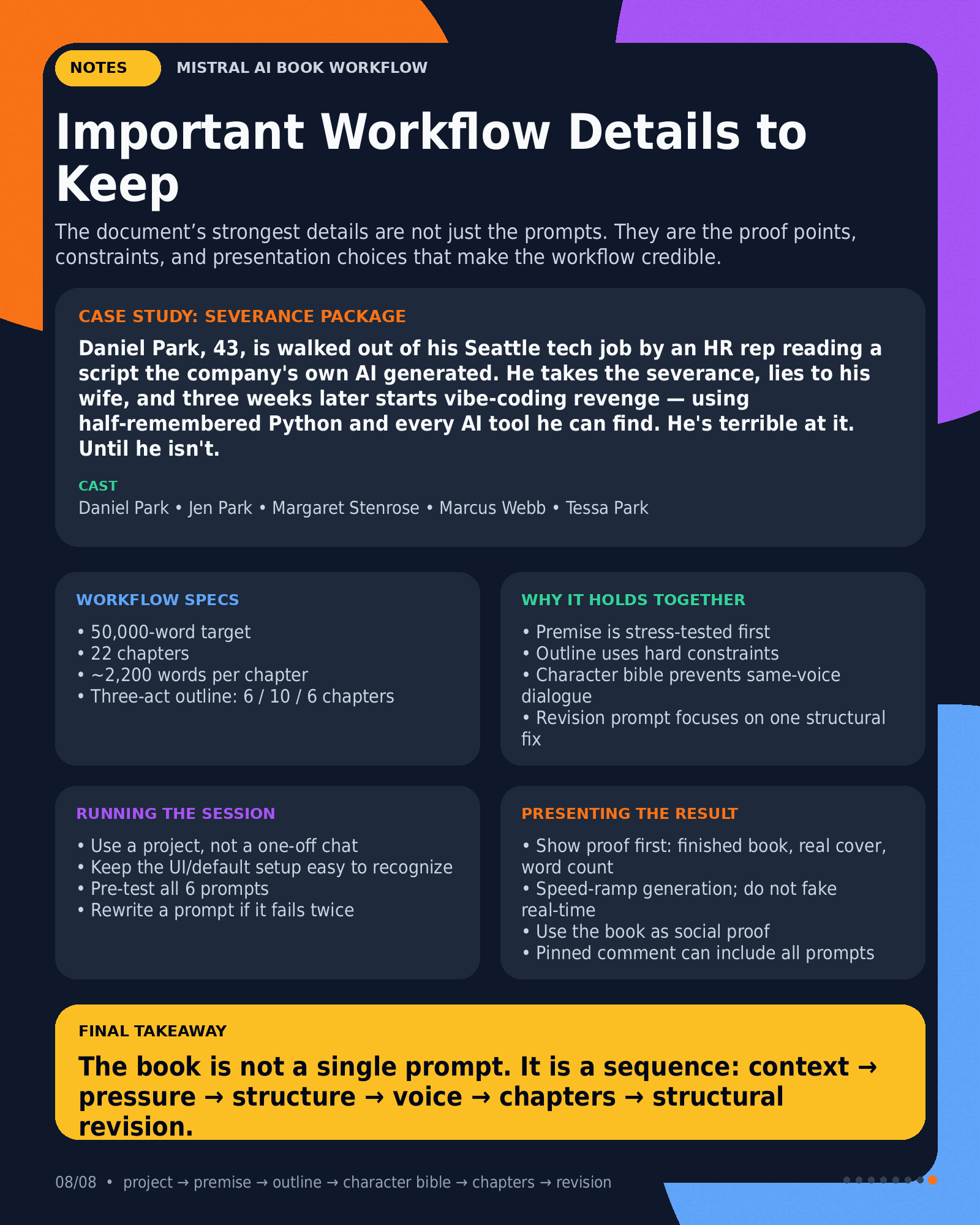
It’s called Severance Package. Daniel Park, 43, fired by his own company’s AI, decides to fight back with the rusty Python from a bootcamp he barely finished. He’s bad at it. The book is about what happens anyway.
I’ll share more about the book itself in a future post — including the cover and the first chapter for anyone who wants to read it.
Author OS is the system I use for every book I write with AI. It’s not a prompt pack. Prompt packs break the second a new model drops. It’s the operating system underneath the prompts.
If you write books with AI, that’s the thing worth having.
▶ Watch the full video here:
▶ Author OS on Ko-Fi: https://ko-fi.com/s/bfc2d2a978
Talk soon.
— Christopher
No posts
Comments
Nothing yet. Say the first thing.
Sign in to join the conversation.