
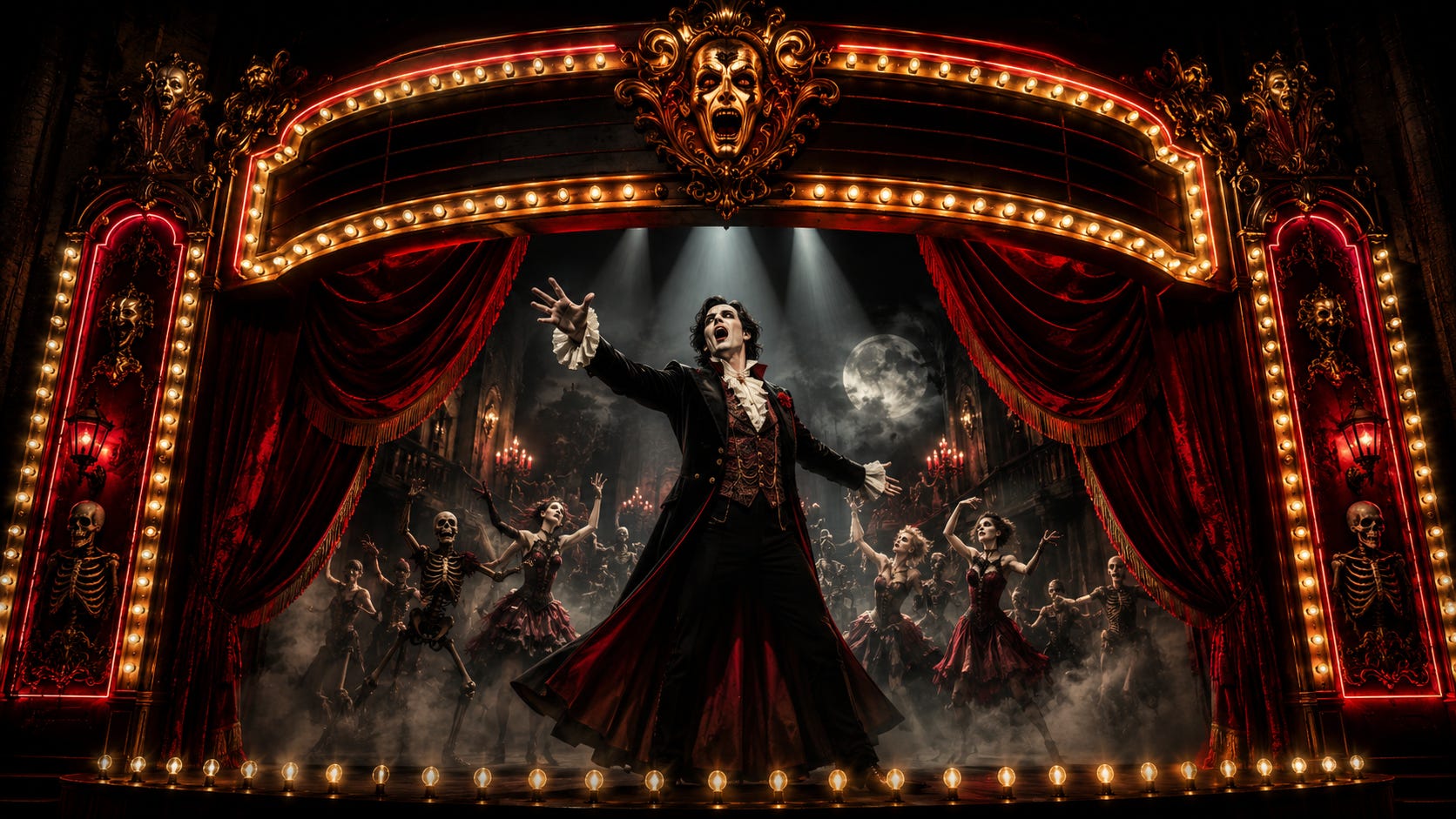
I asked Claude to write me a horror musical.
Not a horror story. Not a couple of creepy lyrics. A musical. Acts, numbers, a villain who gets his own song — something that’s supposed to scare you and then send you home humming.
On paper, this is an unhinged thing to ask a language model to do. Which is exactly why I did it. Opus 4.8 just landed — the newest, most capable Claude you can actually get your hands on — and instead of running another tidy “write me a chapter” demo, I wanted to throw one of the single hardest creative tests I know at it.
Here’s why a horror musical is that test.
Most “can AI write?” demos are easy mode. Premise, outline, one chapter. One skill at a time, graded gently.
A musical makes the model do all of it at once:
Story. Real acts, real escalation, a turn you don’t see coming.
Lyrics that actually scan. Rhyme and meter — lines a human could sing out loud without tripping over them.
Tone, held for the whole runtime. And horror is the cruelest tone there is, because dread evaporates the second the writing gets lazy.
A separate voice for every character. The ingénue and the monster cannot sing in the same register.
Two genres that actively fight each other. Tip too campy and the horror dies. Tip too grim and the whole “wait, why are they singing?” problem swallows the show. Sweeney Todd and Little Shop of Horrors are masterpieces precisely because that balance is so hard to land.
Now here’s the part that matters to you — even if you never write a single song in your life.
Watch what each demand actually maps to:
Meter is prose rhythm with the training wheels off. If a model can hold a beat across a sixteen-line number, it can hold cadence across your chapters. If it can’t, you’ll hear it limp in your dialogue too.
Horror in a lyric is harder than horror on a page. You’ve got rhyme and line length fighting you the whole way, with a fraction of the words to land the scare. So if it can unsettle you in a verse, it can absolutely sustain dread across a manuscript. The tighter the constraint, the better the stress test.
Distinct character songs are distinct character voices. The exact thing that sinks most AI fiction — everyone sounding like the same mildly helpful narrator — has nowhere to hide in a musical. Either the monster sounds like the monster or he doesn’t.
The genre-fusion balance is tonal control, full stop. If you write anything that blends — horror-comedy, cozy mystery, literary thriller — this is the muscle you lean on, and a horror musical shows you in about ten minutes whether the model has it.
That’s the whole reason I run tests like this. I don’t care about the spectacle. I care about what the spectacle reveals — and a horror musical tells you more about a model’s real creative range than a dozen chapter demos ever will.
I’m not going to pretend it was flawless, because it wasn’t. That’s the honest part — and it’s exactly where you’d still need to step in as the writer.
And then there was the moment that actually got me.
[DROP IN THE STANDOUT — the song or line that genuinely surprised you. Tease it, don’t spoil it. One or two sentences is plenty.]
I’d rather you hear it than take my word for it. In the video, I react to the whole thing in real time — the premise, outline, writing quality — so you can decide for yourself whether the new Claude earned the noise.
Watch the full experiment here →
If you write fiction and you’ve been wondering what Opus 4.8 actually changes for you, this is the fastest way to find out: watch it attempt the hardest thing on the menu.
— Christopher
No posts
Comments
Nothing yet. Say the first thing.
Sign in to join the conversation.