
By Wendy H. Jones - Editor in Chief
ISSN 2977358x (online)
This month the magazine is given over to all things holidays. For the British amongst us, holidays means Christmas, Easter, Thanksgiving etc. rather than two weeks in the sun. Holidays give us so much inspiration for fiction
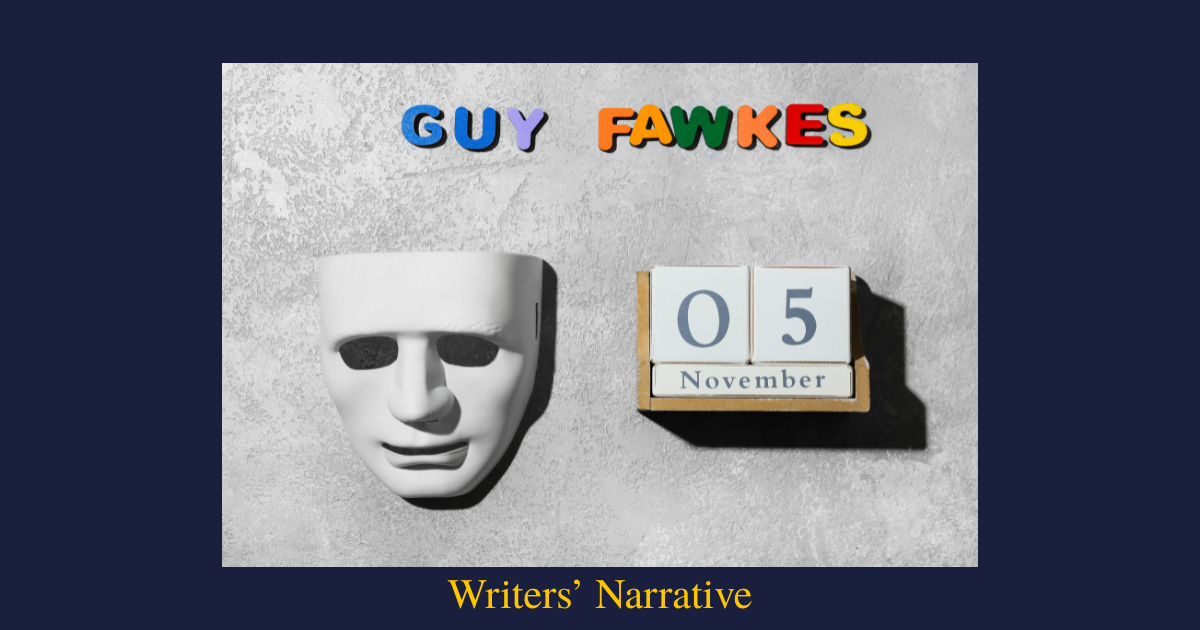
When we think of 5th November or Bonfire Night as it is often called the image that springs to mind is crackling bonfires, fireworks, sparklers and roast chestnuts. The oooohhs and aaahhhs of the crowd mingle with the bangs of the fireworks and the smell of burning fills the air. This is all correct but what does the average person know about the real origin go Guy Fawkes Night to give it it’s real name? If , as writers, we look beyond the obvious we find a veritable treasure trove of ideas, symbolism, history, setting, treason tension and real people. All of these ripe with ways to broaden your writing portfolio.
The story beyond the fun and frolics
In 1605 a group of disillusioned catholics decided to assassinate James 1 and get rid to the protestant led government by blowing up the House of Lords during the state opening of parliament on 5th November. Guy Fawkes was one of these dissenters. Having served in the military he had an extensive knowledge of explosives, so he was the group’s explosive expert. They smuggled in 36 barrels of gunpowder and placed them in a rented cellar under the House of Lords. However, the plot was foiled when Lord Monteagle received a letter telling him not to go to parliament that day. He alerted the king’s minister and the subsequent search found Guy Fawkes guarding the barrels of gunpowder. Arrested and under torture, he confessed and gave up the names of his fellow conspirators all of whom were shot or hanged. The King decreed this to be a day of thanksgiving which has turned into our modern bonfire night. Interestingly, the yeoman still search the cellars under parliament before the state opening. History is fascinating.
Why should we, as writers, care?
Good question and it definitely deserves an answer. There is the obvious one of providing ideas for articles and stories. These stories could be told from a different point of view such as the yeoman who found Guy Fawkes and the barrels. Or you could write a story about Guy Fawkes the man, bringing out his humanity, his family - the story behind the legend. He was obviously someone who cared passionately about his religion and his country. Remember, every villain is the hero of his own story. Or you could write a poem about the event.
However, this story is so much more than that because there are several universal themes hidden within its depths. These include
Betrayal - someone in their midst must have betrayed them by writing the letter to a friend. The originator of this letter has never been discovered despite much investigation.
Loyalty - the lengths people will go to for loyalty to a cause. These are themes which still resonate today.
Political conflict - again, these till resonate today, although not to the lengths of blowing up parliament.
Religious division
Justice versus revenge
Rebellion
Fear and suspicion
Sacrifice
Human feelings
Ideology
All of these themes work in whatever genre you are writing. The Gunpowder Plot is a perfect example of how a story can play out.
Ready Made Atmosphere
Of course, despite the title of this article, one should not dismiss Bonfire Night out of hand. So many stories can be written with bonfire night celebrations as a backdrop.
Romance is a perfect example with fireworks, joy, hot chocolate and general good cheer. The fact it is probably freezing cold allows couples to cozy up to each other for warmth. One can’t forget an ex-girlfriend or boyfriend may show up to spoil the fun and give that added tension.
As a crime writer my thoughts obviously turn to the stuffed guy that represents the real Guy Fawkes This may not be quite such a dummy as one thought. Or the bonfire could be built on top of an already well dead body.
If one is writing a hospital story, bonfire night is one where emergencies, both minor and major, come flying through the doors. Not everyone thinks all those fireworks are a really good idea.
What about writing an article on the effects of loud noises on pets? Apparently silent fireworks are a thing. Whilst I don’t own any pets, I can’t help thinking such an article would help others.
A bonfire night gathering allows the writer to use all five senses in their writing, sight, sound, taste, smell and touch. All can be used in different ways.
Drawing on Symbolism
There is so much symbolism we can draw on when it comes to Guy Fawkes night. We often think of fire as both destruction and renewal. Often people will wear masks - particularly Guy Fawkes masks - on bonfire night. This can be used to hide and reveal identities. Explosions can be used to represent emotional release. The fireworks are essentially light and dark. Ashes represent endings but also, new beginnings. Think of all the the different aspects of bonfire night and see if you can work out even more symbolism. Use these to give your writing greater depth and tension without being too heavy handed. I love exploring symbolism and the ways in which it can strengthen my writing.
Characterisation
There are so many characters which can grow organically from Guy Fawkes Night.
The first and most obvious are the historical characters from the Gunpowder Plot itself. There are of course the main characters but what of seeing it from a different perspective through a different characters eyes. What about the volunteer constable who may have been involved in the arrest. Or seeing it from the perspective of the wives of those involved. Whilst Guy Fawkes remained a batchelor, most of the others were married. Another viewpoint could be that of the average man in the street. What did they think of it all?
Coming back to contemporary times you could have:
A child attending their first bonfire night.
Someone who is frightened of loud noises (I was terrified of the bangs as a child).
A police officer patrolling the park.
A criminal using the festivities as a distraction for nefarious deeds.
A protestor
Again, it is important to think outside the box.
Research and Non-Fiction
I love researching for my novels and non-fiction as it helps to bring real authenticity to the narrative. I’ve spoken a lot about fiction, so I would like to bring non-fiction to the table. Some ideas for a non-fiction article could be:
The story of The Gunpowder Plot - trust me, there is so much more to it than the brief overview I gave earlier.
The story of Guy Fawkes himself, or any of the other main characters.
The bonfire night traditions in your local area. Whilst I have never researched this I am sure there are numerous variations.
The food associated with the time of year. This could either be historical - what did people eat in 1605 - or contemporary where toffee apples and roast chestnuts spring immediately to mind.
Bonfire and firework safety. Yes, this can absolutely be non-fiction. It lends itself to it beautifully. However, when I was a child I read a book where the main characters were in the St. John’s Ambulance, so were first aid trained. Someone got injured by a firework and the main characters stepped in to treat them. This was a brilliant way to bring fire and firework safety in naturally. I have remembered it decades later, although I couldn't tell you the name of the book or who wrote it.
Comparing and contrasting modern versus historic celebrations.
Use a story from a newspaper archive.
Again throw that box away and think outside it. As writers we are creative and we can use that creativity to come up with a unique angle. Trust me, whatever angle you take you will be able to research it.
Conclusion
Guy Fawkes Night isn’t just about fireworks lighting up the sky and joining with others for a fun night out. For us as writers, it isn’t so much the sparks from fireworks but the sparks of creativity that lead us to stories that readers want to read. It’s where history crosses with contemporary and where danger, romance intrigue, memory and symbolism intertwine.
It’s also important to remember that any of the holidays can be used in a similar fashion. Much as I would like to dive into all of them, the length of this article does not allow me to do so. I hope the example I have given is enough to get you started.
For those of you thinking, well I don’t live in the UK, so don’t celebrate this, step out of your comfort zone and try something new. Let’s face it I am sure we have all seen fireworks or a bonfire. Draw on your own experiences, or even use some of the British experiences in your own writing. When it comes to being creative, the world really is your oyster.
Before I go, if you enjoyed this please consider supporting the magazine by becoming a paid subscriber where you will receive more articles each month. This means more opportunities to learn about the craft of writing. Also, please share with your friends. If the article resonated with you please let us know if the comments how you have or will use it to shape your own writing.
Author Bio
Wendy H. Jones is the multi-award-winning, best-selling, Scottish author of adult crime thrillers and cozy mysteries, children’s picture books and non-fiction books for writers. In addition she is a writing coach, editor in chief of Writers’Narrative eMagazine, partner in Auscot Publishing and Retreats and hosts the Writing and Marketing Show podcast which can be found on all podcast platforms. She also hosts Write and Publish with Wendy H. Jones on Substack.
You can find out more on her website Wendy H. Jones Author

No posts
Comments
Nothing yet. Say the first thing.
Sign in to join the conversation.