
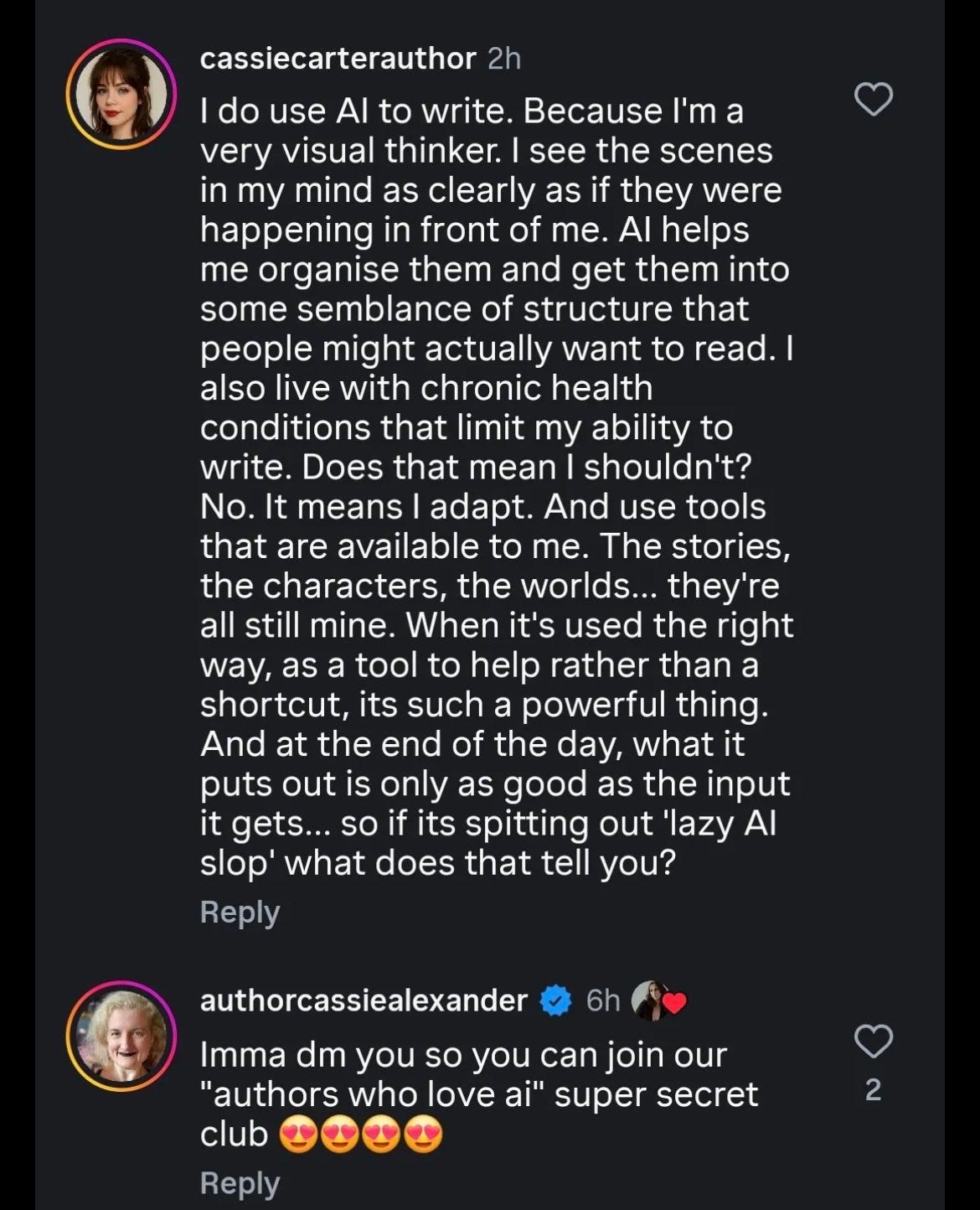
Right now, an AI “author” is going viral for explaining why she uses AI to, as she calls it, “write” her books. I’ll include her post here, but the short version is that she’s a half-literate daydreamer incapable of putting her thoughts into words, who hides behind a chronic illness because it allows her to accuse her critics of ableism. Yes, one of those types. I expect the scores of disabled writers and artists who have chosen to overcome adversity rather than outsource their thinking to a machine would like to have a word with her.
It’s obvious enough to most people (or, at least, I would like to think it obvious) that this is little more than a willing delusion. These are the words of someone who enjoys fancying herself a writer, but demonstrates no desire nor ability to actually write. This delusion, and the accompanying use of AI, is increasing in prevalence at an alarming rate, and among its roots one traces right back to yet another delusion:
“Anybody can write.”
credit to @BookSpotlight on Twitter/X
You’ve heard it before, presumably. Humans are natural storytellers, they say. We’ve been doing it since the dawn of time, and now everybody is literate, and that means anybody can write.
If you’re a writer, you’ve certainly had the experience of telling all sorts of random people what you are, to which they respond with something like, “Oh, I’ve always thought about writing a book.” They will then explain that they have just so many ideas for stories and worlds and characters, and you will politely ask them about said ideas because, frankly, what would be the point of telling them about yours? It’s not as if you’re going to form a writing group with them, for a number of reasons which include the fact that they don’t actually write. But oh, do they ever think they could.
Anybody can write, they say, because we all have ideas and the ability to write them down. That’s all that writing is, isn’t it?
Well, not really. It’s certainly not what writing well means. But, they say (as they have been saying for years), the only thing that matters in a book is whether or not it is a "good story", and it is fundamentally snobbish to call for the writing itself to be good. (In this context, a “good story” means little more than “entertainment”, regardless of quality.)
Anybody can write, it follows, because writing is not really about putting words to the page. The art of writing is not, in fact, writing, but some far more nebulous concept that has been dubbed "storytelling".
Now, accepting the fact that I am fundamentally snobbish, I find that these reigning conceits of writing in our time are not only false but in large part responsible for the scourge of AI “writing”. If the words and the order in which they are put do not matter, but only the ideas behind them, then it is merely logical to accept AI books as real books, acceptably written, by real writers who really write. How can any other conclusion be drawn? Style, voice, prosody—all these and more must give way under the principle, “Anybody can write.”
No. Not anybody can write. In fact, I would even go so far as to say that most people don’t even have the potential to be professional writers. Shocking, I know, but most people also don’t have the potential to be professional football players, or professional singers, or professional chemical engineers. Not everybody is suited to everything, and the only things suited to everybody are dead simple and require neither skill nor talent. Everybody has ideas, but no, not everybody is creative. Ideas are a dime a dozen and they can’t carry a story, or a business, or any of those other things that everybody “has ideas for”.
Everybody who actually can write already knows this. They’ve got some little spark they’ve been cultivating for years, devoting time and effort to developing their skills, learning to look upon their own work and that of others with a critical eye. They’ve honed their craft. They’ve gotten good and they have learned how to determine what is good. As a result, they have standards. For themselves, and for others. So if you can write, and you go around saying that anybody can write, you’re just being nice. And I would like to recommend you quit it, because you’re not being kind.
Kind is complicated, and sometimes it’s not fun. Sometimes it seems mean. Sometimes it might even look a bit like hurting feelings. Nice is all about making people feel good. Kind is about actually helping people.
It doesn’t help someone to tell them that they’re good at something when they really aren’t, certainly not if they’re looking to make a career out of it. Remember all those wildly embarrassing American Idol auditions by tone-deaf dreamers whose friends and families told them they had a beautiful voice? (If not, and I’m just getting old, I have no doubt you can come up with an equivalent example.) I expect we can agree that those friends and families were not being kind, but nice, and were also screwing these people over because they were either suffering from their own delusions or, perhaps more likely, they simply couldn’t buck up the courage to be honest. And kind. Because the kind thing to do in that situation is to pull that person aside and say, “Listen, I love you, it’s great that you love to sing, but you’re just not good enough to audition.”
In the immortal words of Kurt Russell as Wyatt Earp in maybe the greatest western of all time, “Hurts, don’t it?” But unfortunately, sometimes a little hurt needs to happen if you want to help somebody. You’d rather get your feelings hurt in private than on national television, right?
So clearly, at the individual level, honest feedback is important, if sometimes difficult to give or to take. But, as I at least partially discussed in You Have a Moral Obligation to Not Publish Crap, it’s also important on a societal level. Right now, the market is being flooded with literary refuse by the delusional, the narcissistic, and the just plain lazy. I don’t think there’s actually any way to completely stem the flow, but at least having basic standards and discouraging the publication of pure trash would help make things less profitable for the slop peddlers. Maybe, just maybe, a good dose of honest feedback in the average writing community would serve to separate the wheat from the chaff and even, hear me out, help keep people who do have potential from settling for lesser versions of their own work.
So, I’m gonna go out on a limb real quick and assume you have been moved by both the pathos and logos of my extremely in-depth arguments and would like a little crash course in giving and receiving honest, critical feedback in writing, because it can be tricky. You’re cool like that.
Let’s start with giving, because it’s easier and more fun. The first thing is to not just come out swinging with “so you kinda suck at this” even if it’s true. It might be true. I’ve been in college writing class workshops and I have Seen Things. But the idea here is to still be kind about it. To help people. Usually, the best way to do that is to simply and neutrally state the issues you see. Watch your tone more than your tongue. Frame it, when you can, in terms of where it can be improved more than where it’s weak, and try to read the person and how much criticism they can take at once.
You can point out a lack of flow or rhythm in someone’s writing without outright calling it bad. You can note an excess of passive voice or say that a character’s dialogue doesn’t feel real to you or point out a simile that just doesn’t make sense. You can propose solutions or tactics to improve. You can say these things. You should say these things. Otherwise, what good are you? We’re assuming you’re giving solicited feedback here. We’re assuming you actually want to help out your fellow writer. Sometimes that’s going to mean giving them a list of feedback that’s stated neutrally but is largely negative and allowing them to put two and two together.
Now, about receiving that negative feedback. It’ll be rough, sometimes. You’ll get your feelings hurt, at least a little, assuming people are actually trying to help you. No hurt, no help. So, what do you do with that hurt?
You get Irish about it. You take those hurt feelings, shove them out of the way so you can think, and honestly assess the intention behind the feedback. Nine times out of ten, you’ll come to the conclusion that however harsh that person may have been, they were genuinely trying to help you. In which case, say thank you and shut up. I have several people in my life who truly have no filter, and their feedback can be pretty rough at times. But I know them, I know that the way they phrase things is simply a facet of their own personal language, and they are trying their best to help me. I would be a fool and, frankly, an ass if I responded to their kind intentions with a hissy fit because my little feelings got hurt. And, my friend, I do have delicate little daisy feelings, at least when it comes to the people I care about. I’m not saying any of this because I don’t or can’t get my feelings hurt. I’m saying it because I do and can, but I can also deal with that.
Dealing with criticism and hurt feelings is kind of essential to being a writer. And, y’know, a person. If you can’t take criticism then, prose and plot and all the rest aside, writing isn’t for you.
And lastly, it is a good thing that not anybody can write, just as it is a good thing that not everybody can be a surgeon, or a ballerina, or a gardener. It is a good thing that different people are suited to different paths. It is a good thing that not everybody is good at writing, and a good thing that not everybody is good at math. It’s one of the things that allows us to admire and wonder at each other. The idea that anybody can write is one of bland uniformity. It belongs to a world that I would rather not live in. In that world, how could I marvel at the works of the incredible authors who are so much better than me? I’m glad that not anybody can write. I’m glad that I’ll spend the rest of my life trying to get better at writing. I’m glad that every time I open a book by Angela Carter, I have an existential and ecstatic crisis because I had no idea someone could do that with words.
Not anybody can write, and thank goodness. The world is so much more interesting this way.
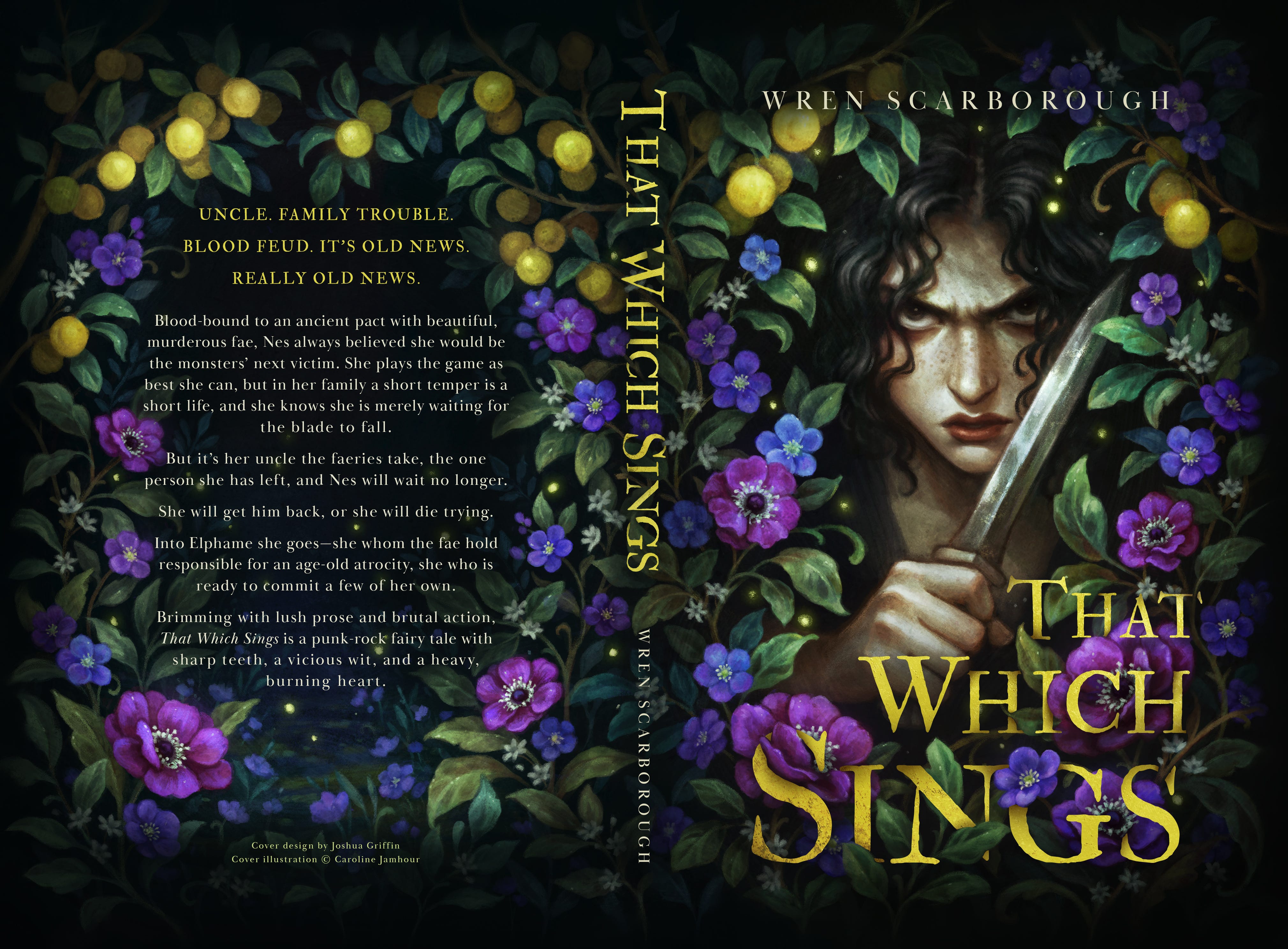
Thank you for reading. If you like what you’ve read here, or if you think I’m full of it and you’d like to prove I suck at writing with some real, solid evidence, check out my book That Which Sings, available to order on Amazon, at your local library or bookstore, or to read for free on Kindle Unlimited.
Comments
Nothing yet. Say the first thing.
Sign in to join the conversation.